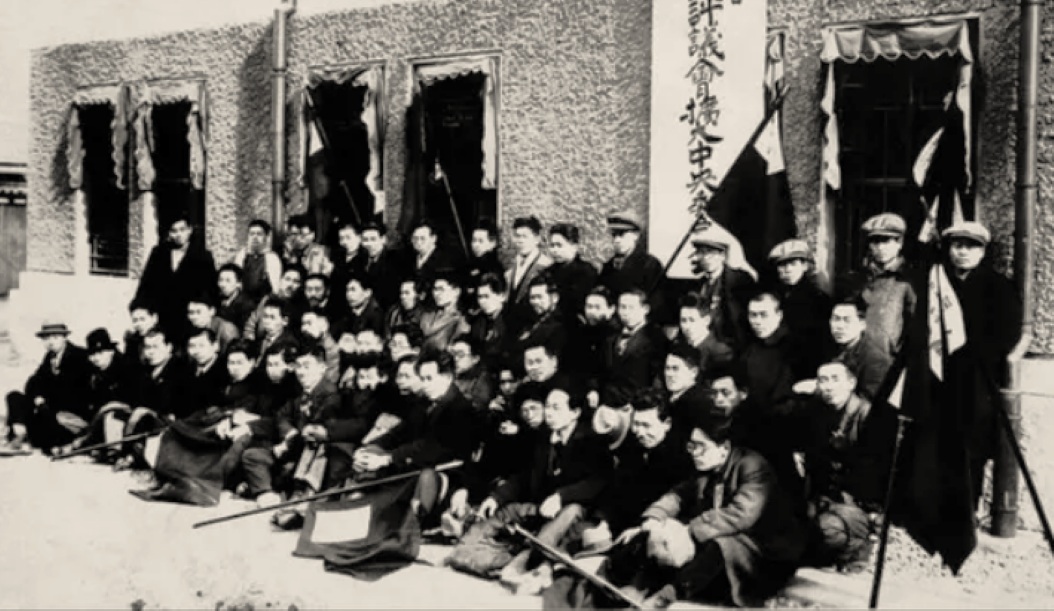
An overview of the organizations and membership of Japanese labor in the mid-1920s just before what would be a rapid increase in activity and growth of the movement.
‘The Labor Movements of Japan’ by A. Popov from Labor Herald. Vol. 3 No. 2. April, 1924.
JAPANESE labor unions appeared simultaneously with the development of the Japanese factory industry, which began to spread after the victorious war against China. However, originally these organizations were really mutual aid societies rather than labor unions, and only during the second decade of the twentieth century were trade unions of the contemporary type organized. In 1912 arose the Uai-Kai, Federation of Unions, rechristened in 1921 as the General Federation of Labor (Nippon-Rodo Sodomai) which now plays a dominating part in the general labor movement. The economic crisis in the grip of which Japan has been struggling since 1920, affected all the Japanese industries and left its mark upon all the aspects of the economic life of the country. In search of cheaper production, the Japanese industrial barons resorted first of all to cutting wages and to the use of woman and child labor.
The government whose imperialist designs stimulated its interest in foreign markets, completely sided with the employers, supporting them not only by legislative means, but by administrative persecution of the labor organizations and of their active members and by arresting both the leaders and ordinary strikers.
The growing industrial depression brought about a general concentration of industry, leading to the bankruptcy of numerous manufacturers.
A Fascist society, Kokusui-Kai, was organized for the struggle against labor and has now about 30 branches in every industrial section of Japan. The capitalist offensive was gradually increasing, reaching its culmination at the beginning of September when Japan was suddenly afflicted by the tremendous earthquake.
The terror against the labor organizations and individual leaders of the labor movement which followed the earthquake was thus merely in keeping with the entire previous policy of the Japanese capitalist government, following logically out of it.
The government persecutions bore fruit in the form of a decrease of the number of unions adhering to the class struggle and of the membership. However, the persecutions aroused and intensified among the progressive workers the realization of the necessity of the organized struggle and of taking part in the political life of the country. This is evidenced by the character of the strike movement, which in 1919 reached its greatest development (497 strikes), gradually falling in number in the succeeding years but assuming a more and more organized character, some of them having all the aspects of important political events.
The labor movement of Japan today can be said to run along three channels: 1) the channel of co-operation between labor and capital, 2) the socialist movement which believes in carrying out its program by parliamentary methods, and 3) the revolutionary movement, which stands for direct action. The first two wings dominate the Osaka Industrial area, while the revolutionary movement is strong in Tokio. The most revolutionary elements of labor are recruited chiefly from among the metal workers, the ship building workers and the miners. The number of organized workers in Japan is small in comparison with the total mass of workers, amounting only to about three per cent. The number of organizations has been decreasing lately, in view of the government terror; for this the movement is compensated by greater internal cohesion and by a growth of revolutionary consciousness.
From the middle of 1920 and until the beginning of 1923, the Anarcho-Syndicalists had almost complete sway over organized labor in Japan. However, since the beginning of 1922, a feeling of disillusionment began to penetrate the labor organizations and the Communist influence has gradually developed. When, at the beginning of 1922, the Japanese government introduced a bill for the struggle against “extreme ideas” which was directed against the Communists, the workers took little interest in it and the failure of the Bill was due chiefly to the opposition of the intellectuals. In 1923, however, when the government made another attempt to pass the Bill through parliament, it met this time with the opposition of Labor, led in the majority by Communists. At the same time the idea of the recognition of Soviet Russia is gaining widespread popularity among the proletariat, indirectly influencing the government, also.
At the congress of the western unions, held in the spring of 1922, the question of the united front was raised for the first time; in October of the same year, 106 delegates from 59 of the most important unions, representing 60,000 workers, assembled at Osaka, to come to a final decision on this question. The meeting was a very stormy one, leading only to the widening of the gulf between the adherents of autonomous federalism and of strict centralism, upheld respectively by Anarcho-Syndicalists and Communists.
The following organizations have expressed themselves as favoring the creation of a federation of all trade unions:
The Japanese General Federation of Labor (Nippon Rodo Sodomai). This Federation is divided into an Eastern (Canto) and Western (Cansi) section.
The Canto section includes, among others the following unions: 1) Kanto-Tecko-Kumia (The Eastern Union of Metal Workers), an organization of workers employed in and around Tokio. The Union has nine branches, consisting of the workers of nine factories. This union is the bulwark of the General Federation of Labor, and the center of the Communist movement of Eastern Japan. Its membership is not large, (1,500) but from the point of view of its class consciousness and discipline, it represents the best union in Japan.
2. Kanto Deiodsku Kumiai (The Union of Eastern Salt Workers), membership 3,300 led by Communists.
3. Naukatzu Rodo Kumiai (The Labor Union of Naukatzu). A small militant organization of about 250 Communist workers.
4. Seiboku Rodo Kumiai (The Fraternal Labor Union) consisting of 500 workers of a car building factory.
5. Ibara Rodo Kumiai (The Labor Union of Ibara) a small organization of workers of an electrical lamp factory.
6. Kogaku Kogikai (Union of Optical Instrument Workers) membership 600.
The Cansai Section includes the following unions (among others):
1. Osaka Kikai Rodo Kumiai (The Osaka Union of Machine Building Workers) membership 2,400.
2. Osaka Dengizu Kumiai, (Osaka Union of Electricians) with a membership of 1,000.
3. Osaka Godo Rodo Kumiai (The Amalgamated Labor Union of Osaka) consisting of 1,000 workers of various plants.
4. Denkino Kumiai (Union of Electrical Implement Workers), with a membership of 600.
5. Todeiko Kumiai (Crockery Workers Ubion) with a membership of about 1,000.
The total number of unions affiliated to the General Federation of Labor is 37, with a membership of 17,000.
Besides these there is a considerable number of unions whose affiliation to the General Federation of Labor is only a matter of time.
The following two union federations oppose the united front, adhering to the idea of autonomous federalism:
1. Rod Kumiai Domakai (Labor Union Federation). This is an Osaka federation, with a total membership of 2,700.
2. Kikai Rodo Rengokai (Metal Workers’ Federation) a Tokio Federation of 3,500 members.
There is also a number of large reformist unions opposed to the revolutionary movement.
The attitude of the Japanese government towards the labor organizations can be seen from the fact that it has been persecuting not only the revolutionary unions, but the organizations believing in the possibility of reconciling the interests of labor and capital as well, and has opposed the organization of factory and shop committees. The struggle against the labor unions continues unabated. No members of trade unions are employed in rebuilding the areas devastated by the earthquake. The General Federation of Labor issued an appeal at the end of September, urging the trade unions of Europe and America to support it in its struggle against the government.
The Japanese proletariat is undoubtedly facing difficult times; in the coming struggle, however, its forces will only become steeled and its energies strengthened.
The Labor Herald was the monthly publication of the Trade Union Educational League (TUEL), in immensely important link between the IWW of the 1910s and the CIO of the 1930s. It was begun by veteran labor organizer and Communist leader William Z. Foster in 1920 as an attempt to unite militants within various unions while continuing the industrial unionism tradition of the IWW, though it was opposed to “dual unionism” and favored the formation of a Labor Party. Although it would become financially supported by the Communist International and Communist Party of America, it remained autonomous, was a network and not a membership organization, and included many radicals outside the Communist Party. In 1924 Labor Herald was folded into Workers Monthly, an explicitly Party organ and in 1927 ‘Labor Unity’ became the organ of a now CP dominated TUEL. In 1929 and the turn towards Red Unions in the Third Period, TUEL was wound up and replaced by the Trade Union Unity League, a section of the Red International of Labor Unions (Profitern) and continued to publish Labor Unity until 1935. Labor Herald remains an important labor-orientated journal by revolutionaries in US left history and would be referenced by activists, along with TUEL, along after it’s heyday.
PDF of full issue: https://www.marxists.org/history/usa/pubs/laborherald/v3n02-apr-1924.pdf
 Revolution's Newsstand