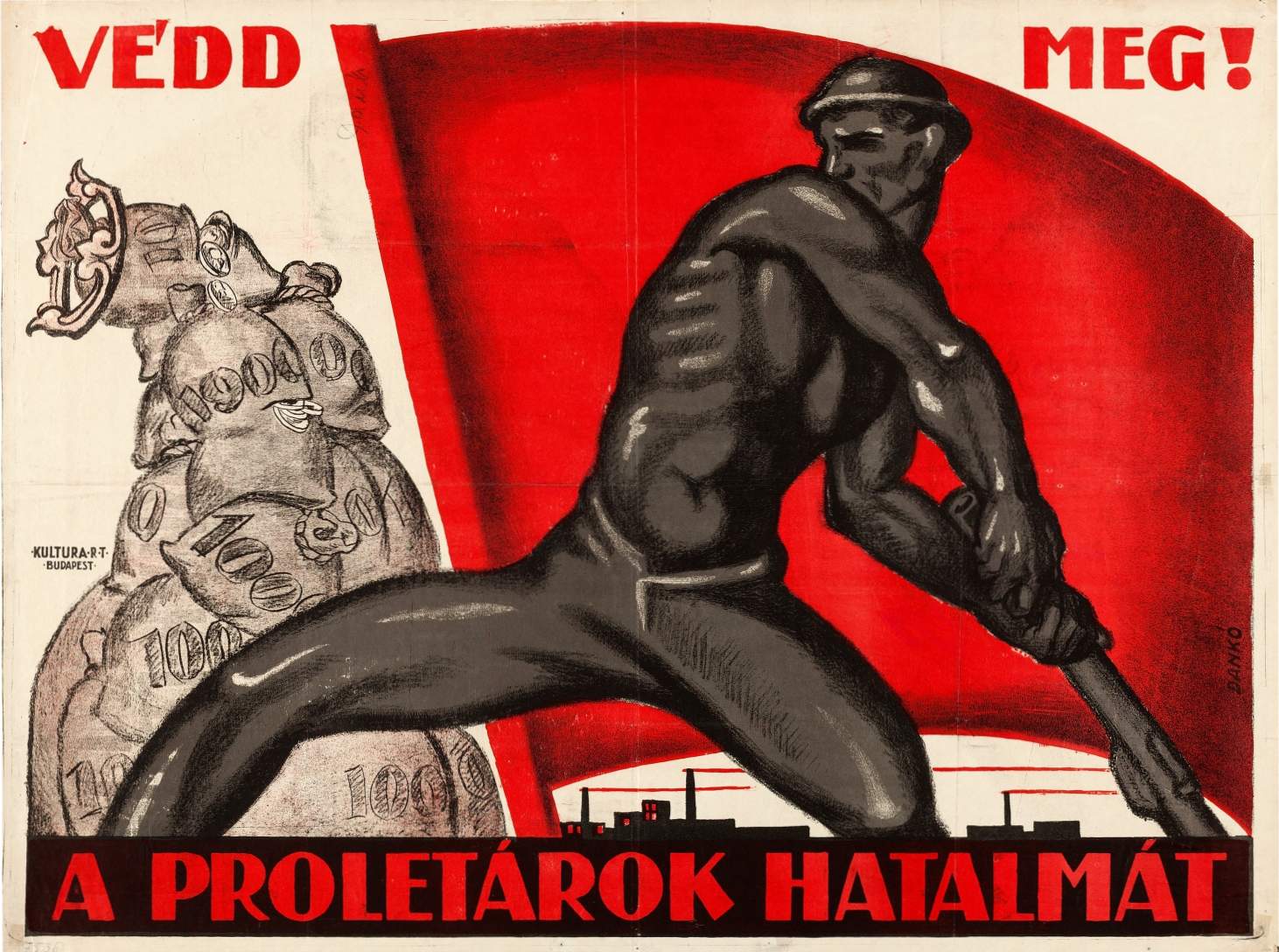
The report by the Hungarian Communist Party’s representative to the founding conference of the Communist International on the revolution still unfolding. Rudas was a veteran of the Hungarian movement, on the left of the Party, and often a factional opponent to ‘rightist’ comrades like Josef Pogany (John Pepper) and Georg Lukacs.
‘The Proletarian Revolution in Hungary’ by László Rudas from Communist International. Vol. 1 No. 1. May, 1919.
Nor more than five months have elapsed since the breakdown of the Austro-Hungarian monarchy, and already, under the pressure of the economic condition of the country, and in view of the utter inability of the governing classes to conduct the business of the State any longer, the Hungarian proletariat has had to overthrow the bourgeois State apparatus and to establish the second Soviet Republic in Europe, in the place of a bourgeois democracy. It was to be expected that the irresistible development of the revolution in Hungary would lead to the adoption of a proletarian form of government. Nevertheless, it was a surprise to all that the bourgeoisie should itself have realised its incapacity any further to manage the apparatus of society and the State, and that the dictatorship of the proletariat in Hungary was thus achieved practically with the approval of the bourgeoisie and without any bloodshed. The question now arising is this:
What were the causes of that quasi-peaceful revolution? A second question is: May a counter-revolution be subsequently expected in Hungary?
When, in October, 1918, the Austro-Hungarian monarchy reached the climax of its century-old agony, and finally went down in the most ignominious manner, the most violent struggle broke out in Hungary between the propertied classes and the urban and rural proletarians. The factories which had, during the war, been turned into prisons, at once became the outposts of the workmen’s rebellion against their oppressors. The rural proletariat, returning from the war, rose up in arms against the landlords, while armed workmen threatened to put a speedy end to any supremacy of class over class. Workers and soldiers were establishing their own councils (Soviets) all over the country, and tearing off officers’ badges of rank. The revolution at once assumed proletarian forms—and this was but natural, since the proletariat was accomplishing it.
As a matter of fact, the power was already in the hands of the proletariat and the poor peasants. The landlord oligarchy had for a long time been governing by sheer violence, and it had long been hampering the economic development of the country. Being short of funds, it was not in a position to conduct agriculture on efficient lines. Its products were gradually superseded in the world’s market by foreign-grown wheat. By dint of artificial import duties on wheat and cattle, and an arbitrary construction of veterinary regulations, it succeeded in ensuring for itself a ground rent, while it constantly increased the cost of living of the working population. The financial aristocracy created by the oligarchy of the landlords, in the meantime, shamelessly exploited the industrial proletariat. It is a well-known fact that this joint management led up to Austria’s imperialist war against Serbia, and to the annexation of Bosnia, Herzegovina, and Albania.
With the breakdown of imperialism, the sham supremacy of the landlords utterly collapsed, and all their representatives, parties and politicians vanished from the political arena of Hungary. The governing classes are being irresistibly driven into the abyss by immutable economic laws, and, while pursuing their own interests, they merely hasten their own ruin.
The collapse of the oligarchy of the landlords brought about the break-up of specific Hungarian imperialism. The peoples oppressed and enslaved by the Hungarian oligarchy, and now set free by the revolution, at once joined hands with their countrymen on the other side of what used to be the frontier of old Hungary. The economic structure, kept together by the power of the Austro-Hungarian monarchy, instantly fell to pieces. Purely agrarian Hungary, now cut off from the supply of raw materials, such as coal, etc., found itself utterly devitalised. The Hungarian bourgeoisie stood unarmed before the invigorated bourgeoisie of the victorious countries that was facing it, in all the splendour of its unimpaired vitality.
None but a class having no clear idea of its own social and economic conditions, but trying for all it is worth to hide the basis on which it rests, and therefore ready to stake its own existence for the sake of momentary advantages—(such is the history of imperialism all over the world)—in short, none but the bourgeoisie could ever hope that the oligarchy of the landlords might be succeeded by another form of middleclass supremacy, i.e., by the supremacy of the industrial and commercial bourgeoisie. The bourgeoisie itself has now prevented any such possibility. Ever since imperialism had produced in Hungary, as it had in all other countries, striking class distinctions, the whole of the bourgeoisie had been clinging to the ruling oligarchy. If the landlords had: been hampering the organisation of the industrial proletariat to a lesser degree than that of the rural proletary incited the industrial bourgeoisie to covet an undivided autocracy—the general trend of imperialism gradually obliterated that tolerance in regard to Trade Unions, and the whole of the bourgeoisie finally concentrated in one camp violently hostile to the proletariat. During the war, the bourgeoisie was solely intent on war profits, its only object being to pocket as many milliards as it possibly could. The breakdown of all that magnificence found it utterly unprepared and unorganised. Omnipotent but yesterday, when it kept down the workers by its millions of soldiers, it proved absolutely helpless today. Politically debile, utterly disorganised from the economic point of view, and exposed to the blows of its imperialist neighbours, the Hungarian bourgeoisie was quite incapable of bracing itself for the struggle. Thus, after the collapse of monarchy, the industrial proletariat was the only class properly organised, hardened in its protracted social struggle, and trained in the strictest party discipline, that was capable of taking the power into its hands. The proletarians and the poorer peasants, together with the paupers of the rural districts, might, if they were headed by the industrial proletariat, immediately overthrow the bourgeoisie and establish a Soviet Republic on the basis of the dictatorship of the proletariat. The stern party discipline, however, proved, to a certain extent, an obstacle to the adoption of that course, the only correct one. The social-patriotic leaders betrayed the working classes of Hungary. A portion of the proletariat that fully realised the position, and was influenced by the propaganda of the then still small Communist group, proceeded at once to expropriate factories, to drive away the shareholders and their directors, and to substitute for them trusted representatives of the working classes; this revolutionary action was branded by Social-Democracy as being arbitrary and unorganised, and as tending to the creation of a new class of capitalists in place of the old one. The collapse of the monarchy was applauded as a “victory” of the working classes, and the workers were enjoined to maintain “order.” The working men let themselves be disarmed; they allowed a “white” army to be formed of former officers, policemen, gendarmes, of small tradesmen ruined by the war, and of desperadoes; the white army proceeded to disarm the soldiers returning from the front. The working men listlessly looked on, while rebellious peasants were shot down by the hundred, and their heels branded with red-hot iron. “Order” was being restored by time-honoured methods.
The Social-Democrats were thus hastening to the assistance of the bourgeoisie, and more and more becoming the police of the “order-loving” parties. The bourgeoisie soon realised the importance of that assistance, and began to sing the praises of the Social-Democratic leaders; it applauded those shrewd, practical politicians who, “opposed in principle” to capitalist society, were, however, “reasonable” enough not to engage in a wild-goose chase after Utopias. Stronger than ever, the bourgeoisie hoped to achieve its long-cherished dream of autocracy.
Everything and every one seemed to have suddenly turned “Socialist.” From the officers of the “white” army, down to the policemen and street hawkers, every one called himself a “comrade.” The Social-Democratic Party was submerged by a wave of lower middle-class elements who rendered it more and more counter-revolutionary, less and less responsive to the needs of the proletariat. In all questions that cropped up the Social-Democratic Party upheld the middle-class point of view, duly covered up by proletarian phraseology.
Thus, it was with the assistance of the “proletarian” Social-Democratic Party that the radical middle-class democracy was formed, the tangled character of which was visible in its very name, “The People’s Republic.” As if under imperialism, in a period of the acutest class dissensions, there was any room for the existence of a “people” as a distinct unit! This proved possible solely because the collapse of imperialism in Austria-Hungary resulted in a state of equilibrium between the classes and a comparative independence of State authority. Since the bourgeoisie had been doomed to failure, and in view of the inactivity of the proletariat, the strength of which was paralysed by its own leaders, power fell into the hands of the lower middle-classes. As usually happens when the lower middle-class is in power, the parties had no programme of their own, vacillating as they did between the bourgeoisie, with its attempts to get hold of power, and the proletariat, which, although still dazzled by Social-Democracy, was, however, sufficiently shrewd to resist the cravings of the bourgeoisie. It is true, the proletariat let itself be convinced that the hour of the establishment of a proletarian State had not yet arrived. It did not intend, however, nor was it in a position, to forego its economic demands as it had its political programme. The sentimental phraseology whereby the bourgeoisie flattered the proletariat afforded but a scant cover for the hatred and fury with which it tried to persuade the working classes—in response to their new demands—that the disorganised capitalist State was not in a position to grant such demands. It was with growing indignation that the bourgeoisie must have observed that the industrial proletariat was being reinforced by rural toilers, who by now were insisting on the expropriation of large estates. In vain did it advocate the creation of a disciplined army and a vigorous putting down, by the State machinery, of the “disorderly masses,” who, not content with the sentimental promises of middle-class democracy, were stoutly upholding the demands of the proletariat in workers’ councils, at meetings, factories, mines, in villages.
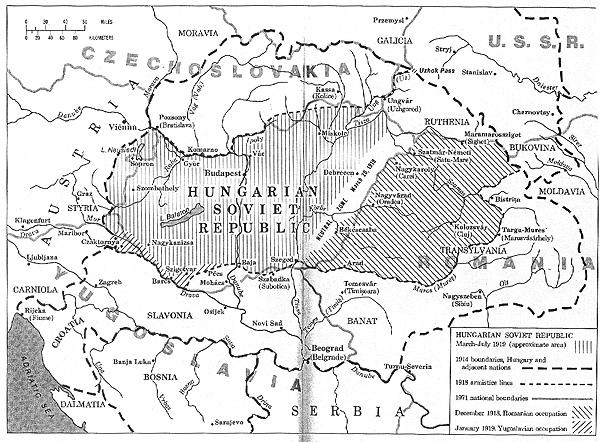
The bourgeoisie at last took up an attitude of passive resistance. Factories were gradually shut down. An excellent excuse was provided by the occupation of the coal-mining district by the newly-formed national States. The bourgeoisie had placed power in the hands of lower middle-class parties which, centring round Social Democracy, were now pursuing a policy of their own—a policy of phrases and unable to prevent the bourgeoisie from accumulating fresh forces in the counter-revolutionary camp and powerless to keep the proletariat from daily addressing new demands to their “leaders,” who were preaching moderation to the Social Democratic ministers.
This was a period of the mustering of forces.
The bourgeoisie was gathering strength for a counter-revolutionary effort, while the proletariat, represented by the now matured Communist Party, was beginning to realise its own power. In the meantime, however, the supremacy was wielded by lower-middle-class politicians, by Social Democrats. There was even a travesty of Bonapartism—in the person of Count Karolyi—and, if he never became a Hungarian Napoleon, it was merely due to the fact that proud Hungary had, in losing its national honour, lost its army, and the soldiers were too hostile to their officers to support Bonapartism. Nevertheless, the appointment of Karolyi to the presidency of the Republic was an attempt to appoint a judge over the classes.
The bourgeois politicians necessarily left all problems unsolved, since they were insoluble within the bounds of bourgeois policy. The hubbub raised round every measure taken as a compromise did not succeed in convincing either the proletariat or the bourgeoisie that it was not a compromise. Too much noise is ever a proof of weakness. It was manifest that the power of the lower-middle-class-Social-Democratic firm was soon to be replaced by a bourgeois counterrevolution, or succeeded by a further development of the proletarian revolution.
The first amongst the lower-middle-class parties to understand this was the Social Democratic. It imprisoned the leaders of the Communist Party, who had been vigorously fighting for a purely proletarian revolution. It ruthlessly swept away all those who stood up for the dictatorship of the proletariat and the introduction of the Soviet system. It shot the workmen of Salgotartan by the score, and, in the meantime—prepared the national assembly elections. Its conservative leaders were thereby merely bringing on, all the more speedily, a split between their right and their left wings. The latter was irresistibly driven towards the adoption of the Soviet system and the demand for the dictatorship of the proletariat.
The counter-revolution lasted too short a time. Owing to an equilibrium between the two decisive classes—the upper bourgeoisie and the proletariat—the power had temporarily been usurped by the lower-middle-class parties. Their power, however, was a purely fictitious one—a debile, bankrupt, and tottering power. The finances were in the most deplorable, the most lamentable condition; the army was scattered and hopelessly disorganised; the bureaucracy was in a State of passive resistance; the constabulary and the police were “Social-Democratically” insubordinate. The country was surrounded by a number of imperialist national States, supported by the Entente, and resolved to bring the country to economic debility, and to force upon it the stoppage of production. A power of that description could not offer a strong foothold to counter-revolution. Any attempt to ensure to the bourgeoisie the supremacy over the remaining portions of Hungary was doomed to be shattered against the predatory covetousness of the Entente, and of the neighbouring States that enjoyed its protection. The economic debility of the bourgeoisie led to its complete political failure. After a short-lived lower-middle-class rule, and after many attempts to appease the industrial and the rural proletariat by dint of sentimental phraseology, that party at last realised its utter incapacity and bowed itself out, while it handed power over to the proletariat. To the proletariat, and not to the upper bourgeoisie —as the latter was too patently beaten, annihilated, condemned to economic and political death. The proletariat thus took power into its own hands and proclaimed its own dictatorship; it transformed a purely bourgeois democracy into a proletarian one, that is to say, into a Soviet Republic.
The wireless whereby Bela Kun, the Commissary for Foreign Affairs, proclaimed that fact to the proletariat of the world, states that the events were accelerated by the imperialistic policy of the Entente, who intended to put Hungary at the mercy of the Rumanian oligarchy. There is no doubt but that the policy of the Entente had a share in opening the eyes of the Hungarian proletariat: in tearing off the mask worn by Wilson, it facilitated to the proletariat the choice between Wilson and Lenin. Nevertheless, this would not have brought about the rule of the proletariat, if the power had not de facto already been in its own hands. The utter failure of capitalism left but one course open: the proletariat was compelled to take into its own hands the authority that had slipped out of the hands of the bourgeoisie.
The question, however, had already been settled at the very outset of the middle-class revolution, in October, 1918. That revolution had been the doing of the proletariat, which had begun it by its strike of January, 1918, and was now bringing it to completion. At the moment of victory, however, the proletariat had been betrayed by Social-Democracy, and misled as to its own strength. It soon discovered, first, that capitalism was no longer fit to stand at the head of the economic organisation, to solve the national, the agrarian, and other questions; and, secondly, that bourgeois democracy could never lead to a victory of the working classes. The German-Austrian elections were a revelation to the working men. And it would perhaps be more correct to say that the conduct of the Entente had, if anything, delayed the triumph of Communist ideas amidst the Hungarian proletariat. The proletariat was afraid to seize power, because the Social-Democrats threatened it with a homicidal raid of the Entente hordes. Notwithstanding these threats, however, the Hungarian proletariat had to accomplish its own revolution, since it was the only way to avoid a bourgeois counter-revolution, and to ward off famine and other sufferings inseparable from a disorganised, a weak, but an all the more cruel capitalistic oppression. A proletarian revolution had everywhere become historically and economically imminent.
The second question, as to whether a counterrevolution is to be feared, has already been answered. The counter-revolution had once tried on its little game, but was ignominiously driven away by the forces of the proletariat, in view of its utter inability to manage the economic and social apparatus. The fact of its weakness became so manifest that even the Social-Democrats could no longer ignore it; and, with the exception of a few leaders who had long ago abandoned the principles of Socialism, the whole of the party recognised the necessity for the dictatorship of the proletariat. The new Socialist Party is now backed by the whole body of the proletariat; owing to the weakness of the bourgeoisie and the strength of the proletariat, tire revolution was a bloodless one, and the Entente alone may endeavour to help the pitiable counter-revolutionary groups. But the new imperialistic States by which we are surrounded will have their hands full with counteracting the formidable strength of the revolutionary and Communist ideas within their own boundaries. The Hungarian proletariat is fully aware of the fact that the economic downfall of capitalism will inflict untold suffering upon the people; it fully realises that its dictatorship cannot secure an adequate supply of coal and of raw materials; all production has stopped, and the average peasant distrustful and impecunious, will at best remain indifferent. But the proletariat has confidence in the ultimate triumph of the revolution throughout the world, and, in the teeth of all difficulties, it will nevertheless manage to organise the new Soviet Republic and defend it against all its foes!
(Delegate of the Communist Party of Hungary to the Congress of the Third International).
The ECCI published the magazine ‘Communist International’ edited by Zinoviev and Karl Radek from 1919 until 1926 irregularly in German, French, Russian, and English. Restarting in 1927 until 1934. Unlike, Inprecorr, CI contained long-form articles by the leading figures of the International as well as proceedings, statements, and notices of the Comintern. No complete run of Communist International is available in English. Both were largely published outside of Soviet territory, with Communist International printed in London, to facilitate distribution and both were major contributors to the Communist press in the U.S. Communist International and Inprecorr are an invaluable English-language source on the history of the Communist International and its sections.
PDF of full issue: https://www.marxists.org/history/international/comintern/ci/old_series/v01-n01-1919-CI-grn-goog-r2.pdf
 Revolution's Newsstand