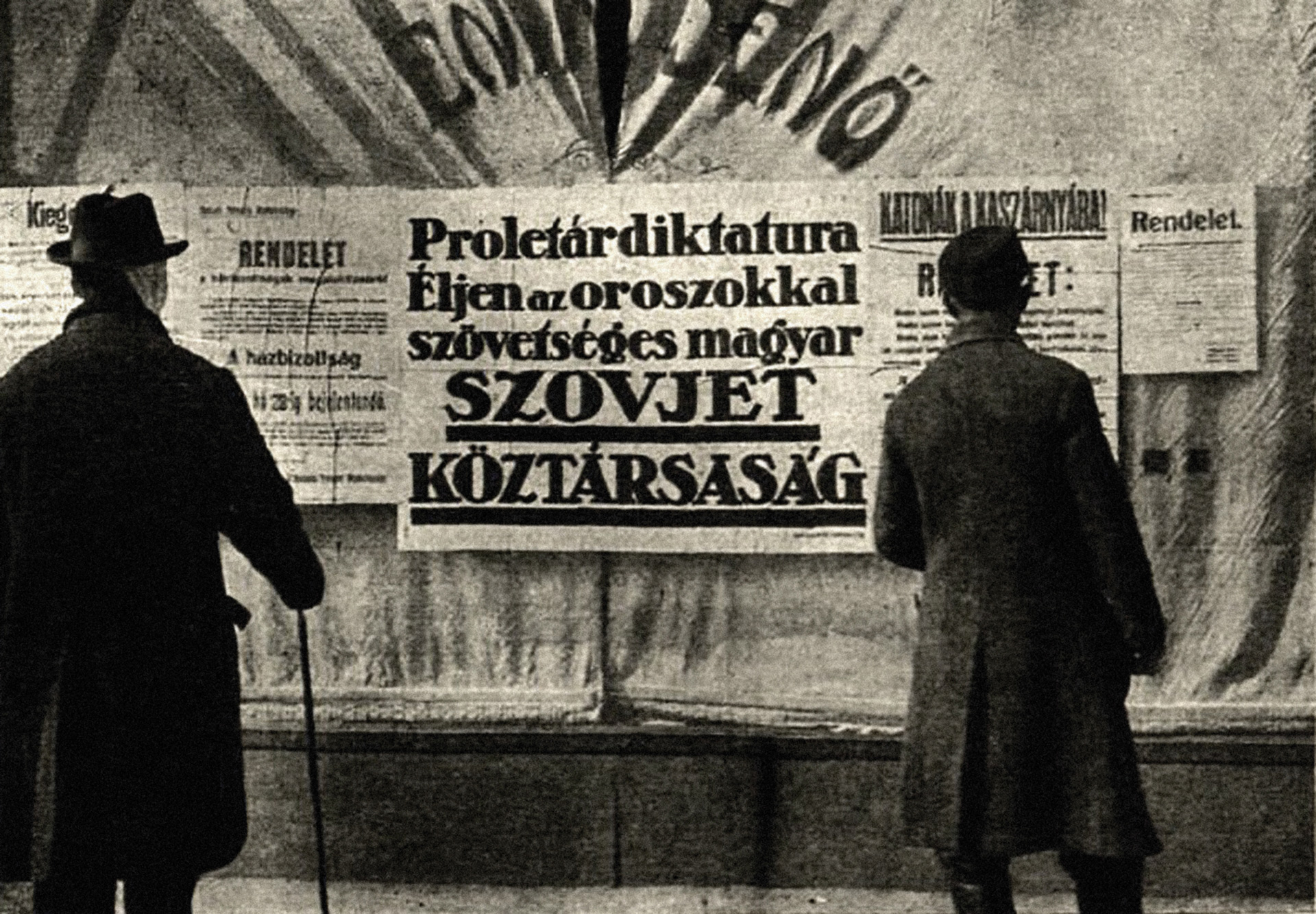
A look back from one of Hungarian Communism’s foremost leaders. Landler was in the left wing of the Social Democrats when the 1919 Hungarian Soviet was proclaimed, joining with the Communists he was Commissar of Trade and a Hungarian Red Army commander. Fleeing with a number of Hungarians to live in Vienna, Landler was a chief rival to Bela Kun in the emigre Party. A delegate to the 3rd, 4th, and 5th Comintern Congresses and on the International’s Executive, after he died exile not long after this was written, his ashes were interred in the Kremlin Wall.
‘The Russian Revolution and the Hungarian Working Class’ by Eugen Landler from International Press Correspondence. Vol. 6 No. 53. November 10, 1927.
The Hungarian working-class, who were fighting against the despotism of finance-capitalists, and landed proprietors, did not watch with sufficient attention the fights of the Russian working class, who were struggling against Tsarist despotism. The attention of Hungarian Social Democracy was directed towards Austria and Germany, towards Viktor Adler and Kautsky.
For the Party of the Hungarian working class the “Democratic revolution” and the “general franchise” alone constituted so-called “burning questions”. They had no idea that in the scorned fraction fights of Russian Social Democracy the questions of the modern revolutionary proletarian movement in general received a final answer.
During the war there came the disappointment in the “sacred” principles of German and Austrian Social-Democracy. Scheidemann, Adler and Kautsky threw themselves with the whole of their authority on to the side of the imperialists. At the beginning of 1917 Hungarian Labour began to look in a different direction and to turn to Russia for leadership and instruction.
That year was the year in which the big political mass movement began in Hungary. In that year there began the vehement stage of the mass movements in Hungary, which in August, 1919, found its temporary conclusion. Instead of the “destructive pacifism” of the peace-loving intellectuals there began the great mass fight of the workers for peace, against imperialist war, but at the same time also against the whole of Austro-Hungarian despotism and against the dictatorship of the system of the landed proprietors and big bourgeoisie set up by finance-capitalism in Hungary. The masses started to move. They were no longer firmly under the control of the Scheidemanns of the Hungarian party leadership; they had already entered the magic circle of the Russian revolution.
The news of the collapse of Tsarism had a revolutionising effect in Hungary. Hungarian labour had always remained true to the traditions of the May celebration. But during the war the functionaries of the working class tried in vain to have May 1st celebrated; the bureaucrats of party and trade union always managed to prevent this; in 1917 the Russian Spring suddenly swept all obstacles out of the way. In 1917 May 1st once more became a Labour celebration in Hungary, and on May 2nd the Hungarian workers in all the factories struck for one day as a demonstration for peace. In May, 1917, a big strike movement set in, even though all the larger works were under military supervision and every strike was classed under the Emergency Law as a revolt.
Tisza fell on May 2rd, 1917, and when it became clear to the workers that the new cabinet was sabotaging the establishment of the new franchise, the class-conscious workers in the factories began in Autumn 1917 to speak of the necessity of creating Worker Councils.
The Hungarian workers had at that time not yet clearly recognised the difference between Mensheviki and Bolsheviki. In the victory of November 7th they saw chiefly the victory of the purely workers government over the coalition government. But this was sufficient for the Hungarian workers, who from the very first moment threw themselves instinctively and completely on to the side of the Bolsheviki. When the news was received that, contrary to the war policy of Kerenski, the Bolsheviki energetically demanded the termination of the war of the imperialist robbers, there were only two names popular among the Hungarian proletarians: Lenin and Krylenko.
The first proclamation “to All!” worked like a revelation in Hungary. There was scarcely a country in which the workers took up with greater earnestness the revolutionary solidarity, which the Russian workers requested of their European comrades. The tremendous spontaneous general strike, which lasted several days at the time of the Brest Peace, and which is without parallel in the history of the Hungarian Labour movement was a convincing confirmation thereof. When the workers in the factories read the great opening speech, which Trotzky made in Brest, a revolutionary fever seized the Hungarian proletariat. When, during the negotiations in Brest, General Hoffmann started to clank his sword, the Hungarian workers rose like one man. About 300,000 proletarians took part in the ten meetings improvised in Budapest and out of hundreds of thousands of mouths there issued the cry: Long live Soviet Russia! Down with General Hoffmann! Down with the imperialist war! Long live the Worker Councils!
The January strike in Hungary differed from the Vienna January strike in that the driving force of the strike in Hungary was solidarity with the proletarian dictatorship in Russia. The slogan of general suffrage was later foisted on the workers by the leaders.
It is characteristic that on the occasion when the party leaders presented a deputation of workers to Prime Minister Wekerle, not only did the members of the deputation speak of the franchise, they also energetically demanded that the Hungarian Government should do everything possible to get General Hoffmann recalled from the peace negotiations. After the party executive had with great effort succeeded in bringing the strike to an end, at all meetings and in all trade unions, without distinction, it had to meet great difficulty on the question of General Hoffmann. Great masses of workers continued the strike. In demanding the withdrawal of General Hoffmann their concern was for Soviet Russia, for they knew that General Hoffmann was an incarnation of the imperialist war of plunder.
For the first time in the history of the Hungarian Social Democratic Party the Party Executive was obliged to resign under the pressure of mass feeling, under pressure of the discontent which followed the breaking off of the strike.
After the January strike, the idea of worker councils became still more popular. Though only in secret, though only in narrow circles, the workers in the factories began to form worker councils. In several regiments, too, attempts were made to form Soldiers’ Councils.
The embitterment of the workers on account of the Executive’s treachery in January in no way signified that the revolutionary feelings of the workers had in any way abated or that the feeling of solidarity in respect of the Russian proletarian dictatorship had diminished. When the Social-Democratic Executive’s ally, Minister of Justice Vászonyi, held in Parliament his notorious anti-Bolshevik speech, in which he besmirched Soviet Russia and threatened to “stamp out Bolshevism”, there arose in the factories such spontaneous indignation that at the extraordinary Party Conference the official representative of the Executive was compelled to stigmatise the allied Minister in the most brutal way.
The prelude of the general strike in June was that the gendarmery shot into the crowd gathered before the building of the machine factory of the Hungarian Railways and killed five workers. The official investigation ascertained that the crowd had cheered for Soviet Russia and the revolution. After this blood bath the proletariat of Budapest marched in tens of thousands to Parliament, which was protected by soldiers and machine guns, with the slogan: “Let’s follow Soviet Russia’s example!”
During the six-day general strike 500 workers were arrested and of these several were charged with “demonstrating for Soviet Russia and promoting victory for the enemy!”
In the general strike in June the slogan for the formation of Worker Councils had already been openly used as one of the chief demands, and nothing is more characteristic of the villainy on the part of the Social-Democratic Party Executive than the fact that at the conclusion of the strike they abused this most popular slogan, the slogan of the Worker Councils. The Executive of Hungarian Social Democracy had learned its lesson during the January strike. It did not dare terminate in its own name the revolutionary general strike. It formed out of the most reliable leaders and employees of the trade unions “Worker Councils”, who then signed the appeal to terminate the strike.
In the second half of the year 1918 the Hungarian Press spread the most hair-raising stories of the “reign of terror” of the Bolsheviki. The Hungarian workers, however, did not for a moment believe these lies. They looked to Soviet Russia as to an ideal and felt every blow delivered by the counter, revolution against Soviet Russia as though it were a blow dealt to themselves. Up to the collapse of the war the chief organ of Hungarian Social-Democracy, “Népszava”, did not dare publish a single attack upon Soviet Russia or Bolshevism.
November 7th, 1917, the triumphant proletarian dictatorship, contributed more than anything else to the revolutionising of the Hungarian proletariat. The Hungarian workers had felt all the suffering of the Russian proletariat during 1917/18, and in spite of the treachery of their own leaders had participated at a distance of many thousand kilometres in the successful fights of their Russian brothers.
More and more reports were received concerning that act of the Hungarian Labour movement which had been played many hundreds of kilometres, aye, even many thousands of kilometres, from Hungary. The workers in captivity succeeded in uniting under the red flag of the international proletarian re- volution thousands of interned peasants. They joined in the fights along the Russian revolutionary front, which extended many hundreds of kilometres. For the first time after the Socialist peasant revolts, which took place in the Hungarian lowlands in the nineties, the Hungarian worker and the Hungarian peasant once more found themselves united in a common fight in the divisions of the Red Guard of the Siberian Steppe.
The leaders and organisers of the prisoner-of-war movement endeavoured to range organisatorily, politically and ideologically in the Bolshevist Party the members of the national sections formed by prisoners of war. That stratum of leaders trained in this prison-of-war movement and converted to the Bolshevik theory and practice of the social revolution became the champions of the resurrection of the Hungarian revolutionary Labour movement. This is the group through which the Russian and Hungarian Labour movements came into touch. This is the group through which the history of that section of the Russian revolution also became a section of the Hungarian Labour movement.
It was in vain that the collapse in the year 1918 brought about the “complete democracy”. As was natural, when at the end of 1918 the Communist Party of Hungary was formed, it had on its side the sympathy of that worker masses, who in a number of fights during 1917 had given proof of their willingness to make sacrifices and of their revolutionary conviction. The advanced sections of the Hungarian proletariat entered the fight alongside the Party: for Soviet Russia, for Soviet Hungary, for the dictatorship of the Hungarian proletariat.
A few months more and communication between the Russian revolution and the Hungarian Labour movement was established, not only through ties of mass sympathy, not only through the organisations of the rapidly developing Communist Party, but through the roar of cannon. The red Soviet flag appeared on the Theiss, in Kassa and in Salgotarjan. The gentlemen of Versailles were frightened and big plans for military operations against the Soviet Union found their way into the desks of the politicians. Court was paid to Austrian and Czech Social Democracy. “Barriers around the Bolshevist danger zone” the only plan of salvation. In the meanwhile, the Russian army succeeded in bringing its whole force to bear upon the destruction of its most dangerous enemies, Kolshak’s white bands, upon the reconquering of the Siberian grain lands and of the Caucasian coal and naphtha fields.
In this way communication between the Russian Revolution and the Hungarian working class was established, a way in which the workers of no other country have followed the proletariat of Hungary the way of armed alliance.
International Press Correspondence, widely known as”Inprecorr” was published by the Executive Committee of the Communist International (ECCI) regularly in German and English, occasionally in many other languages, beginning in 1921 and lasting in English until 1938. Inprecorr’s role was to supply translated articles to the English-speaking press of the International from the Comintern’s different sections, as well as news and statements from the ECCI. Many ‘Daily Worker’ and ‘Communist’ articles originated in Inprecorr, and it also published articles by American comrades for use in other countries. It was published at least weekly, and often thrice weekly.
PDF of full issue: https://www.marxists.org/history/international/comintern/inprecor/1927/v07n63-nov-10-1927-inprecor-op.pdf
 Revolution's Newsstand