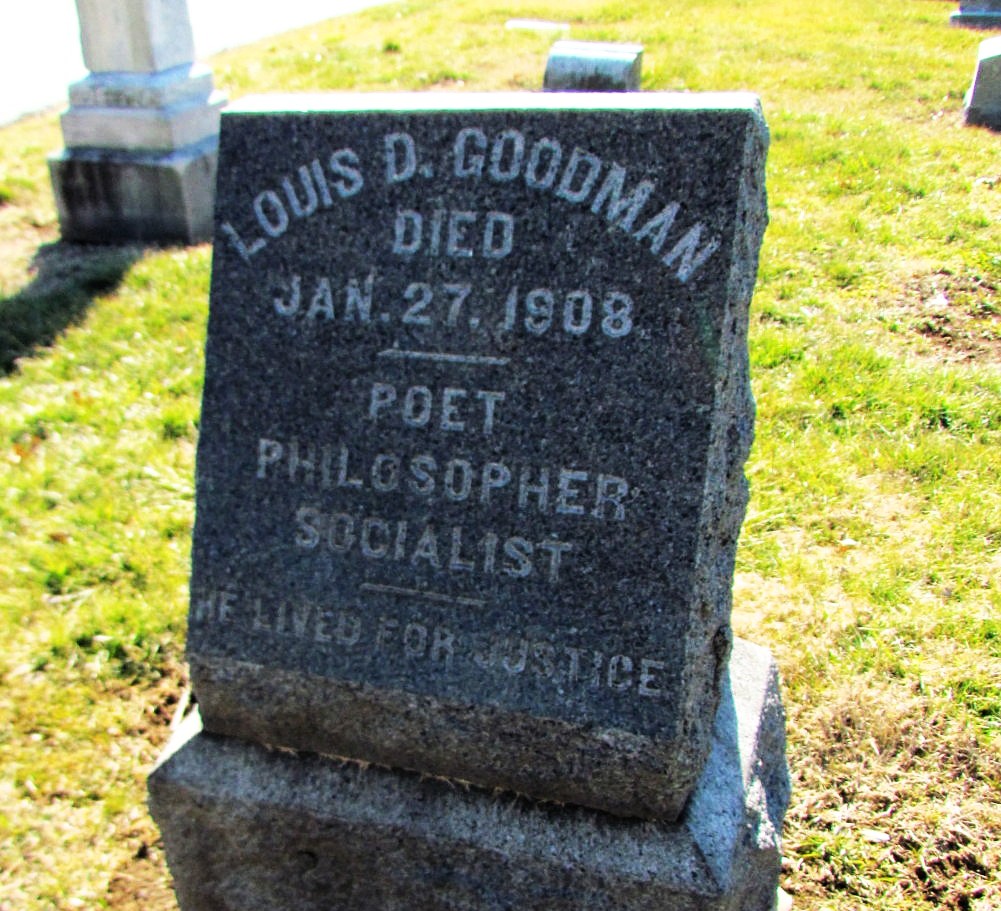
Touching words on the passing of St. Louis activist Louis D. Goodman with, like all past comrades, a familiar personality.
‘Comrade Louis D. Goodman Dead’ from St. Louis Labor. Vol. 6 Nos. 355 & 357. February 1 & 15, 1908.
Comrade Louis D. Goodman Dead.
Our comrades and friends will be sad to hear the news of the sudden and tragic death of Comrade Louis D. Goodman. He died last Monday at the City Hospital, half an hour after he had been found unconscious at Taylor’s book store, 3518 Franklin avenue, as the result of the swallowing of a bottle of disinfectant.
Comrade Goodman had been in poor health ever since the tragic occurrence of last July, when he attempted self-destruction. Comrades and friends who met him often during the last six months say that he had been in a pitiable and unfortunate condition. His friends did their very best to cheer him up, but the shock of July 14 left its indelible mark on the man, and life became a burden for him.
Attorney Ben C. Lindsay, one of the closest friends of the deceased, in a newspaper interview, expressed the idea that it was Goodman’s oratorical gifts that led Goodman to attend so many Socialistic meetings, as it was not difficult for him to make an exhaustive address, and he gloried in it. Goodman was formerly an actor, and wrote poetry for pleasure and economic articles for the papers. This would be a rather poor way of explaining the unfortunate man’s condition which led him to self-destruction.
Louis D. Goodman was of Hebrew parentage. As is the case with many of the Jewish race, he inherited a trait of sensitiveness which was developed in him to such a degree that it became the ruin of his life. Under better social conditions the man’s life might have been one of higher joy and happiness for himself and his surrounding; under the present brutal capitalist struggle for life, men of the soft make-up of Louis D. Goodman are liable to lose out every time. He was the product of social conditions. Active in theatrical work for years he had a chance of seeing, or rather experiencing all the disgusting features of business on the one side, and poverty, misery, hopelessness, and moral and intellectual emptiness on the other side. Next he studied law. For a while the “lawyer business may have had its charms for him, but only for a short time. To a man like Goodman, with his over-sensitive, emotional, and utopian-idealistic make-up, the every day law practice could not permanently attract his interest and attention. He would rather sit in a quiet corner of his office reading Shakespeare or Emerson than stand in the law courts “operating” by means of legal formalities, technicalities and tricks. Goodman was not cut out for a lawyer.
Gradually he interested himself in reform politics. This was a source of food for his mind and heart. His emotional make-up, together with his education in dramatical work made him a good public campaign speaker.
The political reform movement with which he was connected, died a natural death, and Goodman gradually drifted into the Socialist movement. Socialism, a great, world-wide idea, appealed to him very strongly, and he went into the movement with all the enthusiasm at his command, only to discover that Socialism as a theory, and Socialism as a militant proletarian movement are two different things. The one is idealism, beautiful dreaming of the brotherhood of man, the other is a class war, an every day struggle with all its troubles and hardships, with all its pleasures and sorrows, with all its victories and defeats, hopefulness and disappointments, and occasional discouragements.
And during all this work of the man runs like a red threat the almost desperate fight for the daily bread. His idealism, his dreaming of Shakespearean and Emersonian dreams, do no longer fit into the modern capitalist conditions. Idealism, sensitiveness, love, truth and justice are crushed today. Brute force rules supreme.
Louis D. Goodman was good-hearted, he could not see the suffering of others. This great virtue became a source of trouble and disappointment for him. Many a sweet-tongued individual of questionable character would levy on him, try to take the last penny out of his pocket, and this done, would show his ingratitude and disappear, only to make room for another individual to repeat the same game.
Goodman’s funeral took place last Wednesday afternoon. The pallbearers were Julius G. Friton, Ben C. Lindsay. Cornelius H. Fauntleroy, Joseph Solari, Doctor Melvin Moore and George L. Taylor. The funeral took place from Hetlage’s undertaking parlors. No. 907 Chouteau avenue.
ABOUT COMRADE GOODMAN.
At the outset I wish to state that for the last two years I have been in close and constant association with Comrade Goodman, and can say truthfully that I know and understand him as well, if not better, than anyone else, and therefore feel that in penning the following I am simply discharging a duty and doing him simple justice.
Some individuals, schooled in the capitalist school of morals, and imbued with capitalist society standards, look askance on one who made an attempt on his own life; and when the attempt at suicide is successful they add insult to injury and defame the dead by bellowing forth their lying charge of “Insanity! Insanity!”
It never occurs to them that it requires a man of honor, duty and discipline, and often a man of extraordinary character and virtues to attempt self-destruction. It never occurs to them that a dead hero is better than a living slave.
Whatever may be said of Louis D. Goodman he was the sanest of the sane. He was an intellectual genius. He was a man of strong will and extraordinary character. He was brilliant, eloquent and original. By his talents and acquirements he was eminently fitted to delight and to instruct.
I know whereof I speak. I haven’t been so long in the world, but I have seen something of four continents and came in contact with men, and a more extraordinary character than Louis D. Goodman I have never met. He was a little man, but he had a big heart and a big brain. He was intensely human. He loved poetry and art and was esthetic in the extreme. He was extremely sensitive and felt with every suffering creature. A large portion of the melancholy which is reflected in the poetry of all ages he felt in his soul; and in conversation he never failed to dwell on the miseries and misfortunes of the poor; on broken lives, baffled aspirations, useless labors, misdirected talents and pernicious energies. The terrible spectacle of poverty softened his breast. He was constantly hunting some poor devil to do him an act of kindness, to help him out of some legal (illegal) entanglement. He leaned toward those who groaned and suffered and was always ready to dress their wounds. To him the whole universe was a tragedy. Everywhere he could feel fever and hear suffering.
He was an idealist, withal practical. If he were an artist he would have painted images of his fancy and his works would show greater soul, greater diversity and more phantasy than those of the ordinary artist.
He had a love for the marvelous and the beautiful. He admired elegance and adored friendship. He was always eager to discuss prodigious questions which attract and terrify, the fathomless perspectives of abstraction, the precipices of metaphysics. He was impulsive, nervous, impressionable, imaginative. He was sensitive to blame and suspicion, and greatly touched with friendship and kindness. He was subject to sudden change of temperament; he fell quickly from the heights of felicity to the lowest depths of despair. Although guided by impulse, he was under the control of a well-balanced will. He was light-hearted and open-handed. His purse was always at the service of his friends. He was in the world, but not of the world.
And he was a man; a gentleman, if you please. He was as candid and forcible as he was tender and merciful. In an argument he was not personal or abusive. He was not mean. He never took unfair advantage. He was never blunt or discourteous and bore no malice. He studied and understood human nature. He did not hate and therefore made no enemies.
But why this “utter failure” which he ascribed to “incapacity?” Goodman’s life was not a failure as much as he would lead us to believe. Of course, he was intensely ambitious, but unworldly and his temperament was such that he was in constant friction with the world about him. It seems like he could never become domesticated. He could not “take it as it comes.” He was never contented. He took everything to heart and too seriously. The burdens of the weak and oppressed weighed too heavily upon him. I often heard him complain: “The greatest criminals are not within the walls of prison. Dishonesty on a small scale always finds its punishment. Dishonesty on a large scale always escapes. The whole field of the administration of justice in a network of obscure technicalities, giving endless facility for frauds and for the evasion or defeat of justice, turning a law case into a game in which chance and skill had often vastly greater influence than substantial merit,” etc.
Morally and intellectually, Louis D. Goodman was a millionaire. He was a blessing to the poor; a delight to all who knew him; an intrepid soldier of the common good; a fearless fighter in that movement of the working class–the Socialist movement. But if success is to be measured by the amount of accumulated gold, Goodman was not a success, but a failure. He was not a money monger and therefore he was not “cut out” for a lawyer. He was too conscientious, sincere and humanitarian to horde money in the law graft. He was not a good business man because he was not a rascal, and his “incapacity”?
He was incapable of maneuver and insincerity because his convictions were too strong, his enthusiasm too ardent and his temperament too emotional.
The strongest man is not always the most ardent climber– under capitalism.
His qualities were too high for material success. Such high qualities, as he possessed, in order to succeed, must be blended with other elements such as lack of scruples, selfishness, cunning, etc., of which inferior elements Louis D. Goodman was eminently incapable.
I do not sanction suicide. I have too much zeal for the emancipation of my class (as undoubtedly had Comrade Goodman), and too much pride to acknowledge defeat by attempting suicide. But if we examine the road over which the fault has passed we will be more disposed to be charitable and less ready to judge and misjudge; for there are circumstances in some men’s lives when death becomes a happy release.
And then why fear death, if after death one is either not miserable or positively happy? Death is unreal. It can not hurt us. Its hideousness and decay are known to the living, not to the dead. Whatever lies beyond it, death is nothing to us. Indeed,
“To die is landing on some silent shore
Where billows never break nor tempests roar.”
-MICHAEL SHADID.
A long-running socialist paper begun in 1901 as the Missouri Socialist published by the Labor Publishing Company, this was the paper of the Social Democratic Party of St. Louis and the region’s labor movement. The paper became St. Louis Labor, and the official record of the St. Louis Socialist Party, then simply Labor, running until 1925. The SP in St. Louis was particularly strong, with the socialist and working class radical tradition in the city dating to before the Civil War. The paper holds a wealth of information on the St Louis workers movement, particularly its German working class.
PDF of full issue: https://www.marxists.org/history/usa/pubs/missouri-socialist/080201-stlouislabor-v06w365.pdf
PDF of full issue 2: https://www.marxists.org/history/usa/pubs/missouri-socialist/080215-stlouislabor-v06w367.pdf
 Revolution's Newsstand