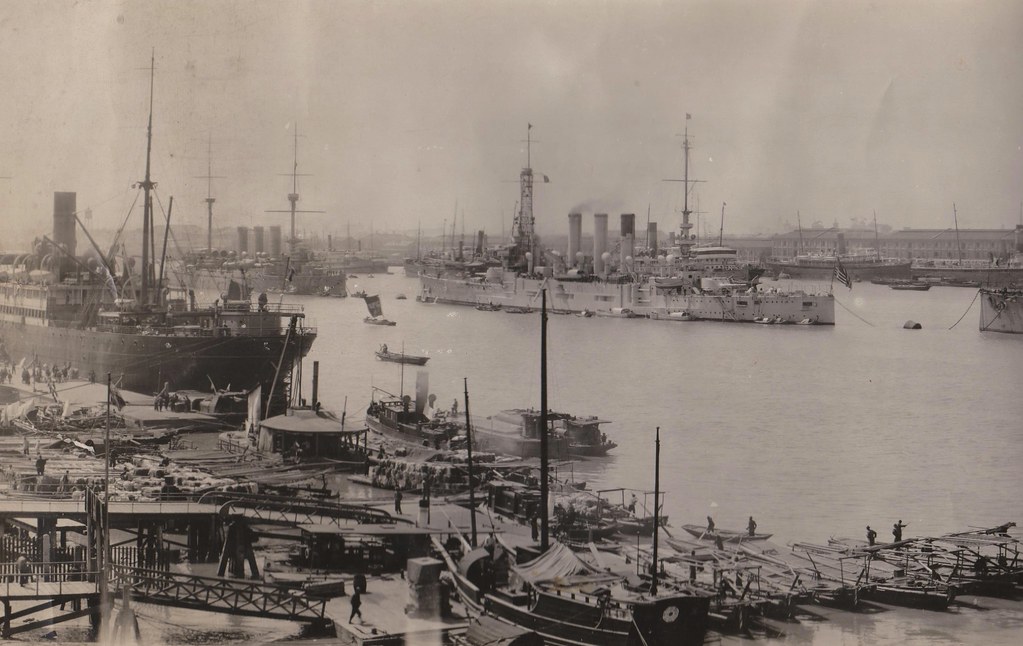
Already considered here, in 1927, the most modern city in the world, a look at the economy of Shanghai right after the that city’s history-changing general strike in March, 1927 but before the insurrection and massacre.
‘Industrial Shanghai’ by M. Rubinstein from International Press Correspondence. Vol. 7 No. 23. April 7, 1927.
Even when one knows the chief facts and figures about the development of the industry and trade of Shanghai, the American boom of its development makes a surprising impression when one approaches the town from the sea.
Silently the vessel steams up the yellow, muddy delta of the Yangtse river. Round about are numerous ships entering the river itself. The mighty river is navigable to a length of 2000 kilometers, as far as the gorges of Setshwang. In its valleys live about 200 million persons, an eighth of the population of the world.
The Yangtse connects the most fruitful and richest districts of China with the sea. Rice, tea, tobacco, cotton and silk in the last few decades coal, naphta and metal also float down the river in thousands of junks and vessels; up the stream however, machines, material, cigarettes and petroleum are being transported.
It is obvious that a port at the mouth of so great a river is extremely important; it is the gate to a country larger than the whole of Europe, to a country which is steering rapidly towards the sphere of modern industry and modern trade. Each of the great imperialist robbers would like to put the key of this gate, through which 60% of the whole trade of China passes, into his own pocket.
Shanghai is not yet in sight. For a long time we steam past low, marshy, fairly desolate banks. Here and there we see one of the uniform type of tugs of the “Standard Oil” and the “Asiatic Naphtha Company. Only the numerous advertisements which remind one of the approach to Berlin or London, speak of the proximity of a large town. We come to a turn. After the ship leaves the broad delta of the Yangtse, it steams up the Wampu on the banks of which Shanghai is situated. On the right, a small strip of land which separates the two rivers, on this strip of land one sees a whole forest of chimneys and numbers of factories and docks.
This is Wutsung, one of the numerous small industrial towns which have sprung up round Shanghai. Here are to be seen the Chinese textile factory Wingon with American automatic looms, the new factory for textile machinery; which works day and night in order to equip the newly built factories and many other works.
The river gets much narrower. In two, almost uninterrupted swarms the steamers pass up and down the river, English, French and American cruisers and gun-boats, green monsters of the “Canadian Pacific”, the “Presidents” of this dollar line, which are distinguished by their peculiar cranes–one of them starts on a world tour every week, the well-built motor-boats of the Nippon-Yussen-Kaisha and innumerable freight-boats of all nations, in all shapes and sizes. It is impossible to count them. The Japanese flag is the most frequent; from year to year it is ousting the English flag more and more. Perhaps it is an illusion of the memory, but the Wampu seems to be much busier than the Thames or the Elbe in 1926.
Even in 1924, the port of Shanghai had outstripped Hamburg in the tonnage of its freight-boats, it will soon out-distance London, according to other accounts it has already out-distanced it and is, to-day, according to one calculation the third, and to another calculation the second largest port in the world. In 1925, the tonnage of the incoming and outgoing ships amounted to more than 30 millions and the turnover of goods in the same year to two milliards of roubles. On the banks of the river, factory buildings, chimneys, cranes, masts and wireless stations stand side by side.
We see the electricity works with a horse power of 160,000, a gigantic building which is always being extended. The current consumed in Shanghai, which was 50 million kilowatt hours in 1913, increased in 1925 to 350 millions.
Further we see the Kainanki ship-building yards which work according to the latest technical achievements and build ships of 10,000 tons. At present they are building gun-boats for the United States. Further we see the textile factory “Evo”, which has become famous since last year’s strike.
Now we come to the town. On the left, lies Putung (the “Brooklyn” of Shanghai), one sees at once the rapidly growing workers’ quarter whence hundreds of ferries and small steamers carry the workers to and from the town; on the right are the buildings and factories of the Yangtsepu district.
There are few towns in Europe which can boast of so concentrated, extraordinary, precipitate a development of heavy industry as can Shanghai. When one sees the two rows of factories and ship-building yards along the river banks, working day and night in two shifts of 11/2 hours with an average wage of 20 to 30 shillings a month, one almost feels one is back in distant Lancashire, the cradle of European capitalism.
In Shanghai there are at present 250 modern factories with 450 000 industrial proletarians. The first place is held by the cotton factories with almost two million bobbins, more than half of which are a present in Japanese hands. Then come the 80 silk mills with 120,000 workers, almost exclusively women and children, and 70 mechanical knitting factories.
Shanghai’s industry however, does not restrict itself to textile industry, as many people imagine. It also has a large arsenal, iron and steel works in Putung, the above-mentioned factory for textile machinery, about ten ship-building yards, the largest of which also produce railway wagons and tram-cars, bridges, boilers etc., then a factory for producing small motors and transformers and a number of works for manufacturing metal-ware.
Shanghai has two electric bulb factories which are constantly increasing their production and even export some of their goods.
The large tobacco factories are rapidly developing. (Since May 1925, 40 new factories have been opened.)
The large, new cement factory, which employs German hands, must also be mentioned, 17 glass factories, 8 match factories, 4 paper mills, 19 steam mills, a large printing works (the Chinese printing works “Commercial Press” works with the newest technical methods, it employs more than 2000 workers. This is a large, combined undertaking, with a large distributing apparatus; it produces printing machines and all imaginable accessories, cinematograph films; it employs permanently more than 100 authors etc. etc.).
Finally, there are many large leather factories. Oil mills, sugar factories, large factories for the production of extract of eggs, albumin and many other works complete the many-sided manufacturing industry of this town of three millions.”
Numerous garages and repairing workshops serve the rapidly growing motor traffic.
The production of films which began last year, is also developing by strides.
To put it briefly, there is hardly any kind of manufactured goods which is not produced in Shanghai, if only on a small scale. This finally abolishes the absurd legend of the “natural” industrial capacity of the white race:
The building trade in Shanghai is also very important; in spite of the extraordinary cheapness of labour, it is almost entirely mechanised.
As is proved by the importance of its port, Shanghai is a great commercial centre. In close proximity to the harbour are gigantic warehouses, grain-elevators, offices etc. which employ thousands of transport workers, clerks and agents.
The narrow, crowded, noisy Nanking road, the scene of the historical shooting of May 30th, is illuminated by the electric light advertisements of three large warehouse stores which are in no way inferior to the large stores in Europe.
Shanghai is also an important financial centre. As soon as the steamer passes the bridge, through the small Suchoi river, full of houseboats (a miniature of the Canton river-town), the so-called Bond begins, that notorious part of Shanghai which “dogs and Chinese are forbidden to enter”. Motors and rickshaws glide swiftly to and fro on the asphalt. Immediately behind the British Consulate begins a close row of palatial banks and offices built of stone. About 20 large international banks show by their external appearance alone that they are the masters of these factories and railways, of the shipping lines and dock warehouses. These are, as a matter of fact, the tentacles which seize on the labour of millions of coolies and of some tens of millions of poor peasants and squeeze from them dividends of 100% for the mad luxury and the wild revelry of the Shanghai bourgeoisie.
The gigantic building of the English “Hongkong-Shanghai Bank”–one of the best constructed bank buildings in the world, raises its head among all the stone palaces of the Bond. It forces all the surroundings into the background. This is the centre of English interests in China. From here are conducted the operations of the British fleet and of the Chinese mercenaries, the town administration of the “international” settlement, the shooting of Shanghai workers, the English Press of Shanghai the most despicable Press in the world and the English police which consists of Indians, Russian White Guardists and Anamites.
In one or two generations, two million Chinese coolies have built up this fabulous city on a desolate swamp, the newest, the most modern metropolis of the world.
European and American technique has been transplanted here in its latest form of development, and with it came into being half a million proletarians in Shanghai. In the course of a few years, their class consciousness developed, and the ideas and experiences, the teaching and methods of the class war were also transplanted thither in their latest forms of development.
Since May 1925, there has been no day without strikes in Shanghai. In 1925, there were more than 300 strikes, during which 375 million hours of work were lost. The general strike and the insurrection of March 21st inscribed new, glorious pages in the history of the fights of the Shanghai proletariat.
Shanghai is often called the Paris, sometimes the New York of the Far East. For the working class however, it has become the Petrograd of the East and it will not be long before it is the Leningrad.
International Press Correspondence, widely known as”Inprecorr” was published by the Executive Committee of the Communist International (ECCI) regularly in German and English, occasionally in many other languages, beginning in 1921 and lasting in English until 1938. Inprecorr’s role was to supply translated articles to the English-speaking press of the International from the Comintern’s different sections, as well as news and statements from the ECCI. Many ‘Daily Worker’ and ‘Communist’ articles originated in Inprecorr, and it also published articles by American comrades for use in other countries. It was published at least weekly, and often thrice weekly.
PDF of full issue: https://www.marxists.org/history/international/comintern/inprecor/1927/v07n23-apr-07-1927-inprecor-op.pdf
 Revolution's Newsstand