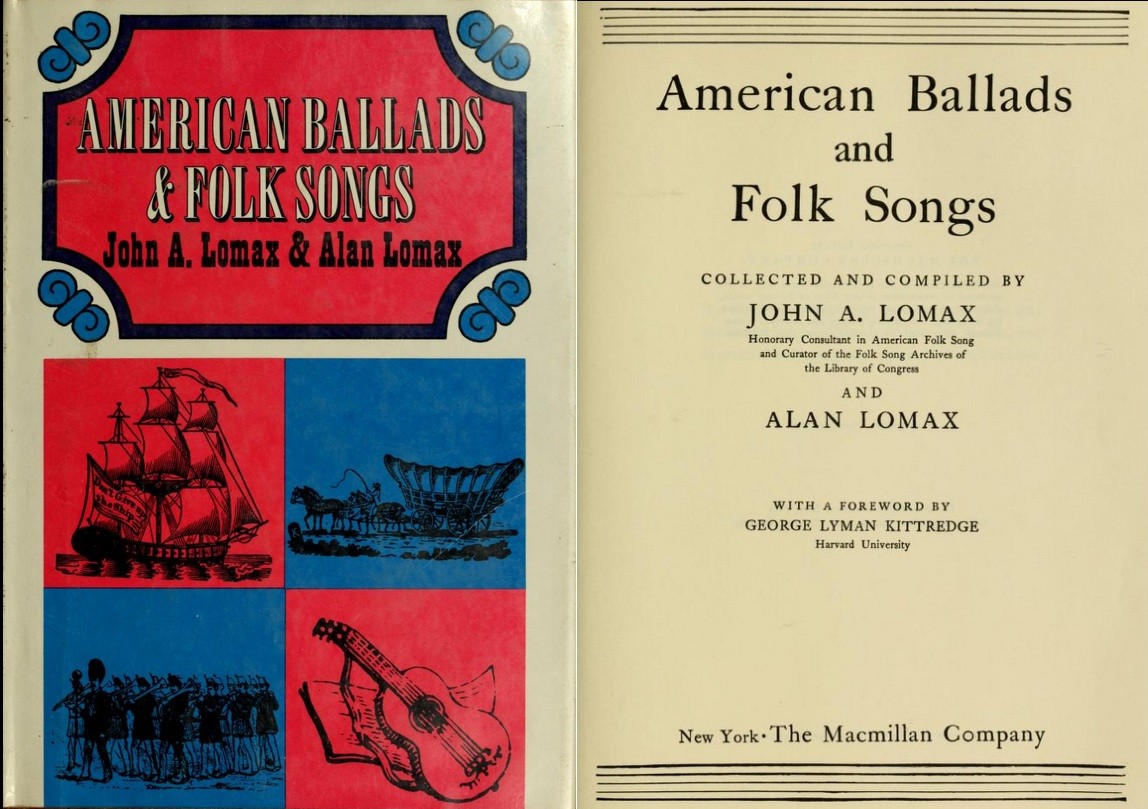
Alan Calmer with a class critique of the now-legendary Lomax collection of folks songs.
‘Part of Our Folk-Literature’ by Alan Calmer from New Masses. Vol. 13 No. 6. November 6, 1934.
American Ballads and Folk Songs. Collected and Compiled by John A. Lomax and Alan Lomax. Macmillan Company. $5.
SIDE by side with a native belles-lettres, an indigenous folk-literature has arisen in this country. The first, created by “professional” men of letters has been—until recently—permeated with the beliefs of the upper and lower tiers of the American bourgeoisie. The second, composed by the “unfettered” laboring masses, has dealt with their every-day experiences and their reflections while at work.
This oral literature produced by the American farmer and worker includes chanteys of Maine fishermen, ballads of the Pennsylvania hard-coal miners, songs of the “shanty-boy” in the old lumber camps of Michigan and Minnesota, the minstrelsy of the Southern mountaineers, Negro workaday songs, cowboy tunes, songs of migratory harvest hands, tales of the loggers and metal miners of the Northwest, etc. Wrought within an expanding industrial bourgeois society, these folk-songs have been largely the expression of a class in itself rather than for itself—to use the Marxian classification which distinguishes a proletariat unaware of its historic role from one already class-conscious. Sometimes, even the alien class ideas, foisted by the reformist labor movement, have crept into these songs.
However, as a rule most of these folk-songs deal in an empirical manner with the daily life of the workers. Songs of this type in the new Lomax collection record the drudgery; (“A-levelin’ up the road bed ain’t no fun, Nor a-drivin’ down the spikes in the boilin’ sun”) ;-some, the dangers of their jobs (“He’s only a miner, been killed underground”) some are random reflections (“Ain’t but de one thing I done wrong, Stayed in Mis’sippi jes’ a day too long”); some are day-dreams of better times (“No more shall I work in the factory”); some record occupational feats (“Dat n***r from Shiloh Can pick a bale a day”) ; some are ballads of American Robin Hoods like Sam Bass of the Southwest and Heraclio Bernal of Northwestern Mexico (“Heraclio Bernal would say, when he met a muleteer, that he did not rob the poor, but rather gave them money”); tall tales of adventure (“Tying a knot in the devil’s tail”) and ribaldry (“Out on the prairie one bright starry night They broke the whisky and Betsy got tight”), etc. These songs are rough, homespun workers’ products—no “professional” rhyming, no literary slickness. The melodies are born out of the rhythms of their labor. A number of references in American Ballads and Folk Songs indicates this relationship. Some of the notes read: “The accents mark the ax-blows of a group of four men, who are chopping down a tree”; “The ‘hanhs’ represent the violent exhalations of breath that occur when the point of the pick sinks into the earth”; “Canal-boat mule drivers sang for precisely the same reason that cowboys yodeled and sang when riding around at night…in order to keep awake and secure entertainment out of their monotonous duties”; “Chanties by the Negro stevedores in the Gulf ports…were developed as an aid in stowing cotton.”
Messrs. Lomax do not mention, however, how songs of Negro laborers, for example, are now used as speed up measures. This music originally an expression of the life of the workers is now an overseer’s whip to make his gang “hustle.” Frequently the song-leader of a work-gang is paid to “liven up” the tune to boost the amount of work done.
Despite the political naiveté of the American laboring masses, a mood of spontaneous revolt frequently flares up in their oral literature. After all, these songs deal with their every-day lives, and it is inevitable that they should contain references to their oppression. There are a few examples of this attitude in the Lomax collection. “De Ballit of de Boll Weevil”—first made into a song by Texas Negroes, then lengthening “as the Boll Weevil journeyed on eastward by easy stages to the Atlantic Ocean”—contains a stanza which reveals the revolutionary sentiments of the Negro sharecroppers:
Oh, de Farmer say to de Merchant,
“I ain’ made but only one bale,
An’ befo’ I bring yo’ dat one
I’ll fight an’ go to jail.”
Negro songs frequently break out against exploitation:
Oh, de ol’ folks tell us dat de right will win;
We’re on an eight-hour system, an’ de cap’n works us ten.
Well, if I had my weight in lime,
I’d whip my cap’n till he wen’ stone blin’.
Ef you work all de week
An’ work all de time,
White man sho’ to bring a
N***r out behin’.
In addition to these, American Ballads and Folk Songs contains some lyrics written just after the Nat Turner insurrection when the Negroes “were put under ‘special restriction’ to home quarters, and patrolmen appointed to keep them in, and if caught without a pass from owner they were dealt with severely then and there.” They tell about the slave who mourns:
My ol’ Miss, she prommus me
Dat when she die, she set me free;
But she done dead dis many year ago,
En yer I’m hoein’ de same ol’ row!
But he looks forward to the day when he shall rise and fight for his freedom:
But some er dese days my time will come,
I’ll year dat bugle, I’ll year dat drum,
I’ll see dem armies a marchin’ along,
I’ll lif’ my head en jine dere song–
Another item in the Lomax volume is “The Buffalo Skinners,” a pioneer ballad describing how seven men were hired with promises” of good wages and food that were never made good, and suffered patiently until:
The season being near over, old Crego he did say
The crowd had been extravagant, was in debt to him that day.
We coaxed him and we begged him, and still I it was no go—
We left his damned old bones to bleach on the range of the buffalo.
However, there are only a few scattered instances of this sort in this volume. Messrs, Lomax seemed to have shied away from most of the folks songs which reflect, even spontaneously, the feeling of the workers toward their bosses. Moreover, they appear to be entirely unaware of the revolutionary folk-literature that has been a part of the American labor movement since mill girls used song and verse as ammunition in their strike struggles over a hundred years ago. For example, they include a number of songs under the heading, “Working on the Railroad,” but omit such indigenous pieces as the Wobbly “Scabbing on the S.P. Line,” or the earlier battle-song of the American Railway Union which engineered the Pullman strike under Debs’ leadership. There is a section, “Songs from the Mountains,” containing lyrics collected in Harlan, Kentucky, but neither “Hungry Miners’ Blues” nor the “ballits” of the Southern textile weavers are included. They do not draw upon the balladry of the Pennsylvania “Molly Maguires,” although there is a group of songs captioned, “The Miner.” They leave out the Wobbly songs of the fields and factories, except a version of “Hallelujah I’m a Bum” (“Why don’t you work like other men do? How the hell we going to work when there ain’t no work to do?”), They might have done an interesting piece of research in tracing the versions of the popular labor song, “Hold the Fort,” from the time when the K. of L. sang “Storm the fort, ye Knights of Labor,” to the present day.
But class-visioned Messrs. Lomax have-become organically incapable of “seeing” such material. Just as the real struggles of the American workers and farmers have never been uncovered by orthodox American historians, so the task of digging up our revolutionary folk-ballads remains a job that has scarcely been started. Nevertheless, this work is of importance not only in the field of folk-literature, but as first-hand evidence in revealing the revolutionary tradition of the American proletariat. For folk-literature, much more directly than belles-lettres, reflects the society in which it is created and the beliefs of the class by whom it is composed.
The New Masses was the continuation of Workers Monthly which began publishing in 1924 as a merger of the ‘Liberator’, the Trade Union Educational League magazine ‘Labor Herald’, and Friends of Soviet Russia’s monthly ‘Soviet Russia Pictorial’ as an explicitly Communist Party publication, but drawing in a wide range of contributors and sympathizers. In 1927 Workers Monthly ceased and The New Masses began. A major left cultural magazine of the late 1920s and early 1940s, the early editors of The New Masses included Hugo Gellert, John F. Sloan, Max Eastman, Mike Gold, and Joseph Freeman. Writers included William Carlos Williams, Theodore Dreiser, John Dos Passos, Upton Sinclair, Richard Wright, Ralph Ellison, Dorothy Parker, Dorothy Day, John Breecher, Langston Hughes, Eugene O’Neill, Rex Stout and Ernest Hemingway. Artists included Hugo Gellert, Stuart Davis, Boardman Robinson, Wanda Gag, William Gropper and Otto Soglow. Over time, the New Masses became narrower politically and the articles more commentary than comment. However, particularly in it first years, New Masses was the epitome of the era’s finest revolutionary cultural and artistic traditions.
PDF of full issue: https://www.marxists.org/history/usa/pubs/new-masses/1934/v13n06-nov-06-1934-NM.pdf
 Revolution's Newsstand