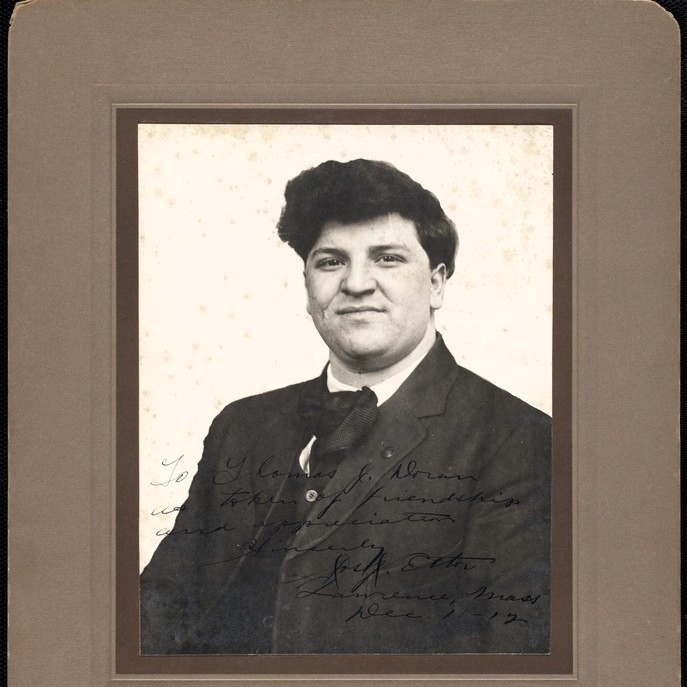
In describing the organizations and personalities met during his competitive pitch made to Massachusetts shoe workers as he sought to build the I.W.W.’s industrial unionism in what was, in many ways, a microcosm of working class politics at the time, Ettor opens a window for a view into the ideas and methods of our movement as it was.
‘Organizing the Shoe Workers’ by Joseph J. Ettor from Industrial Worker. Vol. 1 Nos. 30 & 32. October 7 & 27, 1909.
To the Secretary and Members of Local Union of Shoe Workers No. 167, I.W.W., Chicago, Ill.
Fellow Workers: On instructions from the General Secretary-Treasurer, I came to this district to carry on an agitation among the different local unions to acquaint them with the principles of the I.W.W. and, if possible, Ito get them to vote for affiliation with the I.W.W. I left New Bedford on August 18, reaching here the sale day.
On reaching here one thing was noted, that in so far as the officers were concerned, they tried to discourage me, hoping that I would leave without getting an opportunity to present our ideas to the rank and file.
I was told that the membership would not have any of us, but that, so far as the officers were concerned, they would only be too glad if it were otherwise, especially so with M.J. Tracy, whom you all have no doubt heard of.
Determined to ascertain for myself, I investigated the feelings of the membership in the matter. Everywhere I found that the I.W.W. was held in high regard and looked upon with favor. I then decided to remain here, send letters to the locals asking that I be invited to speak to them. From all, except the Lasters’ Union of Marlboro, the reply was favorable.
I spoke at meetings of the following unions: Chelsea Shoe Workers’ Union, Lynn Independent Edgemakers, Lynn Protective Shoe Workers, Lynn McKay Stickers, Beverly Shoe Workers’ Union, Salem Shoe Workers’ Union, Lynn Goodycar Operatives’ Union, Lynn Independent Lasters’ Union.
The recently organized Packing Room Employes’ Union of Lynn was quite courteous in Its action. It laid my note, together with your manifesto, upon the table.
The Edgemakers took my talk very well, but they decided not to send delegates, for they felt that the promoters of the National Union were not anxious to go the limit in the revolt against Tobin. About the same position was taken by the Shoe Workers’ Protective Union, which is an independent organization of four branches with over 5,000 members. That they were not mistaken is proven by later events.
Workers Like the I.W.W.
At all other unions the membership showed itself in accord with the I.W.W., as proven by their questions and of remarks approved, but the delegates, who invariably were officers, tricked them out of giving them instructions by making it appear that they were in favor of the I.W.W. all along.
The Lasters of Lynn invited me to speak at their meeting and the membership, in order to give an opportunity to other shoe workers to hear the message of Industrial Unionism, called a mass meeting in the big Lasters’ Hall and paid all expenses. But that was the will of the rank and file, and those who draw the salaries care very little for that and they boycotted the meeting, so that on the night of the i meeting none of the local union officers, who draw their $20 and $25 a week, were present. But the workers who put in an appearance certainly became interested, as was shown by the sale of literature.
At a special meeting of the Lynn Lasters’ Union, the rank and file determined not to take chances, turned out en masse to the number of about 500, which is more than one-third of the membership. The question of the I.W.W. was placed before the meeting, notwithstanding the fact that the I.W.W. sympathizers found themselves with a president to rule the motion out of order they were powerful enough to instruct the 13 delegates for the I.W.W.
Some of the delegates who were opposed to the I.W.W. quit, so other men who were with us were elected. Notably among the “quitters” was Charles P. Murray, the pal of T.B. Hickey, who claimed that they were elected president and vice president, respectively, of Tobins’ Boot and Shoe Workers’ Union. Murray is a “gentlemanly labor leader,” who, as he says himself, does not believe in the class struggle and that the I.W.W. will not succeed because it does not sign time contracts with the employers.
Between Thursday, September 2, and Saturday, September 4, the salaried Saviors of Labor, having lost the biggest delegation, realized that if matters were left as the rank and file had decreed, that they and their jobs would not be sure and immediately set to work with telegraph wires, special delivery letters and secret correspondence to get fraud delegates and prejudicing undecided delegates.
The Convention.
September 4, at 2 p.m., the convention was called to order. From the start it was noticed that the crowd who were calling I.W.W. supporters anarchists, “prominent ones,” could be seen to point at the “dangerous fellows.” One of the conservatives was heard to say, “You want to look for them fellows–vote against anything they propose, no matter what it is.” The first reactionary move made was in voting down the I.W.W. motion for an open convention. But they extended a special invitation to the newspapers and set a special table for them. Thus we see that the dues payers, who feed the officers, are denied the opportunity of seeing their stewards at work–but the capitalist press–ah, that’s different! The next move was to refuse a seat to your delegate, Paul Coligny. The grounds for so doing were that the I.W.W. local was not an independent union and that the I.W.W. local was really represented by the two Chicago delegates, on the presumption that most I.W.W. shoe makers are members of the Progressive Union. Powers of Chicago went so far as to state that “as a matter of fact, there was no shoe workers’ local of the I.W.W. in Chicago,” and that it was only organized during the period that I was in Lynn.
Feeling that these “reasons” were not sufficient a special committee was sent out to interrogate Fellow Worker Coligny. He was asked if he was willing to install in the new organization, to which they received the reply of a man who is true to his class, “I am an I.W.W, man and should I get a seat I should act as such. If you make a move that is really progressive, we shall join you.” Asked as to what he would do if the convention went into the A.F. of L. they wore told point blank that the members of No. 167 would not follow. They concluded that Coligny was an “anarchist,” since he would not bow to the will of the majority (?) and voted not to seat him.
The Saturday afternoon session was of short duration. They decided not to meet Sunday to give the committee an opportunity to work on the constitution.
Monday they again convened. The I.W.W. supporter immediately started by proposing an open convention. They had fourteen votes, with twenty-two negatives. Next came the report of the committee on constitution, with the enclosed preamble as you will note. It makes no mention of the class struggle, nor does intend to inspire the workers with hope for a better economic order–the same old proposition, “fair share of our product.” Lots of words put together that have no meaning.
On the question of the name, the I.W.W. supporters introduced an amendment so it would read, “The National Industrial Union of Boot and Shoe Workers, Industrial Workers of the World.” On that was fought the issue–between Industrial Unionists, pure and simple, and “me too Industrialists, but not the I.W.W.” Our supporters, as frankly admitted by all, put up a good fight, but the votes were against them. A motion was made during the discussion that I be given the privilege of the floor, but the pure and simplers and so-called radicals, who are only secret men of the A.F. of L., all stood and argued that they knew what Industrial Unionism means, so I was denied the floor. During the question, Hickey of Tobin-Hickey scrap fame, made the argument that “the I.W.W. is a political body.” Is that not great? Some say we are anarchists—so there you are. Arvid Orlando of the Chicago Progressive argued that he was “an Industrial too,” but that the I.W.W. was only a propaganda body–that if they wanted to organize with “Industrialists” they may affiliate with the Western Federation of Miners and other organizations like it, and that he believed the shoe workers are not ready for Industrial Unionism just now. Statements of that nature should brand any one who claims to represent labor as a fool or a knave.
The Show-Down.
The question being put to a vote received 18 in favor and 26 against. It should be noted that M.J. Tracy, who was a delegate to the first I.W.W. convention, voted “no.” This is the same Tracy who appeared before the special session of G.E.B. in New York in the winter of 1907 and wanted a National Union of shoe workers organized and through his representation the General Office spent quite a sum of money to get out shoe workers’ leaflets in different languages, only to be later burned up for lack of other utility. Tracy argues like Orlando, that the shoe workers are not ready for the I.W.W. But if we take as an illustration his own union, of which he has been business agent, we see that out of five delegates three elected are loyal I.W.W. sup porters. That should be argument enough on that score.
The next important proposition was the union stamp. Same as Tobin, only different in shape and name. It is provided for the manufacturers to secure the stamp. All in the shop be organized in the “United Shoe Workers of America.” Of course, that bars any man who is not in accord with their unionism from working in shops under their control, unless he agrees to become a coward, pay 25 cents a week to an organization he is not in accord with–in other words, its the same old pure and simple principle (?)–you pay dues to us If you want to work. There being nothing definite in the constitution about contracts, one of the I.W.W. supporters introduced an amendment forbidding signing contracts with employers. The conservatives made a stand. Hickey and Regan of Brockton, the latter & member of the new G.E.B., argued for contracts and arbitration; but they found themselves in the minority, not because the conservatives had changed, but there was only thirteen of them in the hall at the time, so the vote was 18 to 13. They lost. I feel sure that if the other thirteen were present it would have been carried.
The convention adjourned by electing M.J. was a member of the Swedish Committee in Chicago. The convention asked him to draw another one. Strange enough, Orlando’s resolution states the same facts as the original one did. It was not facts that stuck in his craw or the language used–as comparison will show. The original finished up as follows: “Therefore, we acclaim with joy and enthusiasm this demonstration of working class solidarity. That we endorse their stand in using Labor’s most potent economic weapon, the “general strike.” That we call upon the workers of America, irrespective of trades, affiliations or anything else, to give these, our fellow workers in this struggle, their financial support and an enthusiastic “welcome.” That was the trouble and not as he would have it–that the facts were not stated. Admitting that the facts were incorrect, it was not up to him to do aught else but correct them and leave the part that gave it real life. For in the last analysis, of what avail is a resolution that deals with a case of this nature except for the revolutionary feeling that it imports?
The argument is made that those who support the I.W.W. here are disrupters of the organization. The fact stands undisputed that it was by the move of the radicals–yes, the Italian and the Jewish shoe workers–that the strike here was won and the organization placed in its present strength, for be it noted that before the strike there were only about 500 lasters organized, but because of the bold move and subsequent victory the Lasters’ Union was increased to the number of about 1500. At present, not only that but the money of these radicals afforded an opportunity to organize several towns around Lynn. It was the move of the radicals that gave impetus to the organizations of other trades outside of the lasters.
The Line-Up.
The question is, what is the line-up? Or, in other words, who is supporting them? The leading ones are banking their chances for success on the fact that Tobin is losing ground and that on the question of Tobin versus Douglas Shoe Co. The executive council of the A.F. of L virtually took the part of Douglas. They argue that the thing to do is to take advantage of that fact. Work hard to build up a shoe workers’ union that will take strength from Tobin and finally break up the B.S.W.U.; that accomplished they can either force a Tracy general secretary and A. Orlando general organizer at a salary of $1300 a year and expenses that are necessary for the latter. The General Organizer thanked the delegates and expressed the belief that the I.W.W. shoe workers’ local would come into the now movement.
The duty of the I.W.W. shoe makers of Chicago and elsewhere is more than ever to be loyal to the organization of the slaves in revolt against capitalism and all their lackeys, whether they be open or hidden! These gents in the past were able to get some of you to go into the Chicago Independent Union with the promise that they would help to organize the shoe workers in the I.W.W. They were false promises and your duty is now to be men and withdraw and devote your energies and enthusiasm in building up a strong local by lining up the slaves of the shoe shops under the crimson banner of the I.W.W.
Toward the end of the convention, acting on the suggestion of one delegate, I wrote out the enclosed resolution and another one, instructing the new G.E.B. to issue a referendum on the question, “Shall the G.E.B. make application for a National Industrial Union of Boot and Shoe Workers to the I.W.W. General Administration?” The secretary asked if the convention wanted to hear the same read, whereupon Delegate Regan of Brockton violently opposed the reading of them on the plea that he had “been tipped off that it was from the I.W.W.” and that it was an attempt to capture the convention on the last moment by a vote of 18 to 25. They were not read. Enclosed you will find the resolution they passed on the Swedish General Strike. A statement in this connection may not be out of place.
The Strike in Sweden.
A member of the Swedish Aid Committee, who is a loyal I.W.W. man, asked me to draw up a resolution on the Swedish Strike and give it to the I.W.W. supporters to present the same to the convention. The same was given to the resolution committee and it received their support. But when it came to the convention Orlando found objection to it on the ground that it did not state the facts, that he compromise with Tobin and his crowd or make application for a charter from the A.F. of L. to take the place of the B.S.W.U. They figure that since the A.F. of L. is after the greater numbers and dollars they will be able to deliver the goods over the head of Tobin. It is all beautifully planned, but unless they have been assured by Gompers and Douglas they will fall and fail miserably. They are dealing with Tobin and that means that they are dealing with a master at his trade. Tobin is no man’s fool when it comes to playing the game of labor faking–he is the pupil of none, but the master of many. These fellows are going to use the stamp against Tobin. There is where the hitch will come in. Tobin will attack them. The fight will not only be a question of boycotting the new union stamp as a scab stamp, from the point of view of Tobin and the A.F. of L., but the fight will go right up to the manufacturers for them to decide the case. It can be readily seen that when it reaches that point the manufacturers will readily decide in favor of the crowd that can make it possible to produce shoes the cheapest. Of course, the new organization cannot compete with Tobin, for if it does it will have to out-scab Tobin. These people have not set themselves on a higher plane of working class principles than the rest of the pure and simplers. They may argue that they will not have a general president. That is only a matter of small importance. The Granite Cutters and other unions (?) have no president, but they have their Duncans and their John B. Lennons. No lofty ideals of establishing a shoe workers’ organization to act in accord with the rest of the rebellious proletarians of this and other lands inspired the majority of the delegates. The majority were imbued with the spirit of revenge against Tobin, but not against Tobinism. Their vision was short. Their efforts were puny and so will their success be short and puny.
Afraid to Fight.
The argument was that the I.W.W. was advocating correct principles, but to organize with us at this time meant to encounter a big fight. That is true. You would have drawn the fire of all enemies of labor, but what have you accomplished by shrinking from the fight? You have merely demonstrated your cowardice to face the enemies of the working class, and by that you have alienated the enthusiastic support of the proletarians of the shoe shops, who are yearning for courageous men to help them out of the cursed pit of wage slavery.
What note of inspiration have you given the shoe workers of other localities that you will stand with them when you refused to endorse or even hear read the resolution advocating the General Strike?
Gentlemen, we are forced to conclude in order to be loyal to the great class of which we are a part that you are unfit to inspire and lead to success the revolt of the shoe workers.
It has been proven that the row is not over the stew that Tobin made the shoe workers eat, but merely an objection against the style of the plate. As far as the “leaders” are concerned, it is only a matter of jealousy and revenge. No organization can ever be successful or true if that be the guiding motive of their life.
Labor must organize upon the recognition of the class struggle that exists between capitalists and workers. There is no mention of any such fact in your declaration of principles, so what can be expected but a pilgrimage over the same road as before?
The eloquence of time and experience will some day show the error of your ways!
The advice of the Industrial Workers of the World to all shoemakers is to organize properly on the basis of the irrepressible conflict between the workers and the capitalists by organizing in local unions of shoe workers under the crimson banner of the I.W.W. and stop following will o’ the wisp schemes, such as pure and simple unions, whether independent or in the A.F. of L
JOSEPH J. ETTOR, G.E.B. Member, I.W.W.
The Industrial Union Bulletin, and the Industrial Worker were newspapers published by the Industrial Workers of the World (IWW) from 1907 until 1913. First printed in Joliet, Illinois, IUB incorporated The Voice of Labor, the newspaper of the American Labor Union which had joined the IWW, and another IWW affiliate, International Metal Worker.The Trautmann-DeLeon faction issued its weekly from March 1907. Soon after, De Leon would be expelled and Trautmann would continue IUB until March 1909. It was edited by A. S. Edwards. 1909, production moved to Spokane, Washington and became The Industrial Worker, “the voice of revolutionary industrial unionism.”
PDF of full issue: https://www.marxists.org/history/usa/pubs/industrialworker/iw/v1n30-oct-07-1909-IW.pdf
PDF of full issue 2: https://www.marxists.org/history/usa/pubs/industrialworker/iw/v1n32-oct-27-1909-IW.pdf
 Revolution's Newsstand