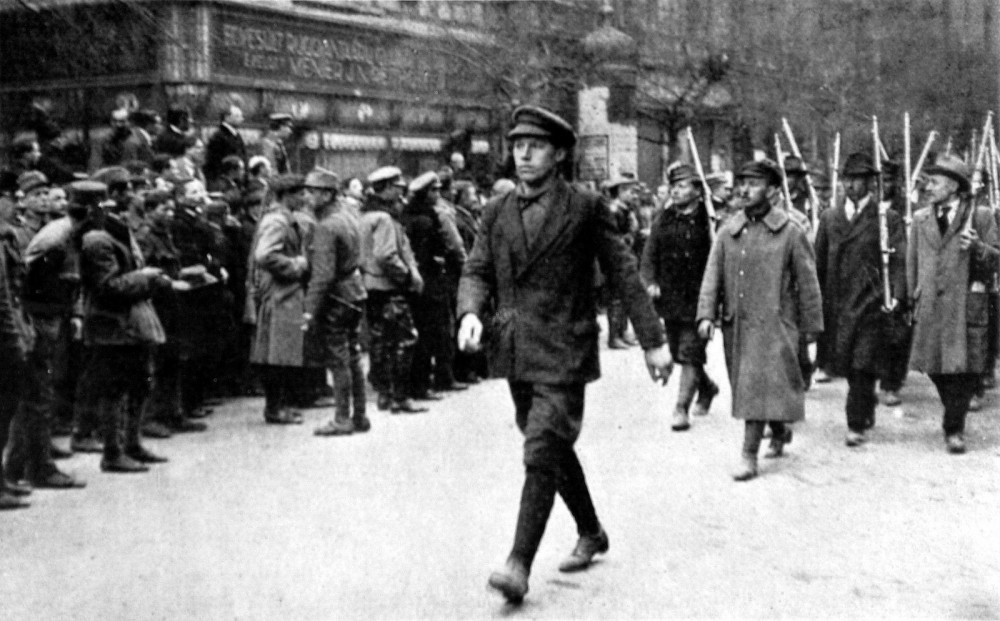
A decade on and Bela Kun gives his perspective s as to the reasons why Hungary’s Soviet Republic was defeated.
‘The Anniversary of the Proletarian Revolution in Hungary’ by Bela Kun from Communist International. Vol. 6 No. 11-13. May, 1929.
I.
THE victory of the October revolution was necessary before everyone could understand the importance of the Russian revolution of 1905. It was necessary to realise that, as Lenin said, without the dress rehearsal of 1905 the 1917 October revolution would not have been possible.
Thus we shall never be able truly to measure the historical significance of the proletarian revolution in Hungary until—in a new epoch of the international proletarian revolution—looking back from the standpoint of the new Socialist Soviet Republic of Hungary, we may consider it as the dress rehearsal in Hungary of the victorious European revolution. Inflexible faith in the revolution is not enough; one must also have that saturation in Marxist revolutionary theory which made it possible for Lenin, even in the blood-drenched atmosphere of the defeat of 1905, to appreciate the tremendous eventual result of the creative power of that vanquished revolution. That result being, of course, the Soviets as the concrete form of proletarian dictatorship.
A whole series of particular characteristics and experiences in the proletarian revolution in Hungary still awaits historical evaluation and verification. So far, however, as its positive revolutionary significance is concerned, we may still use the words which, ten years ago, Lenin spoke two days after the victory of the Hungarian rising, on 23rd March, 1919, in his speech to the Eighth Congress of the C.P.S.U.
“So far the Soviet power had only been victorious among the peoples adhering to the Russian Empire. Short-sighted persons, especially those who are unable to escape from old routine habits of thought—even among socialists—have hitherto been able to proclaim themselves of the opinion that only peculiarly Russian characteristics had brought to life this unexpected turn in the direction of proletarian Soviet democracy; that possibly the old peculiarities of Tsarist Russia are reflected in the peculiarities of this democracy as in a crooked mirror. Now this conception is destroyed in its very basis…
“The bourgeoisie and many of their adherents, at the end of 1917 and in 1918, said that we were usurpers; they could find no other words for our revolution except ‘force’ and ‘usurpation.’ If even now such voices arise—whose absurdity we have repeatedly proved—claiming that the Bolshevik power rests upon force, the example of Hungary would compel them to silence.
“The difficulties of the Hungarian revolution are tremendous. The imperialists can much more easily strangle this country, so much smaller in comparison with Russia. But however great may be the difficulties which still exist in Hungary, we have in this case not merely to deal with the victory of the Soviet power but also with the moral victory which we have achieved. The most liberal and democratic of the bourgeoisie—even those most inclined towards compromise—recognise that, in the period of gravest crisis, when a new war menaces a land already exhausted with war, the Soviet power is a historical necessity. They have realised that in such a country there can be no other power but the Soviet power, the dictatorship of the proletariat.”
The Communist International was founded hardly two weeks before the proclamation of the Hungarian Soviet Republic. The worldwide historical importance of its foundation lay in this: that it really began on a world scale to fulfil Marx’s solution, which, as Lenin said, after the long development of socialism and the working-class movement must find its expression in the proletarian dictatorship. The Communist International’s first step in the fulfilment of this historical path was to lead the proletarian revolution in Hungary to victory with the establishment of the Hungarian Socialist Soviet Republic. It is from the perspective of the historic mission of the International that we must above all consider the significance of the proletarian revolution in Hungary.
II.
The strategic and tactical lessons of the proletarian revolution in Hungary, which, by means of Bolshevik self-criticism, were drawn by the Hungarian Communists and throughout the International, have become the common possession of the whole international revolutionary working-class movement. These mistakes lead back to the fact that the proletarian revolution in Hungary had no such dress rehearsal as was the 1905 revolution for the October revolution.
The Communist Party of Hungary was founded only four and a half months before the victory of the proletarian revolution; and at the very moment of its birth the struggle for power began. The Party developed its spirited revolutionary agitation among the working masses, who, despite the fact that neither revolutionary spirit nor the desire for revolution failed them, had grown up under the influence of reformist teaching and without revolutionary traditions. The Hungarian Labour movement was specially lacking in Marxist theory. And in the socialist movement the question was never posed as to what forces and what questions of the Hungarian toiling masses—with the proletariat at their head—should bring them to revolution. The Hungarian social-democracy, functioning in a country which in many respects was similar to Tsarist Russia, had never introduced the question of a bourgeois democratic revolutionary transformation; and, of course, still less the question of a socialist revolution and proletarian dictatorship. The question of the leadership of the working class in the revolution was naturally just as unrecognised. Even without representation in parliament, it was a party of parliamentary fetichism. The objective which they provided for the working class was the struggle for democratic reforms under the leadership of the bourgeoisie.
The Social-Democratic Party was not the leader of the bourgeois-democratic revolution of 1918 in Hungary. The party had at the most approved, after much hesitation, of the revolution which followed upon the breakdown of the war—a revolution which they had done everything possible to avert. In their endeavour to hinder the revolution they even went so far that their leaders accepted positions in a government which was formed to liquidate even the elementary revolutionary mass movement which then existed. And this in spite of the fact that the only class which the revolution and the downfall of the Hapsburg regime found at all prepared—and which, united with the soldiers and peasants, had smashed the rule of the Hapsburgs—was the working class. The Hungarian bourgeoisie was almost buried under the wreckage of the old Hungary. The defeat of Hungary in the war was in every sense of the word a national defeat for all strata of the bourgeoisie, and also of course for the semi-feudal landlords. There was not only a possibility of oppression by a foreign nation, but one could also foresee that a considerable section of the Hungarian people might actually come under foreign rule. In this situation the Social-Democratic Party became the sheet-anchor for the Hungarian bourgeoisie, and even for the representatives of vestigial feudalism—the big landlords who had not yet approximated to the later stages of capitalist development. The majority of the working class, although not prepared for revolution, was, nevertheless, at first ready for this task, inasmuch as it carried on the class-coalition policy of the war period; in fact, this policy was still further expanded inasmuch as the “revolutionary democracy” became the protagonist of capitalist private property and even of the semi-feudal elements which still remained. The founding of the Communist Party of Hungary, following shortly after the bourgeois revolution, brought the leadership of the revolution into the hands of those working masses who were not prepared to take up the salvation of the bourgeois and semi-feudal elements. The slogans “All Power to the Workers’ Councils,” and “Armed Uprising,” through the agitation of the young Communist Party, became widely known and took root with tremendous rapidity among the masses of the workers. Through the catastrophic defeat in the war and the outbreak of the bourgeois-democratic revolution, the armed forces of the State were completely disorganised. This disorganisation was completed, through the agitation and organising activity of the Communists, by the arming of the workers. The bourgeoisie could only hope for protection from the Social-Democratic Party. But the Social-Democratic Party itself was now by no means homogeneous. Its members, and even some of its leaders—those who joined the Communists after the overthrow of the dictatorship—were hesitating; they were unwilling to serve as maintainers of bourgeois rule.
The fatal error which followed, the union of the Communist and Social-Democratic Parties, was partly due to the fact that the Hungarian Communist Party, despite all its revolutionary vigour, was a young party without revolutionary traditions. On the other hand, one must also take into consideration that during the war period the Social-Democratic Party did not fully differentiate its policy, so that among its membership as well as in its leading sections could be found a large number of revolutionary elements. The “Unity ideology,” which had been fostered in the Social-Democratic Party, had, however, prevented these masses from attaining a completely revolutionary standpoint.
The Communist Party itself, in its totality—despite the experiences of some of its leaders in the Russian revolutionary struggle for power—was not in a position to estimate correctly the position of the Party or the revolutionary situation. Thus it happened that, during the four months of its activity, the Party was not in a position to solve one of the most fundamental questions of the Hungarian revolution; the peasant question.
Thus from these circumstances proceeded the two fundamental errors of the revolution: the union with the Social-Democratic Party and the doctrinaire, unbolshevik treatment of the peasant question—a treatment which lost for the proletarian revolution and for the working class which led it the most important reserve army for that revolution, namely, the peasant masses. At the very beginning these two errors determined the fatal end of the revolution.
III.
Apart from the mistakes above described, the proletarian revolution in Hungary discloses a whole series of special characteristics. Without an analysis of these characteristics, both the victory and the downfall of that revolution remain incomprehensible.
The success of the revolution was even at that time a riddle—not only for the social-democrats in the various European countries, but also for the different pedants in the Communist Party—a riddle which they found it painful to solve. On March 24th, 1929, Paul Levi, then a leader of the Communist Party of Germany, writing in a provincial German Communist paper on the victory of the Hungarian proletarian revolution, said:
“The new revolution in Hungary, which has replaced the bourgeois democracy by a Soviet government, is not actually the fruit of a victorious battle waged by the proletariat against the Hungarian bourgeoisie and junkers. It is not the result of a struggle of the proletariat with the bourgeoisie in which the latter has been vanquished; it is simply the result of the fact that the Hungarian bourgeoisie has—and there is no other word for it—given up the ghost.”
It did not occur to this sensitive renegade—so sensitive that he had to excuse himself for being rude to the bourgeoisie—that it was necessary to analyse the special conditions and forms of the Hungarian proletarian revolution. The concrete circumstances of the victory of the Hungarian revolution, however, are obviously so distinct from those of the October revolution in Russia that it should have been absolutely essential for Party leaders—whose task it was to support the Hungarian revolution as actively as possible—to analyse those distinctions. The fact that some Communist leaders of that time, instead of organising international support for the young Soviet republic which needed it so badly, should busy themselves with faultfinding, naturally worked most disadvantageously for its success.
The final step to the victory of the proletarian revolution in Hungary was, in fact, not an armed uprising. However, this in no way implies that the conquest of State power was not the act of the armed proletariat. The city workers—and to some extent the agricultural workers—fought in a series of armed conflicts with the decaying and partly disarmed bourgeoisie. Industrial and agricultural proletarians had occupied both factories and estates, from which they had expelled the managers and directors by armed force. A number of armed collisions took place in various country towns and villages with the small remaining armed forces of the State. In most cases the necessity for armed action was not present, as the bourgeoisie relied mainly upon the social-democracy. The latter, however, were unable to fulfil the role of a Noske because, as we have shown above, through their own lack of definition of policy, they could not control their own membership. The difference between the proletarian revolutions in Hungary and Russia is not that in the one country it was the result of armed insurrection and in the other not. In both cases the relationship of the opposing classes—which had become distinct at the stage of the bourgeois-democratic revolution—was one of force, namely, the victory would belong to whichever class possessed more arms. The difference was only in this: that in Russia, at the outbreak of the revolution, the bourgeoisie possessed more arms and could offer more resistance than in Hungary.
The common feature of both revolutions was that the internal revolutionary situation was enhanced by the international position of the particular country where the revolution was taking place. This international situation, although different as regards the two countries, in each case worked towards a weakening of the resistance of the bourgeoisie. An analysis of the international and internal factors of the two revolutions would make apparent the special conditions attending the Hungarian revolution.
As Lenin demonstrated, the October revolution was facilitated by the possibility of connecting the Soviet assumption of power with the termination of the imperialist war. While the October revolution found itself confronted by the imperialist war, the proletarian revolution in Hungary based itself on the mass feeling induced by the imperialist peace. Just as did the ending of the imperialist war and the demand for peace, so did the resistance to the imperialist peace-enforcement bring non-proletarian masses over to the side of the proletarian revolution. In Russia the peace-policy of the Bolsheviks for a certain time brought the entire peasantry over to their side as active supporters. In Hungary, the resistance to the proletarian revolution by the bourgeoisie—and especially the nationalist petty-bourgeoisie, the petty-bourgeois intellectuals and the middle strata of the peasantry—was weakened by the expectation that Bolshevism would organise the struggle against the imperialist peace. Even among the workers this important international factor manifested itself in an interesting manner. The masses of the Communist Party were naturally not composed of the aristocracy of labour. Yet when the shadow of the imperialist peace lay heavy on the land, important elements in the labour aristocracy took their place side by side with the Communist Party. These elements feared the economic results of the territorial mutilation of the country, of the separation of industrial districts and the allocation of areas of raw material to other states. Not for a moment did the Communist Party fall into the error of nationalist-Bolshevism. The Communist Party with great energy and success exposed the Wilsonist and social-pacifist illusions of the Second International. But it exposed also, with equal clarity, the movement for the maintenance of Hungary’s territorial integrity and the maintenance of the Hungarian oppressors’ rule. The Hungarian Communist Party in its agitation emphasised that it was opposed to all wars based upon an infringement of the self-determination of peoples; and the Party disorganised the troops which the Social-Democratic war minister despatched against the Czecho-Slovakian and Roumanian armies. The Hungarian bourgeoisie’s overtures to the Entente and the social-pacifism of the Social-Democrats had failed when confronted by the facts of the imperialist peace. This brought all hesitating elements for a while over to the side of the proletarian revolution. The petty-bourgeois patriots—one of the greatest enemies of the proletarian revolution—believed, with a section of the labour aristocracy, that their only hope for the organisation of resistance to the imperialist peace was in the Soviet republic. It is interesting to note how Lenin estimated the proletarian revolution in Hungary quite contrarily to the point of view of the Social-Democratic leaders who accused the Communist Party of nationalist Bolshevism and to the pedantic attitude of Levi. In his speech at the session of the Moscow Soviet on April 4th, Lenin said: “Hungary shows an example of a revolution under quite different conditions. Undoubtedly Hungary will have to carry on a hard struggle against it bourgeoisie. That is unavoidable. It is a fact that when those wild beasts of prey, the British and French imperialists, foresaw the Hungarian revolution they wanted to subdue the country and to prevent the revolution from happening. The difficulty with us was that while the Soviet power defied patriotism and smashed patriotism to pieces, yet we were compelled to conclude the Brest-Litovsk peace.”
Had the Communist Party surrendered, it would have been the maddest pedantry and treachery to the revolution, especially as an important part of the petty bourgeois masses, particularly the bourgeois intellectuals, were weakening in their resistance to the proletarian revolution. The leaders of the social-democratic party, responding to the mood of the petty bourgeois, proposed the common assumption of power. The assertion of the Austrian and Hungarian adherents of Austro-Marxism, that the Hungarian proletarian revolution was really not a proletarian revolution, but a nationalist-Bolshevist, petty-bourgeois opposition to the imperialism of the Allies, is the grossest calumny. It is, however, undeniable that the proletarian revolution, from the international point of view, found itself confronted by extremely difficult, almost insuperable tasks, owing to the fact that after its victory it found itself faced with the imperialist peace-enforcements and the necessity for an armed struggle against them.
As distinct from the Russian revolution, the Hungarian proletarian revolution succeeded at a period when one of the two antagonistic imperialist groups lay defeated. Lenin distinctly stated, when speaking on the conditions necessary for the victory of the Bolshevik revolution in Russia, that the revolution could only carry on because of the possibility of utilising the struggle between the two imperialist robber bands and because these bands were not in a position to unite against the Soviet enemy. As German-Austro-Hungarian imperialism had already been defeated, this same situation did not prevail at the time of the Hungarian revolution. Lenin clearly foresaw the peril involved in this situation and plainly indicated the danger to the proletarian revolution contained in the victory of Allied imperialism and the ending of the war. This situation affected the destiny of the proletarian revolution in no less than three directions. While the war-weary workers were by no means eager for new warfare, certain strata of the small bourgeoisie not only wanted war but wished to take the leadership of the revolutionary struggle into their hands and to transform it into a nationalist war. The exhausted workers of the neighbouring countries, particularly Germany and Austria, were horrified at the prospect of another war. They submitted to the fact that their social-democratic leaders—the Bauers just as much as the Scheidemanns—should use a sort of blackmail against the Entente what they termed as the westward-tending Bolshevik peril. The workers of the new victor countries—especially those of Czecho-Slovakia and the newly expanded Roumania—were lost in the rapture of national liberation and supported their rulers to the utmost. The Entente were enabled to send the armies of Czecho-Slovakia and Roumania against the revolution in Hungary. Under such conditions the proletarian revolution in Hungary could only fulfil one of its tasks from the point of view of international revolutionary tactics, namely to hinder the march of the Balkan army, under General Franchet d’Epernay, against Soviet Russia. Its second task, the support of the westward tendency of proletarian revolution, it could not fulfil, as its foreign policy and also the leadership of its military operations were weakened as the result of the internal situation and the international position of the Soviet Republic.
One of the greatest differences between the Russian and the Hungarian revolutions lay in the military situation. Lenin proved that in the preparation for the success of a proletarian revolution in Russia one must take into account the tremendous expanse of the country and the poor means of transportation, making it possible to carry on an extended civil war. The situation was fundamentally different in Hungary. Even in 1848, Engels showed how the Hungarian revolution of that time was faced by great difficulties as a result of the narrow limits of its area. At that time the unfavourable transport conditions assisted the revolutionary army, the basis of whose operations was 2 times as great as that of the Hungarian Red Army of 1919. While Kossuth, in 1848 and 1849, was able to carry on the war from Budapest, later, in the smaller Hungary of our day, the loss of the capital was equivalent to the breakdown of the revolution, both politically (the largest part of the workers were concentrated here) and from a military aspect (Budapest was the basis of the war industries). At the time of the outbreak of the proletarian revolution the front lay in the north, a distance of two or three days’ march from Budapest, and in the East the Red Army, shortly after the first offensive of Roumania, withdrew its lines to a similar distance from the capital. Thus contrary to the Russian example, the war against Soviet Hungary was carried on by regular armies, which rendered it cryingly imperative for a large number of military specialists to serve in the Red Army, even before it had been possible for the revolution to have overthrown the officer caste.
Finally, a fundamental difference lay in the relations with the peasants in Russia and in Hungary. The erroneous handling of the peasant question by the Hungarian Communist Party as a subjective factor, becomes even plainer when the distinction is observed between the objective historical positions of the Hungarian and Russian peasantry. Lenin perceived that one of the conditions for the victory of proletarian revolution in Russia was the existence among the peasants of a widespread bourgeois-democratic movement. He saw that the party of the proletariat had an opportunity to take away from the Social Revolutionaries—the majority of whom were opposed to the Bolsheviks—the expression of the demands of the peasantry and to realise those demands as soon as the proletariat had gained power. It is undeniable and cannot be sufficiently stressed that the Soviet power in Hungary committed a fatal mistake when it put before the peasants the choice of whether they wanted the division of the land or whether they wished for the continuation of the large estates. They did not recognise the necessity of relating the proletarian with the bourgeois revolution. One source of this error was the effort to keep up the supplies of food for the towns. Another reason was that, based upon our policy of “Immediate Socialism,” we wanted to bring the semi-feudal properties, together with large-scale capitalism, directly over into socialism. Owing to the great differentiation among the peasantry, the objective situation was different from that in Russia. This became apparent even at the time of the bourgeois-democratic revolution, when the whole of the peasantry did not even then support the revolution. Even at this period the struggle between the wealthy peasants and the agrarian proletariat (farm servants and day labourers) was becoming sharper. The agricultural wage earners wanted to prevent the large estates—where they earned their living—being partitioned and passing into the hands of the landowning peasantry. From this circumstance the Communists drew the wrong conclusion, and gave the agrarian wage earners no land; they held the large estates as co-operative farms, but in actuality as centralised Soviet undertakings. Thus the former farm labourer of a large estate, in spite of an improvement in his standard of living, did not mark a sufficient change in his circumstances brought about by the revolution. He did not look upon himself as an owner of the land but as a “State Farm Servant.” Besides this, the historical past of the Hungarian peasantry was different from that of the Russian. When the revolution broke out, there existed no party among the peasants with the characteristics which Lenin instanced in the case of the Social-Revolutionaries. Among the peasants there existed no revolutionary movement, either under Communist or any other leadership, such as existed at the beginning of the 20th century among the Russian peasantry. As a result of these circumstances, then, the victory of the revolution in Hungary was rendered far more difficult than that in Russia, not as a result of subjective errors but as a result of the objective situation. These distinctive circumstances placed the proletarian revolution in Hungary, at its very first victorious step, before the most powerful objective obstacles. These objective obstacles, however, were not insurmountable. The conception that the Hungarian proletarian revolution was from the beginning doomed to failure—a conception which was held by the Hungarian social-democrats and the erstwhile Communist leaders such as Paul Levi in Germany, and the Austrian Strasser and Ruth, Fischer—was a defeatist position with regard to the whole question of the proletarian revolution in Western Europe. In the international situation, at the time of the Hungarian revolution, as a result of the ending of the imperialist war, no Soviet power in any country could have had as favourable a prospect as had the Russian proletarian revolution immediately after its inception.
This only goes to show that the Hungarian Soviet Republic needed even more the immediate and direct support of the international proletariat, and could dispense with such support less easily than could the Russian Soviet Republic.
V.
The internal situation of the international Labour movement at the period of the Hungarian revolution was, however, completely disadvantageous to the success of that revolution. But still less favourable for our revolution was the military position of the Russian Soviet Republic. On March 18th, 1919, it was reported that the vanguard of the Red Army had taken possession of Karnopol. This had a great influence on the “Eastern Orientation” of the social-democracy as well as other sections of the petty bourgeoisie. On April 4th, 1919, Lenin, in his letter to the Petrograd workers, sounds the alarm with regard to the eastern front. He writes:
“The situation on the eastern front has considerably worsened. To-day Koltchak took possession of the Votkinska works. We shall probably lose Bugulma, and Koltchak is pressing further on. The danger is frightful. We appeal to the Petersburg workers to strain every nerve and rally all their forces for the support of the eastern front. The soldiers will be able to feed themselves there and to assist their relatives by despatching food. The main thing is that there the fate of the revolution is being decided. If we can win there, we can put an end to the war, because the Whites will receive no more assistance from abroad. In the south we are on the point of victory. But no forces can be transferred from the south until we have completely won.”
All this made still more difficult the military situation of the proletarian revolution in Hungary, because we had partly depended upon the Russian Red Army and the uniting of the Russian and Hungarian Red troops in order to ensure our success. Here lay also the hopes of the petty bourgeoisie. It was from this hope that there proceeded the neutrality—and even at the beginning the benevolent neutrality—of these elements towards the proletarian revolution. This also had a great deal to do with our coalition with the social-democratic party, because we had reckoned that after the union with the Russian Red Army we would be in a position to drive the weakest and most hesitating social-democratic elements out of the government and out of the leadership of the united parties. Also this was the first source of hesitation among the workers. This hesitation increased when, after the downfall of the Bavarian Soviet Republic, and right on top of the defeat of the Russian Red troops in the south-east through the treachery of Grigoriev, and the advance of Petlura’s and Denikin’s troops, the hope for assistance from the east and west disappeared. Outside the little Soviet Republic, encircled by imperialist troops (Czecho-Slovaks in the north, Roumanians in the east, Jugoslavs and French in the south and Austrians in the west), behind the enemy troops there were only small Communist groups engaged in activity to support our republic, activity which hardly went beyond the borders of ordinary propaganda. The coalition with the social-democratic party, the errors in the blockade, prepared the ground for the democratic counter-revolution.
The internal political errors reduced the power of resistance of the proletarian revolution, so that as a consequence it was not in a position to await the warmly-expected assistance of the international proletariat.
The proletarian revolution in Hungary then, after 44 months’ struggle, remained as the dress-rehearsal for the new proletarian revolution—the proletarian revolution of Europe.
But even in its overthrow it served, as the Second Congress of the Communist International stated, as a beacon for the proletariat of Central Europe. Whatever revolutionary defeatism may say, whatever the social democrats and renegades from Communism may proclaim, the blood of the workers did not flow in vain in this revolution; already new shoots are sprouting in the Hungary of the White Terror. “Laetius ec trunco florabit” as the Hungarian jacobins wrote on the walls of their cells at the time of the French revolution.
The ECCI published the magazine ‘Communist International’ edited by Zinoviev and Karl Radek from 1919 until 1926 irregularly in German, French, Russian, and English. Restarting in 1927 until 1934. Unlike, Inprecorr, CI contained long-form articles by the leading figures of the International as well as proceedings, statements, and notices of the Comintern. No complete run of Communist International is available in English. Both were largely published outside of Soviet territory, with Communist International printed in London, to facilitate distribution and both were major contributors to the Communist press in the U.S. Communist International and Inprecorr are an invaluable English-language source on the history of the Communist International and its sections.
PDF of full issue: https://www.marxists.org/history/international/comintern/ci/vol-6/v06-n11-n12-n13-may-1929-CI-riaz-orig.pdf
 Revolution's Newsstand