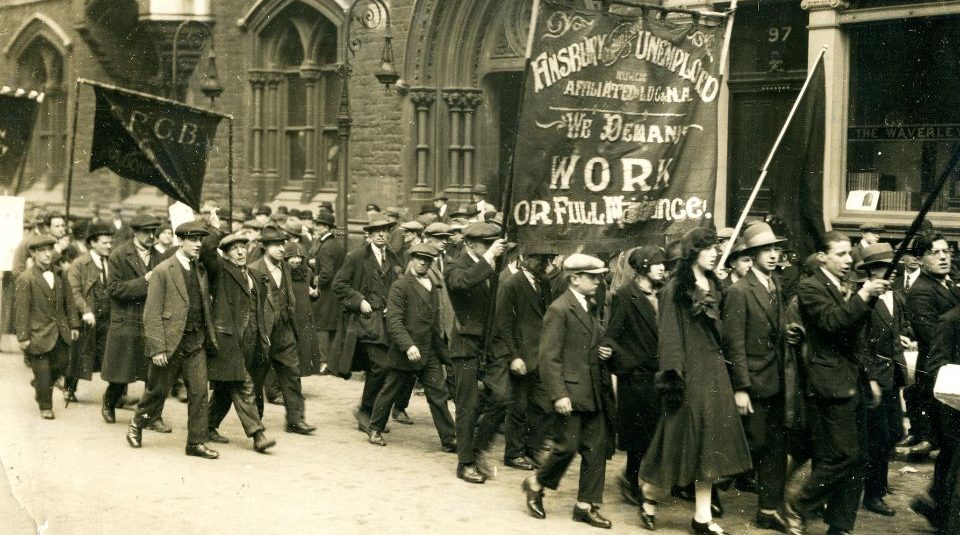
The activities of the Young Communist League during the 1926 General Strike in Britain.
‘The Young Workers in the General Strike’ by R. Schüller from International Press Correspondence. Vol. 6 No. 48. June 24, 1926.
It is exceedingly interesting to learn in what way the working youth and the Young Communist League in Great Britain took part in the recent general strike. And it is very satisfactory to find that the favourable picture which one derived during the general strike regarding the active and enthusiastic participation of the Youth and of the Young Communist League in the struggle, is being confirmed by exact reports and material. In fact the young workers and apprentices, both organised and unorganised, eagerly took part in the struggle in great masses, and the young and small Young Communist League has given a good account of itself. This fact is all the more important and welcome as the trade unions, in general, did not wish the apprentices to take part in the strike, and likewise made very little effort to fetch the unorganised young workers out of the factories.
As regards the extent of the organisation of the young workers, it is a generally well-known fact that in Great Britain (as in many other countries) the young workers organised in trade unions constitute a very small minority.
Neither the apprentices nor the unorganised young workers could expect any strike pay, and the prospect of victimisation was very great, while those workers under 16 of age had not even the prospect of receiving unemployment benefit. The strike of the apprentices and unorganised young workers, in spite of their neglect by the trade unions, was therefore an heroic action which shows how greatly the British working class youth, along with the entire working class, have been roused by the recent events.
The youthful elements everywhere distinguished themselves by special enthusiasm, fighting spirit and activity. This is confirmed from all sources. The Young Communist League displayed the greatest activity and thereby reflected the mood and activity of the working class youth during the strike. Right at the beginning of the fight the League issued the following slogans for the youth:
All young workers into the strike. Most energetic participation of the youth in all strike activity. Representation of the youth on the strike committees and councils of action, Fraternisation between soldiers and strikers! United front of the working youth!
Members of the Central were sent to all the important district. “The Young Worker”, the organ of the League, which on the 1st of May was converted from a fortnightly paper into a weekly paper, was issued daily under the title of “The Young Striker”. Leaflets were distributed wholesale. In addition to this, most of the district executives issued their own strike bulletins for the youth.
The Youth organisation of the Independent Labour Party disappeared during the strike, if possible even more completely than the Party itself. So far as members or local groups of these organisations were desirous of fighting, and this was so in the majority of cases, they had to look to the Young Communist League for leadership. Thus the Y.C.L. reports:
“In Tottenham a 14 years old member of our League issued a strike bulletin quite alone and delivered a speech at a factory meeting. He thereby brought 500 young women workers into the strike and caused them to join the trade union.”
The “Young Striker” states:
“50 young transport workers in Bethnal Green joined in the strike and the Y.C.L. succeeded in getting them to join the trade union.”
Of great importance was the slogan of the League: “Election of representatives of the youth to the strike committees and councils of action.” In many cases the League succeeded in this. In many cases it also succeeded in bringing about the formation of special committees of the councils of action for work among the youth.
The intensive agitation of the Lague for the fraternisation of troops and workers deserves special attention. “The Young Striker” is full of reports of the movements and the mood of the troops, and contains appeals for fraternisation between soldiers and workers. Leaflets were also distributed among the soldiers.
The work of the League was carried on under very difficult circumstances. The Central in London was practically illegal. The Police carried out several raids on the offices of the League. The whole Executive in Manchester was arrested, but afterwards released. The secretary of the League, comrade Springhall, was sentenced to two months hard labour. Many other members of the League were sentenced to fines and imprisonment. The possession of a copy of the “Young Striker” was sufficient during the strike in order to be sentenced to several weeks or months hard labour.
The “Young Comrades League” (the children’s organisation) likewise showed very great activity. Its main endeavours were directed towards enforcing from the authorities support for the children of the strikers in the shape of free meals in the schools, in many cases with success.
The calling off of the General strike has not ended the activity of the League. The League is now concentrating its forces in the fight of the young miners and in defending the unorganised youth and apprentices against wholesale victimisation.
The influence of the Young Communist League has greatly increased. It is also gaining in numbers. The League is now conducting a recruiting campaign in order to increase its membership still further, with the aim of creating a Mass Young Communist League.
International Press Correspondence, widely known as”Inprecorr” was published by the Executive Committee of the Communist International (ECCI) regularly in German and English, occasionally in many other languages, beginning in 1921 and lasting in English until 1938. Inprecorr’s role was to supply translated articles to the English-speaking press of the International from the Comintern’s different sections, as well as news and statements from the ECCI. Many ‘Daily Worker’ and ‘Communist’ articles originated in Inprecorr, and it also published articles by American comrades for use in other countries. It was published at least weekly, and often thrice weekly.
PDF of full issue: https://www.marxists.org/history/international/comintern/inprecor/1926/v06n48-jun-24-1926-Inprecor.pdf
 Revolution's Newsstand