‘Immigration: A Capitalist Dilemma’ by Clarissa S. Ware from Labor Herald. Vol. 2 No. 1. March, 1923.
‘MORE labor-cheaper labor-relieve the labor shortage.” This is the battle cry raised by the National Association of Manufacturers, the National Association of Merchant Tailors, the National Founders’ Association, and such spokesmen of the employing class as Gary, Steel Trust head and “open shopper,” and Mellon, guardian of tax-dodging corporations and incidentally Secretary of the United States Treasury. The question is, how is it to be done?
There are several proposals under consideration to change the present immigration regulations. Senator Reed of Pennsylvania, who as a coal and steel Senator ought to know better, is the leader of the Congressional group advocating restricted immigration with the quota based on the 1890 census rather than the present basis of 1910. In 1890 the main stream of immigration had not yet shifted from Northern and Central to Southern and Eastern Europe. This change would increase the quotas of immigrants from Germany, Austria, Scandinavia, and Great Britain. Two points which this suggestion apparently ignores are; first, that it would increase the quota of immigrants who do not supply the common, heavy, machine labor; and second ,that even the present quotas from these countries are today not being filled. Only 55% of the British quota and 28% of the German entered during the past year.
Contract Labor
This agitation for a change in quotas cannot be taken too seriously even by its advocates. It has the merit of an apparent change, and today a change in immigration policy is being widely demanded. But as Babson pointed out a bit brusquely in his Special Bulletin of January 16th, “Furthermore letting these good North Europe people in, and getting them to come are two propositions. The Reed Bill will not do it. Suspension of the Contract Labor Law will.”
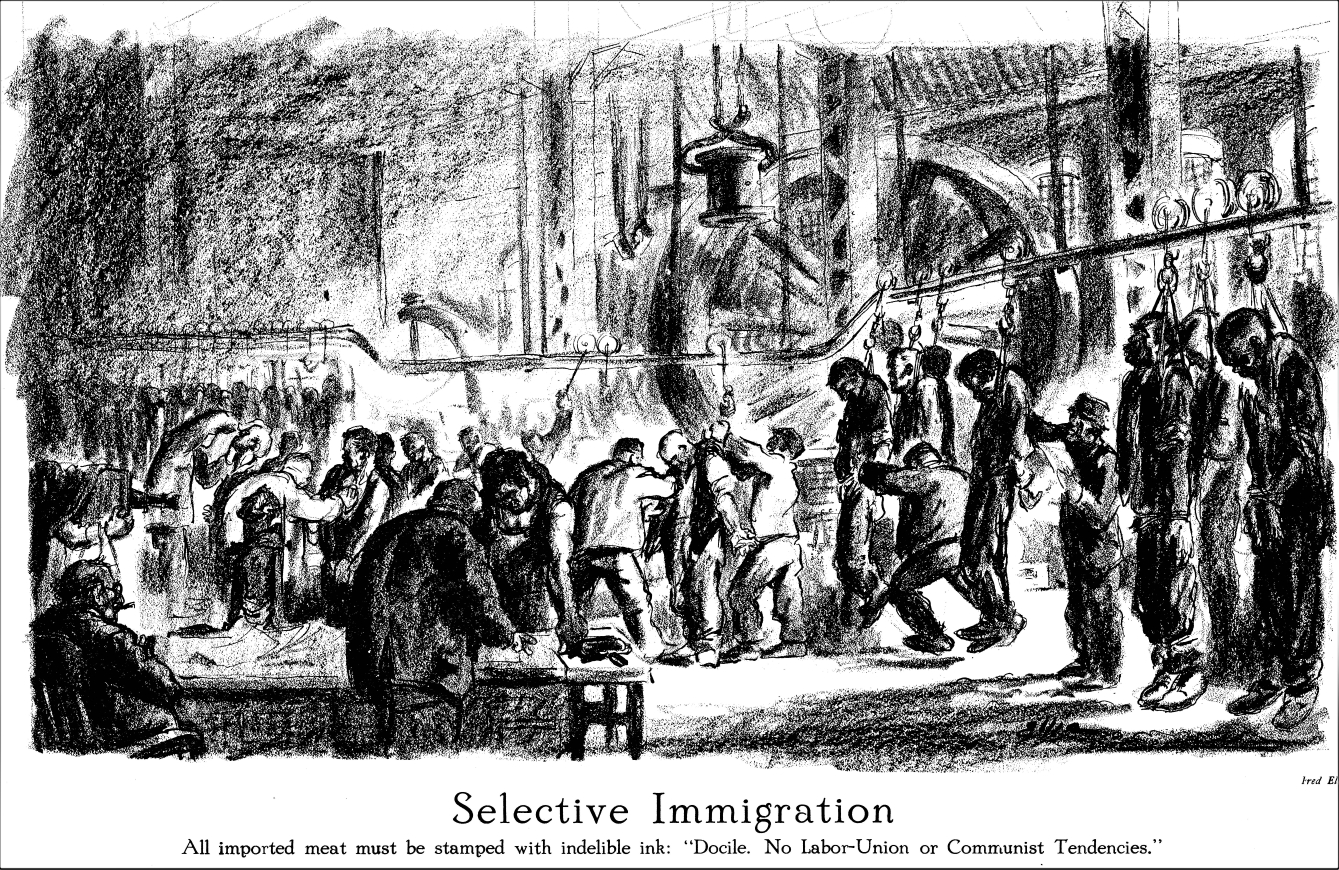
While great publicity is being given to the various restriction policies Senator Colt has introduced the real answer in his Senate Bill S. 4303, which reads as follows : “The Secretary of Labor may, upon submission to him of satisfactory evidence that there is a continuing shortage of labor of a particular type or class which, after reasonable effort, has not been found unemployed in the United States, authorize contracts with and the admission of otherwise admissible, alien labor to such extent as will in his judgment meet such established shortage…notwithstanding that such aliens so authorized may exceed the quotas of their respective nationalities now admissible under this Act.” Babson advised all employers to see to it that that bill is supported, as the solution of the problem from the employers viewpoint lies in importing slave labor on the contract basis.
American industry has been built by foreign Labor coming to this country. First, before the enactment of the Contract Labor Law, the employers imported great droves of foreign-born workers virtually as slaves. With the enactment of the law forbidding this practice, a period of unrestricted immigration set in which continued until the outbreak of the war. During the war immigration could not be a problem to America as foreign-born workers left and no new immigrants came. Once the war was over, immigration loomed as a menace to the foundations of American government according to the sponsors of the present 5% law.
The Employers’ Dilemma
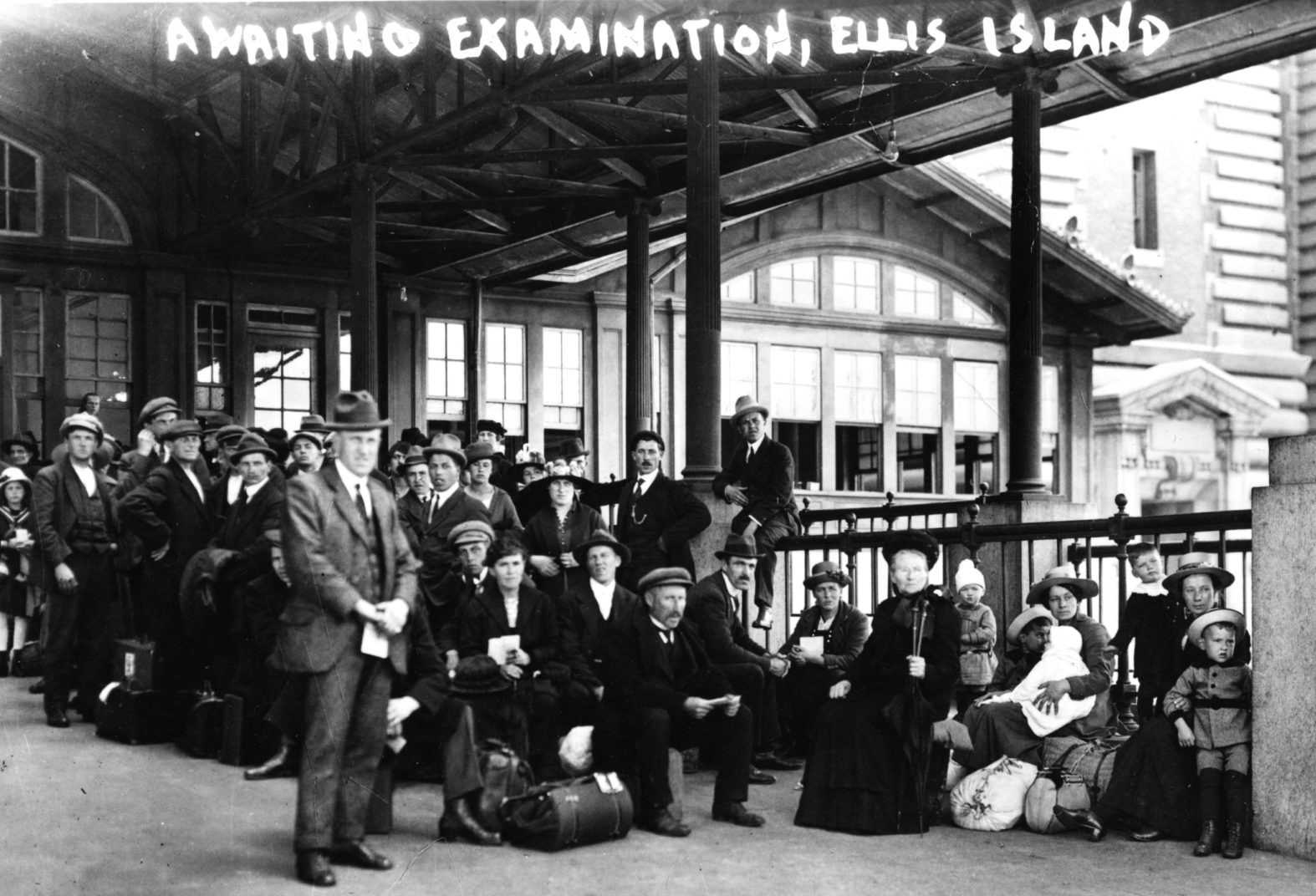
Those countries which had been supplying the bulk of that labor army which had built up America’s industries were in the throes of political upheaval. Because of the fear of such immigration being a source of political “infection,” the lid was clamped on. Today, the employing class is faced with this dilemma. The industrial reserve army must be augmented with a new supply of common, heavy, machine labor. It has been depleted by the cessation of immigration and the attendant increasing homogeneity of American Labor. We are “back to normalcy” with a shortage 0f labor and 1,500,000 officially unemployed according to Secretary of Labor Davis. Industrially, therefore, the employers want immigrant Labor coming from Balkans and Southern Europe. Politically, however, such immigration is still “dangerous.” These countries are in a state of flux. Their political tomorrow is questionable. Workers coming from these countries are looked upon as a sources of revolutionary contagion. On the other hand, the politically safer and saner workers from Northern and Western Europe cannot meet the industrial demands of our employing class. Furthermore, even if these workers could meet the industrial demands, letting them in and getting them to come are two different propositions. Politically, the employers want Northern Europe laborers; industrially, they reject them. Industrially, they must have. Southern European laborers; politically, they must reject them.
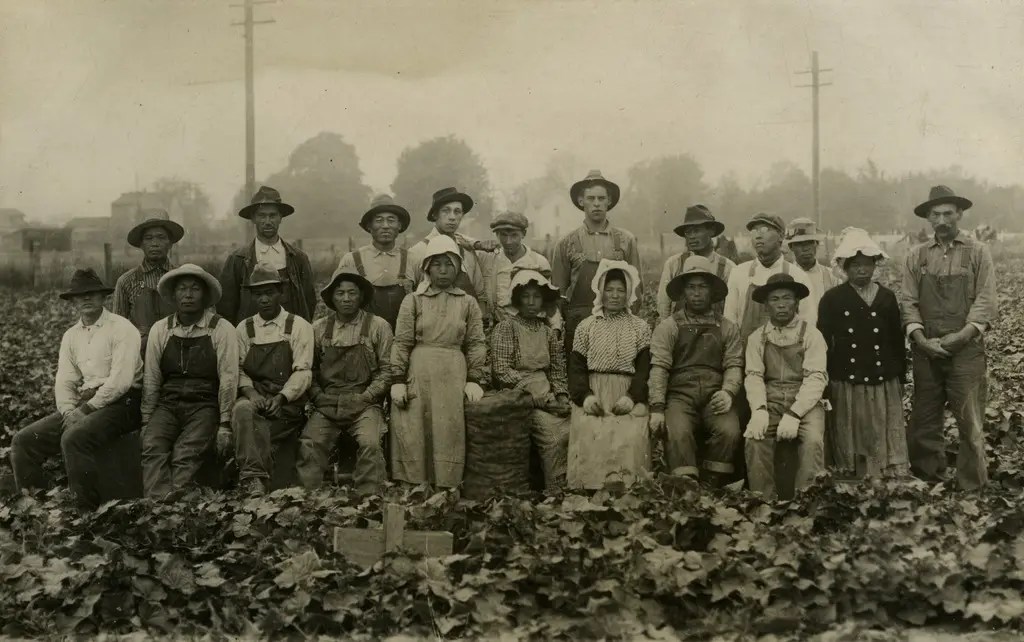
There is still another phase of the problem; where do the farmers come in? We are told by James R. Howard, President of the Farm Bureau Association, that the immigration restriction is undoubtedly affecting the prosperity of the country, and particularly that of the farmer. The powerful industrial magnates are making this offer to the farmers: Give us a large reserve army of city workers. This will force many workers back to the farms, with, the result that farm labor will be cheap. The same industrial reserve army will bring lower wages in the city, enabling the farmer to secure goods he needs because of lowered prices. Thus, so they urge, the purchasing power of the farm dollar will be enhanced and the farmers’ prosperity restored.
This is typical of the propaganda put out by the capitalist organizations in their efforts to destroy the growing solidarity of the city workers with the farmers. Of course it is completely unsound. As a matter of fact, during the period of depression, when there was a gigantic reserve army of unemployed totaling six millions and when wages were being slashed to the bone the condition of the farmer was worse than ever. The capitalists that rob the city workers are the same that rob the farmers. The salvation of the farmers today is not to be found in contract labor, restricted or unrestricted immigration.
The Gompers’ Point of View
Where do Gompers and his family stand on this proposition? The official position of the American Federation of Labor is based on the narrow craft point of view. Gompers advocates the policy of complete restriction of immigration. When it comes to foreigners, Gompers also sees red. The foreigners, according to his conception, would lower the high American standard of living! It is the foreign workers and not the American employers, says he, who are the enemies of our unions! This is Gompersism in theory and practice.
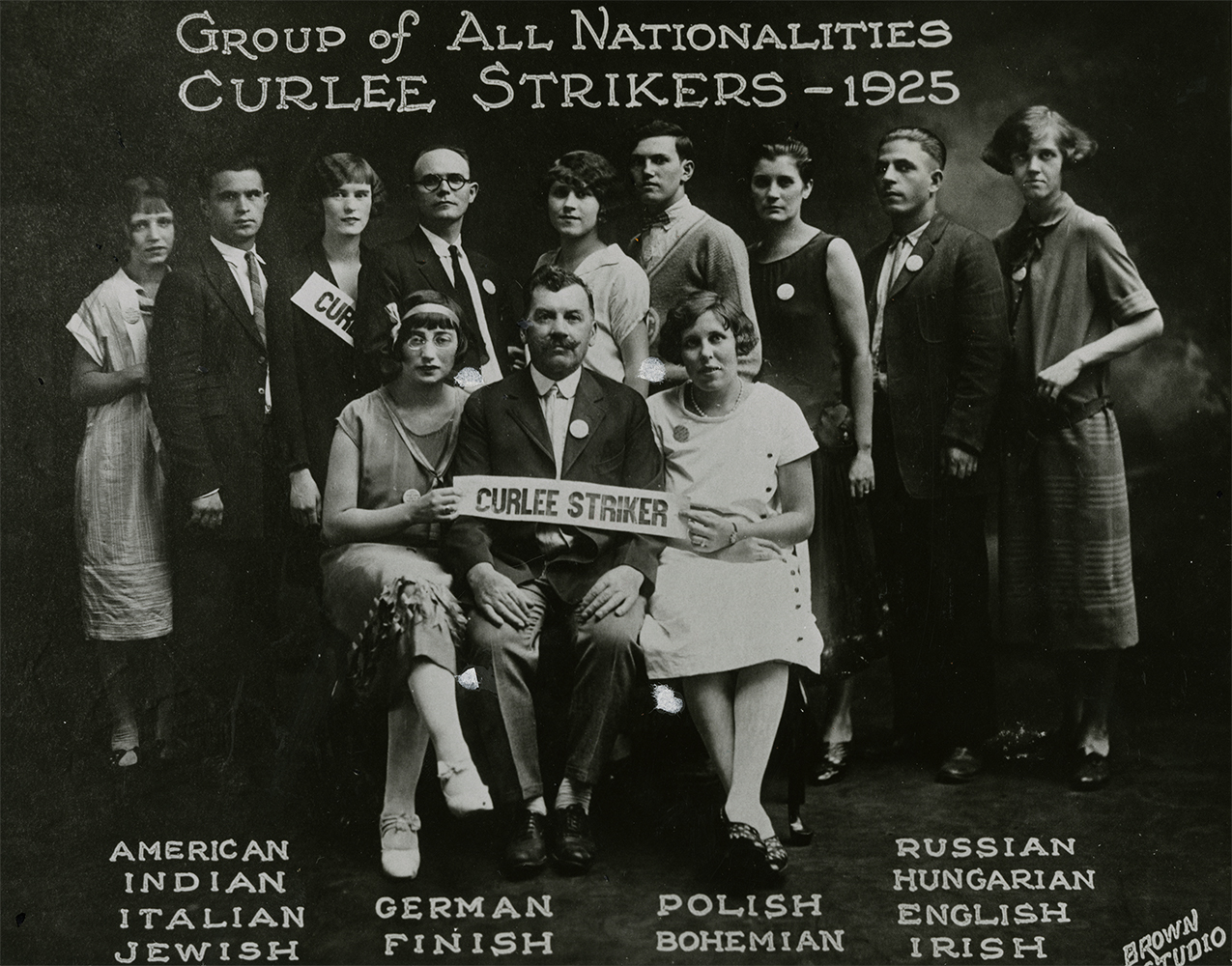
Such is the way our officialdom promotes Labor solidarity. Keep the foreign-born out of America! This is the tribute paid by Mr. Gompers to the heroic foreign workers who fought so well in the mine and textile strikes-battles which, according even to Mr. Gompers, were largely instrumental in halting the wage-cutting and union-smashing offensive. The entire case of Gompers is fallacious. It breeds dissension and division in the ranks of the workers. It plays directly into the hands’ of the capitalists by fostering artificial nationalistic divisions among the laboring masses.
Restriction of immigration will not give the American workers higher wages or better working conditions. That can only be gained by stronger organization, industrial organization the amalgamation of the craft unions into fighting industrial unions. But what can be expected from Mr. Gompers who, in opposition to amalgamation, is lined up with Mr. Gary, with the National Civic Federation, the Chamber of Commerce, the capitalist press, and all the anti-labor forces? What can we expect on the immigration question, from a “leader” who sees Labor’s place in the International as being with United States Chamber of Commerce in the League of Nations?
For Workers’ Control of Immigration
Against the program of restriction advocated by Gompers and against the contract system of the importation! of workers proposed by Colt, we propose the international solidarity of the working class. Let all working-class organizations, regardless of political opinion, hold an international congress to deal with the wages and conditions of employment of the workers of all countries. Let this congress establish a permanent bureau, charged with the task of disseminating accurate information about and regulating the migration of workers on the basis of actual conditions in any particular country at a given moment. This working-class organization will govern the migration of workers so as to preclude even the temporary possibility of detriment to the workers of any country. Such regulation, not being controlled by the organizations of the employing class or their governments that are animated solely by lust for profits, will be the only control of immigration which can protect the workers.
The Labor Herald was the monthly publication of the Trade Union Educational League (TUEL), in immensely important link between the IWW of the 1910s and the CIO of the 1930s. It was begun by veteran labor organizer and Communist leader William Z. Foster in 1920 as an attempt to unite militants within various unions while continuing the industrial unionism tradition of the IWW, though it was opposed to “dual unionism” and favored the formation of a Labor Party. Although it would become financially supported by the Communist International and Communist Party of America, it remained autonomous, was a network and not a membership organization, and included many radicals outside the Communist Party. In 1924 Labor Herald was folded into Workers Monthly, an explicitly Party organ and in 1927 ‘Labor Unity’ became the organ of a now CP dominated TUEL. In 1929 and the turn towards Red Unions in the Third Period, TUEL was wound up and replaced by the Trade Union Unity League, a section of the Red International of Labor Unions (Profitern) and continued to publish Labor Unity until 1935. Labor Herald remains an important labor-orientated journal by revolutionaries in US left history and would be referenced by activists, along with TUEL, along after it’s heyday.
PDF of full issue: https://www.marxists.org/history/usa/pubs/laborherald/v2n01-mar-1923.pdf

