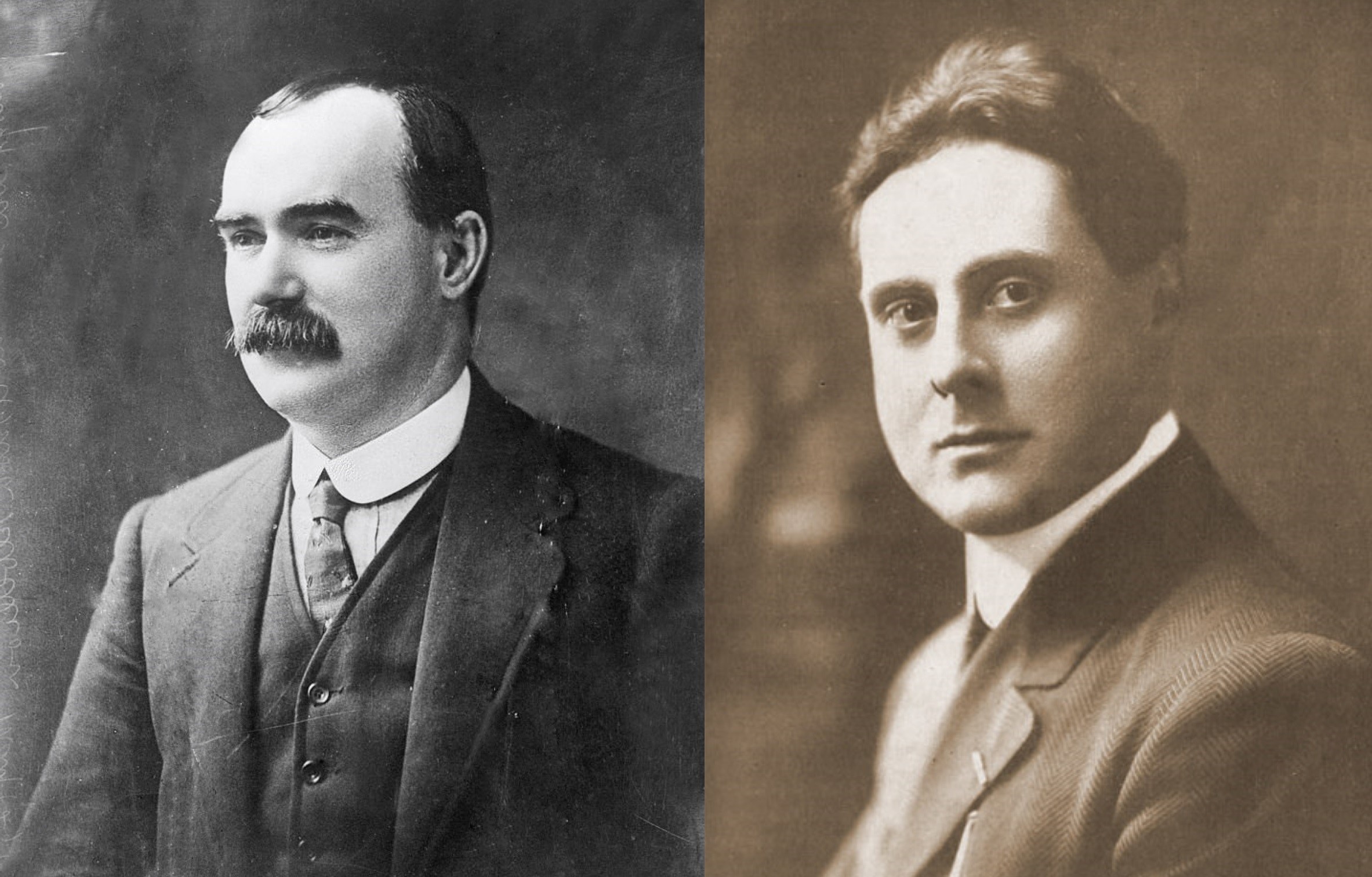
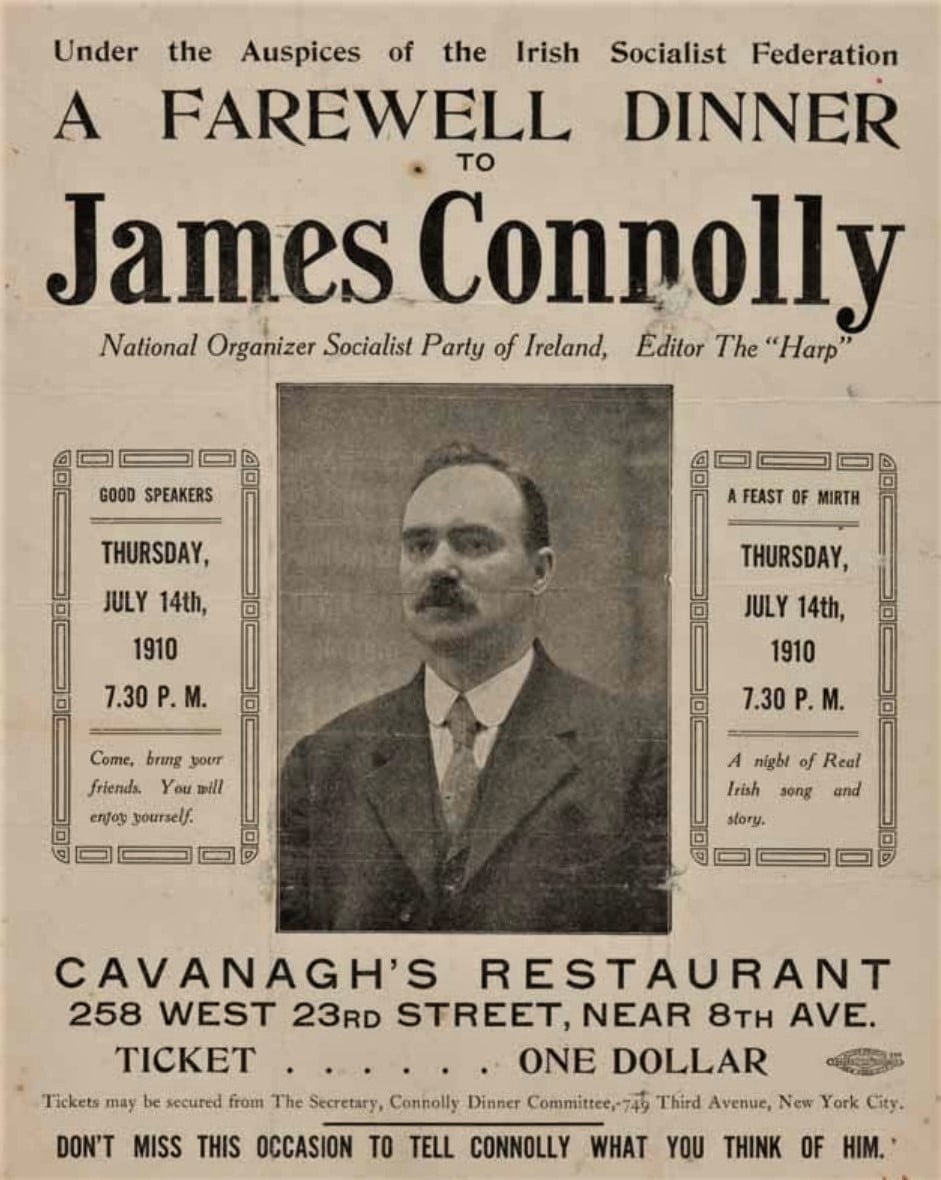
Frank Bohn had, up to a point, a similar political history in the United States as Connolly, who we knew through a decade of common political work. Both were members of the Socialist Labor Party then of the I.W.W., were they both broke with Daniel De Leon and joined the Socialist Party around Debs’ 1908 run. Both were theoreticians and activists in the industrial union movement and shared political circles. Bohn would speak at Connolly’s farewell dinner when he returned to Ireland in 1910 (Bohn misremembers it here as 1908). However, by 1916 the collapse of the International and the resulting war had led Bohn, like so many, on a rightward course that end up outside of the revolutionary movement. However, he offers some priceless glimpses of Connolly’s life in the U.S. in this appreciation written in the immediate aftermath of his execution.
‘James Connolly: An Appreciation’ by Frank Bohn from Solidarity. Vol. 7 No. 333. May 27, 1916.
(James Connolly, on his last visit to this country, was an I.W.W. organizer in New York city. He was also organizer of the Irish Transport Workers on his return to the Old Sod. He was executed in London, following his wound and capture in the Dublin fight.-Editor Solidarity.)
Somewhere in the Tower of London, or elsewhere in durance, desperately wounded and awaiting recovery sufficient perhaps to permit of his execution according to law, is the most remarkable character connected with the ill-starred Irish rebellion, “Jim” Connolly.
Connolly is one of the most gifted men which this period of turmoil in Europe has hurled up to the front pages of the newspapers. He was born in the slums of Dublin and became what such creatures of despair usually become, casual laborers. But Connolly was different. He learned to speak and read several modern languages, including Italian. He studied history, economics, and politics with great diligence and success. While working ten hours a day for a wage of two dollars in the Singer Sewing Machine Works in Elizabeth, I heard him deliver a finished oration at Cooper Union. This address showed not only a wide knowledge of history and economic science, it was spoken with that peculiar beauty and simplicity of diction which so often characterizes the English of cultivated Irishmen.
When his American friends learned that he had been appointed “General- in-Chief of the Armies of the Irish Republic,” they looked at one another in mute astonishment. For “Jim” Connolly probably doesn’t know a rifle from a machine-gun or a field piece from the caisson to which it is attached. Nothing so proves the utter incompetence of the Irish recalcitrants as this outstanding piece of nonsense. I have no doubt the position was bitterly distasteful to the mild-mannered, warm-hearted slave of the forlorn Hope. “Jim” could make a speech, comparable indeed to the great speeches of the world’s great revolutions. He could organize a labor union and lead it in a strike. He was a careful and painstaking editor, could stick, as so few can stick, through thick and thin, and fight on when everybody else was willing to lie down. But by what process of thinking the Dublin rebels evolved the fantastic conclusion that Connolly could lead them to victory his friends in American simply cannot imagine.
FIRST CAME HERE IN 1902
Connolly first came to America in 1902. He toured for several months, from coast to coast, lecturing for the old Socialist Labor Party. I went over to Detroit, from the University of Michigan at Ann Arbor, and heard the speech which he made there to some four hundred working people: That was the best speech, by far, that I had ever heard. There was no shouting, there was no nonsense. Its argument was based upon a wealth of fact. It was deeply emotional, too. The rich Irish brogue made it sometimes hard for an American to follow, but this brogue made his appeal for the workers of Ireland all the more striking.
The following year Connolly re-turned to the United States and remained until 1908. He intended to remain here, and become a citizen. But the struggle for existence on the one hand, and his attachment to Ireland on the other, brought his plan to naught. He was cursed by poverty, and his connections with a small and unimportant Socialist sect prevented him from making a living by lecturing and writing: For one season, later, he toured the country as a lecturer for the Socialist party. For a time he was a labor organizer in New York city. But he never became really acclimated here. He founded a small Socialist monthly, The Harp, for the purpose of advocating Socialism among the Irish in America. This instrument was never really attuned to American conditions. The call of the old home was too strong, and so one fine day the Connollys, large and small, packed up their humble properties and sailed away.
HIS RETURN TO IRELAND
On the occasion of his departure some of his New York friends dined him in true Bohemian style. On this occasion Connolly made a notable and really illuminating speech. He maintained that the Irish people were quite distinct from the other peoples of western Europe in that they had never gone through the feudal stage of development. They had never worn the shackles of serfdom. Private property in the means of production was not a native institution in Ireland: Primitive communism had obtained there until the English invasion. Hence Irish people were, of all nationalities, the most ready to receive the message of modern Socialism. In his book, “Labor in Irish History,” Connolly evolves this thesis at great length. This book is very much worth while. Our working man, “Jim” Connolly, both in the slums and, doomed to casual labor and the unutterable struggle which perpetual poverty and a large family bring in their wake, here appears as an historical scholar with a large grasp of his subject. He applied the Marxian historical method, which he understands as well as anybody now living, to the history of Ireland. Of course we should be in error were we to anticipate finding in this volume only the chemistry and physics of history. It shows, too, where his heart lies, like his speech on the evening before he left. It proves that, while his mind might conceive and his mouth might speak of “Class Struggle” and “Internationalism and Exchange Value” and “Scientific Socialism, the soul of “Jim” Connolly yearned, to follow the green flag and not the red.
WHY HE WENT BACK
On that evening Connolly stated what he himself probably thought was his purpose in returning to Ireland. He was going to help bring about the unity of the workers of northern Ireland with those of southern Ireland, of Catholic with Protestant. After his return the Socialist movement of Ireland was reorganized. The labor unions of Dublin and the labor party, in reality an out-and-out Socialist party, were brought very close together. The main force in this union movement was the dock laborers union. Connolly edited the labor paper. “Jim” Larkin was the head of the union organization. The latter is now in America, as is his colleague, Lehane.
The position of this Connolly-Larkin-Lehane group, is undoubtedly one of the most anomalous in the whole modern labor movement. These men and their followers are not only Socialists. They are industrial union or syndicalist Socialists. That is, they maintain, as an important part of their propaganda, the essential and inherent unity of the workers of all nations. They deliver their message with enthusiasm in England, America, or any other country in which they can be heard. They advocate the complete revolution of all present political government and the substitution therefor of industrial working class organization.
How comes, it, then, that they are found to be so closely allied with the Sinn Fein movement? How comes “Jim” Connolly, most democratic and peaceful of working men, to accept high military office at the hands of an organization of Bourgeois Nationalists? Why, indeed, is he sorely wounded, instead of being engaged in the writing of internationalist editorials in the dingy office of a labor paper in Dublin?
AN IRISH IDEAL
As I have intimated above, the answer is two-fold. While the minds of most European working people think the thoughts of internationalism, and the mouths speak the words in internationalism, their hearts are moved by the deep pulsations of patriotism. This is more true of Ireland than of any other country, and very naturally Britain, with her six hundred years of national growth and greatness, has arrived at the very heights of national life and expression. The working people of Britain are lukewarm about the war, because they sense the fact that a victory for their nation may not result in actual advantage for their class. Has not their nation been victorious in a hundred wars before, and have they not toiled on and starved on through and beyond each victory? But in Ireland nationalism is still an ideal. It still inspires the love of comradeship among all classes. It still holds out a possible something to the worker. If the hated Englishman were only cast out from their midst, things might be better with everybody.
In the second place, the revolutionary laborites of Ireland have permitted themselves to become entangled with the Sinn Fein movement by being misled into the belief that it was good, practical tactics for the working people. In the troubled waters of rebellion they would surely catch some sizable fish. Better proceed to early victory hanging on to the coat-tails of greater powers, rather than proceed with the slow, laborious task of labor organizations by themselves.
DETERMINED EVEN IN WANT
Americans have never been permitted to meet, an Irishman whose mind and heart more truly represented the Irish race in its humiliation and sorrow and failure. I once called on Connolly for the purpose of urging him to make his peace with a labor editor who had deeply wronged him and whose utter unworthiness, then apparent to Connolly, was not yet evident to me. I found him sick in bed, surrounded by his wife and six small children. They were actually suffering from lack of food, and the rent was overdue. The white face of Connolly lay back on the pillow and his voice was weak.
“I shall never make peace with that man,” he said. “I know he can drive me from my job and ruin me temporarily. He has his paper and I have no means of redress. But he is wrong and I am right.”
Amid such surroundings some men might wish to die. Connolly spent this season in writing poems and a booklet on Socialism, of which 40,000 copies later were sold.
Never once during the years that I knew him did I hear Connolly laugh. Yet the faith that was in him seemed to give him a measure of satisfaction with his broken life. Like his race, through its millennium of agonies, Connolly never surrendered and never gained a victory.
“They always rushed to battle
But they always fell.”
The most widely read of I.W.W. newspapers, Solidarity was published by the Industrial Workers of the World from 1909 until 1917. First produced in New Castle, Pennsylvania, and born during the McKees Rocks strike, Solidarity later moved to Cleveland, Ohio until 1917 then spent its last months in Chicago. With a circulation of around 12,000 and a readership many times that, Solidarity was instrumental in defining the Wobbly world-view at the height of their influence in the working class. It was edited over its life by A.M. Stirton, H.A. Goff, Ben H. Williams, Ralph Chaplin who also provided much of the paper’s color, and others. Like nearly all the left press it fell victim to federal repression in 1917.
PDF of full issue: https://www.marxists.org/history/usa/pubs/solidarity-iww/1916/v7-w333-may-27-1916-solidarity.pdf

