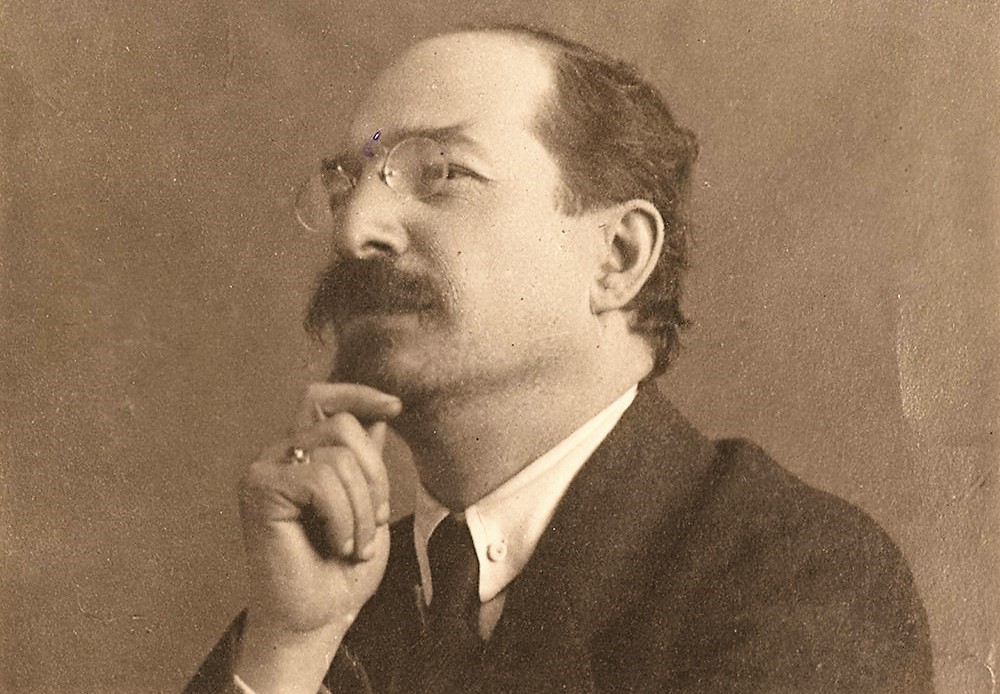
‘The Death of Anatole Lunacharski’ by Nikolai Bukharin from the Daily Worker. Vol. 11 No. 29. February 2, 1934.
FAR away from the proletarian fatherland, in France, Anatole Vasilievich Lunacharski, “the Soviet Ambassador to Spain,” as he will probably be referred to in the foreign press, passed away after a severe illness. The last time I saw Lunacharski with his yellow face of a dying man, death had already laid its fingers on him, although this cheerful “Helene,” who in his life exemplified the magnificent capacities of man still kept up his spirits, proudly held his head jested and laughed with that peculiar ironic, wise laugh which fitted in so well with his entire make-up.
Anatole Vasilievich was one of the most gifted men whom the labor movement of our country has brought to the fore. His was indeed a brilliant talent. He was a man of outstanding artistic abilities. He did not, however, have the iron character, the will-power and perseverance necessary for a true leader of millions.
He did not possess the theoretical profundity, the orthodox spirit and irresistible dialectic logic which distinguishes the true genius of the proletarian Revolution. With a mild artistic character which more than once exhibited fluctuations, Lunacharski never pretended to such a role and his political biography contains a series of truly grave errors. Nevertheless, this fighter of our Party passed through his entire life as one of the noblest knights of the proletarian Revolution and his name will unquestionably enter history as that of a fiery, courageous fighter and enthusiastic builder of socialist culture.
A Generation of Outstanding Revolutionists
Lunacharski belonged to a generation which produced a large number of outstanding figures in the revolutionary labor movement. Almost as a boy he began his underground work, sat in prison, was sent into exile and lived for many years abroad as an emigrant.
In short he passed through a wide schooling in politics and life. He worked among men of such caliber as Lenin and Plekhanov. More than once he held most responsible Party posts in the early stages of the development of Bolshevism.
His splendid militant speeches (his pseudonym was “Voinov,” meaning “warrior”) directed against the Mensheviks, were an excellent complement to the crushing blows of Lenin’s iron logic. Voinov was the reporter on the question of an armed uprising at the Third Congress. He was one of the strong protagonists of Bolshevism at the Stockholm Congress. Voinov-Lunacharski was brilliant publicist and litterateur of militant Bolshevism. But every time that he moved beyond the sphere of influence of Vladimir Ilyich he slipped and sometimes fell very far.
A disciple of Avenarius in philosophy, he passed through a number of intermediate stages. Under the strong influence of A. Bogdanov, he moved from his “Principles of Positivist Esthetics” to his two-volume work “Religion and Socialism,” in which Marx’s scientific Communism was interpreted as a peculiar sort of religion. This tribute to the old idols was immediately stopped short by Lenin. Theoretical mistakes were closely followed by political ones. “God building” and “Forwardism” were two aspects of his deviation which for many years kept Lunacharski out of the main stream of Bolshevism.
Did Not Become Chauvinist
The world War failed to turn Lunacharski into a chauvinist and defensist. A man of vast international culture, he did not betray the position of internationalism. After passing through the wreckage of the July, 1917, days and after seeing the inside of a Menshevist-Social Revolutionary jail, he returned to the fold of the Bolsheviks.
He hesitated in the October days, when the imaginary shells of the Bolshevik guns allegedly destroyed the esthetic beauty of St. Basil and thereby horrified the “Blessed Anatole,” as the leaders of the great battle then jestingly referred to Lunacharski.
AFTER that, however, Lunacharski adopted a firm position. Throughout the Revolution, on all the fronts in the Commissariat of Education and at street meetings, at gatherings of “Komsomols” (Young Communist League) and in circles of authors and artists, in all his multifarious activities, he was a Party poet and writer, one of the most loyal and disciplined of fighters. He fully atoned for his mistakes and blunders.
Lunacharski was universally loved, especially by youth. Vladimir Ilyich forgave him much for he was “devilishly talented.” In the long run his “devilish talent” stood the Revolution in good stead.
“Fascinating,” “Lovable”
As a man, Lunacharski was extraordinarily fascinating and lovable. He was indeed a “Hellene,” if Heine’s terminology may be used. He was full of the “heathen craving for life.” Socialism he interpreted as the unfolding of all the possibilities latent in man, a system making possible a rich and integrated life, with steadily growing demands, with the steadily growing powers of organized humanity.
In Lunacharski, one sees the picture of a hopelessly sick man glorying over new victories on the technical and cultural front. His noble mind and fiery heart responded when he saw thousands upon thousands of new men rising from the new socialist soil. He rejoiced over every forward step of our Party, whose banner he unwaveringly bore throughout the post-October years. He took a vehement part in the battles against the deviations from the Party line.
Anatole Vasilievich has passed away. His loss will be deeply felt by all the builders of and fighters for Communism. His image will remain among us all as that of a bold and daring fighter, full of strength, craving for life and battling for a beautiful life. His was a deep mind and a warm heart. He leaves behind the memory of a poet and scientist, a many-sided personality, much like the bold heroes of the Renaissance. As a Party fighter and builder of socialist education, his name will long be recalled as that of a profound internationalist and ardent lover of toiling humanity.
Proletarian culture has lost a remarkable leader. But proletarian culture lives on.
The Daily Worker began in 1924 and was published in New York City by the Communist Party US and its predecessor organizations. Among the most long-lasting and important left publications in US history, it had a circulation of 35,000 at its peak. The Daily Worker came from The Ohio Socialist, published by the Left Wing-dominated Socialist Party of Ohio in Cleveland from 1917 to November 1919, when it became became The Toiler, paper of the Communist Labor Party. In December 1921 the above-ground Workers Party of America merged the Toiler with the paper Workers Council to found The Worker, which became The Daily Worker beginning January 13, 1924.
PDF of full issue: https://www.marxists.org/history/usa/pubs/dailyworker/1934/v11-n029-feb-02-1934-DW-LOC.pdf

