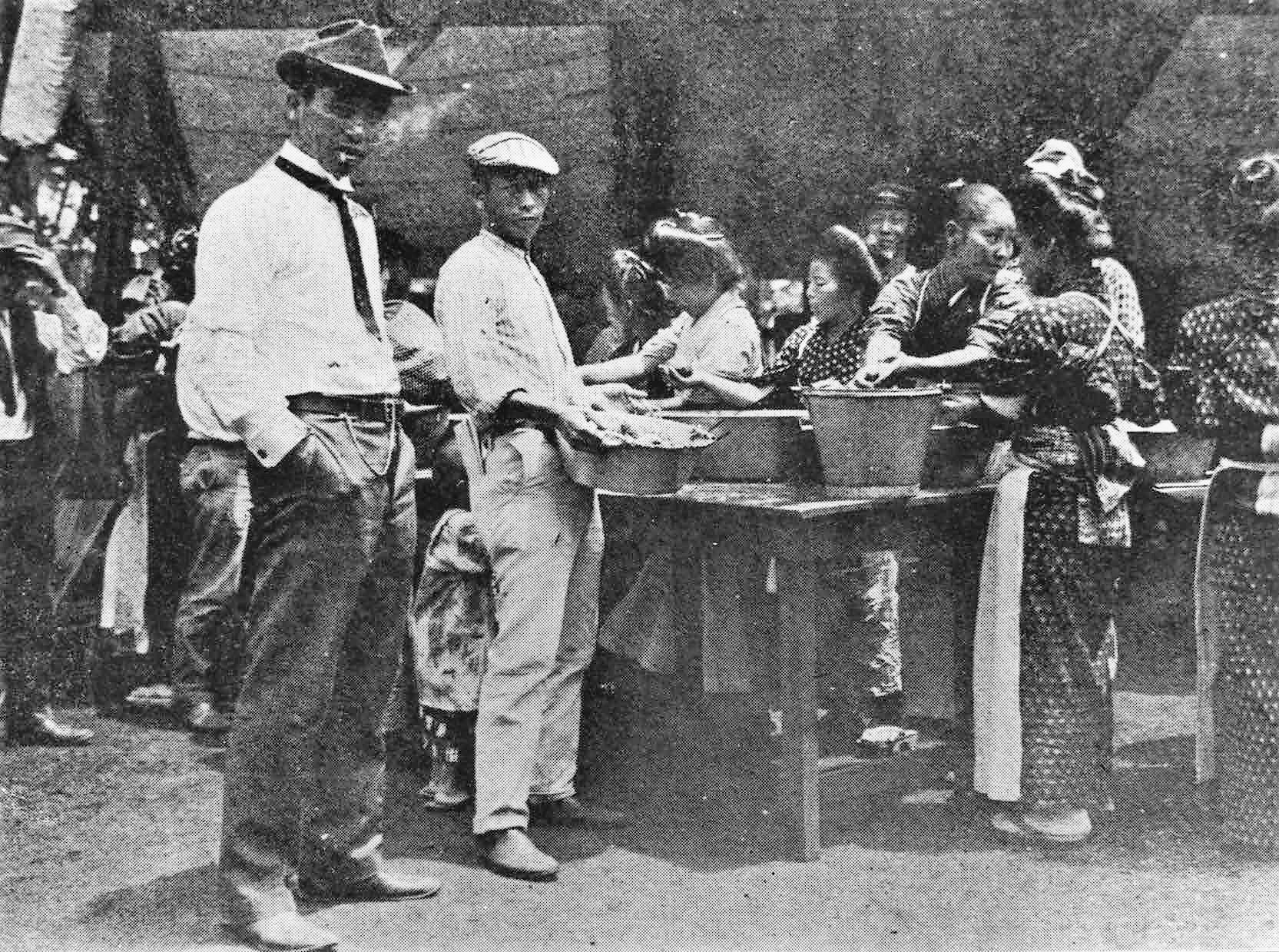
shelters provided for them in Kaka‘ako and Mō‘ili‘ili, Honolulu, Hawai‘i. 1909.
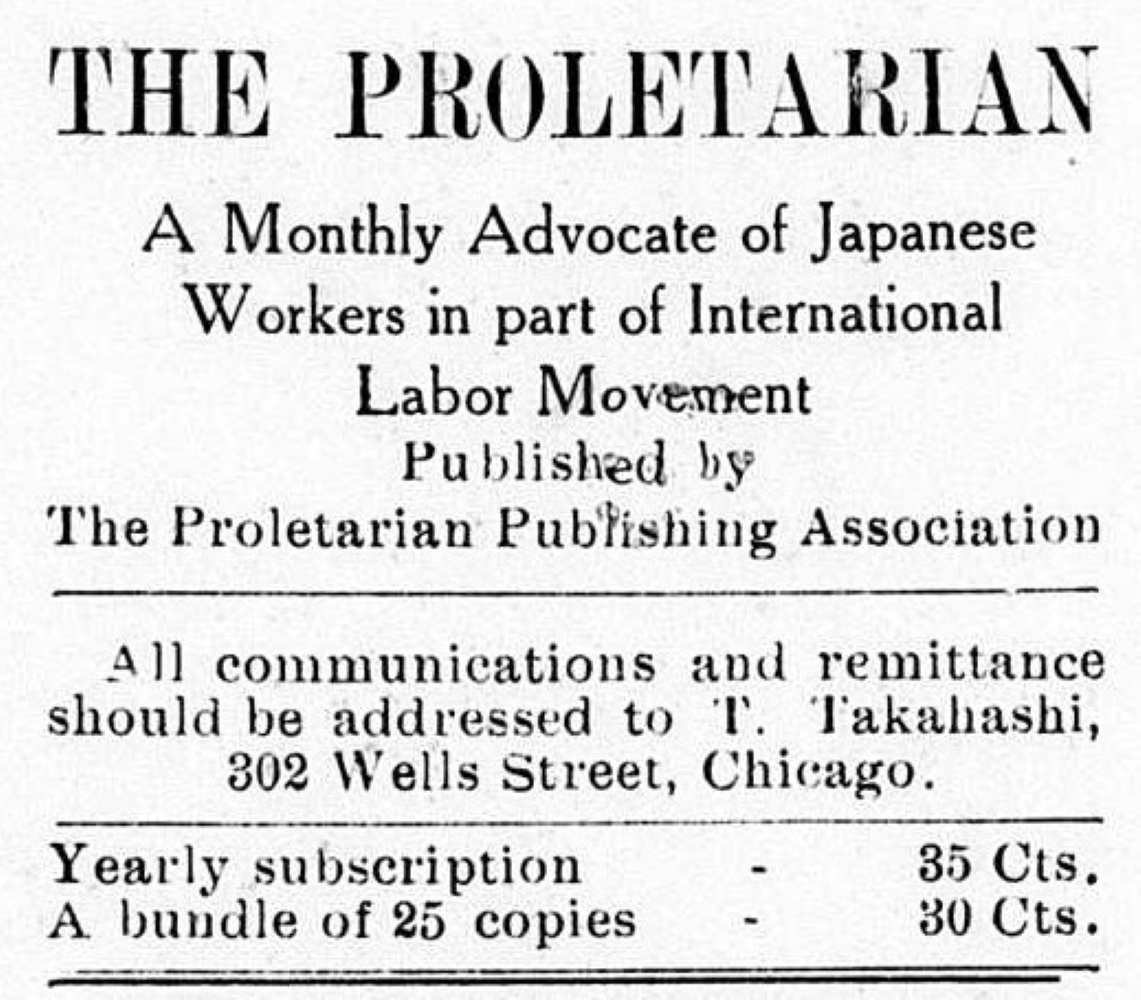
Something of a manifesto, this internationalist plea by Takeshi Takahashi was written for the inaugural issue of ‘The Proletarian,’ published for Japanese members of the I.W.W.. Takahashi describes the condition of Japanese workers in the U.S., repudiates anti-Japanese talking points, denounces the racism of the A.F. of L., the anti-immigrant stance of Socialist Party grandees, and urges white workers to organize with their Japanese fellow-workers in the One Big Union.
‘The Japanese Question’ by Takeshi Takahashi from The Proletarian/プロレタリア(Chicago). No. 1. June 15, 1909.
I speak of this neither from the standpoint of Japanese nor as the representative of a particular nationality, but as a proletarian of the world and one who believes in international unity of the working class.
Yet I shall remain as one among “Jap coolies” on whom the heated discussion is taking place.
Although it is growing rather monotonous to discuss “Japanese exclusion,” still it is very important that this question should be solved.
Such uncertainty should be taken away in order to realize the international brotherhood of the proletariat.
The Japanese question is not a recent problem confronting American workingmen.
Since 1884, following the Chinese exclusion, it has been emphasizing its fierce character year by year.
To hear of racial outrages time after time does not make one so curious.
Recently the action of the California legislature that was a point to prohibit Japanese from holding land and property aroused public sentiment in both countries to such extend that the rumor has been spread on the streets and in the papers about a coming fight between Japan and America in the near future.
What can this be? We must not omit to mention our American socialists who have insisted upon exclusion of Japanese. I cannot pass it by without expressing my observations and views which have for their sole aim the benefiting of the labor movement of America.
Let me take up, first, the principal reasons given for the exclusion theory.
1. Japanese work cheaper than American workers, and in consequence destroy the wage scale of American workers.
2. Japanese act often as scabs while American workers are on strike.
3. Japanese send money home which they earn here.
4. Japanese are part of the yellow race, with different religion and customs. They cannot be desirable citizens of America. They cannot be assimilated with Americans.
The above are the principal statements made against Japanese workers. Whenever the anti-Japanese sentiment is aroused, without a single exception those statements are presented.
We will discuss this matter frankly and widely, thus making the thing clear and distinct.
Now, the first statement, that Japanese work cheap, is absolutely contradicted by the facts.
Japanese work on railroads, in mines and fruits fields in the western states. They get average good wages compared with white workers, of whom a majority are so-called “skilled” laborers, while Japs are “just landed green hands.”
As far as my experience reaches, I can demonstrate clearly many instances against this charge.
As to the second question, “Do Japs scab while white workers are involved in the strike?” I shall not deny the fact that they have acted shamefully in a few cases, but also it must be mentioned that they remained faithful on numberless occasions.
For instance, when that great Pacific coast “Sailors’ Union” strike happened in 1907, in spite of the great effort made by capitalists to get scabs from the Japanese in order to break the strike, they utterly failed.
“Keep all from the boats”–these words passed among Japanese through the medium of press and leaflet, even employment agencies kept themselves from realizing their “interest.”
This objection shows especially the weak point of the anti-Japanese movement.
Are not A.F. of L. men scabbing actually upon Japanese workers?
A protest of union (A.F. of L.) men brought all Japanese workers out of work in certain places and in certain cases.
The “boasted” power of union (A.F. of L.) compelled Japanese workers to accept less wages than the “union scale,’ while the Japanese worker has the same capacity at work, because in the sense that union (A.F. of L.) is supreme.
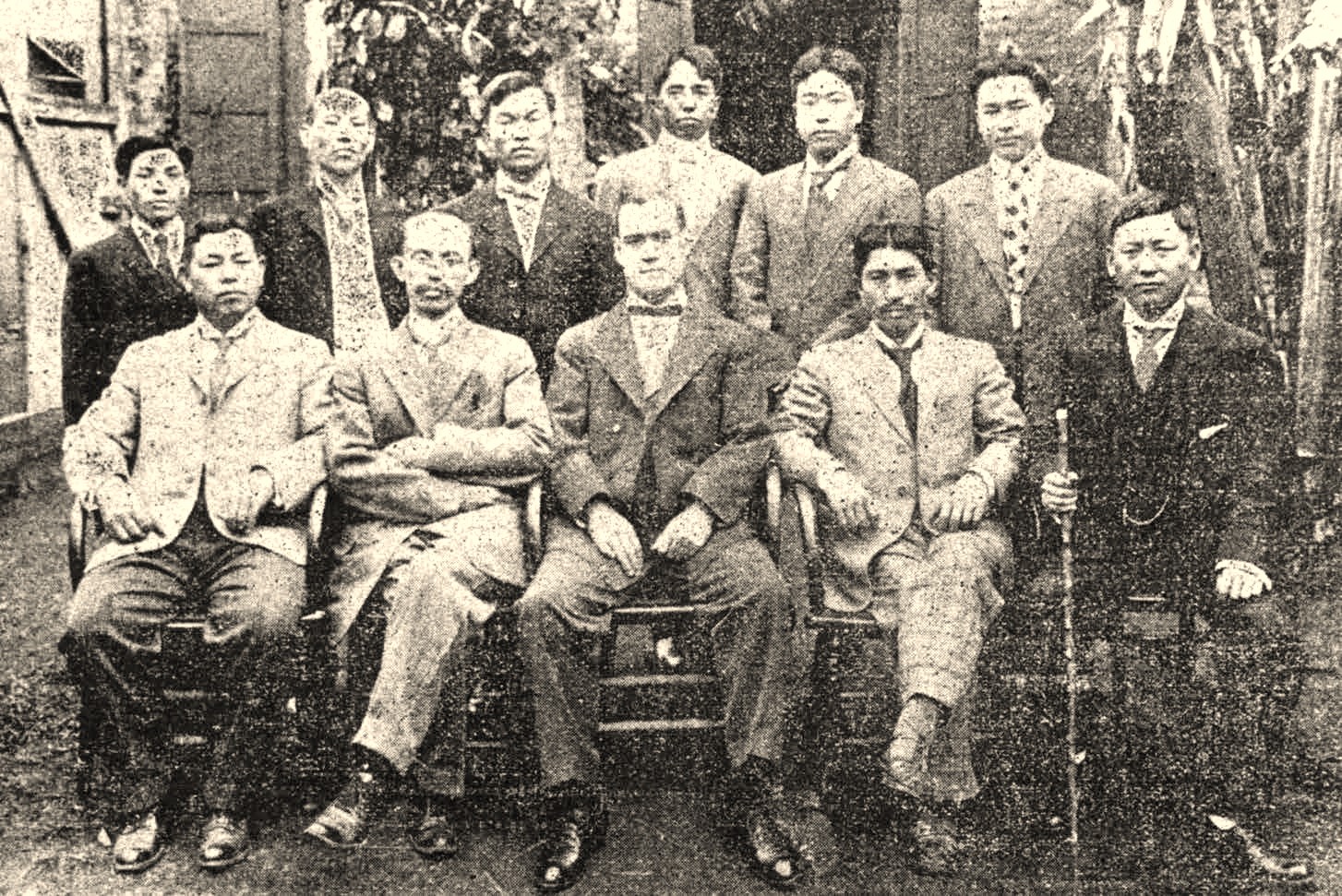
Yasutaro Soga, Kinzaburo Makino, Motoyuki Negoro, Yokiichi Tasaka; back, Yasuyuki
Imai, Tsurumatsu Okumura, Katsuichi Kawamoto, Hidekichi Takemura, Keitaro Kawamura,
Shuichi Ihara. 1909.
After all, in spite of discussion, the scab, unless workers come together in one instead of divided craft unions, or on the basis of petty nationalistic sentiment, will not cease to exist.
The American Federation of Labor blames the Japanese as scabs, and at the same time they act as scabs against Japanese.
Japanese are to be blamed when they scab, but should not be scabbed upon by the group of another nationality. For instance, Japanese in Seattle, Washington, are alarmed over the fall of wages and scarcity of jobs at present, through the invasion of Greek workers into their circle.
I feel that it is ridiculous to reply to the third statement. I am unfortunately not able to show by statistics how much money is sent home annually by Japanese, but, having considered the population and their occupations, it is a very easy matter to figure it out. Exports of American Currency! How flimsy those arguments are! Do they not see the cruel exploitation of American capitalists in the Far East?
Those patriots should sleep soundly when they hear that the American capitalists are easily making silver and gold out of the blood of the yellow race.
They should bow before such capitalists as Rockefeller, who has many oil stocks in Japan and China, and the American Tobacco Trust, which has nearly stamped out the Japanese force from the markets of Manchuria and China.
Japs send money lest their wives and children should come to starve, saving thus a few cents extra in weeks of such hard work, while American capitalists spend millions for luxury in the resorts of Europe.
I wonder why certain peoples are not blamed for such unpatriotic action in “exporting of American currency.”
The fourth attack made on the Japanese is from scanty knowledge of Japan or misunderstanding as to the Japanese.
Notwithstanding Japanese have a different religion and customs, so long as religion and morality develop with capitalism in modern Japan, I see Buddhist morality fading away in the ashes of old Japan. Even Christians, whose infancy in an early period of Japan’s history flashed its nobleness and humanity. now are the chief advocates of the ruling class.
O wonderful specter, Capitalism! It crushed all traditions and customs, religions and moralities.
A peaceful savage native of Turanians was not excepted from invasion by the specter.
Only forty years have passed since the country opened for foreign trade. The people of Japan in that time had two great wars, one with China (1894-95), and lately with Russia (1904-5), and suffered under this specter–capitalism; in other words, poverty and destitution.
Especially, Japanese in this country are most pitiable, not only suffering also from economic oppression, but from the racial persecution which hangs over them.
They can’t be citizens of America: their political rights are denied. They can’t join the union or any other legal organization. Even marriage is not recognized in certain parts.
And the public concludes in the final words: “They can’t be good citizens: they can’t assimilate with Americans and should be excluded.”
I find no words to make further argument.
In concluding these arguments I see that any and all theories of exclusion are standing on the ground of fallacy and powerlessness.
Especially, I denounce the attitude of some American socialists. They claim to be internationalists, and, on the contrary, they are in favor of exclusion of a particular nationality.
What does it mean? Nothing but to prevent the awakening of the Japanese worker and to divide the forces of the working class. By this nothing is exposed but their own weak point, showing the same capitalistic theories and fallacies here.
That they indulge so deeply in politics, which is a monumental delusion of the capitalist system of society, is responsible for how they come to be so degraded from the principles of socialism!
As a matter of fact, Japanese immigrants are reducing in numbers by the strict enforcement of immigration law.
The official records of Washington, D.C., show a reduction in numbers of about 1,300 from June, 1908, to January, 1909.
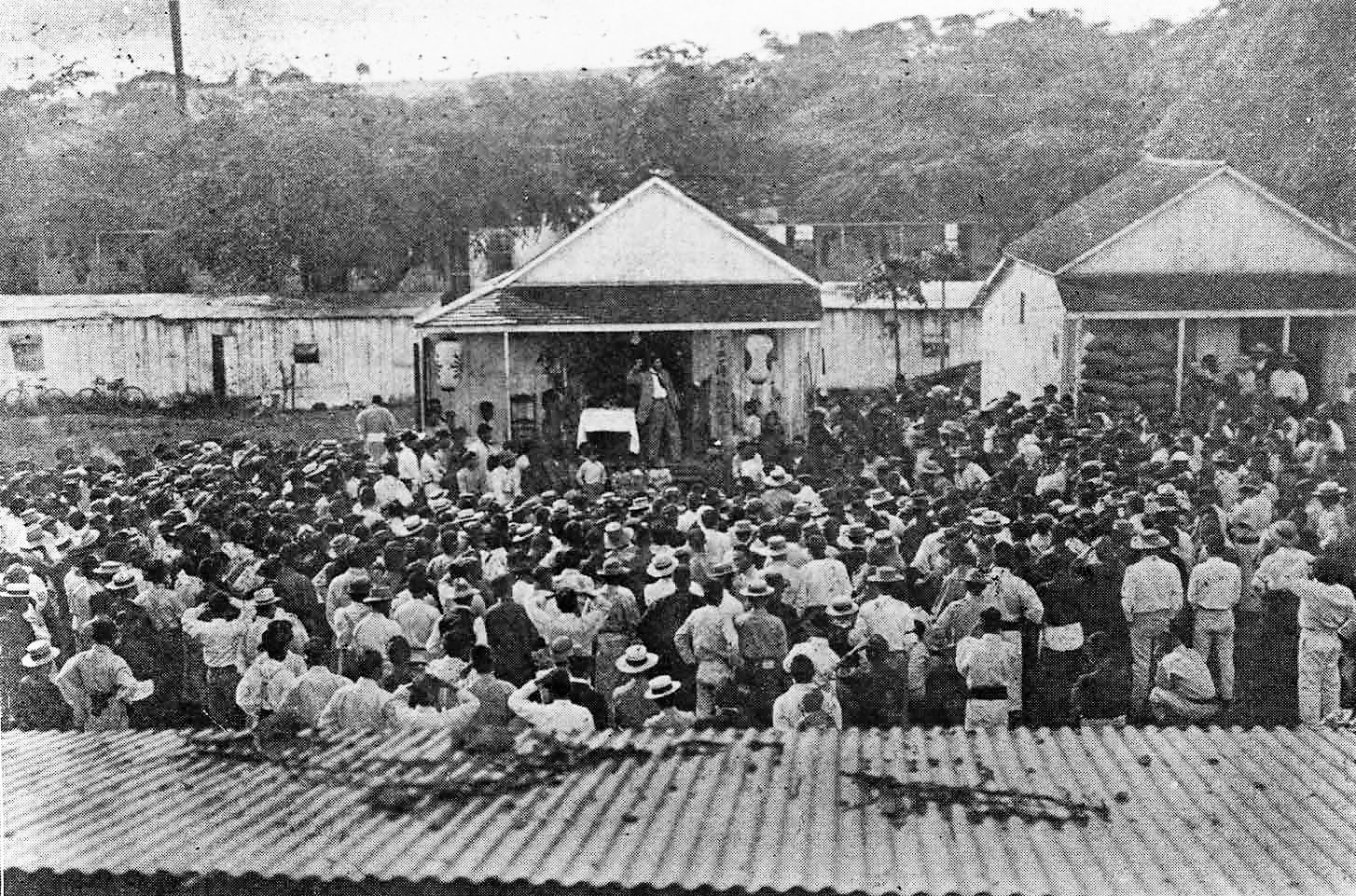
‘Aiea, O‘ahu, Hawai‘i. 1909.
If anyone by this record congratulates himself upon the success of the effort of the anti-Jap movement, it will be a great mistake. If anyone thinks it has solved the problem of race, it will be a great mistake.
I say no! It is only momental phenomena!
Reviews of the social process predict the coming of more Japanese to this continent, notwithstanding efforts of exclusion.
The overpopulation of Japan inevitably compelled her to take up the poli- cy of immigration to other lands. The population has reached over 46,000,000. The average increase of each year is about 45,000. Thus, in a very few years, Japan, the land which is slightly larger than California, will realize Murthusiastic perils.
The last assembly of the Diet passed a bill endorsing the new boat line to South America, assisted by governmental expense. What does it indicate? That “we shall have the same problem on the Japanese question very soon.” However, the trouble may be settled in the western states by governmental negotiations. We can no longer escape facing this problem again unless the proper method is resorted to.
I maintain, here, from a socialistic viewpoint, that to solve this problem permanently there is only one way–industrial unionism. Organize Japanese workers into a union, that is, organized industrially.
Bring them into the American labor movement. This would give them strong impetus to awaken to see the errors of this society, and act directly against any evils which they are suffering today. Put them in the line of march toward emancipation, shoulder to shoulder. There shall be no races nor creeds till we shall possess what we are exploited of.
I earnestly appeal to American comrades to exercise their intelligence sufficiently on this matter, if they think of this problem significantly, for the course of our principle.
Our Japanese workers in this country are rapidly organizing, but along nationality lines. They stand at the psychological moment. Whether they shall take the road of liberty and emancipation, or the road which leads them to narrow patriotism and national pride depends entirely on your attitude shown for this instance.
Do not be short-sighted, but consider the future–not for a locality, but for the interest of the whole working class of the world.
Do you remember, 1904, at Amsterdam, while capitalists of Russia and Japan were fighting in Manchuria like beasts, the workers of both countries had an opportunity to express their true heart to each other through the hands of delegates from both countries. Our French and German workers interchanged cordial messages, when the Kaiser and Clemenceau antagonized each other on the Morocco affair.
Cast off your political hypocrisy for humanity’s sake. Then you will come to one conclusion that you have to shake hands with Japanese workers in our coming revolution!
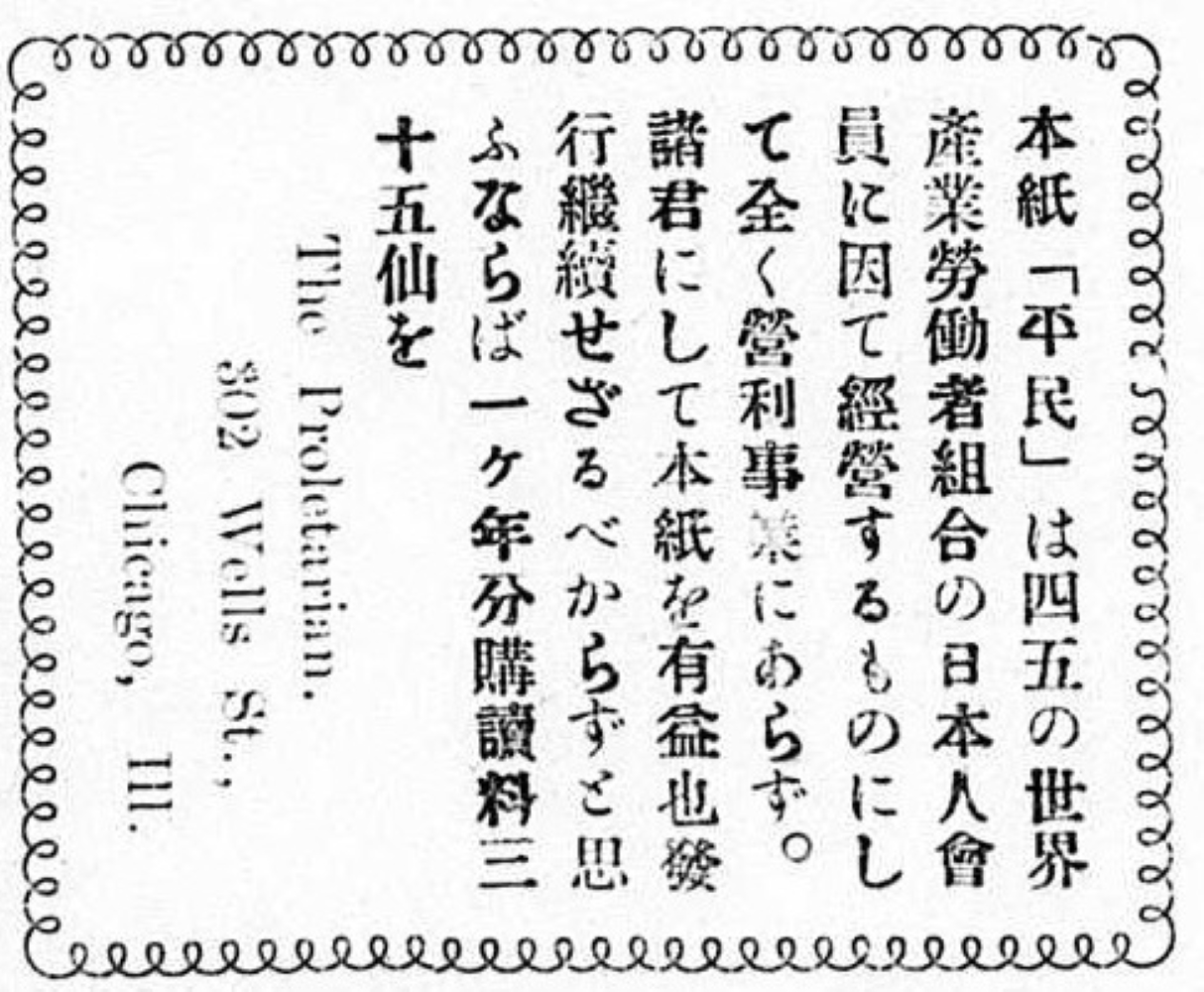
The Proletarian, a bilingual paper published in Chicago by Takeshi Takahashi for ‘Japanese members of the Industrial Workers of the World’, lasted on briefly with a few issues produced in 1909 and 1910. Takeshi came to America as a teenage anarchist, a “disciple of Denjiro Kotoku,” in 1906, and attempted to build a branch of Kotoku’s Socialist Revolutionary Party, established that year in San Francisco. The SRP and the Bay Area I.W.W. held meetings and exchanged papers and by June, 1907 the San Francisco I.W.W. was producing leaflets in Japanese. At the same time, the Socialist Party had passed anti-Asian resolutions in California and nationally. While in Chicago Takahashi’s anarchism developed into anarcho-syndicalism and he joined the I.W.W. in 1907, writing articles about Japanese labor in Hawaii and Japan. With the encouragement of Emma Goldman, Josephine Conger Kaneko and others, he launched The Proletariat in 1909. However it was only to last a year for lack of financial support.
PDF of full issue: https://files.libcom.org/files/The%20Proletarian%20Chicago%20No%201%20June%2015%201909%20English%20Only_0.pdf
 Revolution's Newsstand