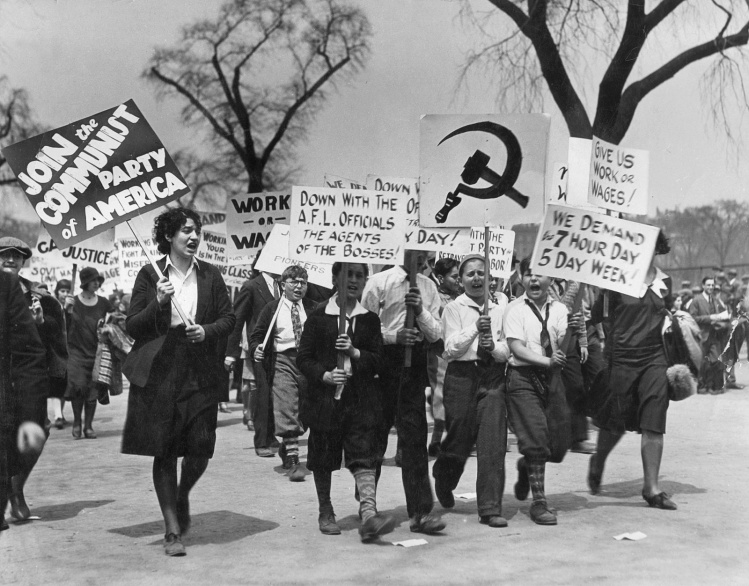
It’s getting to be that time of year, comrades. Communist Party agitprop suggestions for May Day, 1931.
‘How to Organize a May Day Parade’ from the Daily Worker. Vol. 8 No. 99. April 24, 1931.
WHENEVER it is at all possible, on our proletarian holidays and other fighting days, parades, or parades combined with demonstrations, should be organized, rather than just stationary demonstrations. A parade, marching in military formation and discipline, with a band if possible, raises the fighting spirit of the workers to a much higher level than a stationary demonstration. By choosing its route through working class districts, a parade carries the demonstration to the workers, and adds numbers of workers to its ranks as it marches.
More than any other form of demonstration, however, a parade must have the most thorough, detailed preparation.
It is not enough merely to show our numerical strength. We must show our organized and disciplined numerical strength. Therefore, a parade (as well as all other demonstrations and mass meetings) must be made up not of individuals, but of organizations. Every individual starting in the parade must take his place with the mass organization in which he is active (Industrial Union, Unemployed Council, L.S.N.R., etc.). Each organization must have its own banner, signs with its own specific slogans besides the general slogans, and if possible, its own band.
The committee of each organization must come early with the banners and the band to the definite corner at the place of mobilization which has been assigned to them. If possible, the organization should hold a very short meeting in a hall or on a street corner, and then come in a body to the place of mobilization, in trucks with proper decorations, etc., if it possible to secure them.
Each organization must use its own connections with the masses to rally its own sympathizers as well as its members to the parade. (Meetings and house-to-house canvass in its own territory, leaflets and letters to its own contacts, etc.)
Each organization must have a Steering Committee of three, consisting of the best mass leaders in the organization, who shall carry out the instructions of the General Steering Committee, and if it becomes necessary, act on their own initiative. The marchers must be instructed that their Steering Committee are the ones they must follow in case of an emergency. All organizations must take up the question of strict observation of proletarian order and discipline in the parade, demonstration and meetings.
In good time before the date of the parade, the leading committee should apply for a permit; they should find out the regulations as to what size U.S. flag must be carried and other ordinances and in general, they should avoid any conflict over technical details.
The leading committee should mimeograph a map of the line of march beforehand, and distribute it to the organizations, so that the workers can study it. The line of march should be through factory and working class districts.
The march should be 4 or 6 abreast. All marchers keep in step. Keep a distance of 4 feet between each line. Keep several yards between each large organization. For every 10 lines there should be a captain, who marches singly at the side, or in front of the first line.
Workers Defense Corps members should be distributed strategically throughout the parade. They should march at the right or left end of their line. Where the Defense Corps is too weak, each organization should have its own Workers Defense Corps.
As many autos and trucks as possible with signs and decorations should be spaced throughout the parade. Floats, with actors representing in pantomime various phases of the class struggle (lynching, strikes, defense, war, etc.) should be placed on the trucks. Sympathizing artistic organizations (John Reed Club, etc.) can be drawn into this work.
A successful parade constantly increases in numbers. Keeping at least two blocks ahead of the parade, a squad of workers (or possibly pioneers) should go through the workers on the sidewalks, distributing a short leaflet which can be read in 1 minute, urging them to join the parade. As the parade passes factories and workers’ homes, the marchers should wave and call them to come down and join. (There should however, be no shouting “Scab!” or otherwise antagonizing the workers who cannot be persuaded). Workers who join should be absorbed without disrupting the scheme of organization–that is, make new ranks instead of letting the rank get too long. Marchers should adopt the worker who jumps in next to them, lead him in the cheering and singing, propagandize him a little in the rest periods (not with long arguments), stick with him in the meeting later on, and finally get his name and address with all other facts and hand it on to your leading committee afterward. (As for any Party members who may be seen standing on the sidewalk and enjoying the show instead of taking part in the action, their names should be noted, and they should be subjected later to the severest discipline.)
A parade that does not sing and cheer is dead. In their preparatory meetings, the organizations should gather as big a list of proletarian songs as they can and practice them with the membership. The singing in the parade must be organized; the songs must be selected by the Steering Committee, and started by the band. Different ranks must not be singing different songs at the same time. Special detachments of Pioneers may be used as song and cheer leaders.
Besides the singing, fife and drum corps should be organized from Pioneers and Young Workers, as well as accordion players and groups of mouth-organ players. If possible, loud-speaking phonographs, which operate from the generator of a car, should be used with records of the International, etc. In general, when the International is played, it should be sung by the entire parade at one time with all the vigor and respect due to our international revolutionary anthem. Right hand with the fist clenched should be raised when singing the International.
Slogans from a list prepared beforehand should be shouted en masse, in response to a loud speaker if one is available.
The parade should be headed by big red flags. Signs and flags should be distributed throughout the ranks of the organizations, not all bunched in front. Each organization should have at least one streamer sign with two poles, carried at the front, as well as the single-pole signs. There should also be individual letter signs in which each marcher in a column carries one letter of the sign or slogan. All signs should be double-sided so they can be read from behind as well as from the front. All signs should be in English.
The leader of the whole parade should be the General Steering Committee (3 members). They must be the strongest committee it is possible to obtain. They must have their tactics prepared for any emergency that can be foreseen. They must march at the head of the parade. Immediately behind the General Steering Committee should come a row of 6 Pioneers on decorated bicycles, who shall serve as couriers. Their task is to carry instructions to the Organization Steering Committees and bring back reports. Each of the latter committees should also have one Pioneer assigned as courier to carry messages to the General Steering Committee. Every courier must return to his post immediately after delivering his message. Couriers may wear red arm-bands marked “Courier.” This system of couriers is essential. Captains and members of Steering Committees must not leave their own forces under any conditions. The couriers may also be organized on a basis of relays, each one passing the message along to the next, and then returning to his post.
Literature as well as May Day buttons, pennants, etc., must be sold in an organized fashion, by a large force assigned by the leading committee, which shall cover the sidewalks as the parade goes past. The number of workers assigned to sell each publication shall depend on the main political questions at the time, and the composition of the workers in the city. The Daily Worker, of course, comes first.
Every parade must have a definite objective. It should not just go on until it fades away. It should proceed to a definite square or hall, where a meeting should be held. The scheme of organization must not be broken at the meeting, the marchers becoming an unorganized mass. On the contrary, the same organized groups, captains, steering committees, organized cheering, etc., must be kept up.
The Daily Worker began in 1924 and was published in New York City by the Communist Party US and its predecessor organizations. Among the most long-lasting and important left publications in US history, it had a circulation of 35,000 at its peak. The Daily Worker came from The Ohio Socialist, published by the Left Wing-dominated Socialist Party of Ohio in Cleveland from 1917 to November 1919, when it became became The Toiler, paper of the Communist Labor Party. In December 1921 the above-ground Workers Party of America merged the Toiler with the paper Workers Council to found The Worker, which became The Daily Worker beginning January 13, 1924.
PDF of full issue: https://www.marxists.org/history/usa/pubs/dailyworker/1931/v08-n099-NY-apr-24-1931-DW-LOC.pdf
 Revolution's Newsstand