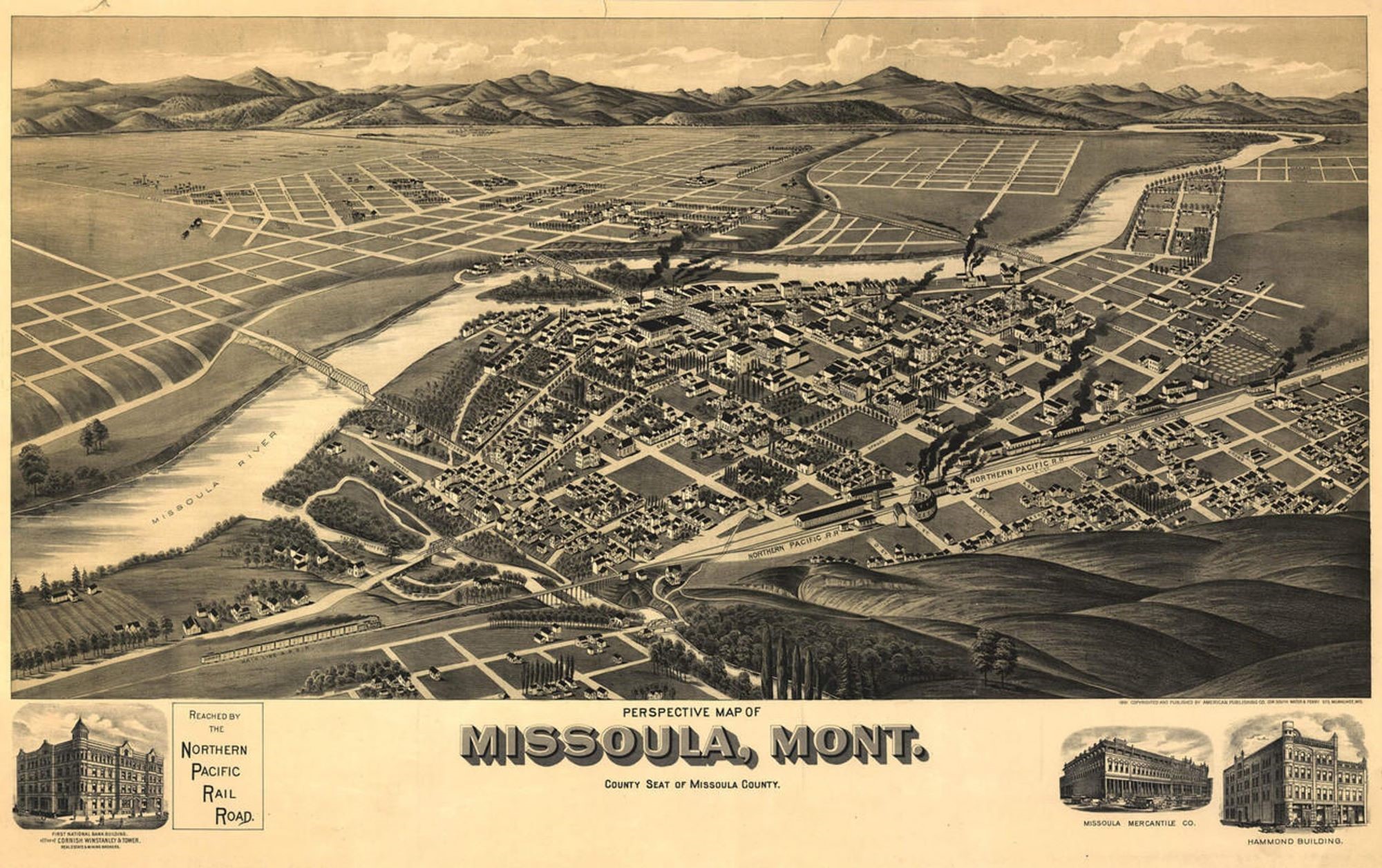
A report on life in the logging and mining jungles around Missoula, Montana.
‘Conditions In and About Missoula’ from the Industrial Worker. Vol. 2 No. 43. January 12, 1911.
Floaters come and go through here almost daily. Some stop at the headquarters, tell their tale of woe and pass on looking and hoping to get in some place where they can get a job. A fruitless search. So monotonous are the reports brought in that one can sum up the entire labor conditions of this entire section.
“We find hundreds of men everywhere on the lookout for work and hiking on and on, hoping and searching still,” they tell our secretary. Those from the west say there is almost an endless chain of them extending from here to Spokane. The camps are full. The living conditions in the camps are proportionate to the meekness and servility of the slaves. The wages in places have lowered as at the Avery tunnel, where the St. P. & M. now pays 20 cents an hour for nine hours. Even the workers in Berger’s Milwaukee have heard of this job. A dozen passed through, having come all that distance to work on that job.
At St. Regis there are several logging camps in operation. I.W.W. men are not wanted. The conditions of. some of the camps are abominable and a majority of the workers are said to be mentally hoosierfied or artful at stool-pigeon tactics.
The work in the Flathead reservation on the irrigation project has about closed for the season. There is some work going on at Post Creek, $1 trip by stage from Ravalli. The boss, McDonald, is reported to be civilized. A sawmill turning out 5,000 feet of lumber per day will soon open up; wages $2.50; board $5.25; hospital fee $1.
In Missoula the masters have gone into their annual winter’s hibernation, while the slaves to the extent of 400 are exceedingly alive, looking for flops and coffee and
Here and there a Dakotan servile semi-sucker is put upon the sewer, but mostly because the A.F. of L. needs his initiation fee. The Kennedy Construction Company, in charge of this work, ofttimes puts on new men, retains them long enough to get that fee for the A.F. of L. and then fires them.
In the Bitter Root valley everything is flat for slaves. The Blackfoot Lumber Company is laying off their men now, so that they can blow in over the holidays and become more servile thereafter. Otherwise from Missoula to Butte it is the same old story; what’s the use of repeating it?
The winter is on and as result the active members of the I.W.W. are somewhat handicapped in their educational and agitation activities upon the job. The idle men everywhere bring home this fact. We must first of all fight like h-l for the eight-hour day. In doing this, we must consider tactics now to that end and knock out of our noodles all philosophical dope. Likewise instead of retrograding into obnoxious chair-warming freaks without concrete sense or usefulness to the organization, let us consider that which is above all most important to achieve in our first round with the boss. Of what value is a thing that wears out the seat of his pants and the chair, plays cards, philosophizes, etc., and indulges in pink-tea conversation on how we will secure automobiles take first-class trips to foreign countries and build rules, regulations and laws for the future co-operative commonwealth, is physically too lazy to rustle a job and fight practically, but continues to pour out his mental slop in business meetings or to live on active I.W.W. men who have just drifted in from a job with a stake, and then in their silly, sizzerino activity often bum those same men for a coffee and sinker? Away with such. poke in the jaw, a boot in the back is the best direct action we could use upon these useless “ornaments,” who insist upon forcing their cheap “gush” down the throats of useful members.
Let us be practical. Local No. 40 is having 5,000 stickers printed for the purpose of bringing the shorter work day to the attention of the wage slave. Any fellow worker of Local No. 40 out on the job should order a supply of these, and stick them up in prominent places where they can be read. Up with the eight-hour day; down with the boss. All boost it.
JAS. B. SHEA, B. F. KRUSE,
Press Committee, Local No. 40.
The Industrial Union Bulletin, and the Industrial Worker were newspapers published by the Industrial Workers of the World (IWW) from 1907 until 1913. First printed in Joliet, Illinois, IUB incorporated The Voice of Labor, the newspaper of the American Labor Union which had joined the IWW, and another IWW affiliate, International Metal Worker.The Trautmann-DeLeon faction issued its weekly from March 1907. Soon after, De Leon would be expelled and Trautmann would continue IUB until March 1909. It was edited by A. S. Edwards. 1909, production moved to Spokane, Washington and became The Industrial Worker, “the voice of revolutionary industrial unionism.”
PDF of full issue: https://www.marxists.org/history/usa/pubs/industrialworker/iw/v2n43-w95-jan-12-1911-IW.pdf

