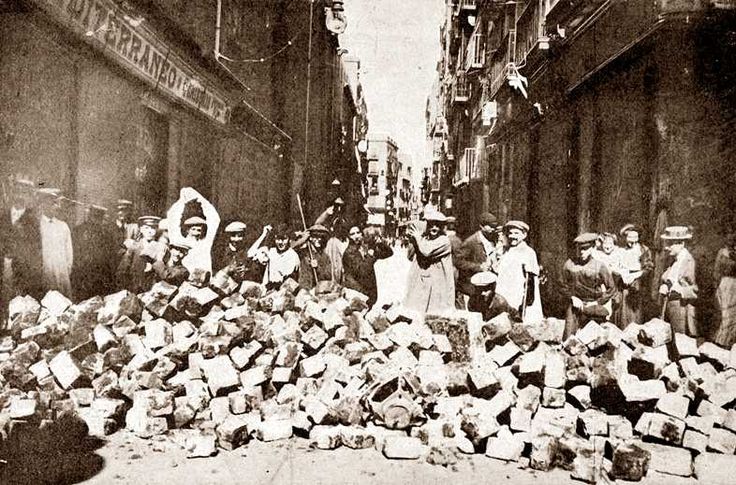
In the aftermath of the 1909 rebellion in Spain, la Setmana Tràgica (The Tragic Week) and subsequent execution of Francisco Ferrer a gathering of U.S. radicals with speeches in six languages was held in solidarity at New York’s Cooper Union.
‘Mass Meeting for the Spanish Revolution’ from the New York Call. Vol. 3 No. 21. January 21, 1910.
Speakers at Cooper Union Show Necessity tor International Action Against Autocracy.
Speakers in six languages addressed an international mass meeting in behalf of the victims of the Spanish reaction at Cooper Union last night, under the auspices of the Spanish Pro-Revolution Committee, a committee of Spanish refugees and workingmen, organized as a branch of the revolutionary committee with headquarters in Paris, for the purpose of raising funds to aid the Spanish revolutionists against the Spanish autocracy.
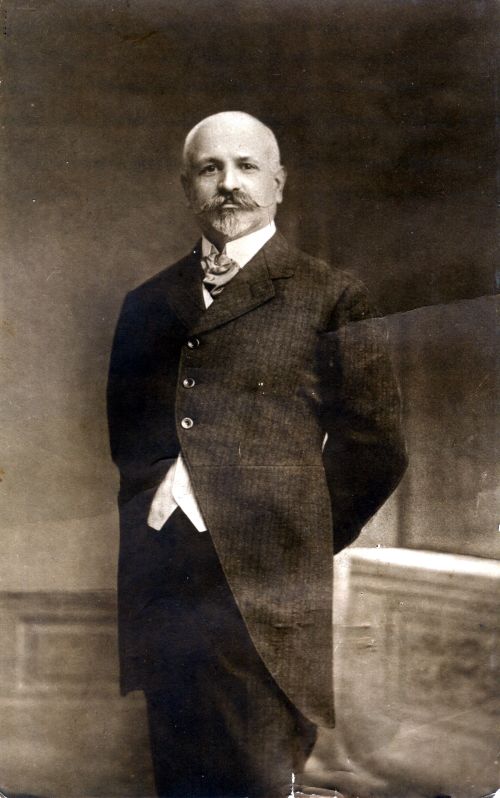
The hall was about two-thirds filled, but the audience made up in enthusiasm for what it lacked in numbers Socialism was represented by Leonard D. Abbott, who acted as chairman, and A. M. Giovannitti, of the Italian Socialist Federation; the Single Tax movement by D.F. Darling and Bolton Hall, lawyers; the anarchists by Michel Dumas in French, August Lott in German, and Herman Michailowitz in Yiddish, and the Spanish revolutionists by James Vidal, ex-secretary of the Barcelona Trades Council, who was, himself imprisoned during the Spanish uprisings and who was a friend of Francisco Ferrer, the martyred educator of the Spanish people. Leonard Abbott pointed out that Ferrer’s schools were still closed, that his property had been confiscated and his teachers imprisoned, and that the Spanish despotism had prohibited discussion of the movement that had been started for a revision of Ferrer’s trial, while. hundreds of prisoners were still confined in the dungeons of Montjuich and other Spanish fortresses.
In Europe, said Abbott, an international agitation had been started by friends of liberty and enlightenment, for the reopening of the schools of the great educator and their restoration to their proper trustees, and it was high time for the progressive elements in America to join In this movement.
Abbott related authenticated cases of the planting of bombs by the Spanish police in order that they might produce “evidence” against the revolutionists and pointed out that the notorious butcher, General Weyler, of Cuban reconcentrado fame, was now enthroned in Barcelona, and his atrocities were allowed to pass without protest or comment by the American politicians, who were moved to interfere in Cuba when a chance for profitable markets was involved.
Monuments were to be erected to Ferrer in Brussels, Paris and Rome, he said, while America remained in- different. For the monument in Brussels 10,000 francs had already been collected, and such intellectual leaders of Europe as Bjornson, the famous Scandinavian author; George Brandes, the celebrated critic, and Ernst Haeckel, the great scientist, were actively interested in these memorials, while in America Lester F. Ward, the sociologist, was the only Iman of intellectual eminence who had vigorously championed Ferrer’s memory.
In this country, said Abbott, the persecution of Carlo De Fornaro for his exposure of Mexican tyranny, the crushing of free speech in Spokane, and the suppression of Emma Goldman in numerous cities, showed that the same fight for freedom had to be made everywhere and that Americans had no reason to pride themselves on their own institutions while denouncing tyranny in other countries. Joseph Darling declared that Americans who were true to the principles of liberty should be just as much interested in free speech in Barcelona as in New York, and that when they protested against tyranny there they were saying two words for themselves for every one said for there.
Darling said that 200 out of 400 deputies in the Spanish Cortes were returned fraudulently, continued:
“Along the walls of many Spanish fortresses there is a long gray line just the height of a man’s heart. If you should walk up to this gray line and examine it you would find that you could pick off flakes of lead–lead from flattened bullets that went through the hearts of patriots who were lined up against the wall of the fortress and shot for trying to emancipate their people, just as Ferrer was shot for trying to educate them. James Vidal spoke in both English and Spanish. The former language is difficult for him, but his eagerness to tell his American Comrades at first hand of Spanish conditions overcame all obstacles and his fiery words were doubly impressive for this attempt.
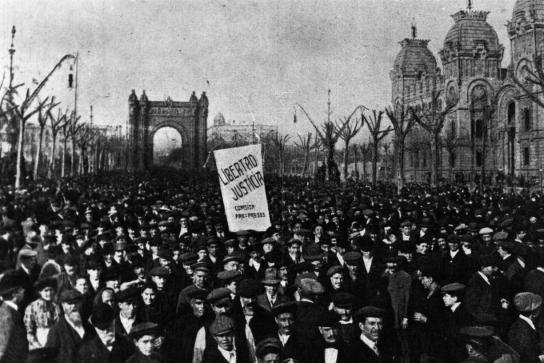
He said that the working people of America, must render the same assistance to the revolutionists of Spain as they do to those of Russia. In defense of the forcible uprising of the Spanish people, he said that they had learned that a handful of force was worth a bagful of rights. He denounced the hypocrisy of the Spanish priests, declaring amidst tremendous applause.
Those who rob and kill come to us with their Christ, but we say: To hell with your Christ! If you believed in his principles you would not oppress and torture us. You are hypocrites, and it is we, the working people, the revolutionists who stand for the peace and harmony that you talk of.”
Bolton Hall said that the old saying. “the truth shall make you free,” was right, but we must first make the truth free, and it is that that Ferrer and the Spanish revolutionists were fighting to do.
The New York Call was the first English-language Socialist daily paper in New York City and the second in the US after the Chicago Daily Socialist. The paper was the center of the Socialist Party and under the influence of Morris Hillquit, Charles Ervin, Julius Gerber, and William Butscher. The paper was opposed to World War One, and, unsurprising given the era’s fluidity, ambivalent on the Russian Revolution even after the expulsion of the SP’s Left Wing. The paper is an invaluable resource for information on the city’s workers movement and history and one of the most important papers in the history of US socialism. The paper ran from 1908 until 1923.
PDF of full issue: https://www.marxists.org/history/usa/pubs/the-new-york-call/1910/100121-newyorkcall-v03n021.pdf

