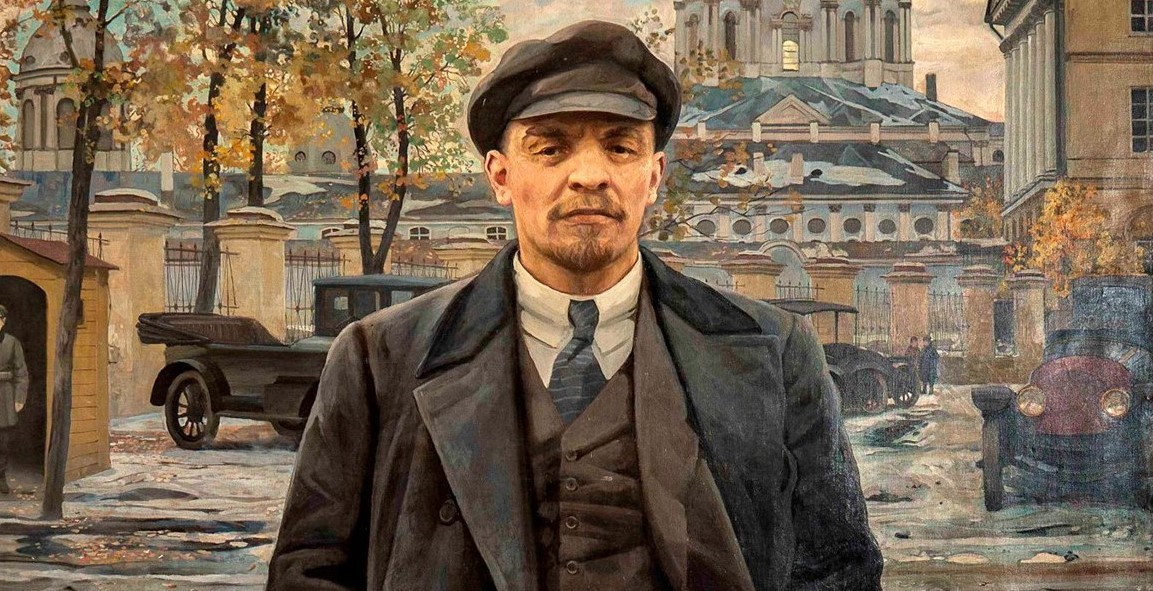
Lenin’s final speech to a Party Congress, complete and in its original translation. The political report of the Central Committee to the Congress given after the conclusion of the Civil War and a year into the New Economic Policy. Lenin analyses the first year of the N.E.P., considers strengths, weaknesses, and offers immediate tasks.
‘Speech of Comrade Lenin at the 11th Congress of the Communist Party of Russia’ from International Press Correspondence. Vol. 2 No. 36. May 12, 1922.
The Genoa Conference.
Allow me to commence the political report of the Central Committee not with the beginning but with the end of the year. Genoa is at present the most actual political question.
You are all of you generally informed with regard to this as the Press has devoted a good deal of space to it, in my opinion too much space, whereby the practical and urgent interests of our reconstruction, in particular of economic reconstruction, have been neglected.
I may say that we in the Central Committee have adopted every measure in order to form a delegation of our best diplomats. We have worked out in the Central Committee the exact instructions for our diplomats who have gone to Genoa. The question at issue is, I will not say a war question, because that word is liable to be misunderstood a question of a racing contest. There exists a very strong tendency to hinder the holding of the Genoa Conference. There are tendencies which want it to take place at any price. These tendencies are at present victorious. Finally in all the bourgeois countries there is a tendency that one could describe as pacifist and with which one can associate the 2 and 21⁄2 Internationals. These are bourgeois tendencies which seek to carry out a series of pacifist proposals. We as Communists have definite points of view with regard to this pacifism. It is altogether superfluous to expound them here. It is at any rate a matter of course that we are going to Genoa not as Communists but as business people. We must negotiate and they must negotiate. We wish to negotiate to our advantage and they to theirs. How the contest will turn out will depend–if only to a limited extent–upon the skillfulness of our diplomats. Although we go to Genoa as business people we are of course not for a moment indifferent as to whom we have to deal with: with those representatives of the bourgeoisie who are inclined to the military solution of the problem, or with those representatives who incline to pacifism; be it as bad as you like, and unable to stand the least criticism from the Communist point of view. The business man who could not grasp this difference and shape his tactics accordingly, would be a very poor business man.
We are going to Genoa for the practical purpose of in- creasing trade and creating favourable conditions for it, without making ourselves responsible for the success of the Conference. It would be ridiculous and absurd to vouch for that. I can say, taking the most sober and clear-sighted view of the prospects of Genoa and without exaggeration, that we shall carry out this plan. We shall do this provided those with whom we have to negotiate in Genoa are sufficiently reasonable and not all too obstinate. We shall carry out our aim without Genoa, if they should persist in their obstinacy, because the most urgent practical pressing interests of the capitalist powers which have sharply arisen in the last year require this. Since such interests exist it is possible that there will be disputes, that there will be divergences on various points, it is even very probable that it will be necessary to diverge, and yet this fundamental economic necessity will itself finally force a way. I believe with regard to this we can remain quite calm. I cannot say in what time, I cannot answer for the result. But one can say with tolerable certainty in this meeting that appropriate trade connections between the Soviet Republic and the remaining capitalist world will inevitably develop further. I shall mention later on in my speech what interruptions are possible with regard to this.
I restrict myself to this statement in the conviction that our greatest difficulties do not lie in this direction. Our party will not turn its chief attention to this question. The European capitalist Press intentionally exaggerates and magnifies the importance of this conference in order, as usual, to delude the working masses. We have allowed ourselves to be influenced somewhat by this Press and have made more fuss than the circumstances warrant. For Communists, particularly for us for those of us who have passed through such serious years as 1917 and the following, Genoa in itself presents us with no great difficulty. I do not recollect that any quarrels or differences have arisen in the Central Committee or even in the Party over this question. This was natural as there was nothing which one could quarrel over from a Communist standpoint, even when one takes into consideration the various shades of Communist opinion. We are going to Genoa I repeat in order to obtain, as business people, the most favorable conditions for the development of trade, which has already begun, which will be carried on further, and which, should anyone succeed in forcibly interrupting it for a space of time, will nevertheless inevitably continue to develop.
The New Economic Policy.
Limiting myself to these few observations on the Genoa question I proceed to questions which, in my opinion are the most important for the past and future years. It seems to me, or at least I have this habit that in the political reports of the Central Committee, not merely the happenings of the past year, but also the most fundamental and essential political lessons of the past year, should be dealt with in order to conduct a right policy in the future and to learn something thereby. The new economic policy is of course the most important problem. If we have in the past year made any kind of considerable and earnest achievement which cannot be taken from us (it seems to me not beyond doubt that we have) that is that we have learnt something from this new economic policy. The events of the future will probably prove whether we have actually learned something and how much.
It seems to me that in dealing with the problem of the new economic policy one must bear in mind the following three fundamental points.
First. The new economic policy is of importance to us as a test of how far we have actually gained the collaboration of the peasantry. We were not able to give sufficient thought to this in the previous epoch in the development of our revolution, as our attention and strength were chiefly devoted to the task of repelling the invasion, etc., and were absorbed by it. The change to the new economic policy was decided upon at the previous Congress with extraordinary unanimity.
This unanimity showed that the new way to Socialist system was an absolute necessity. People who disagreed on many questions, who regarded the situation from various points of view, came without hesitation very quickly to the view that as yet we had no definitely ordered way to the Socialist commonwealth and that the new economic policy was the only possibility of finding this way. In consequence of the development of military and political events, in consequence of the development of capitalism in the old cultural West and changed social and political conditions in the colonies, we were obliged to make the first breach in the old capitalist world at a moment when our country was economically, if not the most backward, yet one of the most backward. The overwhelming majority of the peasantry in our country carried on only very small individual enterprises. The realization of that part of our program of the Communist Society which we could immediately carry out was undertaken to a certain degree apart from what was taking place in the broad masses of the peasants, on whom we laid the heaviest liabilities which were justified by the necessity of carrying on the war. This justification was on the whole accepted by the peasantry. The peasant masses had perceived and understood that this tremendous burden which was placed upon them was necessary in order to defend the Workers’ and Peasants’ Government against the great landowners and to avoid being throttled by the invasion which threatened to destroy all the gains of the revolution. But there was no interdependence between the economic system which was being built up in the nationalized and socialized factories, workshops and Soviet enterprises and the peasantry. We had seen this clear enough at the previous Party Congress. This was so evident that there was no doubt in the Party regarding the inevitability of the new economic policy. It is amusing to read in the organs of the various Russian Parties abroad that the Left Wing Communists are up to the present time opposed to the economic policy. They call to mind in 1921 what was the case in 1918, and what the Left Wing Communists themselves have long forgotten, and chew this over until today in order to assure themselves that the Bolsheviks are concealing differences in their ranks from the eyes of Europe. As we read this we think: let them be mistaken. We know that there were no differences among us. There could be none, for the practical necessity for another means of setting up the fundamentals of the Socialist system was clear to everyone.
The new economy we endeavored to create had no connection with the peasant economy. Is this the case at present? No, we are moving in this direction. The whole importance of the new economic policy, which is sought for in our Press everywhere but where it happens to be, consists in the following: by the new economic policy which we are shaping with enormous labors we are realizing collaboration with the peasantry. This is our merit without which we should not be revolutionary Communists. We have begun to construct the new system on perfectly new lines without regard to the old methods. Had we not entered upon this new policy we should have been overthrown in the first few months.
We have said from the beginning that we must start a tremendous new labor. If our comrade workers in the more developed capitalist countries do not quickly come to our aid our work will be rendered enormously difficult and we will without doubt commit a number of errors. The chief point is this: we must be able to calmly consider where and what mistakes have been committed and build anew. If we have to rebuild our work not once or twice but several times, it will but show that we approach our task, the greatest task in the world, with calmness and without prejudice. One must always bear in mind that the fundamental decisive task of the new economic policy, to which everything must be subordinated, is the setting up of the collaboration of the new economy with the ordinary peasant economy of the masses, under which millions and millions of peasants are living. This collaboration did not exist and it had therefore to be created. Everything had to be subordinated to this idea.
We base our economic policy upon collaboration with the peasantry. We have to change it several times and to organize in such a way that a collaboration of our Socialist work in the big industries and in agriculture is established with that work which the peasant is doing and which he carries on as he understands it. It is our task to make this collaboration evident and to see to it that the whole masses of the peasantry are aware that there is a connection between their present hard, miserable painful and beggerly existence, and the work which is being conducted under the inspiration of far-reaching Socialist ideals. Our task is to help them. The simple average man understands that he owes to us certain improvements in his situation and in more than one respect, but not as was the case with a few peasants during the period of the rule of the great landlord and capitalists, in a period when every amelioration–there were doubtless improvements, even great improvements–was bound up with contempt for, with the degradation of the peasant, and with the violation of the masses, which no peasant has forgotten and no peasant in Russia will forget for decades. Our aim is to establish such a collaboration, to prove to the peasants by acts that we are beginning with that which can be understood by him and which is obtainable by him in spite of his deepest poverty and not with something far off and fantastic from the peasant point of view; that we can help him, that Communism is actually helping him, the ruined, impoverished, painfully starving small peasant in his hard situation. It is absolutely unavoidable that either we prove this to him or that he consigns us to the devil.
That is the significance of the new economic policy. That is the basis of everything and this circumstance is our chief lesson in the application of the new economic policy in the whole of the preceding years and it may be said our chief rule for next year.
The peasants are granting us credit, but this credit cannot be inexhaustible. This you must know, and although we have got credit we have to expedite things. We are inevitably approaching the testing time and this will finally decide the fate of the new economic policy and of Communist rule in Russia.
Not the historical point of view interests us but our immediate work. It is of interest to us whether we shall be able to achieve it or not. Will the new economic policy be of service to us or not, will this retreat prove to be right? Shall we succeed, after having gone back together with the peasant masses, in marching forward together with them a hundred times more slowly, but firmly and without deviation so that they always see that we are marching forward? If so we shall absolutely win and no power in the world can defeat us. Up to now in the first year we have not reached this. This fact must be frankly stated and I am firmly convinced (our new economic policy allows us to draw this conclusion) that we shall solve the problem if we grasp the whole enormous danger that is involved in the new economic policy and if we direct our forces to the weakest point. To get into close connection with the average working peasant, to begin to go forward with him much more slowly than we had hoped, but in such a way that the whole mass is really moving on with us, this means to achieve what we at present cannot expect. According to my view, this is the first fundamental political lesson of the new economic policy.
The Contest.
The second more special lesson is the trial contest be- tween the state and the capitalist undertakings. At present there is springing up in our country the “mixed” enterprises–I shall later on speak about them–which are, like our whole state commerce and our whole new economic policy, the application of commercial methods by us Communists. They also have the significance that here there is taking place a practical contest between the capitalist methods and our methods.
Up to now we have drafted programs and made promises. At the time was absolutely necessary. Without a program and without promises we could not start the World Revolution. The White Guards, among them the Mensheviks, are blaming us for it. But this only shows that the Mensheviks and the Socialists of the 2nd and 2 1⁄2 International have no idea how revolutions arise. We could not start in any other way than this.
But at present things are come to this pass, that we have to secure earnest control over our work, not such a control as the Control Institutions, be these Control Institutions in the Soviet System or in the Party system an almost ideal controlling apparatus. We do not need them, but such a control as is necessary from the point of view of mass economy.
The capitalist could provide. He did it badly, in a predatory way, he injured us and plundered us. The simple workers and peasants, who do not know what Communism is, realize this.
But the capitalist could however provide; can you provide? Such questions arose last Spring. They have not always been distinctly heard, but they were the reason for the whole crisis last Spring. “You are excellent people, but you cannot achieve the economic task you have undertaken”. This is the most simple but the deadliest criticism which was levelled by the peasantry last year and by a large number of workers against the Communist Party. Therefore the second point of the question of the new policy acquires such an importance.
We need a real control. The capitalist works alongside of us: his methods are robbery, he takes profit. And you? You are attempting the work in a new way, you have painted the most beautiful ideals so that you are saints and are already equipped for Paradise, but can you do the work? An examination, a real examination, is necessary, but not such an examination as investigation and censure, by the Central Control Commission, which is then punished by the All-Russian Central Executive. Committee. No, a real examination from the point of view of national economy is necessary. The Communists have received several extensions of time. They have been allowed such a credit as has been granted to no other Government. It is true that the Communists have helped the peasants to emancipate themselves from the capitalists and great landowners. The peasantry appreciates that and has prolonged the time of payment but only to a certain date and then comes presentation. They will ask us, “Can you at least carry on the economic life as others?”
This is the first lesson, the chief portion of the political report of the Central Committee. We cannot manage. This has been proved this year. I should like very much to illustrate it by an example of the “Gostrest” (shortened form of Gosudarstvennyi Trest–State trust).
I am sorry to say that owing to a number of reasons and in a great measure in consequence of my illness I could not prepare my speech and I must limit myself to express my conviction which is based upon the observation of facts. We have this year clearly proved that we cannot manage. This is the fundamental lesson. Had all responsible Communist workers clearly understood that they are not able to manage and that they have to learn it from the beginning, we should have won the game. According to my view this is the fundamental and most essential conclusion. But they do not perceive this and are convinced that those who think thus are “uncultivated people. They have not sufficiently learned Communism. Perhaps they will learn and understand it”. No. I beg your pardon, that is not the point–that the peasant, the non-party worker who has not learned Communism cannot appreciate it but the times are passed when it was necessary to drawn up programs and to appeal to the people to execute them. These times are past. Now it is necessary to show that you are able in the present difficult situation to give practical help to the economy of the workers and peasants, in order that they shall see that you have won the contest. The “mixed” enterprises in which the national and foreign private capitalists and the Communists take part, these companies are some of the organizations in which a contest can be arranged and can be shown in which way we can learn to help the peasants’ economy, to meet their requirements and to help them to get on.
This is the contest which faces us, an absolute task not to be postponed. This is the idea of the new economic policy and according to my opinion the essence of the party policy. We have a number of purely political questions and a great many difficulties. You are aware of them: Genoa, the danger of intervention. The difficulties are great. But they are all of minor importance compared with this difficulty. There we have already seen how it is to be done, we have learned much there, we have learned to know bourgeois diplomacy. That is a thing which the Mensheviks have taught us for 15 years, and they have taught us some useful things. This is not new.
But we have to win the contest with a simple clerk, a simple capitalist and merchant who go to the peasant and do not dispute over Communism but tell him, “If you need to buy, trade or build anything, we will do it for you at a high price; the Communists, however, may perhaps do it for you cheaper, but will probably do it for ten times the price.” Such agitation is very important.
I repeat that owing to our correct policy we have obtained from the people a prolongation of time and credit. But, if I may use an expression relative to the new economic policy, these are promissory notes; and the date of their maturity is not indicated on these notes. At what time these notes will be presented for payment cannot be seen from the wording. Therein lies the danger. That is the peculiarity which distinguishes these political notes from ordinary commercial notes. We must direct. our whole attention to this point. There is no reason for apathy because the responsible and best Communists are everywhere in the State Trusts and in the “mixed” companies. This is of no use as they cannot manage and are worse than an average capitalist clerk who has gone through the school of an important factory or firm. We are not conscious of it; the “Communist haughtiness” has remained. This Communist may be the best, most honest and devoted comrade who endured katorga (hard labor in Siberia) and has never been afraid of death, but cannot handle business as he is no business man, has not learned it, and he does not understand that he must learn it. The Communist who has achieved the greatest revolution of the world on whom if not 40 centuries from the top of the pyramids, 40 European countries look upon with hope for their emancipation from Capitalism must learn from the average clerk who has run about in the shop for ten years and who understands this business. But you responsible Communists and devoted revolutionaries are not only ignorant of these things, you are ignorant of your own ignorance.
Comrades, we have to leave this Congress with the conviction, that we only know that we do not know and that we must learn the most elementary principles and that we have also not ceased to be revolutionaries although many say that we have become bureaucratized. But we have not ceased to be revolutionary and we shall understand the simple fact that we must be able to make fresh beginnings with a new and enormously difficult task. Begin, begin anew if you find yourself in a cul de sac and work it out ten times over if necessary! However reach the desired goal, do not be arrogant, do not be proud because you are a Communist and that the other man is only a non-party clerk and was at one time a White Guard. He, however, can perform the work which for economic reasons it is necessary to perform and you cannot. If you the responsible Communist, holding high rank and office, a Knight of Communism and the Soviet, if you will but understand this you will achieve your aim, since all this can be learned.
We have achieved a certain amount, if only the very smallest amount of success during this post year. But it is very small. The chief matter is that the conviction, the opinion, which has to be shared by all Communists and which has to be promulgated, that the most devoted and responsible Russian Communist knows less than any old clerk, is lacking. I repeat, we must begin to learn at the beginning. If we understand this we shall stand the test. And the test is very severe; it is a test which the market will impose, a financial crisis is facing us. The Russian market and the world market to which you are subjected, to which you are bound, from which you cannot tear yourself, will impose this test on us.
In this way the problem has to be put and only in this way; it will be a severe test and a decisive test. We had many means and methods of overcoming our political and economic difficulties and we can proudly say that we have up to now known how to use these methods and means in different combinations according to the various situations. But now we have no other expedient left. I may say to you without the least exaggeration that this time the real “last and decisive struggle” is going on, not with international capitalism–we shall have to fight out many “last and decisive struggles” with it–no, but with Russian capitalism which develops on the basis of small peasant economy and which is supported by it. Here a struggle awaits us in the near future, the exact date of which one cannot foretell.
To stand this test we have at our disposal political power and a number of possible economic and other means, only we have not the necessary knowledge at our command. The knowledge is lacking. In the event of our learning this simple lesson from the experiences of the past year and allowing ourselves to be guided by it during the whole of the year 1922 we shall also overcome this difficulty although it is much greater than the before mentioned difficulty as it lies within ourselves.
State Capitalism.
With regard to the question of state capitalism our Press and our Party generally commits the mistake of falling into intellectualism and liberalism. We speculate on the conception of state capitalism and consult old books. But in these there is written something quite different. These refer to state capitalism as it develops under the rule of capitalism. But there exists no book which deals with state capitalism which is established under the dictatorship of the proletariat. Even Marx has not written a word on it and he died without having left the exact quotation or any incontrovertible directions. Therefore we are obliged to help ourselves without the aid of quotations. I have attempted to go through our Press. In its preparations for today’s report on the question of state capitalism it is dealing with something quite different, but which however accompanies it. In all the literature on economics, state capitalism is defined as that capitalism which is developed in the capitalist economic order when the state power has got under its direct control this or that capitalist undertaking. But we have a proletarian state which is based upon the proletariat. Its various bodies are elected from the proletariat. Our state gives to the proletariat all political privileges and directs the peasantry from below through the proletariat. You will remember that we have commenced this work with the Poor Peasants’ Committees. Therefore many of us are confused by the conception of state capitalism. In order to avoid this confusion we must always keep firmly in mind that state capitalism in the form in which we have it at present has not been analyzed in any theory or in any literature for the simple reason that all conceptions connected with this term have regard to bourgeois power in capitalist society. We have a state which has left the capitalist track and has not yet entered on a new track. This state however is not ruled by the bourgeoisie but by the proletariat; and we do not understand that when we say “State” that this state is ourselves, the proletariat, the vanguard of the working class. State capitalism is that capitalism the limits of which we shall be able to reduce and to define; this state capitalism is connected with the state and the state with the workers, the most progressive portion of the workers, the vanguard that is ourselves. State capitalism is that capitalism to which you have to fix certain limits but which we have not been able to do up till now. That is everything. And it depends upon us what this state capitalism is to be.
We have sufficient political power, perfectly sufficient; we have at our disposal sufficient economic means, but that vanguard of the working class which is elected to carry out this work, to define the limits, to subdue others in order not to be subdued itself, lacking the knowledge. Only knowledge is wanting. We have a situation unprecedented in history; the proletariat, the revolutionary vanguard, possesses sufficient political power (in the last resort a little more than necessary); at any rate it is not in the least lacking in political power. The chief point of the question is that we understand what this capitalism is which we can and must permit, to which we can and must define certain limits, since it is necessary for the broad masses of the peasants and for private capital to trade in such a way that the ordinary course of capitalist economy and of capitalist circulation is assured as this latter is necessary for the people who cannot live without it.
You Communists, you workers, you, the most conscious portion of the proletariat, you who have undertaken the guidance of the state! Be capable of causing the state which you have taken in hand to act according to your will! A year has passed, the state is in our hands; but has the state during the past year acted according to our will with regard to the new economic policy? No! We do not like to confess this. But the state has not acted according to our will. How has it acted? We are losing control over the machine. It would seem that the man who is sitting at it is directed it. In reality the machine is not going where it is intended to go but somewhere where some unknown person is guiding it. This unknown cannot be exactly defined. Is it illegal or does it come from God knows where, are they speculators or private capitalists or both? Whatever it may be, the machine is not running quite as the man who is sitting at the steering wheel of the machine desires it to. Very often the direction the machine takes is very different from the one it is taking in the imagination of the driver. This is the fundamental thing to be considered in the question of state capitalism. In this fundamental question we have to learn, and only after the necessity for this has been thoroughly drilled into everybody is there any guarantee that we shall learn it.
The Stoppage of the Retreat.
Now I come to the question of the stopping of the retreat upon which I have already spoken in my address to the Congress of Metal Workers. Neither in the Party Press nor in the private letters of comrades, nor in the Central Committee have I since then come across any rejoinder; the Central Committee has approved of my plan. My plan was that the cessation of the retreat should be fully endorsed and emphasised at this Congress in the report in the report in the name of the Central Committee and that the Congress be requested to send out appropriate and binding directions in the name of the whole party.
We have gone back a full year. We must now in the name of the party say: “Enough!” The purpose for which we undertook the retreat has been achieved. This period is ending; relatively speaking, it has already ended. Now there emerges another problem, the redistribution of our forces. We have arrived at a new position. We have carried out the retreat in comparatively good order. There were not lacking at various points those who would have converted this retreat into a panic. The one said at this or that particular point that we had not carried out the retreat correctly. For example, some representatives of the group which called itself the “Workers’ Opposition” (in my opinion they had no right to this title) in consequence of excessive eagerness attempted to enter at one door and arrived at another which they have now clearly demonstrated. They did not realise at the time that their tactics did not tend to correct our movement but in reality only resulted in spreading panic which hindered the disciplined execution of the retreat.
Retreat is a hard thing, especially for those revolutionaries who have been used to marching onwards, who for some years have gone forwards with gigantic success, who have around them the revolutionaries from other countries and think of nothing else but beginning the offensive. It was clear that just because we have made such successful advances for many years and have made such successful advances for many years and have won so many and tremendous victories and because they were achieved in a completely ruined country deprived of all material resources, it was absolutely necessary for us to carry out the retreat. We had won so much that we were not able to retain every position that we had captured in the first assault. On the other hand, it was only due to the fact that (owing to the enthusiasm of the worker and peasant) we had conquered so much, that we had so much ground, as to enable us to withdraw from a very wide area and to go still further without losing our most important and principal positions. The most dangerous thing during a retreat is panic. In the case of a retreat of a whole army (I am speaking here metaphorically) its morale during that period cannot be the same as when it was advancing, because one at every step encounters something which to a certain degree has a depressing effect.
We even have poets who write that at the present time hunger and cold prevail in Moscow; “formerly everything was pure and beautiful, now however one sees but trade and speculation”. We have a whole series of such poetical productions.
It is natural that retreat gives rise to this sort of thing. It is just this that constitutes its great danger. It is terribly hard to have to beat a retreat after a great victorious advances; then conditions become quite different. Formerly everything swept onwards of itself, it was not necessary to enforce discipline. Now however one must be aware of discipline and it is a hundred times more necessary then formerly. During the retreat of a whole army the army does not know where it will halt. There is uncertainty. An It only sees the retreat. occasional cry of panic suffices to cause everyone to flee. The danger is tremendous. In cases where an actual army undertakes such a retreat, machine guns are put in position. If the orderly retreat becomes disordered the command is given: “Fire!” and that is right.
If people (who may be actuated by the best motives) create a panic at the moment when we are carrying out an enormously difficult retreat, when everything depends upon the maintenance of good order, it is necessary at such a time to punish the least breach of discipline with the strictest and most pitiless severity. This applies not only to our internal party affairs, but still more to such gentlemen as the Mensheviks and all the gentlemen of the 2 1⁄2 International.
Some days ago I read in number 20 of the “Communist International” the article of Comrade Rakosi on the new book of Otto Bauer, from whom we have learned something, but who after the war like Kautsky has become a miserable petty bourgeois and now writes, “Now they are turning back in the direction of capitalism; we have always said that the revolution in Russia is only a bourgeois revolution”.
The Mensheviks and the Social Revolutionaries who propagate everything of this kind are surprised when we say that we shall shoot those who are guilty of such things. They are astonished; the question however is clear. In the case of the retreat of an army, discipline is a hundred times more necessary than during the advance, as in an advance all rush to the front. Should however everyone now rush to the rear it would result in inevitable and immediate annihilation.
The chief thing at such a time is to conduct the retreat in an orderly fashion, to fix the end of the retreat definitely and not to give way to panic. And if the Mensheviks now say, “You are now falling back I however was always in favor of retreat, I agree with you, I am your man, we will go back together”, we say to him, “Our revolutionary tribunal will shoot you for this open confession of Menshevism”. If the tribunals fail to do this they are not our tribunals but heaven knows what.
They are not at all able to understand this and ask, “What sort of dictatorship have these people?” We reply, “Either keep your opinions to yourself, or if you will persist in expressing your views in the present situation when we are laboring under the most difficult conditions as in the case of a direct White Guard invasion, we will treat you as we would the worst and most dangerous of the White Guard elements”. We must not forget this.
When I speak of stopping the retreat, I do not at all mean by that that we have learned to trade; on the contrary, I am of the opposite opinion. I should be misunderstood and it would prove that I do not lay my ideas clearly before you if anybody derived such an impression from my speech.
The point is that the nervousness, the bustle which has arisen among us in consequence of the new economic policy, and the striving to adapt everything to new methods must be brought to an end. At present we have a number of mixed companies. It is true they are very few. The People’s Commissariat for Foreign Trade has sanctioned nine new companies in which foreign capital participates. The Sokolnikov Commission (Finance Commission) has sanctioned six companies and the North Forest Trust two. There are altogether seventeen new companies in existence with a capital of several millions which have been sanctioned by different authorities. (Certainly with us there is such a chaos of authorities that one is tempted to yawn at this part of my speech.) In any event we have companies with Russian and foreign capital, but too few. This small but practical beginning shows that the Communists are more less appreciated from the standpoint of their practical value. Those who appreciate the Communists do not do so on account of such high Institutions as the Central Control Com- mission and the All-Russian Central Executive Committee (no doubt, the Central Control Commission is a very good institution and we will extend its powers still further). But if these Institutions appreciate the Communists the international market–picture it to yourself–does not recognise their authority (Laughter). If however the ordinary capitalists both Russian and foreign, enter these mixed companies along with the Communists we say, “We can do a little, we have made something of a beginning, it may be ever so bad, it may be ever so small. Of course it is not much; only think of it, we have proclaimed for a year that we shall turn our whole energy and it is said that we have a great deal of energy to this matter–and in a whole year only 17 companies.
This shows to what a great degree we are clumsy and unskillful and how much we still suffer from “Oblomovism” (from Oblomov, the chief character of the novel of Gontcharov- the Ed.) in consequence of which we shall inevitably receive hard knocks. But I repeat a beginning has been made; the “cleaning up” in a military sense has been successful. The capitalists would not have come to us, if the most elementary conditions for their activity did not exist. A section of them, but only a small section, has come to us; this shows that we have gained a partial victory.
Of course they will attempt to defraud us in these companies and defraud us in such a way that we shall need some years to compensate us for it. But that does not matter. I do not say that this is a complete victory; this is a “cleaning up” which shows that we have already acquired a field of activity, a portion of territory and we can now slowly stop the retreat.
That it is only a “cleaning up” is shown by the small number of contracts concluded with the capitalists, but they have been concluded. We must learn from them and go on trading. In this sense the time has arrived to cease being nervous and crying out and bustling. One letter is followed by another, by telephone follows another: “Cannot we proceed with the new organizing, as we have now got a new economic policy?” Everything is busy, confusion arises, nobody does or carries out the practical necessary work, everyone is debating how they can adapt themselves to the new economic policy. And the result is nil.
And the business people laugh at the Communists and probably say: “Formerly there was a Glavnoupravlyayutchiye” (something between a Minister and Under Secretary of State -the Ed.), now there is a “Glavnorasgovarivayutchtiye” (Chief Chatterer). Doubtless the capitalist are poking fun at us, saying that we have come too late, that we have missed the opportunity. It is in this sense that I say it is necessary that the Congress also approves these directions. The retreat is at an end. The chief methods of activity in accordance with which we shall have to collaborate with the capitalists have been drawn up. These are also comrades who will be able to serve as models for the others, but these are very few. Cease trying to be brilliant and to debate on the new economic policy! The poets may write verses; for this they are poets. But you economists, do not speculate on the new economic policy but increase the number of enterprises, ascertain the number of Communists who can enter on a race with the capitalists!
The retreat is at an end, but now we must carry out the redistribution of our forces. This is the order which the Congress must decide upon, which will put an end to the scurry and bustle and to the unrest. Calm yourselves, do not be brilliant; this would be a positive hindrance. We must prove practically that we do not work worse than the capitalists. The capitalists set up economic intercourse with the peasantry in order to enrich themselves; but you must set up intercourse with the peasant economy in order to strengthen the economic power of the proletarian state. You have a preponderance over the capitalists, as the state power lies in your hands and you have at your disposal a number of economic means. Only you do not know how to use them; look soberly at the facts, throw off the theatrical garb, the solemn Communist garb, simply learn the simple facts and then we shall beat the private capitalist. We control the power of the state, we possess a number of economic resources. If we can but beat capitalism and set up collaboration with the peasant economy we shall become an absolutely invincible power. Then Socialist reconstruction will not be like a drop in the ocean as the Communist Party is at present, but the task of the whole working masses. The average peasant will then “They say, help me”. And he will follow us in such manner that this pace will be a hundred times slower but a million times more firm and steadfast.
It is in this sense that we must speak of the stopping of the retreat, and it will be as well to embody this slogan in some form in a resolution by the Congress.
Evolution or Tactics.
I wanted in this connection to deal with the question as to what the new economic policy of the Bolsheviks really represents, an evolution or tactics? The members of the Smena Vech group have thus put the question. You know this group. It is a political section that is springing up among the emigrants at the head of which stand the most important leaders of the Cadets and some Ministers of the former Koltchak government, people, who have come to the conviction that the Soviet power is building up the Russian state and they must therefore follow it.
“But what State is this Soviet power setting up? ‘They say, the Communist State and assure us that it is merely tactics: in a difficult time the Bolshevists will fool the private capitalists and later on seize their property.’ They can say what they like. In reality, however, it is not mere tactics, but an evolution, an inner transformation. They will come to an ordinary bourgeois state and ought to support them. Different ways lead to the same historical end.”
Thus the Smena Vech people speculate. Many of them claim to be Communists. But there are also many sincere people as Ustrialov. He was, I believe, a Koltchak Minister. He is not in agreement with his comrades and states, “You may think what you like of Communism; I claim that that is no tactical question with them but an evolutionary phenomenon.” In my opinion this direct declaration of Ustrialov is very useful to us. I am sorry to say we have to listen to many “Communist lies ” daily. I especially have to hear many such things in my capacity. I am sick to death of them sometimes. Now instead of these lies we get a copy of the Smena Vech, which says, “This is not the case with you, you only imagine it. In reality you are rolling down into the ordinary bourgeois swamp and various slogans will be submerged in it.”
This is very useful to us as it not merely a variation of what we are constantly hearing, but simply the class truth of the class enemy. It is very useful to scrutinize a literary product not because it is useful in a Communist state to write thus or it is forbidden to write differently, but because it is really the class truth which is openly and brutally proclaimed by our class enemies. Ustrialov says, “Although I was a Cadet, a bourgeois, although I supported intervention, I am in favor of supporting the Soviet Power as it is adopting a course which will end in the ordinary bourgeois state.”
This class truth is something very useful for us, which in my opinion, has to be absolutely reckoned with. This sort of writing of the Smena Vech people is much better for us than the other way of writing, in which many of them claim to be practically Communists, so that from afar it is not easy to perceive whether they believe in God or in the Communist Revolution. One must openly say that such sincere enemies are of great service to us. History knows different kinds of changes. It is not an earnest political way of thinking to rely upon the conviction, the devotion and other excellent properties of the soul. Only very few people possess excellent attributes of the soul. The historical decision, however, is brought about by enormous masses which do not always treat the select few very politely when they do not agree with them.
There have many such changes, therefore we should welcome the sincere declaration of the Smena Vech people. The enemy speaks the class truth and shows us the threatening danger. The enemy is attempting to make this danger inevitable. The Smena Vech people express the hope of many thousands of bourgeois and Soviet officials who are participating in our new economic policy. This is the fundamental and real danger. Therefore we have to direct our chief attention to this question, to the question of who will win in reality. I have spoken of the contest. There is no direct attack upon us taking place. They have not seized us by the throat. We shall see what tomorrow will bring. Today, however, they do not attack us with arms in the hand. In spite of it, the fight against capitalist society has become a hundred times more severe and more dangerous, as we do not always clearly see who is our enemy and who our friend. I was speaking on the Communist contest from the point of view of the development of the Communist contest, from the point of view of the development of the economic and social forms. But this no contest; this desperate fierce struggle is not the last, but one of the last struggles for life and death between Capitalism and Communism.
Wherein Lies our Strength?
Here also the question must be clearly formulated. Wherein lies our strength? What are we lacking? We have completely sufficient political power. There is hardly anybody to be found, who could say that the Communist Party has not sufficient political power in any practical question, in any serious institution. The fundamental economic forces, the large undertakings of decisive importance, the railways, etc., are all in our hands. The leases may be very numerous in some place; in general they are of minor importance, and play a very minor part. The economic forces in the hands of the Russian proletarian state are completely sufficient to secure the transition to Communism. What are we lacking? It is obvious. The leading Communists are lacking in culture. Let us look at Moscow. This mass of bureaucrats, who is leading them? Are the 4700 responsible Communists leading the mass of bureaucrats or vice versa? I do not think we can say that the Communists are leading this mass. As a matter of fact they are not the leaders but the led. Something has happened here which reminds us of the historical events of which we heard in our childhood. We were taught: Once upon time a certain people conquered the country of another people and subjected these people. The conquerors were the victors and the people whose country was conquered were the defeated people. This is a matter of course. But what happens with the culture of these peoples? This question is not very simple. If the culture of the victorious people is higher then that of the defeated, it forces its culture upon the defeated. If the contrary is the case the defeated people forces its culture upon the victors. Has not something similar happened in the capital of the R.S.F.S.R.? Have not 4700 Communists in this city (nearly a whole division and of only the very best comrades) been vanquished by a foreign culture? could give rise to the impression that the defeated possessed a high culture. In no way. Their culture was poor and mean, but still higher than that of our responsible Communists as these latter are not able to manage. The Communists standing at the head of the Government Institutions (the skilled sabotagers often place them at the head as a blind) are often deluded. This confession is very disagreeable, or at least not very pleasant, but I think it ought to be made. This in my opinion is the political lesson of the past year. In this sense the struggle will be carried on in 1922.
Will the responsible Communists of the R.S.F.S.R. and the C.P.R. understand that they cannot manage? If they understand, then they will of course learn, as this can be learned. But to learn we must study. We are used to giving orders and decrees in all directions. But the result is not in accordance with the orders.
The contest which we have commenced by proclaiming the new economic policy is a very serious contest. It seems that it takes place in all state institutions. In reality, however, it is merely a phase of that struggle of the two irreconcilable classes. It is merely a form of the class struggle between the bourgeoisie and the proletariat. This struggle has not yet come to an end. This struggle of culture has not been fought out even in the central institutions of Moscow. The bourgeois experts very often display a more thorough knowledge than our best Communists, who have had at their disposal the whole power, to whom all ways are open but who cannot move one step in spite of their rights and powers.
I should like to quote a sentence from a pamphlet of Alexander Todorsky. The pamphlet appeared in Vesyegonsk, a city in the district of Tver, on the 1st anniversary of the Soviet revolution in Russia, the 7th of November, 1918, thus a considerable time ago. This Vesyegonsk comrade is apparently a member of the party. It is a very long time since I read this pamphlet; I cannot therefore guarantee that I do not make any mistake in quoting it. This comrade states how he attempted the establishment of two Soviet enterprises; how he attracted two bourgeois to this work, that is to say in the manner in vogue at that time, by threatening to imprison them and confiscate their whole property. They were invited to collaborate in the establishment of factories. We know how in the year 1918 the bourgeoisie was invited (Laughter). It is not worth while discussing this in detail. We are now inviting them by other means. The comrade wrote in his pamphlet, “It is not sufficient to defeat the bourgeoisie, to overthrow it. This victory is only half the work. We must force them to work for us.”
These words are very remarkable. These words show that even in the city of Wesyegonsk already in the year 1918 the relations between the victorious proletariat and the defeated bourgeoisie were correctly understood.
It is only half the work to defeat the exploiters, to render them harmless and to overthrow them. About 90% of the responsible workers with us in Moscow imagined that the whole task consisted in merely defeating them, in rendering them harmless, in overthrowing them.
It is a childish, perfectly childish idea to attempt to attain Socialist society merely with the help of the Communists. The Communists are a drop in the ocean of the population. They will only be capable of leading the people, to get them to go their way, if they correctly define this way. But it is not sufficient that this way is correctly defined, so far as it is a question of general historical direction. As far as this is concerned we have defined this with absolute precision. The development in all countries asserts that we have correctly defined it. We must define the way correctly in our country, in our land. In order to be able to do this, it is necessary that we hinder the intervention of the Whites and that we be capable of giving to the peasants goods in return for their grain. If not, the peasant will say, “You are a splendid man, you have defended our country; therefore we obey you. But go away if you do not know how to manage!”. Yes, the peasant will say so.
Only if the Communists will be able to develop industry and agriculture with foreign assistance, only if they will learn from the bourgeoisie, only if they succeed in getting the bourgeois to act in the way they want them to act, shall we be able to direct industry and agriculture.
But the Communists think they know everything, as they are responsible Communists, as they have defeated people quite different from clerks, as they have beaten their enemies on the fronts, who have been people quite different from clerks. This prevailing obsession is ruining us. To overthrow, to disarm the exploiters is the least important part of our task. This part has to be done. Our state political administration and our courts of justice ought to achieve it with less apathy than hitherto. They ought to remember that they are proletarian tribunals, that the whole world is hostile to and threatens us. But this part is not difficult, on the whole we have learned it. The relative activity ought to be increased a little, but this will not be too difficult.
The second part of our work consists of our getting the elements, which are much stronger in number than ourselves, to work with us in such a way that we control the work and understand it while they do something useful for Communism. It is necessary to achieve this: that Communism is established with foreign help in order to be able to. realize practically the necessary economic collaboration with peasant life, to satisfy the peasants, so that the peasant says, “Well, hunger is painful, painfully hard, hardly to the borne. But I see that the government, although it is learning, is rendering us real and practical help.” Here lies the chief point of the actual situation. Some Communists have understood it, but the broad masses of the party have not yet conceived the necessity of attracting the non-party man to work. We have written countless circulars on it and have spoken a great deal about it. But what has happened in the course of a whole year? Absolutely nothing. Among the many hundreds of committees of our party there are not five which can show practical results. We have not yet approached the satisfaction of daily needs; we are still living under the traditions of the years 1918 and 1919. They were the great years, years in which the greatest work in the history of the world was achieved. But to limit ourselves to retrospection over these years and not to see the tasks before us means ruin, inevitable absolute ruin.
Two Examples of Poor Administration.
I should like to give you two practical examples of the work of our administration. I have already said that it would be most correct to analyze exactly the work of one of the State Trusts. I must apologize that I am not able to apply this correct method; for this it would be necessary thoroughly to study the concrete data upon at least one Trust. I am sorry to say that I cannot do this. I must therefore give you two little examples. For the first example I will indicate the com- plaint of the Moscow Food Department, which accused the People’s Commissariat for Foreign Trade of Bureaucracy. The other example refers to the Donetz Basin.
The first example is not quite apt but unfortunately I could not select a better one. At least, I can illustrate the fundamental idea in this example. As you know from the papers, I was not able to take direct part in the work during the last months: I worked neither in the Council of the People’s Commissars, nor in the Central Committee. On the occasion of my short and rare visits to Moscow I received many pressing complaints against the People’s Commissariat for Foreign Trade. I never even for a moment doubted that the People’s Commissariat for Foreign Trade was working badly, that terrible disorder prevailed. But when the complaints became particularly indignant attempted to clear the matter up and to ascertain in at least one concrete instance why the state machinery was not working, and who was responsible for it.
The Moscow Cooperative Society required some canned goods and was obliged to buy them. A French citizen was prepared to supply them. I do not know whether he did so in the interests of international policy and with the knowledge of the leaders of the Entente, that is to say, with the approval of Poincaré and of all other enemies of the Soviet Power. At any rate the French bourgeoisie has not only theoretically but practically participated in this affair, since a representative of the French bourgeoisie was in Moscow and sold the food.
What matter could be more simple? But it turns out that this affair is not so simple from the “Soviet point of view”. It was not possible for me to look into this matter immediately. I ordered an investigation and received a report which contains this famous story. The affair commenced thus. The Political Bureau of the Central Committee of the Communist Party of Russia, after hearing the report of Comrade Kameneff, resolving on the 11th of February that it would be desirable to buy food from abroad. It is of course impossible for Russian citizens to decide such an important matter without the Political Bureau of the Central Committee of the Communist Party of Russia. Only imagine it! Could then 4700 responsible workers (their actual number must be greater) decide the question of the importation of food from abroad without the Political Bureau of the Central Committee? That would be something supernatural! Comrade Kameneff apparently knows our policy and our actual conditions exactly. He therefore did not rely upon the great number of responsible workers but he at once took the bull by the horns, or let us rather say not the bull but the Political Bureau. He at once obtained the following resolution (I heard nothing of a debate): “The People’s Commissariat for Foreign Trade is informed that it would be desirable to import food from abroad, whereby the Customs, etc., etc.” They notified the People’s Commissariat for Foreign Trade and the affair began. This was on the 11th of February. I was in Moscow about the end of February and what did I hear? The groaning, the desperate groaning, of the Moscow Comrades. What was the matter? They could not buy the food. Why? On account of the red tape in the People’s Commissariat for Foreign Trade. At that time I was not participating in the work and was not aware that that such resolution had been passed by the Political Bureau. I merely said to the Secretary of the Council of the People’s Commissars, “Look into the matter, obtain the written permit and show it to me “. The affair ended in Kameneff speaking with Krassin after the latter’s arrival and the canned goods were then bought. All’s well that ends well. I do not doubt that Kameneff and Krassin work together and that they are capable of giving to the Political Bureau of the Central Committee of the Communist Party of Russia the requisite political directions.
If Kamenew and Krassin also had to decide on the political directions in commercial questions we should have an ideally good Soviet Republic. But we cannot however require Kameneff who is a member of the Political Bureau and Krassin who was absorbed in political work in connection with Genoa which needed almost superhuman efforts, to be present at the conclusion of every bargain. It is not possible to call these comrades every time that canned goods are to be bought from a French citizen. It is impossible to work in such a way! This is neither a policy nor new nor economic, but mere farce. I now have the results of two investigations into this affair. One of them was undertaken by the Secretary of the Council of the People’s Commissars, Gorbunov, and his assistant Miroshnikov, and the other by the State Political Administration. How comes it that in the capital of the Soviet Republic, two investigations, the intervention of Kameneff and Krassin and the instructions of the Political Bureau were necessary in order to buy canned goods? What did we lack? The political power? No! The money was also at hand. The political and economic power were there. All institutions were there. What did we lack? The ability. Ninety-nine per cent. of the worker of the Moscow Cooperative Society, against whom I have nothing to say and who I think are excellent Communists and the workers of the Commissariat for Foreign Trade could not approach this matter as civilized people do.
In our fight we must keep in mind that the Communists lack the capacity of reflection. They are able to lecture excellently on the revolutionary struggle, on the situation of the revolutionary struggle in the whole world, but they are not capable of acting reflectively and orderly like civilized beings. But this is necessary in order to overcome the dreadful poverty and misery. It would not be correct to accuse the responsible Communists of not working conscientiously. Their overwhelming majority, 99% of them, are not only reliable but they are people who have proved their devotion to the revolution under the most difficult conditions, who before the overthrow of Czarism and after the revolution literally sacrificed their lives. The rational treatment of the most simple state affairs; the understanding that this affair is a state affair, a commercial affair, that it is necessary to find out the obstacles when they exist and to place the guilty ones before a court on account of their red tape, all this is necessary for us. I believe that the proletarian tribunals will be able to punish the guilty. But in order to punish the guilty, you must first find them. But I am certain it is impossible to find them. Everybody may consider this affair. There are no guilty persons but there exists red tape, muddle and bustle. Nobody is able to work properly; nobody understands how to deal with state affairs. All White Guards and sabotagers takes advantage of this. We had a period of the severest struggle against sabotagers. This task is now before us. The sabotagers are there and one must fight against them. But how is one to fight against them under the conditions I have described? These conditions are more dangerous than sabotage. When a sabotager sees two Communists quarrelling over the date on which they should make application to the Political Bureau to get fundamental directions on the importation of food, he takes advantage of it. He does not need anything more. Had a more skillful sabotager played off one Communist against the other and helped them with his treacherous counsel, there would have been no end to the matter, and who be the guilty? Nobody. The reason lies in this, that two Communists, responsible and devoted revolutionaries are quarrelling over nothing, over the date on which the Political Bureau can be asked to give directions as to the importation of food.
Thus the question stands. Herein lies the difficulty. Every commercial clerk who has gone through the school of one of the important capitalist undertakings can do such a thing. Ninety-nine per cent. of the responsible Communists however cannot do it and will not understand that they cannot do it, that they have to learn it from the beginning. If we do not understand this, if we do not learn from the beginning, we shall not solve the economic task on which our whole policy is based.
The other example that I wanted to mention refers to the Donetz Basin. You know that the Donetz Basin is the centre, the actual basis of the whole of our industry. Without the reconstruction of the Donetz Basin, without the increase of the output up to the required standard, there can be no question of the reconstruction of the great industries in Russia; we cannot speak of a real Socialist development as the great industries are a prerequisite thereto. The Central Committee have always had this in mind and have kept their eyes on the Donetz Basin. Our task consists of setting up so correct an organization that any disputes arising may be settled in time, that the administration is not isolated from politics. The basis of our politics and our administration is the connection of the vanguard with the proletarian masses, with the peasant masses. If we forget this connection, if we merely think of administration, the damage is done. The mistake which has been committed in the Donetz Basin is a small one compared with other mistakes. But it is a typical example. The Central Committee had unanimously demanded, “Let the working group go on with their work there! Place even minor disputes before the Central Committee for its decision, as the Donetz Basin is not insignificant district, but is a region without Socialist development remains merely a pious wish!” But our whole political power, the whole authority of the Central Committee did not suffice.
This time a mistake in administration was committed, but of course a number of other mistakes were committed.
There you have an example. We did not lack the political power, but the capacity to manage, to distribute the people rightly and to avoid small disputes that interrupted the economic work of the state.
The Foundation Must be Laid.
I think it necessary to consider under a special heading the revolutionary tasks which we have completely solved and which now form an ineradicable part of the history of the World Revolution, if we speak of our revolution and think over its destiny. Our Revolution can show such performances. Of course the Mencheviks and Otto Bauer, the representative of the 21⁄2 International, are exclaiming, “Their revolution is a bourgeois revolution.” But we say that it is our task to carry out the bourgeois revolution to its end. A White Guard organ wrote, “For four hundred years corruption had been accumulating in our institutions but the Communists cleaned this up in four years.” This deed is our greatest performance. What have the Mensheviks and the Social Revolutionaries done? Nothing. Neither here nor in advanced, progressive Germany have they been able to remove the corruption of the middle ages. They blame us for our greatest deeds. It remains to our eternal credit to have carried out the revolution to its end.
One can sense the approach of war. Even reformist organizations are passing resolutions against war and threaten a strike in the event of war. If I am not mistaken I recently read in a paper that an excellent Communist delivered a speech against war in the French Chamber and pointed out that the workers will prefer rebellion to war. We cannot put the question as it was put in the year 1912 at the time of publication of the Basle manifesto. Only the Russian Revolution showed how war can be ended, at least in one country, and how difficult it is to end a reactionary war by revolutionary means. Reactionary, imperialist wars in all parts of the world are unavoidable. Humanity cannot forget that many millions of men were killed and that in the solving of all such questions many more millions will be killed and it will not be forgotten. The conquests of the Russian Revolution are not to be obliterated. No power in the world is capable of destroying the achievements of the Soviet State. It was a victory of historical importance. For centuries man has set up states according to the bourgeois type. For the first time the form of the non-bourgeois state was discovered. Perhaps our apparatus is bad. They say that the first steam engine that was invented was bad also. It is not even known whether it worked. That is not the most important matter, however, but the fact that the invention was made. The first steam engine may have been unserviceable. But thanks to it, engines exist today. Our state apparatus may be thoroughly bad. It has, however, been created. The greatest historical invention has been made. Therefore all Europe and thousands of bourgeois papers may relate how poverty and disorder reign among us. In spite of this the Soviet State is attracting to itself the workers of the world. These are our greatest conquests which cannot be effaced. These conquests mean for us, the representatives of the Communist Party, merely the open door. We are confronted with the task of laying down the basis of the Socialist system of society. Have we already solved this task? No, not yet. We have not even the Socialist basis yet. The Communists who imagine that it exists are committing the greatest error. The firm, clear and sober distinction between what is the historical merit of the Russian Revolution and that which we perform badly, what we have not yet created and what we have to rebuild, this distinction is the thing that matters.
What is the Main Problem?
Political events are always very complicated and confused. They can be compared to a chain. In order to cling to a chain it is not sufficient to hang merely on one link. It is not possible to choose the link of the chain to which one wants to cling. What was the main question in 1917? The ending of the war. The whole nation demanded it and this demand dominated everything. Revolutionary Russia achieved the ending of the war for Russia. It caused great trouble. But the fundamental need of the people was met. By this our victory was assured for many years.
The people felt, the peasants perceived, every soldier returning from the front understood that the Soviet Power is a government standing much nearer to the working people, and is much more democratic. Although we committed many blunders and serious mistakes in different directions everything was right as we fulfilled this chief task. What was the main problem, the chief task in the year 1920? The military advance. We had been attacked. The world-dominating Entente attempted to strangle us. We needed no propaganda there; every non-party peasant understood what was the matter. The great landowners came. The Communists could fight against them, therefore the peasants in the majority were for the Communists; therefore we were victorious. The chief issue in the year 1921 was the orderly retreat. Therefore, stricter discipline was necessary. The Workers’ Opposition said, “You underestimate the workers, the workers should take the initiative in a higher degree”. I say, “The initiative consists in making the retreat in good order and strictly maintaining discipline”. Everybody who might have created panic or caused a breach of discipline would have ruined the revolution as there is nothing more difficult than making a retreat with people used to conquering, penetrated by revolutionary ideas, who in their soul considered any retreat a betrayal. The greatest danger is disorder. The most difficult task is the maintenance of order.
What at present is the main problem, the chief task? Our chief task does not lie on the political field, not in the change of direction although this idea has been much debated in connection with the new economic policy. This is empty gossip. It is the most dangerous chatter. We are beginning to bustle in connection with the new economic policy, to reorganize the institutions and to establish new ones. This is the most harmful gossip. We have come to the opinion that the main problem, the chief task, lies in the people, in the selection of people (this idea is the substance of my report). It is difficult for a revolutionary who has been used to fighting against it, to see that the greatest importance lies in detail work and in education and to accept this idea. But we have arrived at a situation which must be weighed politically and soberly. We have advanced so far that we are not able to retain all our positions and ought not to retain them.
Our international situation has enormously improved during the last few years. We have invented the type of the Soviet State. This is a step forward for the whole of mankind. The Communist International confirms this by reports from all countries. Nobody has even a shadow of doubt about it. But as for the practical work, the masses of the peasants will not support the Communists if they are not able to grant them practical help. Chief attention must not be concentrated upon legislation, upon the publication of the best decrees and so on.
There was a period when these decrees were a sort of propaganda. They laughed at us, they said the Bolsheviks do not understand that their decrees are not fulfilled. The whole White Guard Press produced a great number of jokes thereon. The publication of decrees was justified in a period when the Bolsheviks had taken over the power and showed to the average peasant, to the average worker, “We should like to have the state administered in this way; there is the decree, try it!” We informed the simple workers and peasants of our ideas on policy in the form of decrees. In this way we have acquired an enormous confidence which the masses of the people gave us and still give us. It was a period, and was a labor that had to be done at the beginning of the revolution. Without this we should not have come to the head of the revolutionary movement, wo would have remained in the background. Well this period is past and we do not like to admit it. Peasants and workers would laugh at us now if we ordered them to construct this or that institution or to organize it anew. Simple peasants and workers have no interest in it. And they are right. The emphasis lies no longer in decrees. You Communists should not go with these to the people although we in the state institutions are overwhelmed with such petty details. But you should not cling to this link of the chain. The main problem is not be found there. The problem lies in the fact that the people are not rightly distributed, that responsible Communists who worked excellently during the whole revolution are now actively engaged in these commercial and industrial undertakings of which they know nothing and in this way conceal the truth; that the rascals are able to hide themselves behind the backs of the Communists. The main problem is that practical control over what is produced does not exist. These are prosaic little tasks, trifling duties. Now, after the greatest political upheaval has taken place, under present conditions and as we have to exist for a time in the capitalist world, the nucleus of the whole situation does not lie in politics in the narrow sense of the word, nor in revolutions, nor in reorganization. So far as it is necessary we shall do it: but do not go with it to the people! You must select the right people and control practical results. This work will be appreciated by the people.
We are merely a drop in the ocean of the people. We can only govern them when we correctly understand the demands of the people. Without this the Communist Party will not be able to lead the proletariat; without this the proletariat will not be able to lead the masses and the whole state machinery will collapse. What is now the most important thing for the people, the working masses? Practical help in their terrible misery and famine. It is for them the most important thing when we show them that the improvement required by the peasant actually takes place. The peasant knows the market and understands trade. We cannot introduce direct Communist distribution. Our factories and their machinery cannot cope with it. In consequence of this we must provide for the people by means of trade. But we must do it as efficiently as the capitalists have done it. If not, the people will not be able to put up with such an administration. This is the central point of the situation. nothing unforeseen arises the chief attention of our work during the present year should be devoted to it if the following three conditions are fulfilled. First, that no invasion of Withe Guards takes place. Our diplomacy is doing everything to check this, but in spite of it invasion is possible any day. We must be on the alert and undergo certain heavy sacrifices for the Red Army and of course we have to fix the extent of these sacrifices. The whole bourgeois world is only waiting for the opportunity to strangle us. Our Mensheviks and Social Revolutionaries are the agents of this bourgeoisie, therein lies their political role.
The second condition is that the financial crisis does not become too acute. We are approaching it rapidly. You will hear of it in the discussion on financial policy. Should it become too acute and too deep we shall be compelled to make many changes and to use all our forces to remove it. In the event of the financial crisis not being too acute it would even be of service to us as it would lead to a purification of every possible trust from incapable Communists. We must not then forget to do this. The financial crisis shakes the enterprises and the institutions. The rotten enterprises are the first to collapse. It is not permissible to lay the whole blame on the experts and to pretend that the responsible Communists are always very good, that they have fought bravely at the front and have always worked well. Should the financial crisis not become too acute we shall be able to derive profit from it and to undertake a purification among the responsible Communists and in the economic bodies; not such a purification as has been undertaken by the Central Control Commission and the Central Examination Commission respectively, but a rigid purification.
The third condition is not to commit any political mistakes at this time! Of course economic development will be hampered should they arise. In this event it will be necessary to enter into debates on the correction of errors and the maintenance of the right line of action. But should such deplorable mistakes not be committed, then our chief task will not be decrees, not politics in the narrow sense of the word, nor institutions, nor organisation, (the responsible Communists and the Soviet Institutions will have to perform this work so far as it will be necessary) but the selection of people and the control of performance. If we actually learn the necessary things, if we furnish practical assistance, we shall overcome all difficulties.
The Soviet Institutions and the Party.
Finally. I must deal with practical side of the question of our highest institutions and their relation to the party. The relations which have grown up between the party and the Soviet Institutions are not correct. My opinion in this respect is shared by all comrades. I have already shown as an example how unimportant concrete affairs have been laid before the Political Bureau for it to decide upon. It is difficult to remedy the actual state of affairs, as in our country only one governing party is ruling and as one cannot forbid the party members to make complaint. Therefore all sorts of matters, which properly are under the jurisdiction of the Council of the People’s Commissars, are laid before the Political Bureau.
I trust that the Congress will deal attentively with this question and order that it is necessary to free the Political Bureau and the Central Committee from petty affairs and increase the work of the responsible officials. It is necessary that the People’s Commissars are made responsible for their work. It cannot be allowed that in the first instance application is made to the Council of the People’s Commissars and afterwards to the Political Bureau. It ought not to be permitted to make application to the Council of the People’s Commissars for every petty thing. The People’s Commissars themselves, and not their deputies, ought if possible to take part in the work of the Council. The character of the work of the Council of the People’s Commissars ought to be changed in one direction: They ought to pay more attention to the control of the execution of orders. I did not succeed in this respect during the last year.
We should take care to diminish the number of Committees of the Council of the People’s Commissars and of the Council of Labor and Defense, that they should know their own affairs and decide them, that they should not transfer them to an unending number of sub-committees. Some days ago we undertook a committee purification. There were 120. But how many were necessary? 16. And this was not the first purification. Instead of bearing the responsibility, of laying their decision before the Council of the People’s Commissars and being responsible for it, they shielded themselves behind committees. No person can find his way about these committees. It is impossible to find out who is responsible, everything is entangled and finally a decision is made for which all are responsible.
In this connection it is necessary to point out that the autonomy and the activity of the District Economic Conferences ought to be extended. Russia is at present divided into new districts. The decision was carried out according to economic, climatic and living conditions, according to industry, fuel and so forth, on a scientific basis. It was upon this basis that the District Economic Conferences were established. Of course partial improvements will be necessary, but the authority of these District Economic Conferences ought to be increased.
Apart from this we must see to it that the All-Russian Central Executive Committee works more energetically and meets regularly in sessions which last longer than up to now. These sittings ought to deliberate on the bills which are at present hastily laid before the Council of the People’s Commissars when there is no urgent need for it. It is better to postpone an affair in order to give local workers the chance of thoroughly considering the matter and of requiring great deal from the introducers of legislation, which is among us not always the case.
If the sessions of the All-Russian Central Executive Committee last longer it will allocate its work to sections and committees and will be able to examine the work more critically in order to solve what, according to my opinion, is the main problem, the essential task, of the present moment.
The most important point is to lay stress upon the selection of people and the control of the actual execution of orders.
We must not be afraid to admit, we must admit that in 99% of all cases the responsible Communists have held offices for which they are not suited, that they are incapable of performing the work allotted to them and must to learn it. If we understand this and if we have sufficient time for it–as far as I can judge the general international situation we shall have sufficient time to learn it–then, we must do it at all costs.
International Press Correspondence, widely known as”Inprecorr” was published by the Executive Committee of the Communist International (ECCI) regularly in German and English, occasionally in many other languages, beginning in 1921 and lasting in English until 1938. Inprecorr’s role was to supply translated articles to the English-speaking press of the International from the Comintern’s different sections, as well as news and statements from the ECCI. Many ‘Daily Worker’ and ‘Communist’ articles originated in Inprecorr, and it also published articles by American comrades for use in other countries. It was published at least weekly, and often thrice weekly. Inprecorr is an invaluable English-language source on the history of the Communist International and its sections.
PDF of full issue: https://www.marxists.org/history/international/comintern/inprecor/1922/v02n036-may-12-1922-Inprecor.pdf

