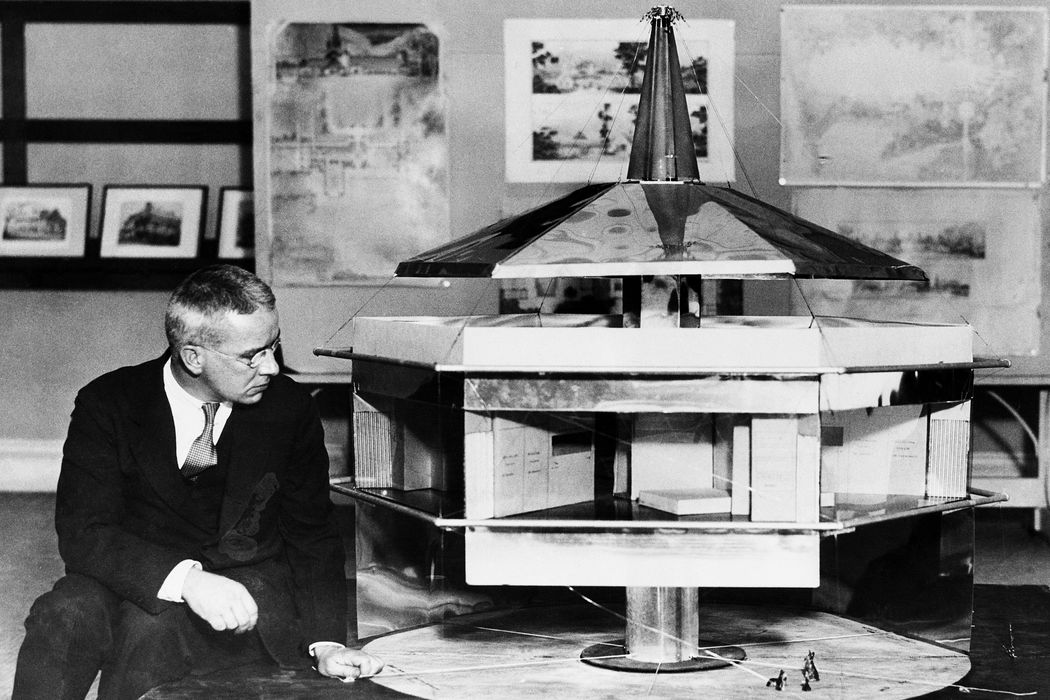
An important article for the Marxist study of architecture. Meyer Schapiro, a leading art historian and critic of the 20th century, writing as John Kwait, offers his Marxist critique of Buckminster Fuller and Knud Loenberg-Holm’s Structural Study Associates and their theory of a ‘universal architecture.’
‘Architecture Under Capitalism’ by John Kwait (Meyer Schapiro) from New Masses. Vol. 8 No. 5. December, 1932.
This article was offered to Shelter for publication in the November issue and was rejected by its editor, Buckminster Fuller. He not only rejected it—which was to be expected—but dishonestly announced in the November issue (p. 16), in an attack on the John Reed Club and the New Masses, that “Mr. Kwait had been so effectively answered as to be silenced.” He crowns his dishonesty by a truculent Credo, p. 5, in which he offers Shelter to the world as a public forum and invites a “public demonstration of his error.” He has since expressed his intention to publish the following article in a later issue, which may never appear, and has excused the rejection on the ground that there was no room for the article. Yet at the time he received it, he was still accepting (and borrowing and pirating) material for his November issue, which consists of 136 large pages of two and three columns of type, with an immense mass of news clippings and private correspondence.
My article on architecture in the New Masses, May 1932, is the subject of comment by R. Sherman in the last number of Shelter, a newly founded architectural journal. If in reply this journal is submitted to a detailed criticism here, it is because it is the organ of the S.S.A. (Structural Study Associates), a group of fifty architects and technicians, who are aggressively concerned with architecture as a social instrument and with housing reform as a substitute for revolution. Mr. Sherman included in his review a condescending refutation of communism, but said nothing of that part of my article which pertained most vitally to the S.S.A., namely of the criticism of the faith in an automatic evolution of society through improved housing technique, irrespective of the conflict of class-interests. For how can one suppose that a new device for manufacturing cheaper houses, controlled by the corporations, which are, by their very nature, party to overproduction, competition, wage-slashing, unemployment, speculation, will by itself work any appreciable change in the structure of capitalist society? Yet the S.S.A. admits throughout that adequate shelter is impossible under existing capitalist production. The irresponsible, socially unplanned introduction of a new technique in a major industry may even precipitate new crises in generating further unemployment and in unsettling the realty and financial markets. But I do not believe the S.S.A. has the intention of accelerating the decay of capitalism by monkeying with it in this manner. Nonetheless, its faith in such an automatic purification by technique, in “evolution” and the good-will of capitalism, is basic for its social philosophy.
But from the inconsistent, confused expositions of this philosophy in the various articles by the S.S.A., from the uneven mixture of mystical and technical notions and the ill-digested shreds of socialist doctrines, the S.S.A. emerges, with its humanitarian ends, not as a radical, progressive group, but as an ineffectual, parasitic cheerleader in the present campaign to boom the building industry. Though avowedly “socialistic,” it is more attached to the interests of finance and industry, since it awaits from the leaders of business the crucial steps in the reconstruction of society; and finally, it represents a reactionary tendency in its attack on Russia and its specific critique of Communism. Such groups as the S.S.A. are the first allies of Fascism.
The journal Shelter revolves around Mr. Fuller (Harvard University and U.S. Navy) and his patented “shelter,” the dymaxion, — one of several factory-made houses, now being designed for various competing manufacturers, in the efforts to discover a virgin industry for intensive, large-scale exploitation. Mr. Fuller has gathered about him a group of architects and technicians—the S.S.A.—for anonymous, cooperative investigation of housing, an investigation which, if successful, will culminate in the manufacture of several million dymaxion houses, at a cost of $800 a house, but at a sales-price of only $3000, or—to use the efficient terminology of the S.S.A.—at 50 cents a pound. Each house is planned as an independent, self-sufficient unit. It eliminates (at what final social expense, is not stated) those public utilities to which Mr. Fuller mistakenly attributes the causes of high rent, excessive taxation and inflated land-values. And it even promises a decentralization of city-life, since it would be possible to plant such a house in one day at a distance of 150 miles from the city or any industrial center.
Although Mr. Fuller speaks constantly of the people and the masses, and even the proletariat, we can guess for what class his dymaxion is intended by the mimeograph and the amphibian airplane-automobile which are listed among the furnishings. The airplane will enable the worker to come quickly to his factory from a distance of 150 miles. As for the cost of rural land, this will be negligible, since land-values will disappear when houses can be planted or removed completely in a single day, by Zeppelin. By its special installments and mobility the house will cut off its “feudal-roots,”—it will no longer be land-tied as in the 19th century. “The existing theory of land-economies will suffer a profound change,” and still more radical social changes will follow from the decentralization of cities brought on by Mr. Fuller’s Dymaxion. The writers of the S.S.A. even hint at socialism.
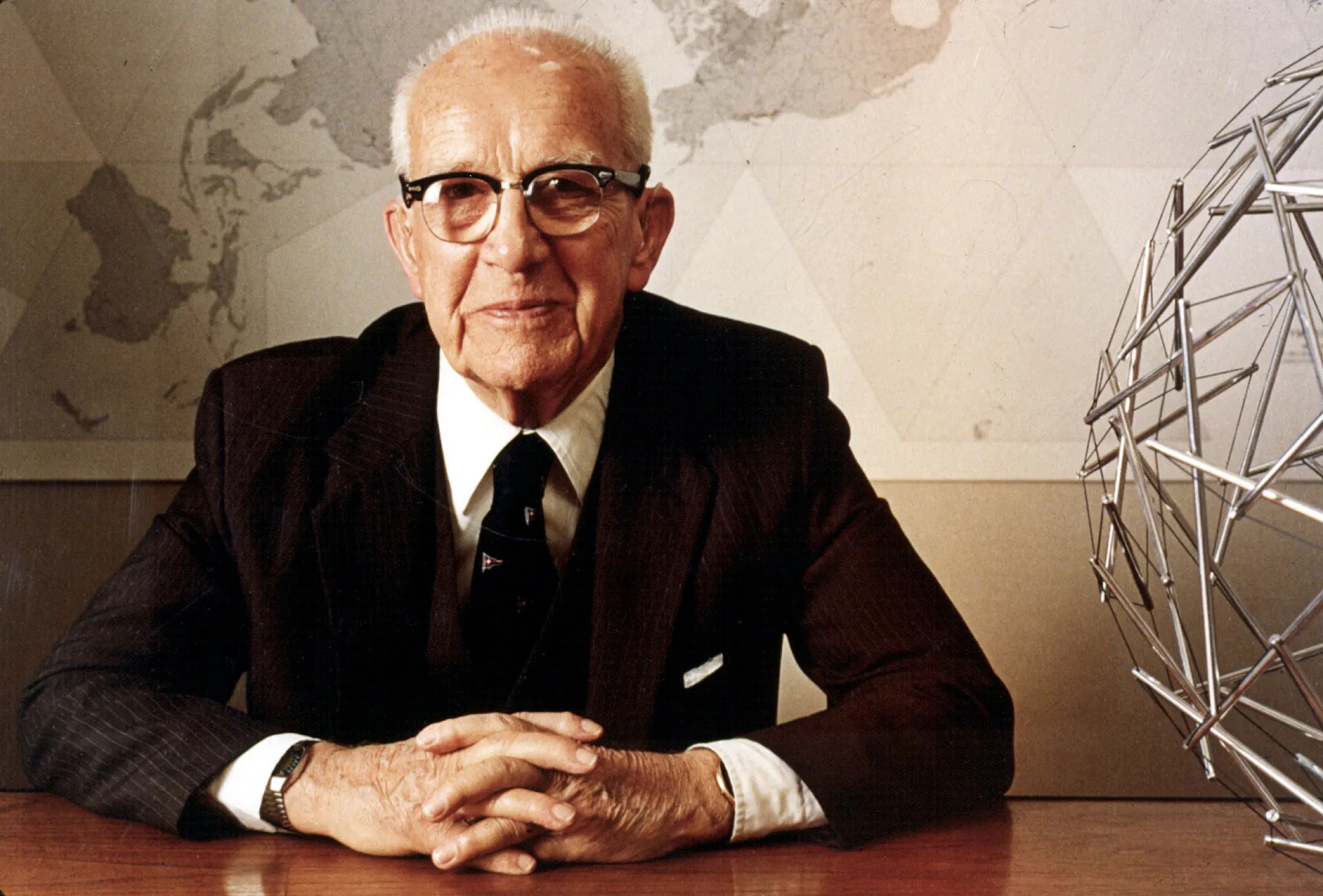
In the eight articles by members of the Structural Study Associates, their social philosophy is nowhere stated in a clear fashion; but it is evidently based on the views of their leader, Mr. Buckminster Fuller, a prominent engineer who has contributed to the present symposium a long and chaotic article on “Universal Architecture” and “Industrial Emancipation Conditions.”

He proceeds from the notion that the housing industry is the primary one to-day and that it has a tremendous future since it must produce 20 billion shelters in the next 70 years, hence 280 million a year. Analysis of present methods leads to the conclusion that private-profit is prejudicial to Universal Architecture, but that change from capitalism to a better system of communal service will come about automatically from the social attitudes resulting from improved technology. Because it is possible to produce all the material goods of life with the barest effort—seven hours per month per worker—the existing wasteful industry will necessarily be replaced by a more scientific system of which the socialist character is intimated but not brought out clearly. Precisely how technology will yield this result is never stated; but it is assumed that a liberal architecture, designed to make people comfortable, is an ideal framework of society and a model to other industries, and must lead to elimination of present corruption and poverty. Legislation is astutely rejected as the means (but) “industry is and will be responsible for the majority of growth performance, to the extent of the development of a popular awareness of the conditions outlined.” And “thereafter by the process of the Americanly preferred accelerated evolution, as opposed to revolution, there will develop an even more universal awareness of the already factual establishment of the abstract credit system.” Capitalism, it seems, will simply wither away. It will disappear silently. The ruling class will awaken one morning and discover that its holdings are valueless, but that its services to humanity will continue on a noble technological level.
This inevitable evolution, latent in technology, is partly described in another article by Mr. Breines, who says of the slums and all buildings under ten storeys in height that “because of the accelerating cessation of productivity of these obsolete structures, the owners had stopped paying taxes, and were, in effect, getting rid of them to the city. In this way, you see, the municipality gradually became the owner of all the land, and, in a subtle evolutionary manner, a socialist municipality had been established.” But despite this happy retrospect from the year 1940, learned by the Man-from-Mars from the workers playing checkers in the Empire State Building which had been converted into an apartment-house in 1932 for the unemployed who were engaged at 10 cents an hour in demolishing slums for their bosses, the real agent of reform is not merely the “subtle evolutionary” process. For Mr. Fuller it is the “contemporary industrial designers” who “have the responsibility of establishing the new society for the yet untainted new life whose simplified unselfconscious environment may thus forever be freed from the dominant abuses of past selfishness.”
We can guess from their latest designs how our industrial designers will meet this responsibility. We know too well the outcome of those post-war trends of industry which academic economists assured us were leading straight to a profit-sharing paradise with a six-hour day and a submissive working class.
It is astonishing that Fuller alludes to Marx and the Soviet Union for we would expect that one who has read Marx (he speaks of the “extraordinary vision of this philosopher”) and has acquainted himself with Soviet society would be more direct and realistic in his analysis and social programme. But Fuller’s is a home-made, private social criticism, with bits of half-assimilated ideas from more systematically constructed doctrines. He is an engineer and a propagandist for efficiency, but he is indifferent to the efficiency of his own writing. His social criticism renounces consistency in its chaotic form and exclusive jargon; it betrays its confused nature in the alliance of the technical and social ideas with fragments of mysticism, theosophy, and other esoteric cosmic positions, including science in the persons of Millikan and Pupin speaking through the New York Times.
At the head of his article, he writes, “an admixture of interpretive notions of universal conditions provides a dialogic triangulation strange to Manner, but eventually provocative of individual stabilization—by challenge—instead of by Teaching.” Of such a concept is the following articulation.” Of the “new industrial housing” he says parenthetically,—“technically known as fourth dimensional housing design”; and of his own models for reproducible, cheap houses, he writes: “Euclid’s fallacial cubistic geometry having been completely abandoned in contempo-physics, for radionic spheroidal relative growth concept, it is typically paradoxical of a feudal aping society, that man still evolves his dominant physical activity, ‘building,’ from ignorant tradition.” He calls his style “Universal Architecture” (as distinguished from the merely “international” modern style), and says that “intellect is sole guide to Universal Architecture which is humanity’s supreme survival gesture. Universal Architecture (is) scientific antidote for war.”…“I have faith in the progressive intellectual revelations of the unity of truth, of the truth of unity and truth of the eternal now.” That might have been said by a Hindu adept to a ladies’ club for the Promotion of Panpsychic Mysteries. That it should appear in the manifesto of a group of fifty “radical” technicians is a sign of the credulity and helplessness of a professional group in America, which can rally to a leader who announces these rhythmic truths as part of a social program.
The confusion of the S.S.A. extends also to its technical and scientific articles. In reality, this lengthy journal with over fifty large pages of two and three columns of reading matter contains very little of technical interest. There is an article by an S.S.A., describing a project for a theatre, which was never erected. The work of the architect is praised by the editor for its “cleanliness and integrity,” its “purity” and even “genius.” When we read the architect’s description of his own project we discover the earmarks of left-bank aestheticism; at least five cases of type; vague manifestos; pseudophilosophical language; and worse than all these, a bogus mathematical formula, with a pompous integral and incalculable elements,—a “law of construction” in which the color of the stage (F) is divided by the “material, animate and inanimate (Mi/a)…O what sense is a call to social efficiency in which the “technician” offers such ridiculous theatrical equations as a guarantee of precision? This is a Rube Goldberg formula, which can make us laugh, but builds no houses. It is like the mathematical signs in cubist and abstract pictures; they beg us to credit the artist with a superior insight, somehow related to an esoteric, reputable physics.
But within the very covers which contain this snobbish appeal to meaningless symbols is another article by a technician, a Harvard prizeman, Mr. Theodore Larson, who attacks formulas and exact science, who tells us that “physicalism” is dead, determinism abandoned, and a new “metatechnic” science, redhot from the German press, is about to remake the world. “The empiricism of blundering business has failed. Just as in the field of science the theory of determinism has been abandoned, so elsewhere is Physicalism inadequate. Industry, as the tool of an advancing civilization and culture, must become directional, teleologic. No longer can the physical dominate the mental; the supremacy is that of the imagination, the abstract.” Only Mr. Larson’s imagination. And we will not encourage it to build houses or a new society. What could be more absurd than a theory of reform of housing (and thus society) by engineering skill which rejects determinism in physics? But Mr. Larson has thought very little about these matters; almost every phrase in his scientific pronouncements is third hand and befuddled. He has merely swallowed hastily and only incompletely digested an English abstract of a speech on “metatechnics” by the rector of the technical school of Karlsruhe, Prof. R. Plank. He has taken from it only those items agreeable to his supreme, abstract imagination.
Despite Mr. Larson’s lyrical rejection of the “physical,” Mr. Fuller guarantees us that the new improvements in housing “today are in the hands of the most advanced scientific circles, such as those which establish the mechanical compositions of light or sound sensitive vibration cells.” What he means is that projects for profitable cheap housing are being studied in the laboratories of the General Motors Company, A.O. Smith Company, etc.
Mr. Larson has a great deal more to say about the expanding universe and the future of mankind; but I will not quote any further specimen of his scientific opinions. I mention, however, as indicative of the social attitudes that often go with such views his optimistic account of recent human progress under capitalism (poverty, suicide, war and lynchings unmentioned) and his remarkable nationalistic statement that the “fusion of races is almost complete,”—this in the United States with 12,000,000 Negroes and an appropriation for deporting radical aliens!
There are two more articles by S.S.A.’s which have a direct interest for the New Masses. One is Mr. Lonberg-Holm’s criticisms of the award of a prize for the design of the Palace of Soviets to Hector Hamilton; the other is Mr. Sherman’s comment on my own article in the May issue of the New Masses. Mr. Lonberg-Holm properly attacks the award, for Hamilton’s project is an inept affair, dressed up too much like the monuments of big-business in America to serve a Communist republic. But though he is right to condemn the choice on symbolic-aesthetic grounds, he expresses the aesthetic sentimentality of his group in inferring from it that “political communism and pragmatic capitalism are no more different than the space symbols they select.” The correspondence between artistic forms and society is not so thoroughgoing that they can be so mystically identified. The Russians still speak the language of pre-revolutionary days. Especially in a period of revolution, it is to be expected that a new society will retain inferior forms of the preceding. The award to Hamilton is only one detail in a thousand in present Soviet life; besides, the prize-design was unsatisfactory and will not be carried out.
Finally, if the newer techniques of building, for which Lonberg-Holm speaks, imply a socialized function and are more consistent with Soviet planning, they do not necessarily by themselves produce socialism, as the S.S.A. would like to believe. Arts, like cinema and printing, also imply a public consumption, in contrast to privately owned, unique creations. But the cinema and the printed book, no matter how efficient technically, no matter how cheap and accessible to the entire public, are also the vehicles of class interests and are themselves a means of exploitation. As a perfected technique architecture points to the greatest social possibilities; but these possibilities cannot be realized in their fullness in a capitalist society where technical advances are inseparable from exploitation and misery. Russia is today the only country in the world in which the new types of housing are accessible to the working class. Elsewhere they are limited to the bourgeoisie and to the small minority of better-paid workers; and even then, they are constructed with municipal subsidy.
Mr. Sherman’s article, entitled “Transition,” seems to embody the views of the S.S.A. on Communism and revolution. It contains hardly a just remark, and betrays the weakness of thought evident in the articles already discussed.
First, he attributes the lack of a national idiom of design in America, not to peculiarities of the social-economic structure or to the conditions of architectural production in the last hundred years, but to the mixture of peoples. This is false, since not only have all individual, single-tongued nations of Europe had a similar diversity of design in the 19th century, but in America itself, architectural types have been produced mainly, if not only, by Anglo-Saxon architects till very recently; and in fact, it might be said that the tendency to unification of type has received an impetus in the last few years from foreign architects, who have settled in the United States, as well as from industrial standardization.
In commenting on my article he agrees that the most developed modern architecture implies radical social changes. Like Mr. Fuller he says that “we face a social revolution and must accept its responsibilities.” In listing the “potentials of a new order of affairs” he includes the “changing outlook of proprietary interests due to an increasing public repudiation of current economic customs” and the “definite trend toward decentralization.” But J.P. Morgan’s outlook has not changed, and it is his outlook which counts in Mr. Sherman’s industrial-financial world. The imaginary public repudiation he speaks of (does he refer perhaps to the recent sermons reported in the Monday Times?) has not had the most trivial effect on unemployment, on the drastic wage-reductions of the poorest classes, on the public attitude to strikers and the suspension of civil rights, on police lawlessness, lynchings and the Scottsboro crime, on the expense for armaments and the international preparations against Russia and China, and on a hundred crucial evils produced by “current economic customs.” The meaning of “customs” here is really psychological; it is similar to the idea of another S.S.A. that the present “exigencies” might be solved by “over-all social-economic adjustments too long delayed in their solution by the arbitrary slight of a money-grubbing world. This conception of money-grubbing as the cause is typical of moral liberalism which neglects institutions and social fixtures. It follows from this that if everybody, including the workers, could be persuaded by some deeply persuasive philosopher, not to grub money, on the ground that it is unnatural and therefore not really the best life, all would be well with us again.
Not merely customs, but institutions must be repudiated, and not merely repudiated, but abolished, — something Mr. Sherman has no eyes for, no understanding. For like his colleagues he trusts the “Americanly preferred evolution” and would “not fight forces, but use them.” This is advice to the unemployed; do not fight bosses, use them; reeducate them for service and for Universal Architecture.
What Mr. Sherman’s “new order of affairs” will be like he does not say. He rejects communism as unsound, too static, in fact, for creative capitalism; and he cites in proof that Stalin has introduced “industrial captains, identical with capitalistic practice,—a beneficial heresy that proves the fallacy of communism.” Evidently Mr. Sherman thinks that a Russian industrial captain is the same as an American captain of industry. Perhaps capitalism and communism are the same thing, for he writes a little later that the “revolution has in fact arrived. Variously heralded for years, it is at last in our midst, bloodless, brought about by the tacit, widespread recognition of basic facts.” This intangible and invisible, as well as inaudible, revolution has also the reassuring quality of impotence. For the facts to the recognition of which the writer attributes the present state of revolution,—”first that the business-only-for-profit system is no longer capable of adequately fulfilling our needs; secondly that industry is slowly shaping a rational architectonic emergence” have even been openly, not merely tacitly, recognized by Hoover. “The administration’s recent pronouncements regarding financing and home-building—though necessarily impotent—were testimonials to the national importance of both facts.” Is it necessary to discuss further this obvious position according to which Hoover is a dangerous, but alas, impotent radical? This confused and largely verbal position is the sick-bed resolution of half-repentant industry, which promises to substitute for the business-only-for-profit system a government-subsidized system of business-for-profit, without sacrifice of its property or political power. It is the necessary position of Mr. Sherman, who is an editor of the Architectural Forum, “Time Fortune’s recently acquired publication for integrating the new shelter industry” by impotent testimonials to imminent progress.
The architects of the S.S.A. are victims of a professional fallacy. They exaggerate the importance of housing as a lever of social change, for a lever by itself it is powerless. They do not see that housing is one of many industries, and subordinate to the capitalistic production of machinery, raw materials, transports and power; and that whatever the technological advances in building, they do not alter the crucial relation of boss and worker or the present status of private property. On the contrary, such changes in technique as these architects advocate, may be even more prejudicial to the social order they desire, as long as the changes are applied by private corporations, which ruthlessly dismiss workers upon each technical innovation and ultimately produce a general lowering of real wages. The large-scale factory production of small houses to be rented to workers or to be sold to them on the installment plan is a refinement of modern “company-housing” which gives capital an effective weapon against strikers. Because of the failure to state in clear language the simplest economic facts of ownership and exploitation, the social criticism of these architects, whether intended or not, appears to be the usual preliminary smoke-screen of “social service” that precedes the revival or booming of the inflated building industries. Several pages of Shelter are given over to excerpts from newspapers and journals announcing the collapse of capitalism and the impending boom in the housing industries. “Mankind,” says a writer in the same issue, “is on the threshold of a general industrial emergence wherein the prime activity (prevision of shelter) is foreseen in all political, financial, editorial and welfare circles, pointing to an extraordinary industrialization of housing…Builders are applying themselves with frenzied energy (this by the critic of “moneygrubbing” and over-production) to the industry that industry missed as the magazine Fortune puts it. Now all this is encouraging, if belated, and a healthy sign for the future.”
Hence the article by Peter Stone, called Tooling Up, a newsy article on the latest projects and models for large-scale house production. It is a parasitic item in the present efforts of builders to obtain public subsidies for huge enterprises. Since there is the possibility that new types will be factory-made and partly metallic, new industries—aluminum, steel, automobiles, etc.—have become interested. The wealthy and the formerly prosperous middle-class have no need of houses, so the builders must turn for profit to the housing of the lower-middle-class and the better-paid workers (also a phantom minority). This project is easily stimulated by philanthropic propaganda, especially for public subsidies. The “technical” report of Mr. Stone contributes little but paraphrase of studio gossip and reports from other journals. He summarizes, without important valuations, the efforts of various firms, and encourages them. He slaps them on the back and says, attaboy General Motors, attaboy Westinghouse; he gives finally the very original suggestions of the S.S.A. (anonymous and cooperative) that a symposium be held including circus-designers and racing-sailer designers, “who have hydro as well as aerodynamics to contend with”; he suggests streamlined shelters “to be hung-up in a manner such as to allow them to head into the wind.”
In these conceptions of the problem we discover the meaning of the S.S.A. It is a confused liberal group of architects, who are still tied to the ideas of their masters. Though opposed to aestheticism in architecture, they remain bohemian and arty in their sentimental view of technology and the social mission of architecture. The manifesto of their leader is written in an oracular, telegraphic style, with a sort of stream-of-consciousness flow of ideas—as if he were talking to himself—in the manner of little reviews which live for one issue.

Despite its momentary criticism of capitalism, which is not very different from the aesthete’s, or even the industrialist’s distress before a specific, unprofitable inefficiency, this group has not liberated itself from the currents of capitalistic enterprise and is innocently booming a privately-owned industry under the mistaken thought that it is reforming the universe. The technicians who offer their brains to capitalism are offering a commodity which will be bought or cast aside like any other goods.
The capitalist honors technique when it brings him profits; but the technician himself is only his tool. The technicians have power to reorganize society only as members of a solid working class movement. For a group of architects to trust technology as an automatic principle of social evolution is to commit themselves to the existing rulers of industry and to support the status quo. How clearly this comes out in the article of Mr. Sherman who concludes that the revolution has already taken place! It is the reduction to absurdity of the whole position of the S.S.A.
The New Masses was the continuation of Workers Monthly which began publishing in 1924 as a merger of the ‘Liberator’, the Trade Union Educational League magazine ‘Labor Herald’, and Friends of Soviet Russia’s monthly ‘Soviet Russia Pictorial’ as an explicitly Communist Party publication, but drawing in a wide range of contributors and sympathizers. In 1927 Workers Monthly ceased and The New Masses began. A major left cultural magazine of the late 1920s and early 1940s, the early editors of The New Masses included Hugo Gellert, John F. Sloan, Max Eastman, Mike Gold, and Joseph Freeman. Writers included William Carlos Williams, Theodore Dreiser, John Dos Passos, Upton Sinclair, Richard Wright, Ralph Ellison, Dorothy Parker, Dorothy Day, John Breecher, Langston Hughes, Eugene O’Neill, Rex Stout and Ernest Hemingway. Artists included Hugo Gellert, Stuart Davis, Boardman Robinson, Wanda Gag, William Gropper and Otto Soglow. Over time, the New Masses became narrower politically and the articles more commentary than comment. However, particularly in it first years, New Masses was the epitome of the era’s finest revolutionary cultural and artistic traditions.
PDF of full issue: https://www.marxists.org/history/usa/pubs/new-masses/1932/v08n05-dec-1932-New-Masses.pdf
 Revolution's Newsstand