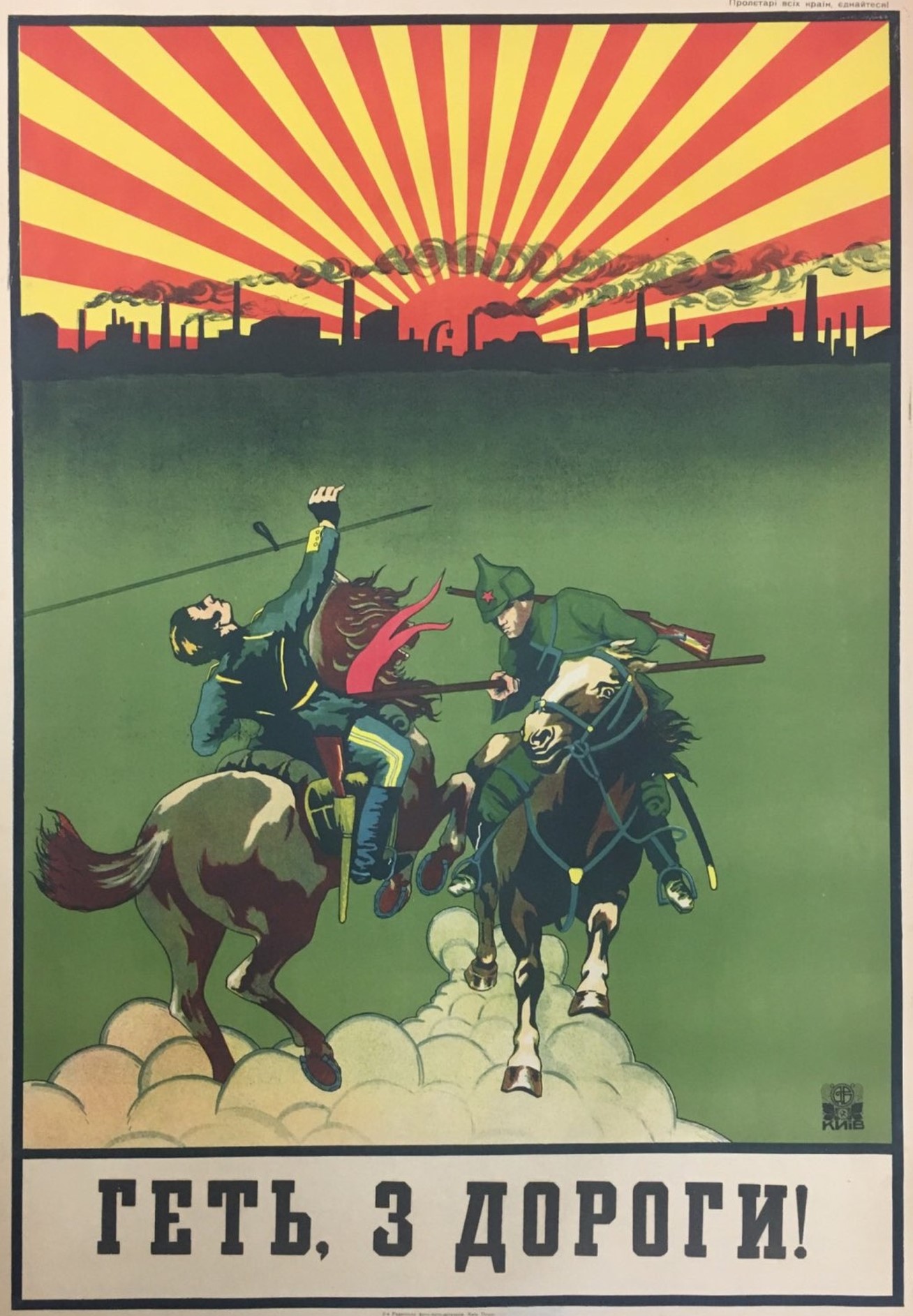
The military correspondent of ‘Soviet Russia’ with a fascinating study of the Cossack’s transformation from whip of the ruling class to the Red Cavalry and their role in the Civil War.
‘The Red Cossack’ by Lt. Col. B. Roustam Bek from Soviet Russia (New York). Vol. 4 no. 5. January 29, 1921.
ON THE eve of the approaching departure for Soviet Russia, I feel that I must say some words about the Red Cossacks of the Russian Soviet Republic.
There are only Red Cossacks left in Russia! There are now only bitter reminiscences in the Workers’ and Peasants’ Republic of the reactionary Cossacks, who became famous for their “nagaikas” (knouts) and their terrible atrocities, to the whole world. These monsters, with their bloodthirsty “atamans” (chiefs), and their officers, either perished during the civil war or have sought a somewhere in Constantinople, in the various Balkan states, in France, in England, in China and Japan, in short, they are dispersed all over the globe, living on with feeble hopes of once more regaining their former position.
The Cossacks always represented by themselves a quite separate population in Russia attached to the late empire by a long process of historical evolution, and gradually they became a blind weapon of the autocratic Russian government.
The cradle of the Cossack warrior is the Zaporozhie or Zaporoshskaya Sich, the district lying on the banks of the River Dnieper, where it is narrowed by the rapids and divided into a number of small rocky islands.
In the fifteenth century, when the whole of the south of Russia, abandoned by its princes and harassed by the Mongolian nomads and Turks, resembled a desert of ashes, thousands upon thousands of inhabitants, having lost their homes, were seeking asylum as well as thirsting for revenge. Men became fearless and accustomed to look straight into the face of danger and death. Common danger united men along the impregnable rapids of the Zaporozhie, and that was the beginning of the first Cossack community.
From all the corners of Russia young as well as old people streamed to this place. Men of profession, honest as well as merely self-seeking, began to look on the Zaporozhie as a harbor of refuge, where freedom and equality reigned. After a time they became so numerous that when the Sultan of Turkey, the greatest enemy of Russia, whose hordes were crushed by the Cossacks, asked a prisoner of war, “How many are there of you?” he received the reply, “There are as many of us as there are small hills in the vast steppes of Russia. There is a Cossack behind every hill.”
The birth of the Cossack race is really an inexplicable event in history. It was like fire struck out of the flint of Russian sorrow. It was a pledge of Russian strength, of the greatness of Russia’s future, as well as its safeguard, then menaced by barbarian autocrats. The ruling princes in the south of Russia flattered the free, independent Cossacks, trying to win them over to their side, and persuaded them to organize their okolitsi and kurni communities into regiments and military districts under the atamans and hetmans. (Ataman, a district chief; hetman, a commander of a whole Cossack force.)
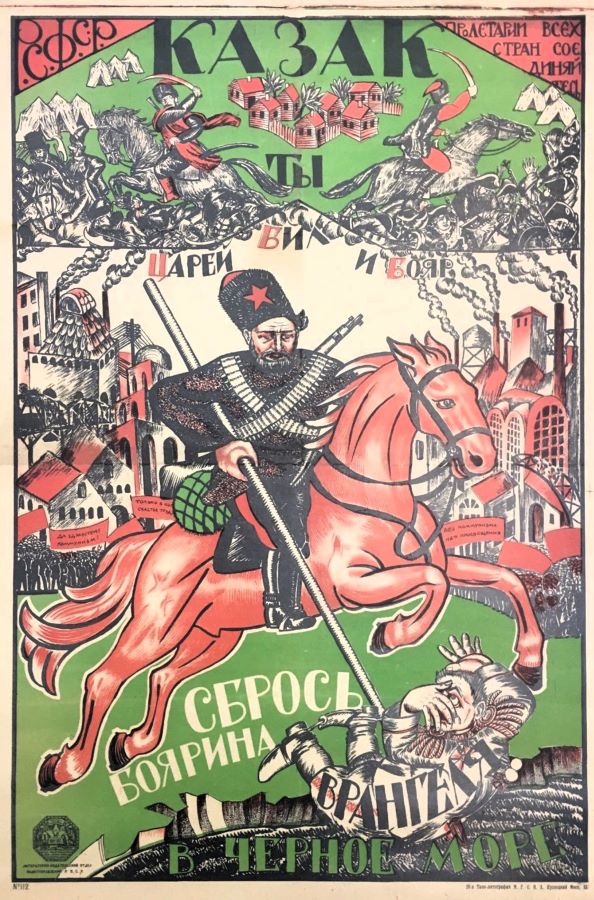
The Cossack force was really a military republic, a nation in arms, with the freest constitution the world has ever seen. It was not exactly an army. Nobody entering the Zaporozhie could imagine that he was among warriors, so fully occupied were they with their peaceful pursuits. There was no trade the Cossack did not practice. Spirit-distilling, brewing, smithwork, wheelwright’s work, armorer, powder-maker, and all other trades that were practiced in those days were familiar to them; while merrymaking and enjoyment found as many devotees among them as the “sword, horse and rifle” of their motto.
One thing only was strictly forbidden to those in the Zaporozhie. No woman was allowed to cross its limits. Of course, in time this restriction weakened and vanished altogether with the development of the civilization of the Cossacks themselves. In the days of the Hetmanship of Sobessky, the Cossacks were an invaluable cavalry for Poland, and had the latter respected their religious faith and their love of freedom and self-government, the Cossacks would never have joined Russia as they did under Peter the Great.
It may be imagined how priceless was such a cavalry as that of the Cossacks. Eight days after the alarm for mobilization they could concentrate their forces, fully armed, receiving as pay only one gold coin per man. When war was over, and all the Cossacks returned with rich booty to the Sich, the warriors again became peaceful citizens, and resumed their work in the fields, fishing, or their other trades, and became once more the so-called free Cosaacks—communists—because there was no private property in those days; in the Sich all belonged to the voisko (army).
All the men were registered and known to their atamans, and were obliged at the first sound of the alarm to join the colors.
In addition to these, there were the voluntary Cossacks, as they were called, mostly Mohammedans, who were exceedingly numerous.
War was usually planned by the Cossack atamans assembled in council, and had to be approved by the majority of the population.
Immediately after the declaration of war by the Hetman, the essauls (captains), in full war kit, mounted their horses and spread the news of war through the villages, calling out: ‘Brewers and drunkards, enough now of brewing beer and lying on your down pillows. Go and earn knightly fame and honor. Husbandmen and herdsmen, who are enjoying yourselves outside the Sich, enough of our following the plough with boots besmudged by the soil. Go and earn Cossack’s fame!” And at this call the whole of the Zaporozhie was transformed into the biggest military factory in the then-known world.
Besides these warlike qualities the Cossacks were artists, poets, and musicians. Music and song, which are a living force among the Russian troops, especially in the Red Army, were introduced by the Cossacks. Gallant and fierce in the field, the Cossacks could shed tears when listening to a touching song.
Even when under the yoke of the autocratic rulers of Russia, the Cossack regiments always sang in their songs the deeds of their revolutionary leaders. The place of honor in these songs was always that of the great revolutionist, Stenka Razin. Even the severest restrictions could not prevent these songs. The Free Siberian Cossack Yermak, the conqueror of Siberia, and even the famous self-styled Tsar Peter Federovich, i.e., the Cossack Pugachev was celebrated in the poems and songs by the Orenburg and Ural Cossacks. After the successful campaign against Charles XII of Sweden, Peter the Great, Tsar of Russia, fearing the growing power of the Cossacks, by a very skillful ruse transferred a great portion of the Zaporozhian Cossacks or the Ukrainian Cossacks to the Don District, thus laying the foundation for the Don Cossack voisko. The Empress Catherine II entirely put an end to the existence of the Cossacks in Ukraine, introducing there the serfdom of the peasants, and that portion of these Cossacks who remained with the Poles perished there entirely, under the oppression of the Jesuits. The Russian rulers gradually won over to their side the Cossacks of the Don, by granting to them some special privileges, including a sort of autonomy, which gradually lost its importance when several of the atamans of the Cossacks were approached by the Tsars, and after being knighted were invested with very large estates in various parts of the empire. This brought it about that such atamans or prominent Cossacks became very rich, and finally attained a great influence in their region, and by means of bribery altered the laws as they liked. The nineteenth century found the Cossacks under the absolute control of the Tsars, their regiments directly under the War Office, which, to be certain of its actual control, appointed a considerable percentage of the atamans and the commanding officers of the Cossack regiments, leaving no person of Cossack origin. At last the Chief Ataman of the Cossacks as a rule became heir to the throne.
Thus a bourgeoisie was artificially created in the Cossack voisko. These unpleasant “reforms”, even in the early days of the existence of the Cossacks of the Don, under Russian rule, made many of them emigrate, a part to Turkey, a part to the Caucasus, and farther to the east and northeast, thus creating the Ural, Orenburg, and Semirechensky Cossacks, who found themselves comfortable far away from the centers of the autocratic oppression of the Russian Tsars. The Siberian Cossacks, though under Russian control, and formed by the famous Yermak, “the bandit of the Volga”, enjoyed their freedom longer than the others, thanks to the distance between Siberia and Russia.
No country in the world has such a frontier guard as Russia. From the Don to the Pacific, the Cossacks were settled, supplying the Russian Government with a most brilliant cavalry, to protect the gigantic frontier of Russia in Europe and Asia, and to protect the throne from internal danger.
Practically the Cossacks cost but little to the imperial Russian Government. The Empire endowed them with certain special privileges, and they were bound in return to give military service at a certain age and under certain special conditions. The Cossacks constitute ten separate voiskos and some independent regiments.
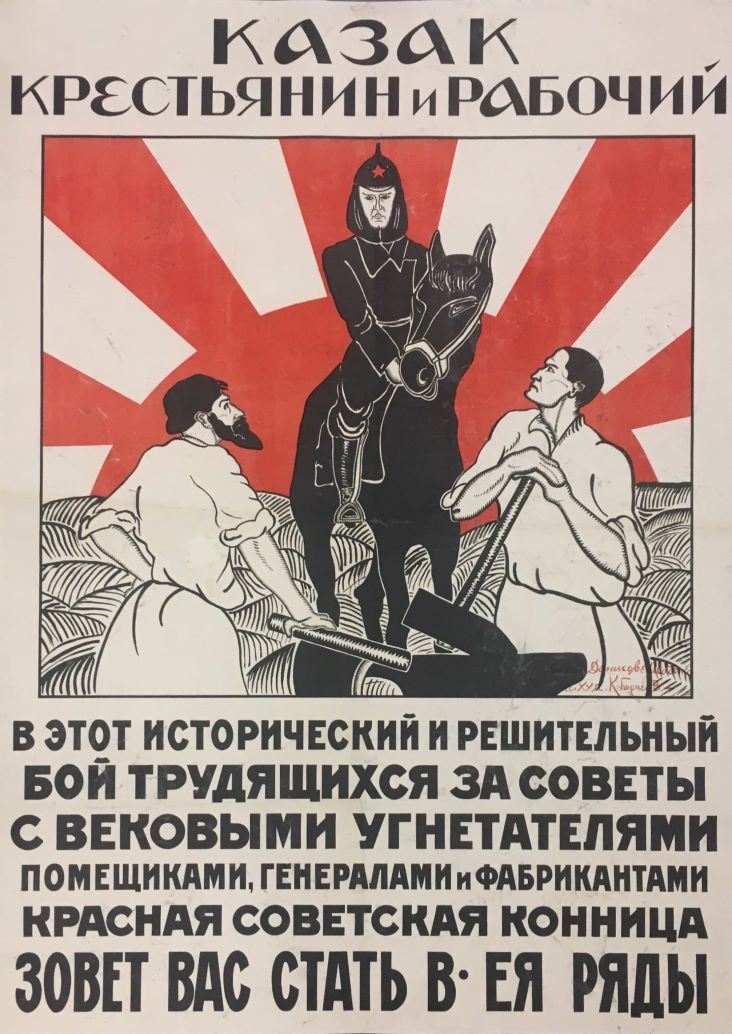
The voiskos are: Don, Kuban-Terek, Astrakhan, Ural, Orenburg, Semiryechensk, Siberian, Transbaikal, Amur, and Ussuri. Besides these, there were in Russia six regular squadrons of Daghestan Cossacks, three adrons of Kuban Circassians, eight sotnias of Terek Cossacks, three sotnias of Kara Cossacks, two infantry sotnias and one mounted sotnia of Batum, and, during the Great War in Transcaspia, several sotnias were formed from the Torkomans. (A Sotnia: 125 horses (from cto=—100).)
In some Caucasian regions close to the northeastern shores of the Black Sea, as well as in the region of Kuban and Terek, in the Caucasus, there are tribes of Cossacks, some of whom have never been horsemen. They wear the Circassian uniform, and for centuries have always been the best hunters in Russia. They are called plastuni; but I have never found the word in an English or American dictionary or in the military literature in those languages.
Now that Denikin and Wrangel are among their British friends, they can say much about these plastuni, whe played a great part in the failure of their foolish scheme to crown themselves in the Kremlin. A plastun has no rival either as a shot or in his ability to approach the object of his attack noiselessly and unnoticed. His capacity in this direction is so wonderful that even when you practically know where he is hiding, you cannot find him. This is all due to the fact that from childhood they are accustomed to rambling in the woods and on the mountains, armed only with a big knife, and very often meeting wild beasts and fighting them at close quarters.
To catch a sitting bird with the hand is an easy thing for a plastun. His eye is as sharp as the eye of a homing pigeon—the farthest-sighted bird in nature—his ear is so sensitive that there is a saying among the Cossacks: “When a plastun is listening he can hear the grass growing.”
In this respect the plastuni have no rivals and their reconnaissance is necessarily better and more complete than any reconnoitering of the best air service in the world.
The British and French, together with Denikin and Wrangel, had an opportunity to learn the ability of the Bolshevik plastuni, who gave them much trouble.
The history of the Cossacks in the Red Army begins with the second half of 1917, when the class struggle began in all the Cossack regions. The best elements of the working Cossack population suddenly joined the workers and peasants of Russia, and declared war on the Cossack bourgeoisie. It was a terrible and sanguinary struggle. The rich elements of the voiskos were numerous, well-equipped and perfectly led by experienced officers, of high military standing and innate bravery. The revolutionary Cossacks had to organize themselves and to form military units sufficiently armed and equipped in order to face their kinsmen who had gone over to Denikin and Kolchak.
It was on the 7th and 10th of January, 1918, when, at the stanitsa of Kamenskaya and in Taaritain, assemblies of the Red Cossacks took place. The resolution of this assembly which was sent to the Government of General Kaledin, was nothing else than an ultimatum. The Red Cossacks ordered the reactionary government first to submit to the Cossack Revolutionary Committee, and, secondly, to atop the formation of the “White” volunteers, to disarm them, and to exile them from the Don District.
It was ordered also that all the arms and ammunition taken from the White Detachments were to be delivered to the Commissar of the Revolutionary Committee, who was the only one entitled to issue the permits to leave the town of Novocherkassk. Third, the latter must be occupied by the Red Cossack regiments. Fourth, the members of the krug, the Council of the Voisko, must be dismissed. Fifth, the police which the Government of Kaledin had placed in the industrial districts must be recalled; and, sixth, to inform all the inhabitants of all the stanitsas (Cossack settlements) of the Don Region that all administration henceforth is in the hands of the Military Revolutionary Committee.
This resolution became effective through an order signed by the President of the Committees of the Cossacks, Ermin.
In reply to this ultimatum, Kaledin started an offensive and captured the Stanitsa of Kamenskaya.
The revolutionary Cossacks understood that without the support of Soviet Rusia they would be powerless to fight the reactionary general, and they sent Comrade Antonov to Moscow for help.
It was agreed that the Red Army should be moved to the Don Region, and as soon as the foe should be defeated, the Soviet troops should retire, but, in exchange for this help, the Soviet Government requested a full recognition of the Soviets as a supreme authority over the Don Cossacks.
Finally, the Don Cossack Republic became a federative state of Soviet Russia.
A counter-offensive of the united forces of the Red Army, together with two newly formed Don Cossack regiments, under the command of the Cossack Lt.-Colonel Golubev, began with Novocherkassk as its objective. The counter-revolutionary detachments under the command of General Chernezov were defeated, and Chernezov killed, but this victory did not encourage Golubev, who betrayed the cause and later went over to the “Whites”.
Soon after this campaign, General Kaledin shot himself and a certain confusion was produced amongst the Cossacks, due to the various treacherous acts of their opportunist leaders.
But Comrade Antonov did not lose heart, and continued his advance on Rostov, where General Kornilov’s forces were in full concentration. At the stanitsas of Matveyevo and Kurgan a decisive battle took place, where an entire battalion of the Kornilov infantry was cut down by the Red Cossacks. The uprising of the workers in Taganrog supported the military operations of the revolutionary forces, who continued to press the retiring enemy. Heavy rains and bad roads prevented the Reds from using their cavalry and artillery in field strength, and only the 5th Cavalry Division and the other Artillery Brigade took part in that pursuit. A series of brilliant victories of the Red Army was crowned by the capture of Novocherkassk, while all members of the White Don Cossack Voisko Council were captured with Ataman Nazarov at their head. And finally, after a most stubborn resistance by the Kornilov army, it was forced to retire to the Kalmuk steppes.
Kornilov certainly would have been cut off and his forces would have been completely annihilated, had the order of Comrade Antonov been carried out by the 112th Stavropol Regiment, to attack the enemy from Bataisk, but unfortunately this regiment, in the early period of the revolution, was not sufficiently disciplined, and returned to Stavropol of its own choice, thus providing a way for Kornilov to escape.
The Commissar and all the commanding element of this treacherous regiment were declared traitors to the Revolution.
Thus ended the first in any way important campaign in which the Red Army and Red Cossacks cooperated against the counter-revolution.
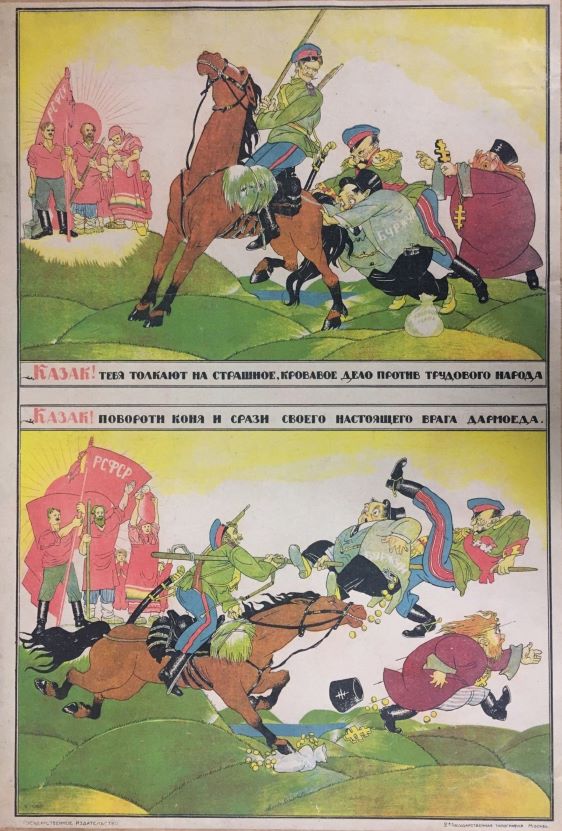
The growing reactionary feeling among the Cossacks of the Don forced the Revolutionary Government to form a new organization, in order to increase the revolutionary spirit in the Don region. A “Fraternal Union of the Cossacks and Sailors” was formed, and this improved the entire situation. The Russian sailors, a most revolutionary element, encouraged their Cossack comrades, who had become downhearted, thanks to the lack of arms and ammunition. A period of the most fierce fighting for arms began throughout the region. Often sons disarmed their fathers, and brothers fought their own brothers, in order to take, each from the other, a rifle or a sword. It was the most dramatic period of revolution the world has ever witnessed.
Gradually the Red Cossack regiments became stronger and stronger; their number increased with extraordinary rapidity, and in the middle of 1918 the first considerable Cossack units appeared on the eastern front, formed by the Orenburg Cossacks.
The former Tsarist officers of the Orenburg Cossack voisko, the brothers Kashirin, formed the so-called Red Kashirin Division, and for several months they raided in the Orenburg steppes, absolutely cut off from the main body of the Red Army. In view of the most difficult conditions, this division accomplished one of its raids of one thousand versta, which might be compared with the famous raid of Blucher, and at last joined the Red Army.
The third Red Army perfectly knew what the Kashirin division had done during the three years of civil war, and it was considered the best fighting body of that glorious army.
As the official report says, the Orenburg Cossack voisko gave to the Red Army endless numbers of the most brilliant fighters, and played a great part in defeating Kolchak on the Orenburg-Aktube front.
The Siberian Red Cossacks distinguished themselves first in fighting Kolchak, when the remaining part of the Red Siberian Cossack regiments broke through from the rear, through the Kolchak lines, and joined the advancing 5th Red Army, thus inflicting a serious blow on the forces of the usurper.
The Cossacks of Semirichye played a very important part in the revolution. From the very beginning they supported the Soviets, and in August, 1919, they became so strong, thanks to the reinforcements received from the Orenburg Cossacks, that they were able to defeat the Ataman Dutov, and the bandit Semionov’s allied bands. The defeat caused the entire debacle which both reactionary Cossack leaders suffered, one after the other.
The Kuban Red Cossacks, from the first days of the Civil War, joined the eleventh Red Army in masses, and finally three-quarters of the cavalry of that army was made up of these Cossacks, who desperately fought the bands of Denikin, and entirely annihilated the famous “‘officers’ corps”, the only hope of the Denikin staff.
The heroic Red Taman Army, which so marvelously cleared the Caucasian shores of the Black Sea of the Wrangel invasion, was largely recruited by the Don and Kuban Cossacks, amongst whom many were plastunt. The Taman Army was decorated by the proletarians of Moscow with the Order of the Red Banner, for the capture of Tsaritsin, and this glorious army was also betrayed by one of its supreme commanders, Sorokin, and waa obliged to cut its way in the Armavir direction, through the army of the enemy, constantly fighting without cartridges for two months. Bayonets were the only arms of these incomparable heroes.
And the deeds of this army are a real glory of Red Cossackdom of the Soviet Republic. The names of Comrade Blinov and of many other leaders will be inscribed by the Russian Revolution with red letters in its history.
Besides the great deeds of the Red Cossack voiskos, we can note on almost every front the most remarkable activity of the smaller Cossack units. For instance, the regiments named after Stenka Razin, and after Emelian Pugachev, cut off from the Red Army by the enemy, did not surrender but wandered far in the rear of the enemy forces for about three months, succeeding in effecting their return to the Red Army, losing in battle more than half of their men. In the winter of 1918, Comrade Dumenko organized the regular Red Cavalry on the Don front, and in the middle of January, 1919, he penetrates in the rear of the Whites in the Tsaritsin region. Here he defeats 23 of the enemy’s regiments and accomplishes a raid of 400 versts in one month. Four regiments of the Whites are captured by this Red cavalry leader, and 50 big guns, hundreds of machine guns, and an armored train, together with a number of armored motor-cars, are among his trophies. In the region of Kelentskaya and of Borisoglebsk, this same Cossack, Dumenko, defeats several cavalry divisions, pushes them to Khoper, and in the middle of December, forces the Don and captures Boguchar and thence moves his cavalry on Novocherkassk. Having defeated the enemy at the station of Chertkovo, at Millerovskaya, and Kamenskaya, toward the end of December he approaches the important railway junction of Likhaya-Zapovednaya, where, after two months of fierce battles, he defeats the famous Mamontov, takes 5,000 prisoners, and, on January 7, 1920, Dumenko’s cavalry, after having covered 350 versts, occupies Novocherkassk, capturing 167 big guns, 8 tanks, 500 machine-guns, 8 aeroplanes, 60 Ford tractors, 60 motor-cars, and 7 echelons of foodstuffs.
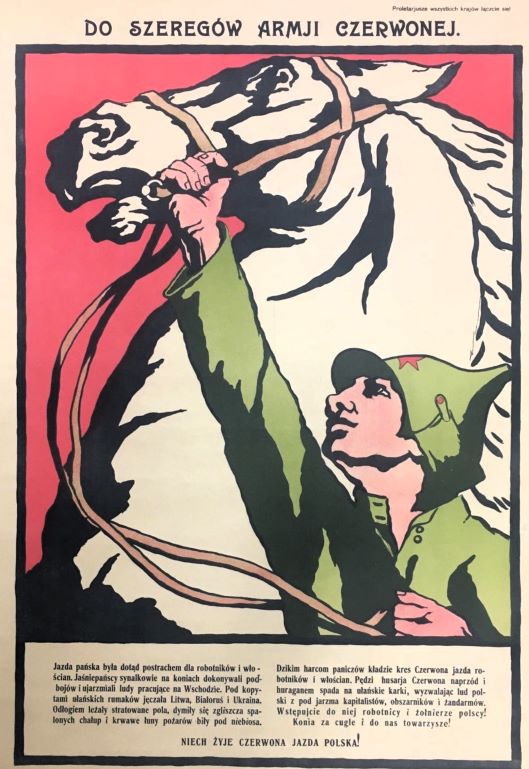
After this success of the Red Cavalry, the great creator of the Red Army, Trotsky, issued the famous order: “To horse, all proletarians.”
To Comrade Budenny is entrusted the task of forming a cavalry corps. The brilliant career of this Cossack, who is now at the head of the regular cavalry, begins in the Voronezh region. Into this region he pushes the again rising Mamontov, thus attracting the attention of General Shkuro, who hurries up towards Orel in order to reach Moscow. By means of a most skillful manoeuver, Comrade Budenny moves his cavalry on Taganrog, and, after making his way to Kursk-Kupiansk, being reinforced by the Red infantry, inflicts several decisive defeats upon the enemy, who tries to occupy the Donets industrial region. Fifteen hundred men of the division of General Markov are cut down, to the last man, by the Budenny cavalry; 1,200 are taken prisoner with 67 officers and enormous booty. Thence, Budenny moves his cavalry on Taganrog, and, after having captured this town, he directs his march on Rostov and Nakhitchevan, where the defeated Mamontov still tries to reorganize the remainder of his forces. In the night of January 8, 1920, both these towns are in the hands of Budenny’s men. Eleven thousand prisoners, 7 tanks, 33 big guns, 170 machine-guns, etc., are the booty of the Reds.
The further glorious raids of this cavalry genius are still fresh in the memory of the readers of Soviet Russia. The Polish Campaign and the Wrangel debacle are closely connected with Budenny’s name, which puts in the shade all the great cavalry leaders of the world, including Blucher, Murat, and Lee. All of them seem mere infants to me in comparison with the cavalry captains of these humble Red Cossacks of the great and glorious Red Army.
The Red Cossacks are the guardians of the Russian Revolution and, with such a guard to protect it, there is no force in the world which can crush it.
Soviet Russia began in the summer of 1919, published by the Bureau of Information of Soviet Russia and replaced The Weekly Bulletin of the Bureau of Information of Soviet Russia. In lieu of an Embassy the Russian Soviet Government Bureau was the official voice of the Soviets in the US. Soviet Russia was published as the official organ of the RSGB until February 1922 when Soviet Russia became to the official organ of The Friends of Soviet Russia, becoming Soviet Russia Pictorial in 1923. There is no better US-published source for information on the Soviet state at this time, and includes official statements, articles by prominent Bolsheviks, data on the Soviet economy, weekly reports on the wars for survival the Soviets were engaged in, as well as efforts to in the US to lift the blockade and begin trade with the emerging Soviet Union.
PDF of full issue: (large file): https://archive.org/download/SovietRussiaVol4And5/21-SovietRussia_text.pdf

