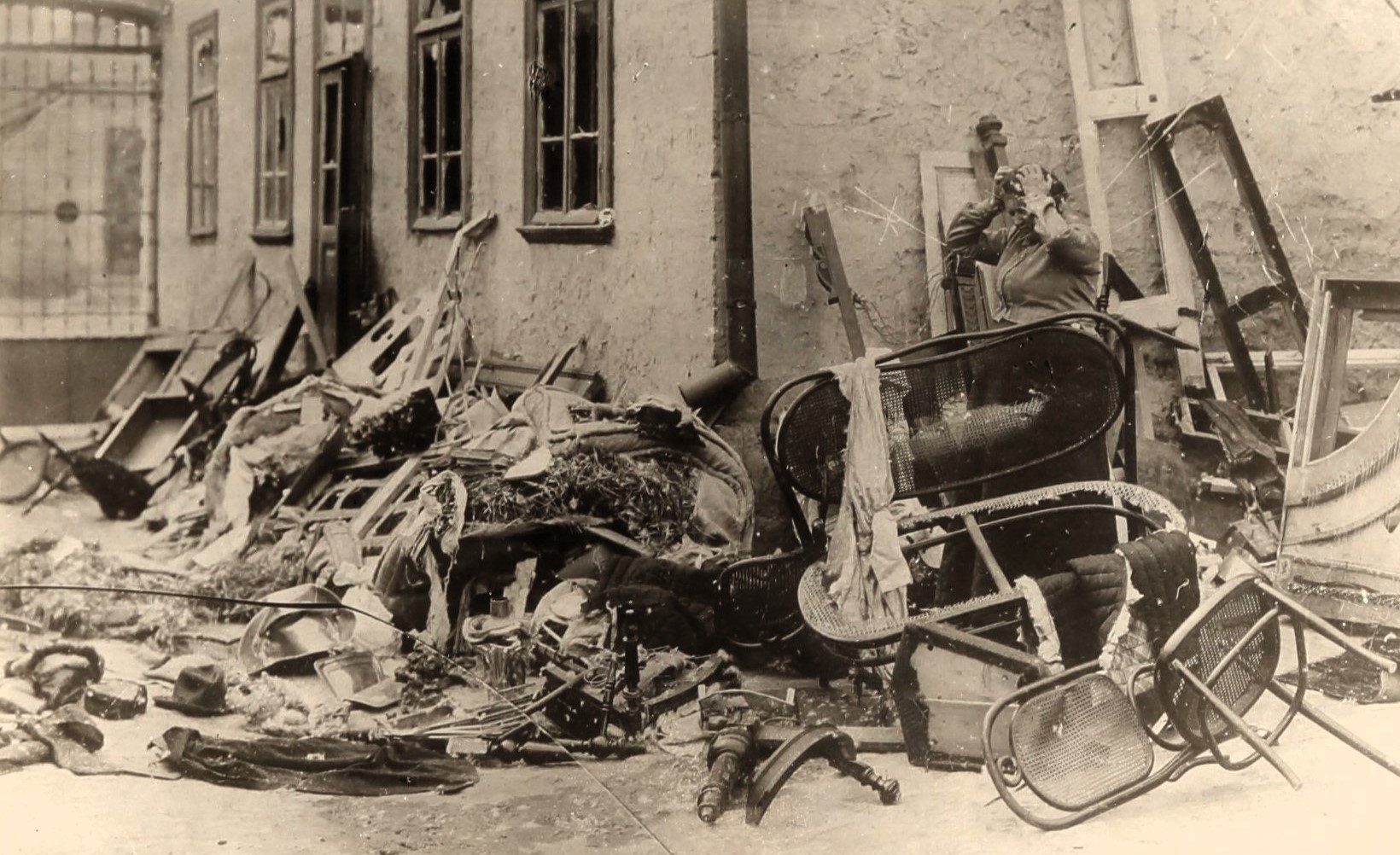
Editorial from the official paper of the New York City Socialist Party on the April, 1903 Kishniev pogrom (there were a number of pogroms in today’s Chișinău, Moldova). Though one of many such attacks on Jews in the Russian Empire during the period of the 1905 Revolution, the Kishniev massacre became a symbol, and as such was used by enemies as well as friends of the Revolution.
‘Kishineff—One Act in a World-Drama of Crime’ from The Workers (New York). Vol. 13 No. 8. May 24, 1903.
The responsibility for the horrors of Kishineff has been so clearly placed, the identity and the motives of the real criminals so plainly revealed, that none who care and dare to think need fail to understand.
The men whose hands were actually reddened at Kishineff hated the Jews. They were inspired by racial prejudice and religious fanaticism. But they are not the real criminals. They were mere blind and dumb tools in the hands of others.
Plehve and Pabledonosteff and Nicholas and the landlords and manufacturers and merchants and bankers who stand back of them do not hate the Jews as Jews. They will not refuse to dine with a Rothschild nor will, the Rothschilds refuse them a loan to-morrow if they guarantee a satisfactory per cent.
It is the Revolution that they hate and fear–the Revolution, which means thought in the brains of the tollers, which means the end of antagonisms among the oppressed, which means the beginning of the end of oppression and class division in every form.
The working and thinking Jews of Russia are a menace to the government and to the sanctified wrongs of tithes and rents and interest and profit for whose perpetuation the government exists. If they would work without thinking, the strong arm of the law and the military would protect them in their right to exist in misery. But this they will not and cannot do. Ostracized and isolated as Jews, as exploited toilers they have learned or are rapidly learning sympathy with their fellow sufferers of every race and every faith and teaching it in turn to those about them. That is why the government gave the signal for the massacre.
Kishineff is a new St. Bartholomew’s day, a dastardly blow aimed by the powers of reaction at the life of the future.
But it was not only designed directly to intimidate the Jews who form so important an element in the revolutionary movement in Russia and elsewhere. It is part of a larger policy, a consistent policy of the international ruling class.
The Christian peasants and artizans who, at Plehve’s hint, went out and murdered their neighbors are no less exploited and oppressed than the Jews. They are only more ignorant and therefore more easily ruled.
They suffer. They live on the verge of starvation all the year, for the profit of the propertied class. Their sufferings must breed discontent and resentment. It is the policy of the rulers to keep them in ignorance, to cultivate their prejudices, so that, when their resentment must burst out it can be directed against their fellow sufferers and away from their oppressors.
That is not a peculiarly Russian policy. Anti-Semitism in Austria or France is the same in origin and in purpose. Nor is the Jew the only object against whom such blind prejudice is turned. Even in our own boastfully enlightened country, we can see the powers of propertied society, though the press and other agencies, always busily fomenting prejudices and antipathies among the workers– setting white against black, native against foreigners, now cultivating hatred of the Jew, now of the Catholic, now of the Chinese, now of the negro, now of the Spaniard, now of the Italian. In the ridiculous dagger-and-dynamite romances that our New York dailies have been giving us under the name of news in the last few weeks, the same malign purpose of capitalism is to be traced.
It would be idle for us to spend words in denunciation of the Kishineff murders or in condolence with the victims. Enough words have been given to that, when no words are adequate.
Nothing is cheaper than denunciation and condolence. All official and propertied Christendom condemns the crime and expresses sympathy with the sufferers. That does not bring the dead to life nor does it disturb the Czar’s peace of mind. He knows where are the real sympathies of the rulers and owners of the world. He has been their partner–the partner of American as well as European respectability–less than three years ago, in committing still bloodier outrages in China for no less infamous ends. If he should send Grand Duke Boris over again next week, he knows the distinguished guest would again be entertained at the White House and on Fifth Avenue and the ghosts of Kishineff would not mar the feast.

There is but one power that Nicholas and partners in this guilt fear. It is the same power that the Kaiser fears, that the Rothschilds fear, that the Morgans and Rockefellers fear. It is the foe at whom their blow was struck–and vainly struck, for it will recoil against the oppressors in the end.
That foe is the revolutionary movement. It alone can sincerely protest, for it alone has clean hands, not stained with the blood of Chinese, of Filipinos, or of Boers. It alone will be able to put an end to massacres and to the legalized massacre called war, for it knows no divisions of nation or of church, knows only the outraged right and the growing might of the world’s workers.
Not as Americans to Jews, but as workingmen to workingmen, we say: Remember Kishineff! Remember all the crimes of the rulers! And by your sincere and unwavering and fearless International solidarity render such crimes forevermore impossible!
Against the reactionary cry of “Down with the Foreigner!” we raise the cry of revolution: “Workingmen of all countries unite! You have nothing to lose but your chains; you have a world to gain.” Down with all class rule!
The Worker, and its predecessor The People, emerged from the 1899 split in the Socialist Labor Party of America led by Henry Slobodin and Morris Hillquit, who published their own edition of the SLP’s paper in Springfield, Massachusetts. Their ‘The People’ had the same banner, format, and numbering as their rival De Leon’s. The new group emerged as the Social Democratic Party and with a Chicago group of the same name these two Social Democratic Parties would become the Socialist Party of America at a 1901 conference. That same year the paper’s name was changed from The People to The Worker with publishing moved to New York City. The Worker continued as a weekly until December 1908 when it was folded into the socialist daily, The New York Call.
PDF of full issue: https://www.marxists.org/history/usa/pubs/the-people-the-worker/030524-worker-v13n08.pdf
 Revolution's Newsstand