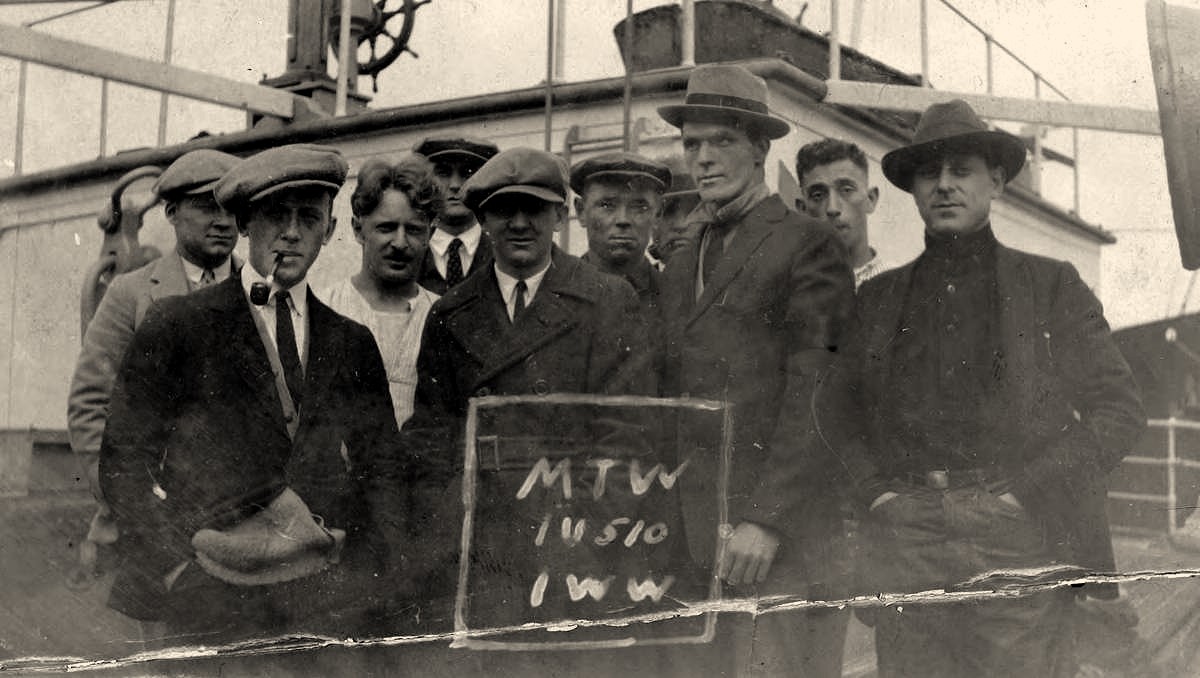
Another chapter from Tom Barker’s classic serial, ‘The Story of the Sea.’ Barker was a self-educated, working-class Marxist, a leading figure in the New Zealand and Australian I.W.W., deported to Latin America for his anti-war and union activities, where he worked the Buenos Aires docks and became a leader of the international marine workers organizing and delegate to the Red International of Labor Unions. All of that intimate knowledge goes into this survey of the then current character and organization of the marine transport industry in different countries and regions around the world.
‘The Story of the Sea: VI. Marine Trade Unionism’ by Tom Barker from Industrial Pioneer. Vol. 1 Nos. 2 & 3. April, 1921.
VI.
The Old and the New.
In 1805 the navies of England and France fought the battle of Trafalgar. The ships were of wood, and were propelled by the wind. In their day these wooden walls were the pride of the sea. The hopes of mighty nations hung upon their old-fashioned guns, and their press-gang enlisted crews.
Time has flown and industry has changed. The one-time efficient ship, “H.M.S. Victory” lies in Portsmouth Harbor, while near her lie the battle cruisers and the furtive submarines, which today are the arbiters of naval supremacy. They are the results of inventive genius applied to the fiendish art of human destruction. They are scientific, speedy and dreadfully accurate. They are new, the “Victory” is old. One modern battle cruiser could sink a thousand “Victory’s in two hours. We live in a scientific age when the new triumphs over the old the iron ship over the wooden one, the steamer over the barque, and the oil-burner over the coal-burner. The international shipping trusts have annihilated the small national groups by swallowing them.
Old forms of organization have to give way to new. Forms of working class unionism of twenty years ago are now obsolete and useless. Marine trade unionism has outgrown its usefulness; it belongs to a dead age, that of the sailing ship. It was an organization of tradesmen united to protect their trade interests and to monopolize their skill. It believed then, and believes now, that the capitalist class has a right to exploit the working class. It perpetuates the idea that the skinners and the skinned have interests in common. By working hard and long, said the old trade union official, a worker is both helping himself and his employer. He attempted to make the workers believe that the more they produce the more will they receive for their labor in the form of wages.
Such notions have long ago been exploded by Karl Marx, the famous economist, upon whose teachings has been founded the new movement of the advanced workers of today. All the great triumphs in ship-building, and advances in ocean traffic have made but very little difference to the marine worker. On the contrary, there is more unemployment, more hunger and poverty among the toilers of the sea than ever before. The deck-hand on British ships works the same hours as he did in 1887, after the formation of the National Seamen’s and Firemen’s Union. It is true that wages have gone up since the war, but the rise does not compensate him for the rise in the cost of living. He has to pay three or four times as much for his clothes as formerly, and the quality is abominable. Very little change for the better is to be found in the treatment accorded him, in his wages and accommodations, when compared with the improvements that have taken place for the officers and the saloon passengers. There are many ships afloat where the crew have to eat in the same quarters that they sleep in, and quite a large percentage where there are no baths for the firemen when they come from their tiring work below.
Our Wages and the Bosses’ Profits.
When we gauge the so-called advance in wages we must do so in the comparative sense. To do so we must ask ourselves the following question: “Do the marine workers get a larger or a smaller portion of the productivity of their labor than they did thirty years ago?” Everyone knows that they get far less than they did formerly. We know that the marine workers manned the ships during the dangerous period of the war, and were as well off at the close of it as they were at the beginning, while the ship-owners reaped tremendous profits, scandalous dividends. As long as shipping is operated under private ownership, the conditions of our life will become worse, while those of our masters will become better. Hence, if we are out for anything at all, we must organize for the definite control of industry. We must organize to end our slavery by the One Big Union.
The power of our masters has grown tenfold. Our existing trade unions have made no such advance, although the number of their members has increased. In plain words, the existing national unions and the so-called international unions are like so many wooden warships at the mercy of one giant battle cruiser straight from the fitting yards. Our unions are obsolete, their structure is defective, and while their guns make a big noise, they are actually more dangerous to their own crews than they are to the enemy. They have no speed, and have as much direction as a derelict. Their national anthem is, “Work, boys, work, and be contented.” That is also the national anthem of a lunatic asylum. Their flag is the yellow flag of ignorance and cowardice. The working class movement can never march ahead on the international battle-field as long as these forms of disorganization exist. Just as the bow and arrow is useless against the machine gun, so also is national lapdog trade unionism useless against the Capitalist World Octopus of Ocean Transport.
Great Britain’s Funeral Societies.
In Great Britain we find three unions of seamen and firemen. The National Seamen’s and Firemen’s Union is the coffin society led by Mr. Havelock Wilson, M.P. C.B.E., etc. This outfit is now water-logged, and the man at the wheel is seated in a bath-chair. In Glasgow and Southampton the Seafarer’s Union holds sway. This union was born from a squabble between Mr. Wilson and Mr. Emanuel Shinwell, who has conferred upon the Seafarer’s the honor of possessing him to guide their barque towards the doldrums. Some time ago Mr. Shinwell received a sentence of six months at one of His Britannic Majesty’s rest-cure Homes for participating in the 40-hour strike in Glasgow. While he was in, Mr. Wilson set to work to corner up his opponent’s membership. The Hull Seamen’s Union was formed as a break-away from Mr. Wilson’s fold. It has very strong objections to foreigners who do not have the good sense to be born in Great Britain or India.
Germans, Austrians and Turks are refused membership in that union. The German Ambassador, needless to say, goes quite often nowadays to Buckingham Palace, and as I sit writing this, the yellow Mr. Legien, of the lap-dog German trade union movement, is sitting beside Jouhaux and Bob Williams in the Holbom Restaurant at the Hard Labour Congress.
“The Old Man of the Sea”
We cannot touch upon marine unionism without discussing Mr. Havelock Wilson, M.P., C.B.E., etc. This ancient barnacle is a dead weight on the body of the marine workers of the world. His own constituents are tired of him. He is a Liberal in politics, and so reactionary that labor is going to oppose him at the next election. He is a cast-iron dictator; the rules of his union make it impossible for him to be ousted. His retarding influence is as baneful upon the great organization that he controls as that of “Grandpa” Gompers upon the American Federation of Labor. No advance can be made of an international character as long as Wilson’s Funeral Society retains its prestige. There are overseas unions that have done more for their members in one year than Wilson’s union has accomplished for its members in 33 years.
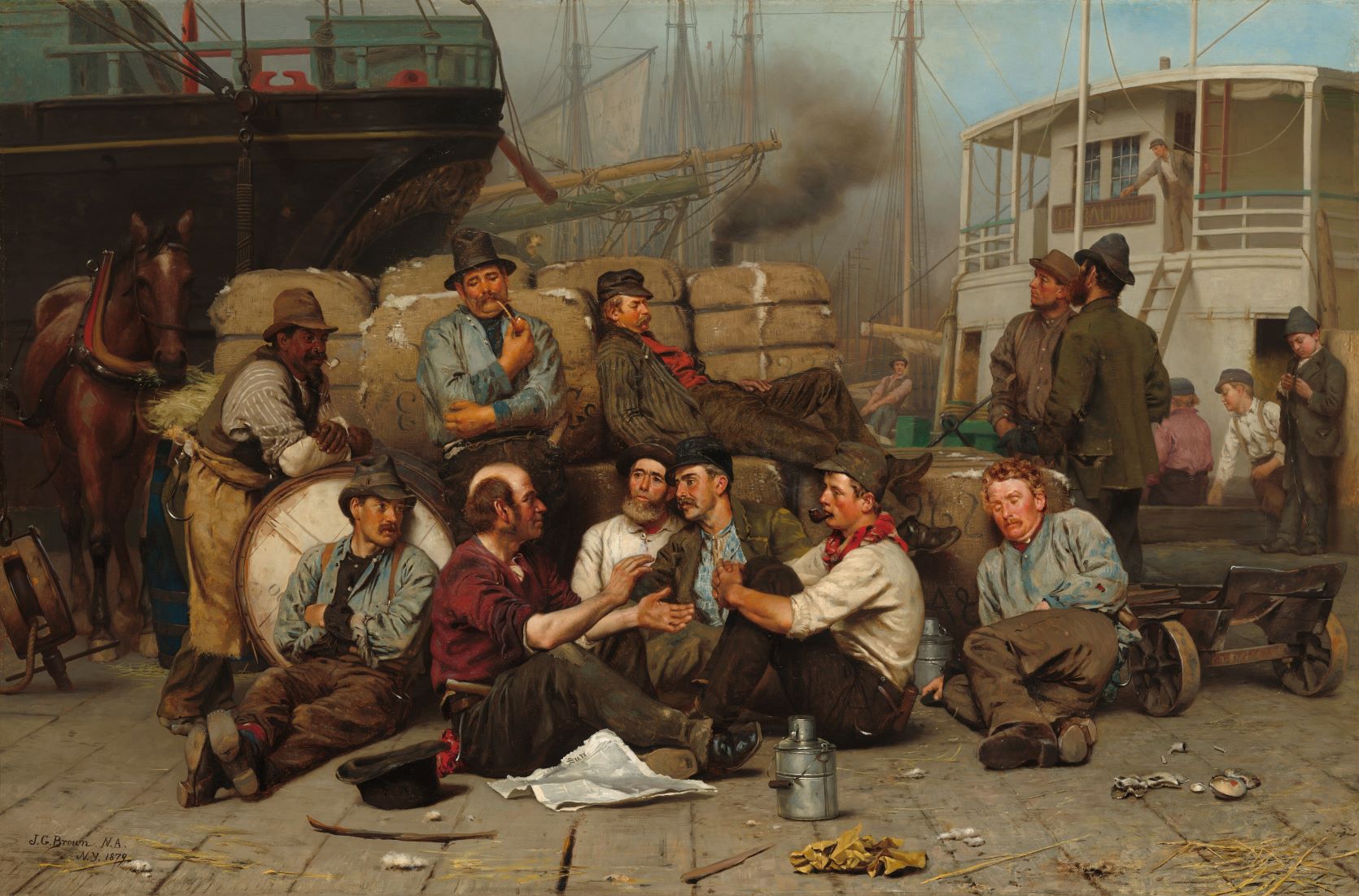
Intelligent marine workers will remember that it was Wilson who used his power to stop Ramsay MacDonald from going to Russia some few years ago. It was on one of his scab ships that three of the best men in the Swedish working class movement were sentenced to death. The “Amalthea” carried men to break the Swedish dock strike in 1908. Only a few weeks ago efforts were made to fill the places of striking Belgian sailors by members of Wilson’s Union. The Coffin Society, in short, is in the hands of the Chamber of Shipping. Havelock Wilson received the Order of the British Empire on the recommendation of the British Government while the war was on. Some of the other members of the union received the same honor. Every working man knows quite well that these baubles are not given out for helping the men who toil, but for bull-dozing and sidetracking them. Wilson and his creatures caused the tabling of a resolution by the Italian seamen’s union in Genoa at the International Seamen’s Congress a few months ago, calling for action to compel the foreign imperialists to cease their blockade of Soviet Russia. He allowed the eight-hour day for seamen to be defeated by one eighth of a vote. His seamen and firemen are receiving £15 a month while in the United States the seamen and firemen are receiving about £24 a month.
Wilson, in addition to being a paid official of his union is also a Member of Parliament in the House of Commons. That brings him in the nice little sum of £400 a year. There are now possibly about a million unemployed in the country, but that does not trouble in the least “the ancient mariner” who is not fit to look after one job properly, never mind two. There are large numbers of unemployed marine workers who could hold down either of the jobs as badly as he does. His organization is well hated throughout Europe, for his Coffin Society holds the Belgians, the Dutch, the Danes and the Spaniards from doing anything for themselves. The organ of the German Sea¬ men’s Union, “Seemansbund”, says that Wilson’s union is ‘merely a minor appendage of the British shop-owners’.
“Some” Supper
There is one thing that ought to be engraved in letters of gold on his monument when in the fullness of time he becomes entitled to one, and that is the fact that he accomplished more for British seamen than even Lord Nelson did. Nelson managed to get his men bread on two days a week. Wilson, however, contrived to get HIS men bread on three days a week, the remainder of the days being, of course, “biscuit” days. Possibly when the world’s seamen use the last coffin for this funeral society, British seamen will be able to have bread seven days a week as a right—and not as a privilege.
We have great pleasure in reprinting the following account of the “Annual Dinner of the British Seamen’s and Firemen’s Union”, and we ask the members of this and other unions to read it carefully and ask themselves what they pay their union dues for. The excerpt is from London “Solidarity”, the organ of the Shop Steward’s movement.
Lions and Jackals at a Feast
“The National Seamen’s and Firemen’s Union held their Annual General Meeting at the Memorial Hall, London, during the first week in October, 1920. The ‘Annual General Meeting Dinner’ took place at the Holbom Restaurant on October 5th, at which prominent ship-owners were present, and also representatives of the Government departments. Along with most of the officials of the Union, they were well fed and wined, at the expense of the members of the Union—though we doubt with the consent.
“They certainly did themselves well.
“It will interest those seamen and firemen who are paying one shilling per week to the organization to obtain better conditions, and who expect the Union to fight the shipping magnates, to know that the dinner consisted of EIGHT courses. We would give the menu (which of course, was printed in French, as all high class menus are), but we feel it would be likely to incite to riot the thousands of sailors and firemen Who are now hanging around union and shipping offices in all the ports of the kingdom, unable to get ships, or food for themselves and their children. Thomas Chambers, C.B.E., Treasurer of the Union, was wine steward, and he carried out his duties (on this occasion) with great honor. He was warmly complimented by the ship-owners present on “the lavish supply of very fine wines”. They are certainly judges, and apparently Chambers has had some experience before and knows their tastes ‘ by now.
“The toast list was as follows:—
“First, ‘The King’; With several knights, baronets, C.B.E.’s and other stiffs present, “George’ would naturally take first place.
Then the ‘National—or isn’t it Gnashional—Seamen’s and Firemen’s Union of Great Britain and Ireland’, coupled with the names of J. Havelock Wilson, Esq., C.B E., M.P., C.B.E. This toast was proposed by the Rt. Hon. C.W. Bowerman, M.P.
“‘The Shipping Industry’ coupled with the names of Sir Joseph Maclay, Bart., W. J. Noble, Esq. (President of the Chamber of Shipping), and Henry Radcliffe, Esq. Proposed by Sir Montagu Barlow.
“After that ‘The Guests’ coupled with the names of Sir Walter Kinnear (Controller of Insurance Department, Ministry of Health) proposed by Councillor Peter Wright (Mayor of Newport).
“Presentation by Thomas Chambers, Esq., on behalf of the officials and members of the N.S. & F.U. to Mrs. Havelock Wilson.
“Quite a nice slap-up little dinner, let me assure you. Of course, after the champagne had begun to work, things got a bit lively, but nothing serious. Unparliamentary language WAS used, but with quite good feelings between the lions and the jackals. Nothing was said about the rank and file in any of the speeches, but doubtless arrangements were made as to their future in conversation”.
Time and time again have conferences been deferred between the union and the bosses. On every occasion some excuse has been brought forward. First it was the Genoa conference, and then it was to wait until the Wilson Coffin Society swallows Comrade Shinwell’s remaining members. Now matters have been deferred until after a meeting is held in Brussels, which, according to Mr. Wilson’s recent speech at Marseilles, is going to perform wonders for ALL the seamen of the world. We are just wondering what kind of “junk” is going to be handed to the marine slaves by the bath-chair Moses who has been leading his tribe by the nose thru the Egyptian desert. We are afraid that there is a long sojourn coming in the desert to create the necessary stamina to lead us to the “Promised Land”.
Other British Marine Workers.
In Great Britain there are separate organizations for officers, engineers, wireless operators, and all those engaged in the steward’s department. Thus on a British ship we can easily find the members of five or six unions, and possibly in addition a few men who are members of no union whatever. Each man owes allegiance to a different union, which gives him feeble protection in home ports, and none at all in over-seas ports. This is the principle of craft unionism, the gospel of despair. The workers are divided into sections, so that they may be attacked one at a time by the powerful shipping interests. One section goes on strike, just like the wireless telegraphists did not long ago, while the other union men go on working, easing perhaps, their trade union con¬ sciences by paying a sixpenny levy to support their poor brothers, who— sob!—are on strike.
The basis of marine unionism in Great Britain is rotten to the gore, and neither fine-sounding names nor aggressive talk can alter that fact. It amounts to suicide on the installment plan. Although most of the unions are within the Transport Workers’ Federation, it does not prevent them from acting as they have done in the past. The axe has to go to the root; the spirit and structure of craft unionism must be destroyed. And we must remember that even an Industrial Union of British Marine Workers cannot attain its objective if it confines itself solely to the ports of the United Kingdom. Capitalism is scientific in its structure and international in its scope; the Unionism of the Workers of the Sea must also be scientific in its structure and international in its scope.
***
Ireland.
IN this “poor distressful country” our fellow workers of the Transport Workers Union command our attention and admiration. Their courage and heroism stand in marked contrast to the cowardly supineness of the British organization. Neither terrorism nor outrages deter them. The great majority are for scientific world unionism, and within their island they are perfecting their weapon to take their stand by the Brotherhood of the Seas and Docks, when it makes its advent. Organizations that live in the world of struggle must generate both clear-minded and intelligent men, men who are in the movement for the sake of their class and not for personal ambition, the degrees of capitalist universities or the thirty pieces of silver of the master-class press. You men on the Cork and Dum Langshaire docks, and you Irishmen who toil on the ships of the world, throw in your forces for establishing the dictatorship of the outcast seaman and the pariah longshoreman.
Scandinavia.
It is regrettable to know that in Scandinavia the unions are as divided, and their outlook almost as reactionary, as in Great Britain. The late secretary of the Norwegian Seamen’s and Firemen’s Union recently received a gold medal from the King for something he had not done for his membership. The members “sacked” him. In Norway there is, however, a steadily growing spirit among the men for something better. Overseas they are the fighting spirit of unionism, and there are no better men than the boys from the fjords for letting the world know about the necessity for One Big Union. During the recent fights for unionism in the ports of South America, they were the backbone of the Union, ready to picket or strike at a moment’s notice. The officers are, in the mass, more democratic, and there is not the air of “stand-offishness” that is so typical of other nations. In Sweden the seamen are in the hands of Charles Lindley. He is the same type of man as Havelock Wilson, and was the right-hand man of Herr Branting, the Social Democratic White-guard, when the latter was Premier. The question for the Swedish marine workers is whether or not they can afford to wait until Mr. Lindley is translated to the Kingdom of Heaven. The deep-water Swedes are good fellows and they are good organizers and aggressive.
Early in 1920 in Denmark the Firemen’s Union went on strike. Prior to that event there were separate unions for seamen and firemen. They were defeated in the bad old fashion, after being sold out by parliamentary bell-wethers. (The term “bell-wether” is a rather good one, and fits the average politician. A bell-wether is an educated sheep which leads the other muttons into the slaughter pen, and then steps back to lead the next batch. The muttons, which are very human in their instincts, will always follow their leader. They emulate their two-legged cousins by going into a long sleep after they have been beguiled and soothed by the bleats of their political misleaders). The Union was fined 400.000 crowns, but if the members would consent to work industriously and continuously, the government is willing not to collect the fine. While the strike was on, the ships were worked by scabs from the rural districts, and these gentry ran the ships to oversea ports where union men belonging to the Yellow Transport Workers Federation, handled the cargo. When I was in Kristiania, in April, 1920, the strike was just declared. The Danish motorship “Afrika” came into port. Her anchors were no sooner down than the seamen and oilers went on strike. They were taken off the ship and sent back to Denmark, probably to jail. The “Afrika” had cargo on board for Lisbon, and the officers and engineers worked her, the largest motor-ship in the world, and took her down to Lisbon without an able seaman of a motorman aboard her. So you See, fellow worker, what motor-ships are going to mean to you in the years that are going to come. They will not need you, that’s all.
Long distance scabbery is one of the worst evils of our present state of disorganization. In July, 1919, the Finn barque “Lawhill” left La Plata, Argentina, with a scab crew. This was reported by the Marine Transport Workers to the Danish union. When the “Lawhill” arrived in Aarhus, Denmark, she was tied up, and her scab crew were chased ashore and afterwards heavily fined for their treachery. Isolated actions such as this case shows what a punch a World Organization could develop, as it would make it impossible for scabbery to exist in the marine industry.
In October, 1920, the politicians were ousted from the control of the Danish marine unions, and Fellow Worker Borgland was re-instated in the presidency. In order to avoid the fine, the industry is to be re-organized on Industrial Union lines, and there is to be a break-away from Havelock Wilson’s machine. During the strike of 1920, the Danes did not get solidarity from the Yellow Amsterdam Federation
The Eastern Baltic.
On the Eastern shore of the Baltic, the Finnish Seamen’s and Firemen’s Union have their centre at Helsingfors. According to Fellow Worker Ahonen, the secretary, the Finns are in sympathy with the creation of a fighting international. I have found Finns in overseas unions to be a fine militant type, very determined and intelligent. Owing to the predominance of the White Terror, the wages and conditions are villainously low. The wages are equivalent to about £3.00 English per month. In Reval efforts are now being made to line the workers up, and matters are too unsettled in Riga and other ports to form any idea of the future.
Germany.
Marine unionism in Germany is in a deplorable state. That is due mainly to the fact that the greater part of German ships are now in Allied hands. The pre-war tonnage of 5,135,000 tons had been reduced to 419.000 tons in June, 1920. Thus the “Deutsche Seemannsbund” has lost about 90% of its former influence. As a result of this the German workers are suffering tremendously, but the spirit that runs thru their publications is far ahead of many other countries. There have been many industrialists deported to Germany from the United States and other countries, and the slavishness that used to be characteristic of German merchant ships has almost ceased to exist. All the ships owned in the old Austrian-Hungarian Empire to the extent of 1,052,000 tons have been confiscated by the Allies, and are now under the Italian flag, and the blue-and-white striped Inter-Allied flag. Hence there are no unions in those district, outside of the Italian Union which has now spread to the Eastern Adriatic.
Holland.
In Holland we have another advancing body of dockers and seamen, who are fed up with Havelock Wilson and the reactionaries in control. Fellow Worker van den Berg, the secretary of the Netherlands Transport Workers’ Federation, is a student of advanced forms of organization, and is anxious to see something newer and better. The men are not afraid to strike, but wages are very low and conditions are bad. During their strike of February, 1920, solidarity was extended to the Dutch workers in the ports of the United Kingdom and Argentina. Rotterdam is one of the most promising ports in the world for the new organization.
Belgium.
Since the war the Belgian Seamen’s Union has been re-organized as a part of the National Seamen’s and Firemen’s Union of Great Britain. The Belgian section, however, has accomplished far more for its membership than Wilson’s union has in its 33 years of uselessness. Indeed, in 1919, Mr. Wilson had to issue a warning to the Belgians that they were going too fast. All the fishermen are also organized in the union. In the pre-war days, conditions were very bad out of Antwerp, and until quite recently the companies used to brand their men on the arm with a rubber stamp. The Belgian dockers are very militant, and a few months ago tied up three blackleg-loaded ships that came from Malaga, in Spain. Antwerp is a very promising place.
France.
In France the organizations are weak and the wages low. A French officer does not receive as much wages as an American seaman. There is, apart from the official element, quite a good spirit growing up, as was exhibited when the captain of a French ship had the steward arrested in Hull. The whole crew struck and were taken, under escort, back to France for trial. They were sentenced, but speedy action and a strike procured their release. A large section of the men were colored, and from the French possessions. No action was taken in Hull to protect their French fellow workers, altho they are both in the Yellow International.
The Peninsula.
Portugal is in a state of chaos, and at the mercy of several unscrupulous political groups, who are always getting in and then thrown out in their turn. The unions are making headway, but the cabecillas — professional chiefs — are still a hindrance.
Spain is under the iron heel and the quarters of the fighting organizations are “clausurada por el gobierno” — closed by the government. La Sociedad Naval de Marineros y Fogoneros of Barcelona exists in secret in the foc’s’les, but the leaders are lying in the fortress of Montjuich. The Spaniards are fine fighters for the cause, and right thru the main Spanish ports there are hosts of deportees whose propaganda for the One Big Union is making strides. In the Canary Islands the wages are very low for both marine workers and dockers, being less than half the wages paid in Bilbao and Cadiz on the mainland.
Italy.
The Italian coast-line is under the control of the “Lavoratori del Mare” — the Toilers of the Sea — with headquarters in Genoa. This latter port is one of the promising ports in the world movement. The revolutionary activity among our Italian fellow workers is too well-known to need any extensive description. More than any other nationality outside of Russia they have manifested their manhood, particularly by initiating the blockade on munitions to be used against the Soviets, and afterwards by insisting upon the unconditional release of the Red crew of the Russian Soviet steamer, “Rodosto”. These are only two incidents out of many. Genoa is to be one of the great ports in the reconstruction of the Bed Marine International. It is the largest shipping centre in the Mediterranean for over-seas ships.
The Levant.
The only organizations in the Levant outside of Russia are the Greeks Seamen’s Union and a small industrial International Union in Constantinople. Little is known about the Greek organization, but that little is good; the members do not stand for any nonsense from the employers. The Russian port and marine unions have been isolated owing to the blockade, but trade is sure to be soon opened up, and there are orders for at least 600 ships in hands of Vanderlip and Co., of the U.S.A. We may take it for granted that the Union in the Black Sea will be a model organization, and their living and working conditions as ideal as human ingenuity can make them. The Brotherhood of the Sea will receive an enormous accession of strength and militancy from their affiliation.
The Far East.
There are organizations lifting their heads in the ports of Japan, China, Burma and India. In 1914 Ping Yin, a Chinese, formed a seamen’s union in Rangoon, Burma, which possessed a weekly newspaper in Chinese. Lately a union has been formed also in Madras and Calcutta. These things are encouraging, for whether we, the marine workers like it or not, we have to organize together, white and colored, for our common emancipation. We cannot let our race rivalries get the best of our common-sense. There must be One union, or unions that act as one, in Calcutta and Singapore as well as Glasgow and Antwerp. The Eastern people will be easily organized once the language difficulty is overcome.
Oceania.
The Australian Union has undergone a vast change in the past few years. The reactionary officials have been thrown out of their jobs. Wages are lower than on American ships, but conditions are better. One is now spared the odious sight of a seamen carrying his bedding about with him, and the company, in addition, must supply eating and other utensils. The food is good, and there are opportunities to pay off at almost any port that a man desires. In June, 1920, the seamen and wharf-laborers in Sydney, N.S.W., gave the Labor Government thirty days in which to release the famous I.W.W. Twelve, otherwise they would declare a general strike. Their action forced the release of ten of the men, including Peter Larkin, Tom Glynn, Donald Grant and others, after they had been in jail for nearly four years on trumped-up evidence. The Australian Seamen’s and Firemen’s Union recently issued a call to the marine workers to establish an international understanding, and such will be welcomed everywhere thru the Island Continent.
In New Zealand the seamen are still in reactionary hands, but the wharf-laborers are a militant section of New Zealand Transport Workers’ Federation, and may be relied upon, in the main, to support a move in the right direction. In Westport, N.Z., the dockers used to commence their week’s work on each Monday morning by having their union meeting starting at 8 A.M. After they had terminated their own business then they were ready to do the work for the boss. It is a good example to follow, fellow workers.
North America.
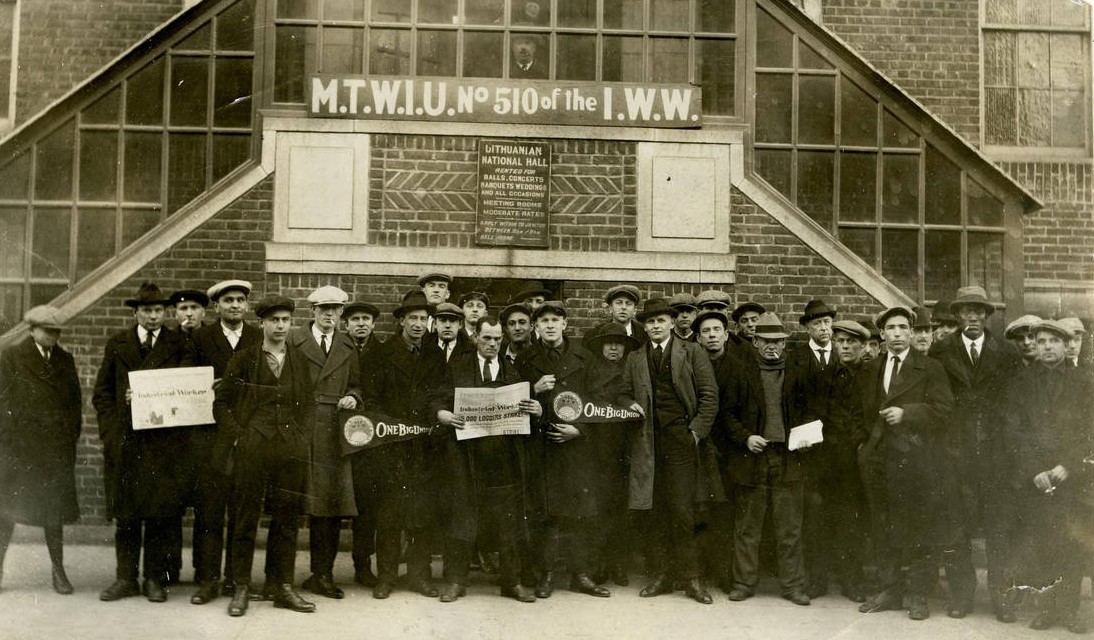
Organization of marine workers in the United States is divided between The International (?) Seamen’s Union and the Marine Transport Workers of the I.W.W. The officials of the former union are well paid, and not worth the money. They believe that by lobbying around the Senate House in Washington, they will help the seamen. As a matter of fact, such work never altered anything of importance for the seamen. It is true that the conditions on U.S. ships are an improvement over those prevailing on ships of other countries, but we have to remember that the U.S. is a new-comer in marine transportation, and that she has been compelled to give good conditions in order to attract men to go to sea. It has been necessity more than lobbying that has accomplished things. The Marine Transport Workers are destined to grow and to bind together the marine workers in the United States. The warring craft and graft unions on the New York water-front must give way to the scientific form of organization adopted by their fellow workers in Philadelphia. In the Gulf and on the West Coast the ONE BIG UNION has to come, and the fighting vanguard of the I.W.W. will easily carry the day if they will but bestir themselves. More than the members, of any other party or union, are the I.W.W. men scattered around the world. There is no corner of the world where one does not come across the “wobs”. They leave a good trail behind them. It is all the easier to make headway because both the American Federation of Labor and the International Seamen’s Union insist upon ignoring even the Yellow Amsterdam Federation. The U.S. is big enough and wide enough for the I.S.U.
Mexico and the West Indies.
In Mexico the I.W.W. has undertaken the organizing of the marine workers, and are establishing locals in Tampico and Tuxpan, both big oil ports. Cuba is becoming quite a red centre, where there have been many strikes of late. Trinidad and Jamaica have also had labor troubles, in which the marine workers were prominent. The world movement need not fear the workers in these countries being behind. They are ripe, when the right men blow along.
South America.
There are three great maritime nations in South America, the A.B.C. countries, viz., Argentine, Brazil and Chile. In Argentine the Port Workers’ Federation is one of the most advanced and scientific organizations of its kind. The leaders are fervent industralists, know what they want and how to get it. They have a fighting alliance with the Red Transport Workers’ Federation, and the Marine Transport Workers, which since May, 1919, has catered for the oversea workers of all nationalities and unions who arrive in the ports of the Republic. The Federacion Obrera Maritima — the Argentine Seamen’s, Firemen’s, Officers’ and Engineers’ Union — is reactionary, but with a big leavening of industrialists. When this organization is lined up with the dockers and the overseas union, then the coast of Argentine will be the closest organized in the world, and the international boss will have his work cut out. The M.T.W. doubled wages, abolished shanghai-ing, reduced hours, and established job control in these ports, a thing that could be accomplished in every maritime country if the workers would only set to work to do it.
In Chile the marine workers are organized in the “Gonte del Mar” — the People of the Sea — and the dockers and launch-workers (nearly all cargo is worked from the ships to lighters on the West Coast) belong to the Union of Lancheros y los Estibadores de los Puertos Chilenos. These are sections of the Chilian I.W.W., which possesses a membership of 28,000 members and is the bane of not only the Chilian, but also the “gringo” capitalist. In the last two years, the organization has spread to Arica in the North and down to Puerto Montt, Corrall, Coronel and Talcahuano in the South.
The port workers in Brazil possess many radicals in their ranks, and during 1919 and 1920 many of their members were deported for agitational work in Rio de Janeiro, Bahia and Santos. The conditions on Brazilian ships are scandalous and wages are very low. In many cases the shops are manned with navy men who are paid at navy rates. Since the war Brazil has obtained quite a large merchant fleet, mainly at the expense of Germany. Callao in Peru and Monte Video in the Eastern Republic of Uruguay are also important ports that have to be reckoned with in the business of organization.
Conclusions.
Something more than a mere International Transport Workers’ Federation is needed to bring these workers together into one organization, or at least into such an understanding of one another that they will act as one organization. The black shadow of Havelock Wilson has deterred the movement long enough. The isolated action that we have witnessed during the year 1920 is enough evidence of the present childish way of fighting capitalism. The Danes and the Dutch were both defeated simply on account of a lack of understanding. World Transport is the strategic point of International Capitalism. The marine transport industry is the most cosmopolitan of all industries. The proletariat can never assume control until it conquers the ocean routes and the ships that follow them. The present state of sectional, national unionism reminds one of so many mosquitoes attempting to push an elephant over. Let us consider the enormous power that we are fighting, and climb, for the moment, out of the dingy foc’s’le or the grimy port where we work. When the dockers in Liverpool discharge the grain from a Norwegian barque, do they ever think of the brown-skinned Argentine workers who reaped it, loaded it to the railway, pulled it to the docks, and then packed it away in the comer of the hold where they find it? Or of the polyglot crew that has brought her thru the trades, across the Line and thru the mists of the Channel?
Let us, I say, rise out of our ordinary groove and notice our own share in the production and distribution of wealth. We are one of the links in a long chain, that stretches from the Argentine wheat field to the baker’s shop in Swansea. From our combined labor springs all the wealth that we see around us. We produce the gorgeous banquets for our masters as well as our own meagre meals. Fine clothes for our masters and their over-fed cubs, and dungarees and shoddy for ourselves and our children! Our labor is much the same as that of our brothers in Shanghai, Sydney or Valparaiso. There is so little difference that it is not worth fighting over.
There are a thousand good reasons why we should be in one organization fighting the same fight against the same tyrants. Let us forget our nationalities, and remember that we are of the same class, and that our interests are the same. Let us counter the Giant Octopus with the fighting armour of One Big Union on the Sea and the Docks.
Let us, I say, build from the stocks up, a super warship of Proletarian Power, and wipe their cursed slavery from the seas. Let us erect Industrial Democracy in the foc’s’le, and build the structure of that future administration that will control all the ships, and place them beneath the banner of the World Organization of the Toiler of the Sea.
“He who would be free, himself must strike the blow”.
The Industrial Pioneer was published monthly in Chicago by the Industrial Workers of the World from 1921 to 1926. The precursor of the Industrial Pioneer was the One Big Union Monthly. Heavily illustrated, the journal included arts, prose, and poetry along with historical articles and analysis. Editors included John A. Gahan, Vern Smith, H. Van Dorn, and Justus Ebert.
Full issue PDF: https://www.marxists.org/history/usa/pubs/industrial-pioneer/Industrial%20Pioneer%20(April%201921).pdf

