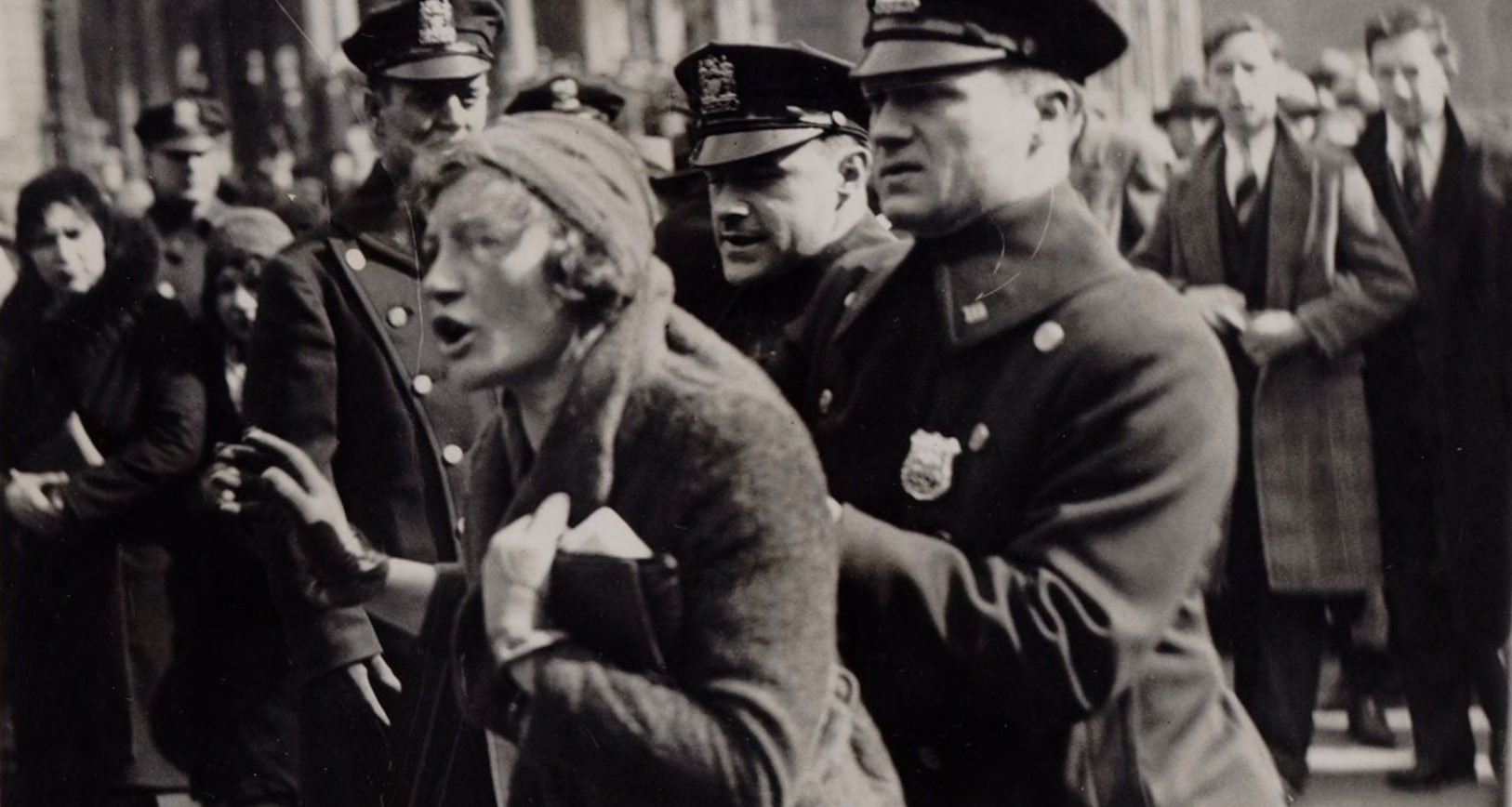
Sometimes you stumble upon a compelling photo and are lucky enough to find its context. While the comrade being arrested in this picture was unnamed, she is most certainly mentioned in the article below. The early months of the Great Depression saw numerous such demonstrations, this one called by T.U.U.L., for relief. In the following weeks, the first Hunger Marches would begin.
‘Tammany Cops Attack–Slug Workers Asking Work or Wages–Workers Fight Back’ from The Daily Worker. Vol. 6 No. 306. February 28, 1930.
20,000 Jobless Demonstrate at N.Y. City Hall
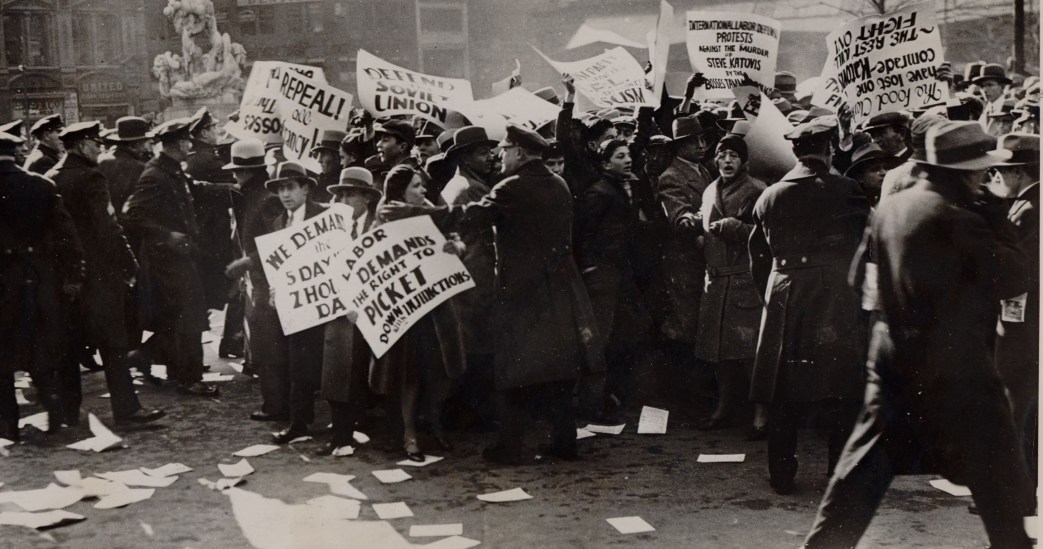
Mayor Walker, and the speed-up bosses back of him, mobilized 500 police of all arms, and an unknown number of hundreds of “newspaper reporters,” that is, plain clothes men with reporters cards stuck in their hats, to avoid hearing the imperative demands of 20,000 New York unemployed yesterday afternoon. City Hall Park was black with jobless workers and those who had struck work to come down and add weight to their protest against starvation imposed on their class by capitalism. At 12:30 a committee of 20 stepped out of the immense throng and started up the steps to present Walker with a little request for immediate emergency relief, unemployment insurance, no work—no rent, seven hour day and five-day week, etc.
Squads of police leaped upon then; and dragged them away.
Police horses, and pushing and swearing patrolmen shoved through the crowds to break them up. The thousands of unemployed showed a stubborn determination not to leave. For over an hour and a half they kept the plaza, parading continually as a living protest, yielding before police charges, reforming and flowing back, many rising to speak here and there, others rising after those were pulled down. The demonstration surged back and forth on the streets around City Hall, in front of the Woolworth building, north of the Municipal building onto Broadway and back to the City Hall.
Placards were held up demanding work or wages, calling on the workers to fight in order not to starve, and voicing the demands of the unemployed councils of the Trade Union Unity League which had called this demonstration.
In some cases workers defended themselves resolutely against the pushing and shoving of the police, in some cases police ran amuck swinging and clubbing with their blackjacks. In Beekman St. Hospital badly beaten and thought to have fractured skulls are Sam Liebowitz, Isadore Klinghofer, and one other.
Among the arrested are Klinghofer, Randolph McNeil, Sadie Van Veen, and Rebecca Forman. Anna Rollins was arrested earlier in the day for distributing leaflets announcing the demonstration, and her case comes up Saturday. Thousands of leaflets were distributed particularly in the Bowery slave markets.
Among those slugged and beaten up was the secretary of the unemployed councils, Sadie Van Veen. She spoke half a dozen times, being dragged down each time, and was finally taken to court on a 300 pound policeman’s charge that she “attacked him.” In court at the Tombs with her was Rebecca Forman, under a similar charge. Van Veen in her testimony detailed the whole T.U.U.L. program for the unemployed, and outlined their demands. Both got a suspended sentence. A seaman, C.S. Johnson, “blackballed” out of the Standard Oil of New Jersey, fought to defend speakers in three different skirmishes. He was badly beaten about the face and head and has a cracked rib, but is as determined to fight on as ever.
A screen has been placed around the bed of Klinghofer to prevent his talking to the other patients, and telling them of the need for organization of the unemployed.
The committee to see the mayor was made up of representatives of all the unemployed councils, and also George Siskind of the T.U.U.L., Otto Hall, Negro organizer of the Communist Party; Sadie Van Veen, secretary of the unemployed councils; Michael Obermeier, of the cafeteria workers; Fred Biedenkapp, of the Independent Shoe Workers; Julius Portnoy, of the Needle Trades Workers’ Industrial Union; Paterson, a young Negro worker; H. Hymes, of the Marine Workers’ League; Albert Tate; a Negro woman worker; H. Weinstock of the unemployed building workers.
The Daily Worker began in 1924 and was published in New York City by the Communist Party US and its predecessor organizations. Among the most long-lasting and important left publications in US history, it had a circulation of 35,000 at its peak. The Daily Worker came from The Ohio Socialist, published by the Left Wing-dominated Socialist Party of Ohio in Cleveland from 1917 to November 1919, when it became became The Toiler, paper of the Communist Labor Party. In December 1921 the above-ground Workers Party of America merged the Toiler with the paper Workers Council to found The Worker, which became The Daily Worker beginning January 13, 1924.
Access to PDF of full issue: https://chroniclingamerica.loc.gov/lccn/sn84020097/1930-02-28/ed-1/seq-1/

