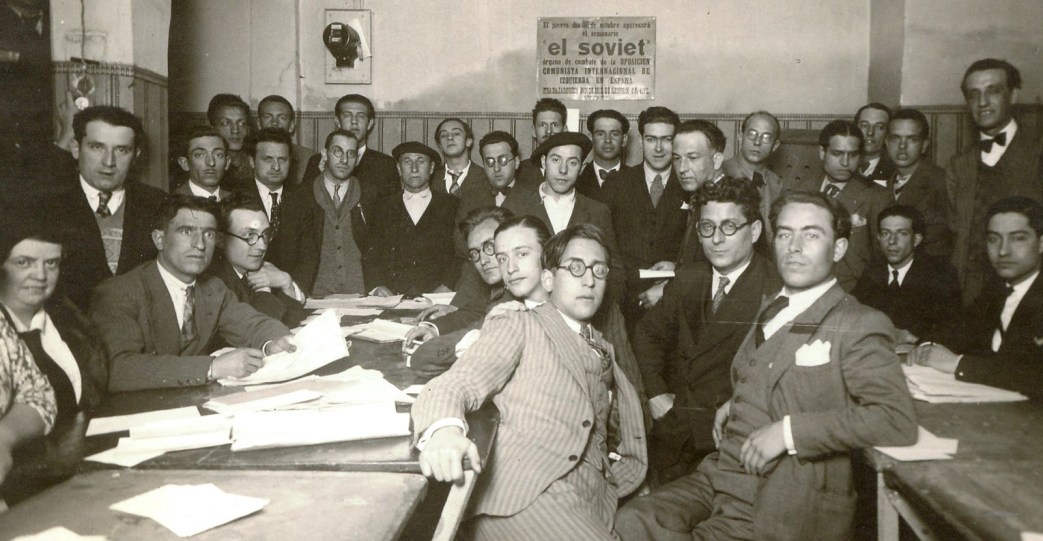
Joaquín Maurin was an exemplary figure in illuminating the larger, fluid, dynamic of syndicalist-Bolshevik debates and relations that would define first period of the Comintern. A CNT militant who became formative in developing Spain’s’ Communist movement, emerged at the central leader of the 1920s Spanish C.P. Later Maurin would align with the so-called ‘Right Opposition,’ forming the Workers and Peasants Bloc in 1931. That Bloc would unite Andreu Nin’s Left Opposition to establish the P.O.U.M. in 1935, in what was an almost unique fusion between historical ‘Right’ and ‘Left Oppositions’ to the Stalinist leadership of the International. A decade before those events, Maurin provided this valuable overview of the Spanish state’s 1920’s political landscape in the1920s: serving as an important background to Spain’s Civil War the following decade.
‘Political Parties in Spain’ by Joaquin Maurin from International Press Correspondence. Vol. 3 No. 59 & 60. September 6 & 13, 1923.
I.
The evolution from feudalism to capitalism was a somewhat slow process in Spain. The large landowners were successful in gaining decisive influence upon the policy of the country. The antagonism between the agrarian government and the interests of gradually growing industry constantly increased in intensity. Industry developed most rapidly in the province of Catatonia. The conflict between the agrarians and the industrialists had the effect of inclining the industrial bourgeoisie of Catalonia to the idea of separation; Catalonia opposed Spain. The war favored the industrial development of Spain, and brought about great changes in the relative powers of the various social strata. Industry became more powerful. In 1917 it seemed as if there would be an upheaval, and that the industrialists would deprive the agrarians of power. But the increased strength of the proletarian movement tended to cause the industrialists to come to an understanding with the agrarians. Since this time there has been a retardation in the progress made by Spanish industry. At the present time, Spain cannot work up its raw materials, it exports them in exchange for industrial goods. The most important industries today are the textile industry in Catalonia, and the metal industry in Biscaya. But the machinery in the Spanish factories is out of-date, and the goods produced are of an inferior quality, unable to bear comparison with those of other capitalist countries. Under these circumstances. Spanish industry is only kept going with the aid of a exceedingly heavy protective duties.
Crisis has become a chronic condition, industry demands continual further rises in the customs tariffs. Reductions of wages and abolition of the eight hours day in many undertakings have not been able to improve the situation. Many branches of industry, as for instance the railways and the bourgeois press enterprises, can only carry on with the aid of state subsidies.
Spanish agriculture is still carried on along feudal lines. Hundreds of thousands of Landowners rule the nation. The majority of the large farmed estates are to be found in the middle and south of the country. Some of these landowners possess 1,000 square kilometres of land. I here are many smallholders and tenant farmers who have to deliver up one third or one half of their crops to the landlord, from a technical point of view Spanish agriculture is also extremely backward, but it is protected from foreign competition by protective duties.
The landowners are divided politically into two parties. The conservative and the liberal. Whenever the state has been in danger, the conservative party has taken the necessary repressive measures. Until the end of the nineteenth century, this party was led by Canovas, who bears the responsibility for the colonial defeats suffered by Spain, and for the atrocities of Montjuich. Canovas was killed by the anarchist Angililo, and the leadership of the party passed into the hands of Maura, notorious for plunging Spain into the Morocco adventure, and for having Ferrer shot. During recent years Maura has lost much of his prestige in his own party. As party leader he was replaced by Dato, who introduced an atrocious system of White Terror. On March 9, 1921, Dato was shot at Madrid by Casanellas, who is living at Moscow at the present time. The conservative party has now broken up into several groups at feud with one another.
After the downfall of Maura in 1909, the liberal party came into power. The post of prime minister was filled by Canallejas, a former revolutionist, whose radicalism was however only evinced by a moderate anti-clericalism after he was prime minister. Besides this, he energetically suppressed the labor movement. On the 12th November 1912 Canallejas was murdered. At the present time the liberal party is once more in possession of power. In reality there is no serious difference between the conservative and liberal parties. The two form actually one party, only that this party has divided into two fractions in order to be better able to maintain its power and to hold the ministerial seats alternately. In practice the program of both parties consists in maintaining the power of the landlords. These two parties will carry on their little game until the political power of industry and of the proletariat destroys the balance.
The party representing Catalonian industry is the Catalonian League which has existed for 20 years, it inclines to separatism, and would not be opposed to Catalonia being attached to France. Economic difficulties and terrorism induced the league to come to an understanding with the agrarian parties, and to participate with them in the government after 1917. The main interest of the Catalonian League lies in the increase of the protective duties, and in the improvement of the commercial treaties. The leader of the Catalonian League is Cambo, the cleverest politician belonging to the Spanish bourgeoisie, and the most deadly enemy of the proletariat. The name of Cambo is inseparably bound up with with Terror. He is held to be the moral originator of the murder of Segui.
When the industrialists founded their separatist party in Catalonia, the agrarians in Barcelona attempted to form a counter party. This task was undertaken by Lerroux. He founded the party by making use of powerful revolutionary phraseology. The radical party considerably damaged the party of the Catalonian industrialists, and drew many workers into its ranks. Its importance has greatly declined since the year 1912.
The middle strata of Spain, combining with a section of the proletariat, founded the republican party. In 1913 the reform party split off from the republicans. This reform party is prepared to cooperate with monarchist governments. The republican party is equally disunited, and falling into decay.
At one time there also existed the so-called Jaimist party, the party of the pretender Don Jaime of Bourbon. This party was monarchist and absolutist Its fighting troops have now been absorbed into the stalled “Free Trade Unions”, yellow unions whose chief aim it is to murder the revolutionary workers. Schism and decreasing influence mark the whole of the bourgeois parties of Spain.
Besides the political parties, there is another force which ruled the politics of the country from 1917 until 1900 – the military Juntas, the officers’ leagues cooperating with King Aphonso XIII for ultra-constitutional action. The Juntas furthered the catastrophic Moroccan, enterprise to the utmost of their power. The Juntas and the King hold together, but the Spanish defeats in Morocco in 1921–22 have much diminished their influence.
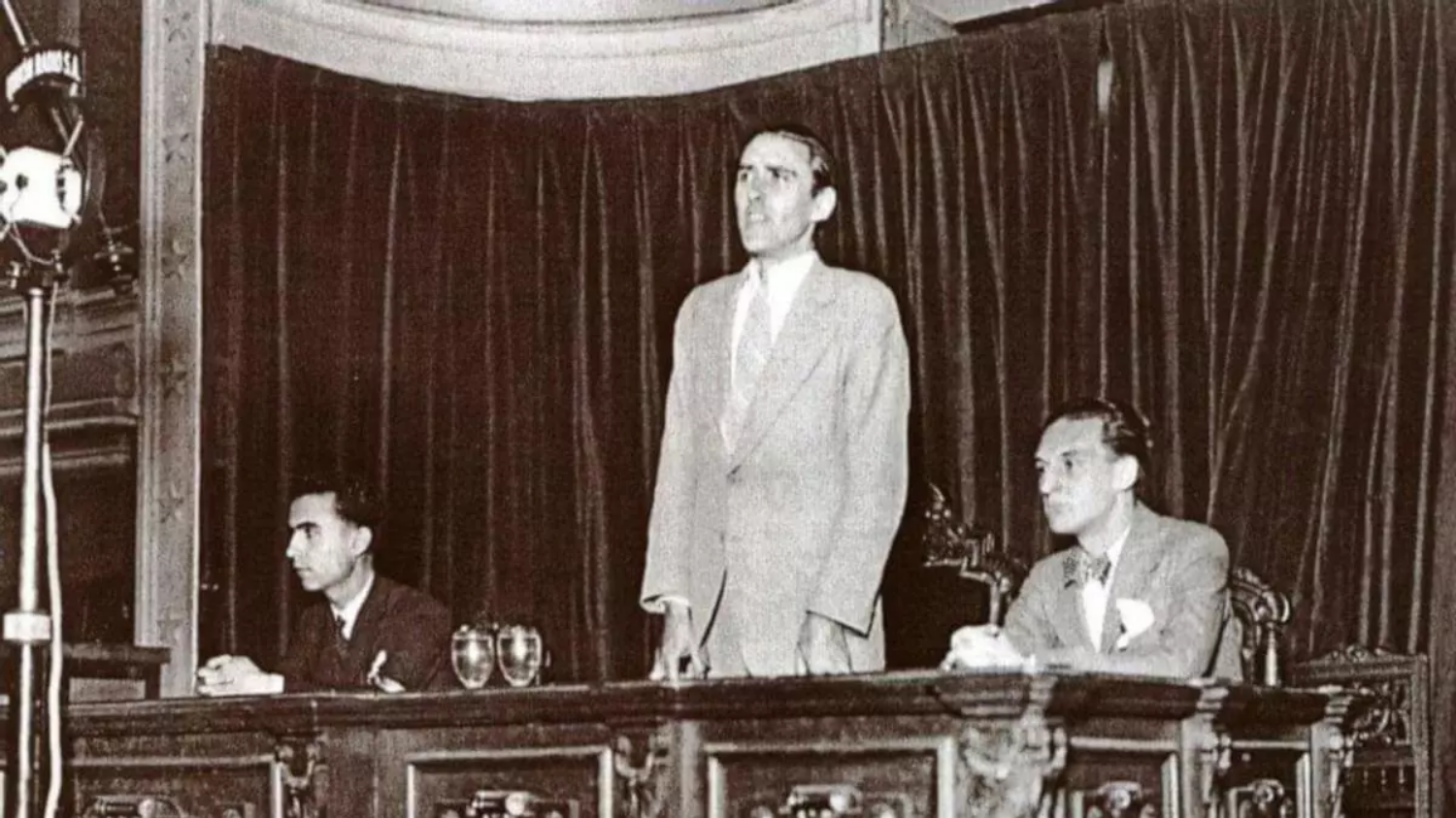
A further article will deal with the parties of the Spanish proletariat.
II.
The Socialist Party of Spain has been a sickly creature up to now. Up to the year 1919 it was bound to the Republican Party by the closest ties. Many of its present leaders have come from the ranks of bourgeoisie republicanism. In fact it is itself nothing more nor less than an ordinary bourgeois-republican party. Its propaganda centres much more around the forms to be adopted by governmental activity than around economic questions or class warfare.
Until the time of the split to which the Communist Party of Spain owes its existence, the Socialist Party numbered about 40,000 adherents. Today, its membership is considerably less. It exercises its chief influence in Madrid, Biscaya, Asturia, Galicia, and Andalusia. At the last ejections in April 1923, it gained seven seats in parliament, five of which were in Madrid, one in Bilbao, and one in Austunia. In the two provinces last named it openly enjoyed the support of the government. In Madrid, on the other hand, its victory was due to its campaign against the monarchy, which was held responsible for the military collapse in Morocco.
During the most active period of the Morocco campaign, the Socialist Party preserved a discreet silence. It also carefully Preserved silence at the time when the White Terror raged in Barcelona. Delighted with this description of “socialist action”, the bourgeois government acted most benevolently towards the socialist candidates in the provinces.
The socialist press is confined to the Madrid daily paper: El Socialist, with an edition of about 2,000, and to about 7 or 8 provincial weekly papers, each of which has also an average of about 2,000 subscribers. Almost all the notables of bourgeois republicanism contribute to El Socialista. If the party has, up to now, never nominated a candidate for bourgeois state power this is not owing to class consciousness, but solely to a republican state viewpoint, it cooperates zealously with the government in the institution for social reforms, where socialists and bourgeois intelligenzia make a joint study of social laws.
Pablo Iglesias is the best known representative of Spanish socialism, but his age and poor health have obliged him to abandon all public activity. His fundamentally republican standpoint has always prevented the Spanish socialists from separating from petty bourgeois radicalism. Iglesias is responsible to a very great extent for the error of making Madrid the centre of socialist activity, and for abandoning Barcelona, a great industrial city with over 300,000 proletarian inhabitants, to monarchist influences.
On the trade union field, the Socialist Party works through the organ of the General Labor Union, built up on the local unions and the national industrial federation. At the turn of the year 1919–1920 the General Labor Union comprised about 250,000 adherents. At its last congress, held in November 1922, the business report mentioned 218,000 members. As a matter of fact the number of members cannot much exceed 100,000. About one half of its members are peasants. It possesses not the slightest influence in the industrial districts, as for instance Catalonia. I he socialist tactics pursued by its leaders, Largo Cabaliero and Saborit, have completely disorganized the labor groups in Biscaya and Asturia, so that here there is nothing left of the old trade union organizations except the old bureaucratic framework. The reformist policy of the General Labor Union has caused some important trade unions, such as the Madrid Woodworkers’ Union, to leave this Union and to remain autonomous. Shortly before its November congress it expelled several revolutionary sections and some Biscayan trade unions from its ranks. And since this congress 29 further trade union sections have been punished for their communist views by expulsion. The leaders of the General Labor Union are at the present day the firmest pillars of Spanish capitalism in its wage cutting offensive.
Between 1902 and 1912, the working masses in Barcelona were under the influence of a governmental agent, the republican Lerroux. When the dissolution of the radical party set in, anarchist propaganda found an excellent soil in the Barcelona environment. Workers who had been led by the nose for 10 years by a “revolutionist” in the pay of the government, were very easily induced to follow the slogan: “Down with all politicians!” Pablo Iglesias, this remarkable socialist, withdrew himself entirely from the great labor centre, Barcelona, so that the small anarchist groups were able to seize upon the leadership of the proletarian movement.
Segui, who was murdered on March 11, of this year, showed the Spanish workers the road from anarchism to syndicalism. Thus the anarchists heading the labor movement became syndicalists. Between 1912 and 1915, Barcelona went through a period of complete confusion. The radicalism of Lerroux became disintegrated, and anarcho-syndicalism arose. In the year 1918, the National Labor Confederation of Catalonia was founded. This was the beginning of the formation of unified industrial labor unions.
The mass movement centred round the fight for higher wages. The terrorism exercised by the workers, the formation of united unions, and the relatively good state of the markets, tended to increase wages. There was a triumph for the National Labor Confederation, which held its second annual congress in December 1919, attended by the representatives of nearly a million workers.
Until April 1920 this magnificent Catalonian labor movement was under the leadership of the syndicalist elements of the confederation, headed by Segui. Then the anarchists commenced to fight to obtain power. The trade union committees passed into their hands. Suice this time the organizations – this must be plainly stated here – have gone from one defeat to another. The great lock-out was followed by the period of suppression, two great strikes in Barcelona were lost, and in November 1920, the government began a White Guard regime. The murder of all workers’ functionaries became systematic. This period of murder and violence lasted until November 1922.
The reorganization of the trade unions was taken up at the end of the year 1922. The National Labor Confederation of Spain, whose main centre of support is in Barcelona, survived the White Terror and probably comprises about 250,000 workers at the present time. In Barcelona it has a daily pa|ier at its disposal: Solidaridad Obrera (Labor Solidarity); this has a circulation of 30,000. The confederation has also about 8 weekly periodicals with an average edition of 3,000 copies.
The National Labor Confederation is composed of local trade union sections and regional unions and confederations. Affiliation to the Communist International was resolved upon at its annual congress held in 1919. But in June 1922 the national council of the confederation withdrew from the R.I.L.U. in consequence of a campaign of anarchist agitation. At the present time the National Labor Confederation is undergoing a severe crisis. The anarcho-syndicalism which has hitherto maintained the leadership is in a state of complete dissolution, and this dissolution reacts on the trade union organizations. Before the period of White Terror, the watchword of the movement was “direct action”. Terrorism was frequently held to be a means of attaining improvements. This description of direct action led however to a collapse. The employers were equally skilful in the employment of terrorism as a weapon, indeed they far outdid the workers in this. When the period of suppression neared its end in 1922, the anarchists were ready with the new slogan of “cultural work”: The salvation of the proletariat was now to be sought in the organization of schools, in instruction, in lectures. The anarcho-syndicalist press speaks of nothing but education, of moral qualities, and such desirable things. No stone is left unturned to make strikes impossible. The masses are offered a program for the improvement of housing conditions, betterment of street hygiene, etc. on a – communal basis!
The anarchists still at the head of the movement show an obvious lack of understanding of class war. Most of them are still exponents of the republican radicalism of Lerroux. They are one-time republicans who have been converted to anarchism. Having once been deceived by bad leaders, they cherish a deep antipathy against anything under the name of politics. They are inveterate federalists, speak unceasingly of liberty, revel in admiration of the French revolution, maintain closest intercourse with the republicans, but create an ever-widening chasm between themselves and the socialists and communists.
The situation resulting from these facts is exceedingly critical. The masses stream into the trade unions, but the lack of any revolutionary leadership and the hollow phraseology on individual culture disappoint them bitterly. The trade union committees resign their offices one after the other, and the persons composing them change frequently. Strikes break out, even extensive wage strikes, as for instance the last transport workers strike in Barcelona, but there is no one to undertake their determined leadership.
Under such conditions there can naturally be no victory. On the contrary, every struggle is bound to lead to defeat as soon as it becomes prolonged. The disintegration of anarcho-syndicalism will last some time yet. A reorganization centre has already been formed: the revolutionary trade union committees, composed of communists and syndicalists, these are gradually gaining ground. We believe that they will succeed in inducing the National Labor Confederation to descend from its Utopia of anarchist philosophy and to return to the solid ground of class warfare, so that it may be once more a powerful trade union organization fully equal to its tasks.
International Press Correspondence, widely known as”Inprecorr” was published by the Executive Committee of the Communist International (ECCI) regularly in German and English, occasionally in many other languages, beginning in 1921 and lasting in English until 1938. Inprecorr’s role was to supply translated articles to the English-speaking press of the International from the Comintern’s different sections, as well as news and statements from the ECCI. Many ‘Daily Worker’ and ‘Communist’ articles originated in Inprecorr, and it also published articles by American comrades for use in other countries. It was published at least weekly, and often thrice weekly.
PDF of full issue: https://www.marxists.org/history/international/comintern/inprecor/1923/v03n59[37]-sep-06-1923-Inprecor-loc.pdf
PDF of full issue 2: https://www.marxists.org/history/international/comintern/inprecor/1923/v03n60[38]-sep-13-1923-Inprecor-loc.pdf

