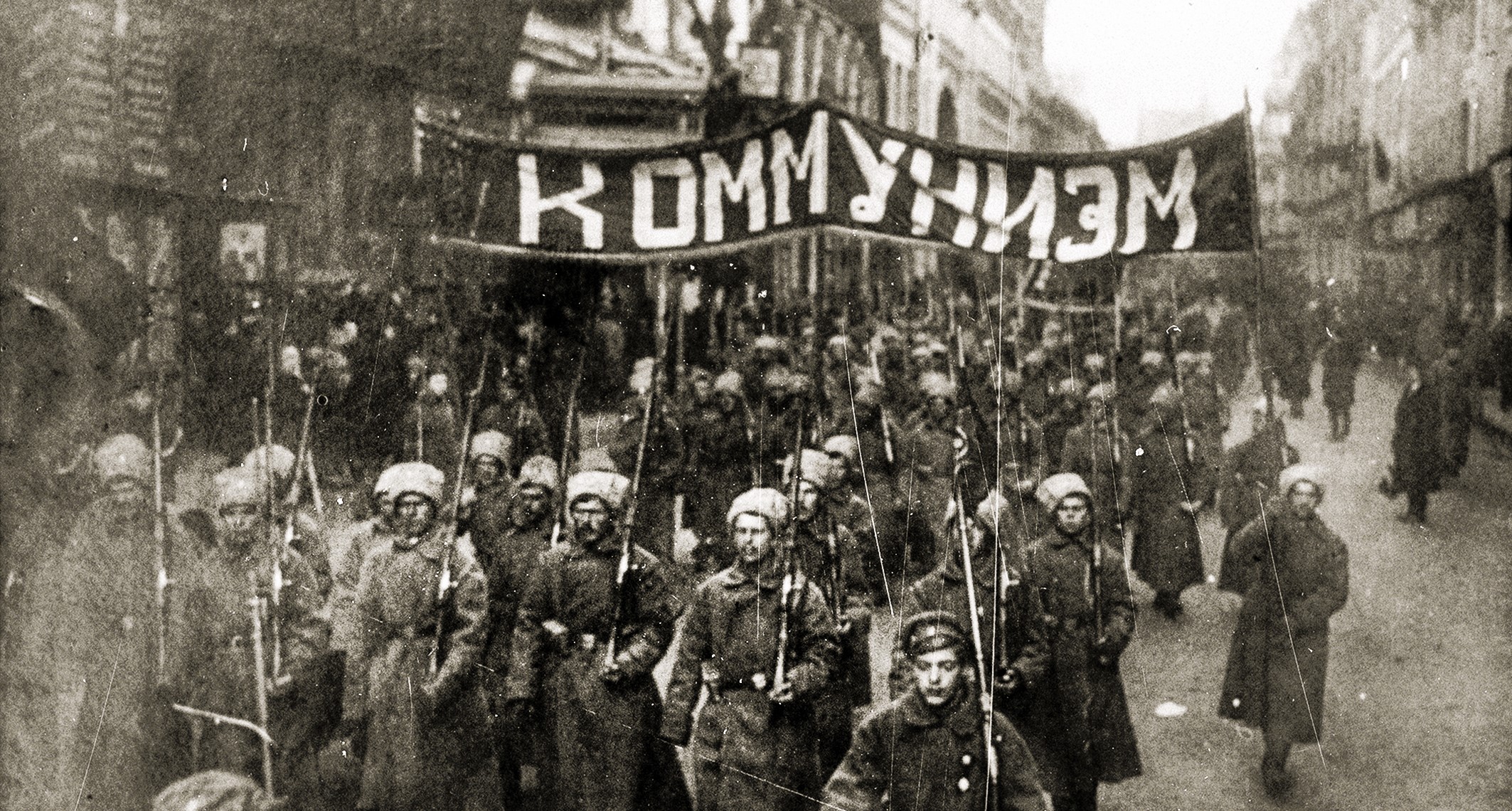
Lenin proposes a name change. When Lenin returned to Petrograd from Switzerland on April 16, 1917, the following day he presented what is now known as his ‘April Theses’ to Bolshevik members of the All-Russian Soviet, one of which was to rename the Russian Social Democratic and Labor Party (Bolsheviks) to the Communist Party.
‘A Name for Our Party Which Would be Scientifically Sound and Conducive to Proletarian Class Thinking’ by V.I. Lenin from The Tasks of the Proletariat in Our Revolution. Little Lenin Library No. 9. International Publishers, New York. 1932.
19. I am coming to the last point, the name of our party. We must call ourselves the Communist Party–just as Marx and Engels called themselves Communists.
We must insist that we are Marxists and that we have as a basis the Communist Manifesto, which has been perverted and betrayed by the Social-Democracy on two important points: (1) The workers have no country; “national defence” in an imperialist war is a betrayal of Socialism; (2) Marx’s teaching about the state has been perverted by the Second International.
The term “Social-Democracy” is unscientific, as Marx showed repeatedly, particularly in the Critique of the Gotha Programme, in 1875, and as Engels restated in a more popular form, in 1894. Mankind can pass directly from capitalism only into Socialism, i.e., into social ownership of the means of production and the distribution of products according to the work of the individual. Our party looks farther ahead than that: Socialism is bound sooner or later to ripen into Communism, whose banner bears the motto: “From each according to his ability, to each according to his needs.”
That is the first reason.
Here is my second: The second part of the term “Social-Democracy” is scientifically wrong. Democracy is only a form of state, while we Marxists are opposed to every form of state.
The leaders of the Second International (1889-1914), Messrs. Plekhanov, Kautsky and their ilk, perverted and debased Marxism. The difference between Marxism and Anarchism is that Marxism admits the necessity of the state during the transition from capitalism to Socialism; but (and here is where we differ from Kautsky and Co.) not the kind of state found in the usual, parliamentary, bourgeois, democratic republic, but rather something like the Paris Commune of 1871 and the Soviets of Workers’ Deputies of 1905 and 1917.
There is a third reason: Life and the revolution have already established here in a concrete way (although in a form which is still weak and embryonic), this new type of “state,” though it is not really a state in the proper sense of the word.
It is now a question of the action of the masses and not merely of theories of leaders.
Essentially the state is the power exercised over the masses by a group of armed men separated from the people.
Our new state, which is now in process of being born, is also a real state, for we, too, need detachments of armed men; we, too, need the strictest order, and the ruthless crushing of all attempts at a tsarist as well as a Guchkov-bourgeois counter-revolution.
But our forming, new state is not yet a state in the proper sense of the word, for the detachments of armed men found in many parts of Russia are really the masses themselves, the people, and not simply privileged individuals, practically unremovable, placed above and separated from the people.
We ought to look forward, not backward; we ought to look away from the usual bourgeois type of democracy which has been strengthening the domination of the bourgeoisie by means of the old, monarchistic organs of government, the police, the army, and the bureaucracy.
We must look forward to the advent of the newly born democracy, which is already ceasing to be a democracy, for democracy means the people’s rule, while, obviously, an armed people could not rule over itself.
The word democracy is not only not scientific when applied to the Communist Party, but, since March, 1917, it has simply become a blinker placed upon the eyes of the revolutionary people, preventing the latter from establishing boldly, freely, and on its own initiative a new form of power: the Soviets of Workers’, Soldiers’, etc., Deputies, as the sole power in the state and as the harbinger of the “withering away” of the state as such.
There is a fourth reason: We must take into account the objective international condition of Socialism.
Its condition is no longer what it was between the years 1871 and 1914, when Marx and Engels consciously allowed the inaccurate, opportunist term “Social-Democracy.” For history proved that what was most needed in those days, i.e., right after the defeat of the Paris Commune, was slow work of organisation and enlightenment. Nothing else was possible. The Anarchists were then, as they are now, theoretically, economically, and politically wrong. The Anarchists made a wrong estimate of the time, for they did not understand the world situation: the worker of England corrupted by imperialist profits; the Paris Commune destroyed; the bourgeois-national movement in Germany flushed with recent victory; and semi-feudal Russia still sleeping the sleep of centuries. Marx and Engels gauged the hour accurately; they understood the international situation; they realised the need of a slow approach toward the beginning of the Social Revolution.
We, in turn, must understand the peculiarities and the tasks of the new epoch. Let us not imitate the woe-Marxians of whom Marx himself said: “I sowed dragons and I reaped fleas.”1
The objective needs of capitalism which has grown into imperialism have brought forth the imperialist war. This war has brought mankind to the brink of a precipice, to the destruction of civilisation, the ruin and brutalisation of countless millions of human beings.
There is no other way out, except a proletarian revolution.
And just when that revolution is beginning, when it is taking its first awkward, timid, weak, unconscious steps, when it is still trusting the bourgeoisie, at that moment the majority (it is the truth, it is a fact) of the Social-Democratic leaders, of the Social-Democratic parliamentarians, of the Social-Democratic papers, in a word, all those who could spur the masses to action, or at least the majority of them, are betraying Socialism, are selling Socialism, are going to fight the battles of their national bourgeoisie.
The masses are distracted, baffled, deceived by their leaders.
And should we aid and abet that deception by retaining the old and worn-out party name, which is as decayed as the Second International?
It may be that many workers understand the meaning of Social-Democracy honestly. It is high time that we learn to distinguish between the objective and the subjective.
Subjectively, these workers, who are Social-Democrats, are the most loyal leaders of the proletarian masses.
Objectively, however, the world situation is such that the old name of our party helps to fool the masses and retard their onward march. Every day, in every paper, in every parliamentary group, the masses see leaders, i.e., people whose voice carries far, whose acts are very much in evidence, who also call themselves Social-Democrats, who are “for unity” with the betrayers of Socialism, the social-chauvinists, and who are trying to collect on the notes issued by Social-Democracy…
Are there any reasons against the new name? We are told that one may confuse us with Anarchists-Communists.
Why are we not afraid of being confused with the Social-Nationalists, the Social-Liberals, the Radical-Socialists, the foremost, the most adroit bourgeois party in the French Republic at deceiving the masses? We are told: “The masses have grown used to the name, the workers have learned to love their Social-Democratic Party.”
That is the only reason, but this reason goes counter to the teachings of Marxism, disregards the revolutionary tasks of tomorrow, the objective position of Socialism the world over, the shameful breakdown of the Second International, and the injury done to the cause by the pack of “also Social-Democrats” surrounding the proletarians.
This reason is based solely on laziness, somnolence, and love of routine.
We want to rebuild the world. We want to end this imperialist World War in which hundreds of millions of people are involved, and billions of dollars are invested, a war which cannot be ended in a truly democratic way without the greatest proletarian revolution in history.
And here we are, afraid of our own shadow.
Here we are, keeping on our backs the same old soiled shirt…
It is high time to cast off the soiled shirt, it is high time to put on clean linen.
Petrograd, April 23, 1917.
First published as a separate pamphlet, September, 1917, by the “Priboi” publishing firm.
NOTE
1. An expression which Marx borrowed from Heine. Ed.
The Tasks of the Proletariat in Our Revolution by V.I. Lenin. Little Lenin Library No. 9. International Publishers, New York. 1932.
Contents: Introduction by Alexander Trachtenberg, I) The Tasks of the Proletariat in Our Revolution -Draft Platform for the Proletarian Party, The Class Character of the Revolution That Has Taken Place, The Foreign Policies of the New Government, Unique Dual Power and Its Class Meaning, The Peculiarity of the Tactics Following from the Above, Revolutionary Defencism and Its Class Meaning, How the War Can Be Ended, The New Type of State Arising in Our Revolution, The Agrarian and National Programmes, Nationalisation of the Banks and Capitalist Syndicates, The State of Affairs in the Socialist International, The Breakdown of the Zimmerwald International – The Necessity of Founding a Third International, A Name for Our Party which Would Be Scientifically Sound and Conducive to Proletarian Class Thinking (April 23, 1917) II) The Tasks of the Proletariat in the Present Revolution (April 20, 1917), III) Letters on Tactics, Foreword, The Present Situation (April, 1917).
PDF of original pamphlet: https://ucf.digital.flvc.org/islandora/object/ucf%3A5341/datastream/OBJ/download/The_tasks_of_the_proletariat_in_our_revolution.pdf
 Revolution's Newsstand