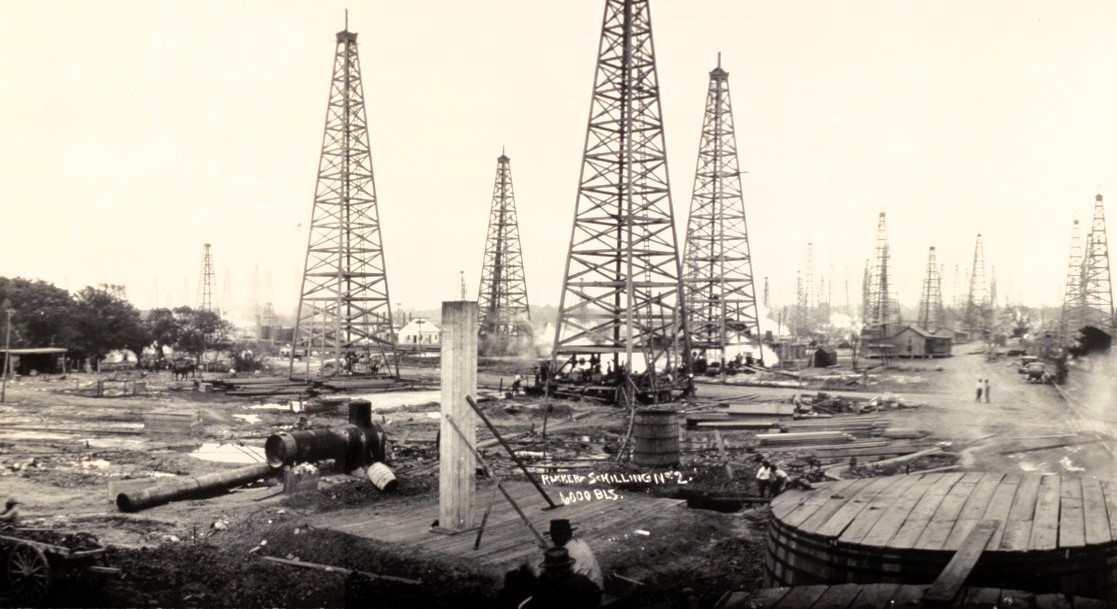
The racialized hellscape of Texas in the oil boom.
‘In Texas Oil Towns’ by Sam from the Daily Worker. Vol. 4 No. 247. October 29, 1927.
HOUSTON, Tex., Oct. 25. I “smelled oil” a few miles before I approached Bay Town, which is the first of the three towns (from Houston) comprising the Goose-Creek Oil territory. The other two are Goose Creek and Pelly.
Distinctly Different.
Even though all three towns lie just within a mile distance from each other, they are just as distinctly different as are the lower East Side and Riverside Drive.
Bay Town, which is the youngest of the three is chiefly populated by the Mexican laborers. From 6 to 10 p.m. you will see them standing in groups and chatting in that lively Mexican language, or listening to a Mexican song on a victrola. One gets the impression of being in Mexico, so predominant is the Mexican in Bay Town.
And just about a mile away, seems like the same town, same two blocks of business houses, but a different. element entirely. This is Goose-Creek. Here they are more business like. Most of the faces are black. The predominant element is the Negro, and also the younger, unskilled, shifty white laborer.
Pelly is the “Aristocrat.” There live the bosses, and skilled workers of the oil fields. Here most everyone “owns his home and flivver.” Both are worth about $800.00. There is no place for the “dirty n***rs” here in Pelly. They can be seen here only at work.
Rich Oil Fields.
Between Bay Town and Goose Creek lies the biggest oil refinery I ever saw. As far as I could see there were stretches of tanks, pipes, pumps, some kind of machines and again the same things. For miles it spread.
And just outside of Pelly, right by the road, are located the oil wells. Working three shifts. No stops. The oil is transferred directly to the refineries thru a system of underground pipes. A great deal of the oil is spilled all around the wells. Just by the road. Forming large brown-black pools. Treacherous it seems. I do not know how deep they are. There is only one odor around; the stench of petroleum. Heavy. Leaving its stench on everything.
Conditions of Work.
Conditions of work are far from being good. The oil magnates’ greediness for profits, is evident all around. The lives of the workers are not protected. Instead, a system of insurance is established. It is compulsory, and the insurance fee is deducted from the salary.
There is no organization at all among the oil workers. And the American Federation of Labor seems to be too busy fighting the militants in the trade unions, to even think of organizing the oil workers.
Wages.
The majority of the oil workers are unskilled laborers. Mexicans and Negroes mostly. They receive from $2.00 to $3.50 a day. Or night shift. Same hours for night shift. The highest skilled workers receive up to $150.00 a month. Day or night shift. The laborers live in constant bondage, due to debt, to the local petty sharks (store keepers) who see to it that the laborers get the least for the most. They live from pay-day to pay-day (twice a month) and keep on paying the ever-increasing debts.
Women Terribly Exploited.
There are hardly any women employed in the oil fields. While the men are working in the oil fields the women try to get any sort of employment in the towns.
I spoke to a few girls working in the laundry in Goose Creek. Here are some of the conditions as told by the girls. Nine-hour day without rest One dollar thirty-five cents per day Conditions intolerable. Several of the 36 girls employed faint every day. The company deducts from the wages the fainting time. I asked them why don’t they organize and get better conditions. Did not care much; just worked temporarily, they said. The local stores often (at pay-days) employ a number of girls, during sales, and pay them $6.00 to $8.00 a week. For an 11-hour day. Six full days.
These are the conditions of the “liquid gold” workers, and their families. There is only one way to improve their conditions. Organization. How soon?
The Daily Worker began in 1924 and was published in New York City by the Communist Party US and its predecessor organizations. Among the most long-lasting and important left publications in US history, it had a circulation of 35,000 at its peak. The Daily Worker came from The Ohio Socialist, published by the Left Wing-dominated Socialist Party of Ohio in Cleveland from 1917 to November 1919, when it became became The Toiler, paper of the Communist Labor Party. In December 1921 the above-ground Workers Party of America merged the Toiler with the paper Workers Council to found The Worker, which became The Daily Worker beginning January 13, 1924.
PDF of full issue: https://www.marxists.org/history/usa/pubs/dailyworker/1927/1927-ny/v04-n247-NY-oct-29-1927-DW-LOC.pdf

