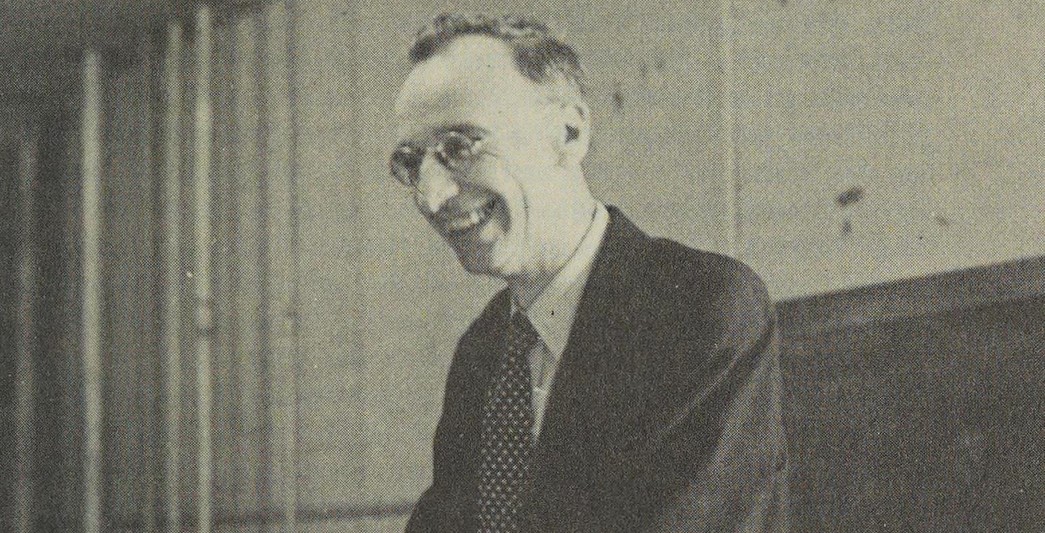
Taking the long view and knowing history, Muste finds hope for the labor movement.
‘Progressives Can Win’ by A.J. Muste from Labor Age. Vol. 18 No. 2. February, 1929.
Hopeful Aspects of the Situation
There seems to be a good many people who think that we ought to have a progressive labor movement. But can we have such a progressive movement as is described elsewhere in this issue of Labor Age? That is the big question. Perhaps we are like children, crying for the moon?
It is certainly true that there are tremendous difficulties in the way of developing a more progressive labor movement in the United States and anyone who thinks the job is an easy one had better not tackle it at all. Here, however, I want to point out one encouraging aspect of the matter. The fact is, as indicated elsewhere in this issue, that it is only a few years ago (four to seven years to be exact) that we had such a progressive labor movement in the United States. What we had five years ago we may perhaps have again. The labor movement knows many ups and downs, and certainly the fact that progressivism has had a hard time of it for a short while does not warrant the conclusion that it is dead forever. If that were the case, the whole American labor movement would have been dead long ago.
Furthermore, the progressivism that constituted such an important element in the American labor world a few years ago was not a freak appearance that had come suddenly from nowhere and might be expected to disappear as suddenly and completely. On the contrary, progressivism had a long, normal and natural growth in our movement.
I can best make my point clear perhaps by an illustration from the development of the British labor movement. About 1850 there appeared in Great Britain what we should call “pure and simple trade unionism.” The prevailing structure of the unions of the period was craft or trade rather than industrial. The dominant unions were those of the building, printing and certain other skilled trades. The movement did not believe in independent political action. It accepted the prevailing system of industry and simply sought for immediate gains in the way of wages, hours and conditions under that system. It was a trade union movement suited to the period when British capitalism was young and growing, when the wage level was rising, and industry was still on a comparatively small scale so that the skilled workers held the key to the situation.
Now about 1870, this type of unionism was well established, and it must be set down to its everlasting credit that it laid the permanent foundation of the British labor movement so that that movement was never again virtually wiped out in a crisis as had happened before. Having become firmly established, this unionism gradually became conservative and stale, as so often happens to institutions and movements of all kinds, and the utterances of some of the leaders of the British Trade Union Congress at that time are such as to make those of the present Executive Council! of the A.F. of L. sound revolutionary by comparison!
During the 1870s there also came a change in the British economic and industrial position, however. Germany and the United States developed their industries and Britain no longer reigned alone as “the workshop of the world.” The standard of wages was no longer rising steadily. “Big industry” was coming in and with it masses of unskilled and semi-skilled workers. The skilled workers accordingly no longer held the key to the situation. They found it more and more difficult to protect their own position, but even if they succeeded in doing this, they failed to organize the masses. The movement became less and less a movement, more and more a business proposition for a small percentage of the workers.
The Tide Turns
In 1889 comes a turning of the tide. Great strikes of unorganized workers in the basic industries began to occur. Unions were formed in these industries and it is the unions of those industries, railroad workers, miners, dock workers, steel workers, that became the backbone of the British Trade Union Congress. Independent political action is again tried and the British Labor Party developed. The movement no longer accepts the present capitalist system as final, but begins to think of itself as a great social force destined to bring in the good life for all men.
Now if we turn to the United States, we find that the labor movement in this country has on the whole followed the same line. From about 1880 to 1900 what we call “pure and simple trade unionism” developed under the auspices of the American Federation of Labor, and it must be set down to its credit that it laid what appears to be a permanent foundation for the American labor movement. In this movement of the 80s and 90s the craft and trade union rather than the industrial union predominated. The building, printing and a few other skilled trades were the most prominent in the movement. Independent political action was eschewed. The movement occupied itself almost altogether with the achievement of immediate gains.
It was a movement suited to a time when American capitalism was comparatively young.
By 1900 “big industry” was developing in the United States, and a change comes over the labor movement also. Big strikes of unskilled and semi-skilled workers occur. Industrial unions are built not only outside the A.F. of L. by the I.W.W., but inside the A.F. of L. in such unions as the United Mine Workers and the United Textile Workers. Unions of railroad workers, miners, machinists, become more prominent in the general labor movement. The workers become increasingly interested in independent political action. In 1912 Debs polled nearly 1,000,000 votes at a time when women did not yet have suffrage and a million votes meant a great deal more than they do today.
Industrial Unionism Grows
The great war comes along and for a moment interrupts this development, but it is noteworthy that immediately after the signing of the Armistice the thread is taken up again. In 1919 and the years immediately following, railroad workers, miners, machinists, etc., are to the front in the movement. There is a fresh tendency toward industrial unionism in one form or another, as, for example, in the building up of the System Federation scheme among the shop crafts on the railroads. All kinds of experiments to develop labor political action are tried. These culminate in the well-known LaFollette campaign of 1924.
Before that date the labor movement had already suffered serious set-backs in some great strikes, and immediately after the LaFollette campaign the labor progressive movement seemed to collapse entirely, although LaFollette had polled about 5,000,000 votes. The reasons for this collapse we cannot go into at length here. Suffice it to say that when American capitalism had caught its breath after the close of the war, it found itself in possession of a vast industrial machine which had been built for war purposes but was turned effectively to peace purposes. It found its rivals weakened by the war and largely at its mercy. American big business was thus in the saddle. It learned a few new tricks. It was able to give the workers what seemed a high standard of living and to render them, superficially at least, contented. At the same time changes occurred in the labor movement. Some moved to the right, some to the left, some took an uncomfortable seat in the middle of the fence, spending most of their time perhaps in protesting to the Communists that they were not A.F. of L.ers and to the A.F. of L. that they were not Communists!
But surely no one who has the slightest knowledge of labor history expects that these conditions will last forever. Big business in America is powerful indeed but it has not been proven that labor is altogether powerless to stay its headlong course. Nobody who knows his America will expect the farmers and workers to be as meek and quiet forever as they have been in the past few years. Only a few short years ago we had a vigorous labor progressivism. We can have it again, if we will and if we make skillful use of the conditions with which we are confronted. Assuming that we have the conditions out of which progressivism may possibly grow, two things need to be done immediately. First, such progressive elements as exist must be brought together. They must talk through their problems together. They must come to understand each other and must organize their forces. Secondly, we must launch a campaign of education among the workers wherever they can be reached, teaching them what the present regime of Coolidge-Hoover-Mellon republicanism, big business and imperialism is actually doing to them. Let’s get busy at these jobs, and we shall soon lose that it-can’t-be-done feeling.
Labor Age was a left-labor monthly magazine with origins in Socialist Review, journal of the Intercollegiate Socialist Society. Published by the Labor Publication Society from 1921-1933 aligned with the League for Industrial Democracy of left-wing trade unionists across industries. During 1929-33 the magazine was affiliated with the Conference for Progressive Labor Action (CPLA) led by A. J. Muste. James Maurer, Harry W. Laidler, and Louis Budenz were also writers. The orientation of the magazine was industrial unionism, planning, nationalization, and was illustrated with photos and cartoons. With its stress on worker education, social unionism and rank and file activism, it is one of the essential journals of the radical US labor socialist movement of its time.
PDF of full issue: https://www.marxists.org/history/usa/pubs/laborage/v28n02-Feb-1929-Labor%20Age.pdf

