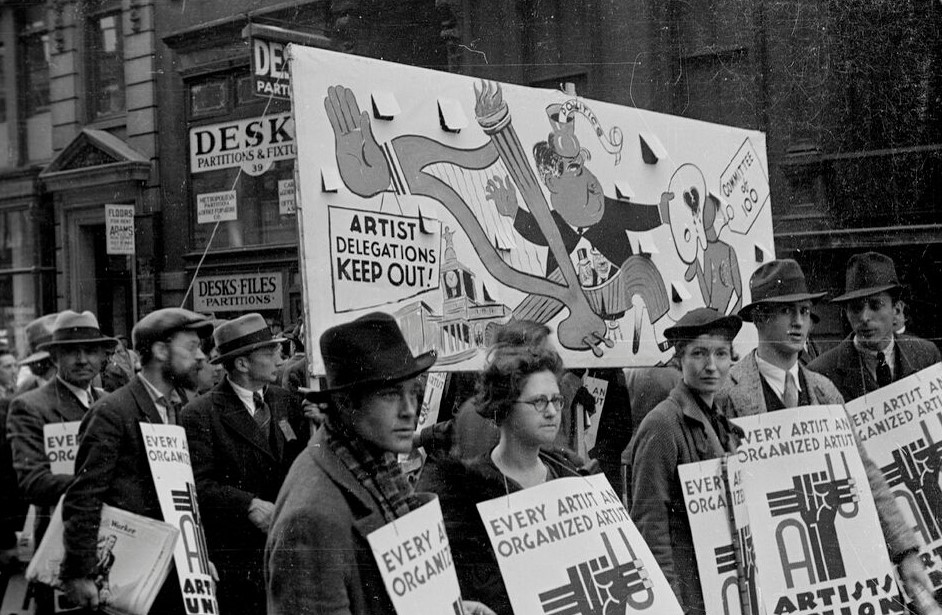
Unemployed artists organize during the Great Depression.
‘Artists on Work Relief’ from Art Front. Vol. 1 No. 2. January, 1935.
Project Organization — Artists’ Union
THERE is a great need for the services of unemployed artists: There are public buildings which need the work of mural painters and sculptors. There are hundreds of social institutions which require the services of teachers of arts and crafts. The city administration said that it recognized this need, and that it was going to carry out an art program which would arouse the creative and appreciative faculties of the millions of underprivileged children and workers in the city. The city hired two hundred and ninety-three unemployed artists to do this. One hundred and fifty-three of them are teaching painting, drawing, crafts, sculpture, pottery, marionette production and commercial art. One-hundred and eight are decorating the walls of schools, hospitals, and welfare institutions, prisons, and other public buildings. Twenty-eight are busy doing posters for tax-free or tax-supported institutions.
The city sent these artists to places where an art program was never heard of. They went into the poorest and most slum-ridden sections of the city. They succeeded in interesting thousands of children and adults who never had an art education. Their exhibitions were praised everywhere. Public officials, from the mayor down, were photographed, visiting workshops, lauding exhibitions, and shaking hands with puppeteers.
The city administration was going in for Art in a big way. The mayor loves art, and he wants the city to love it, too. But the artists, to say the least, are a little skeptical. Only a handful are employed at present. Thousands of applications of unemployed artists are gathering dust in the College Art Office. The artists who are on work-relief are under the continual threat of lay-offs. This whole art program has taken the form of a cheap political gesture and not that of a program which the administration announced—one which would meet the needs of the unemployed artists and the masses of New York’s working people who would benefit from a thorough-going art program.
The work of these artists has successfully testified to the legitimacy of their demand for permanent jobs with professional wages. The administration and its dictators, the bankers, don’t think so. They don’t think they are getting art cheaply enough. In spite of the fact that the city only pays twenty-five per cent of the salaries of these artists, which amounts to six dollars per week per artist, they still think the cost of art too high. The administration and its bankers have decreed that work-relief must go, City Chamberlain, Mr. Berle, makes the following statement in the N.Y. Times of Dec. 7th: “The general attitude to unemployment that appears to be existent in financial circles favors the substitution of a subsistence dole for work-relief.” This “attitude” has been made concrete by the renewal of investigations of artists on work-relief. This is the prelude to lay-offs and wage-cuts. Mr. Corsi, head of the Home Relief Bureau, announced that all workers with less than two dependents will be dropped from work-relief rolls. The bankers, the Mayor, Hodson and the College Art Association are making no bones about their antagonistic attitude toward artists on relief. Hodson has recently further outlined the policies of the administration. He suggests that in order to salvage the pride of all those on home-relief, they should have the opportunity of working for their miserable dole. This means that artists will find themselves teaching and painting on walls at two dollars and fifty cents per week. This is clearly a forced labor policy. This is how the administration plans to carry out its art program.
In the face of these policies, the only resource left to the artist that can protect his means of livelihood is organization. The artists on the projects are realizing this more keenly every day and are joining the Artists’ Union in growing numbers.
Each project has elected its own grievance committee which handles all cases of discrimination and injustice. These are many. The mural projects have received inadequate supplies of materials after long periods of delay, These, when received, are found to be of poor quality and hamper the progress of the work on the walls. The scaffolding is of the most inferior kind and no definite statement has yet been received from College Art on the question of workmen’s compensation in case of injury. All sketches must be submitted to an art commission, which enforces the strictest censorship. Jonas Lie heads this commission. Jonas Lie, you will remember, paid for the release of John Smiuske, a jailed Rooseveltian who destroyed a painting which did not deal sympathetically with the President’s countenance. By this action Lie definitely showed himself as an opponent of our democratic rights which, to the artist, mean freedom of expression and conception. These are a few of the difficulties of the mural painters.
On Project 259, which consists of art teaching in settlement houses and in social institutions, other grievances are encountered. These artists are over supervised, not only by a staff of supervisors and snoopervisors, but also by timekeepers who arbitrarily dock them a half day’s pay on the timekeeper’s own opinion of what constitutes lateness. They have also been subjected to continuous transfers, which greatly hamper the development of their work with the children. This last grievance, however, has finally been eliminated through the activities of 259’s Grievance Committee, Artists can no longer be transferred at the whim of a supervisor or a house. The artist must be consulted first. Many art teachers have been forced to purchase their own supplies in order to keep their groups going. The Grievance Committee has taken this up, too, but many of the artists hesitate to press this issue, fearing that it will jeopardize their jobs. These are but a few of the local grievances which organization has taken steps to eliminate.
Every grievance can be eliminated. Every demand can be won. Every job can be made permanent, and at professional salaries, if the artists solidly organize their ranks against the policies of the administration and its bankers. The artist must realize that passive resistance cannot stave off the waves of lay-offs and wage-cuts and the recurring relief crises. Adequate appropriations must be forced to maintain all artists now on work-relief and to expand the program to include all unemployed artists in the city. This can only be guaranteed through the united action of the employed and unemployed artists. Build the Union!
The demands of the project artists are:
1. Permanent jobs.
2. Professional salaries.
3. Workman’s compensation,
4. Supervision by and for artists.
5. No discrimination against organization.
Artists’ Committee of Action meets every Monday, 8:30 p.m., at its new headquarters, 919 Eighth Avenue, between 54th and 55th Streets.
Art Front was published by the Artists Union in New York between November 1934 and December 1937. Its roots were with the Artists Committee of Action formed to defend Diego Rivera’s Man at the Crossroads mural soon to be destroyed by Nelson Rockefeller. Herman Baron, director of the American Contemporary Art gallery, was managing editor in collaboration with the Artists Union in a project largely politically aligned with the Communist Party USA.. An editorial committee of sixteen with eight from each group serving. Those from the Artists Committee of Action were Hugo Gellert, Stuart Davis, Zoltan Hecht, Lionel S. Reiss, Hilda Abel, Harold Baumbach, Abraham Harriton, Rosa Pringle and Jennings Tofel, while those from the Artists Union were Boris Gorelick, Katherine Gridley, Ethel Olenikov, Robert Jonas, Kruckman, Michael Loew, C. Mactarian and Max Spivak.
PDF of full issue: https://www.marxists.org/history/usa/parties/cpusa/art-front/v1n02-jan-1935-Art-Front.pdf
 Revolution's Newsstand