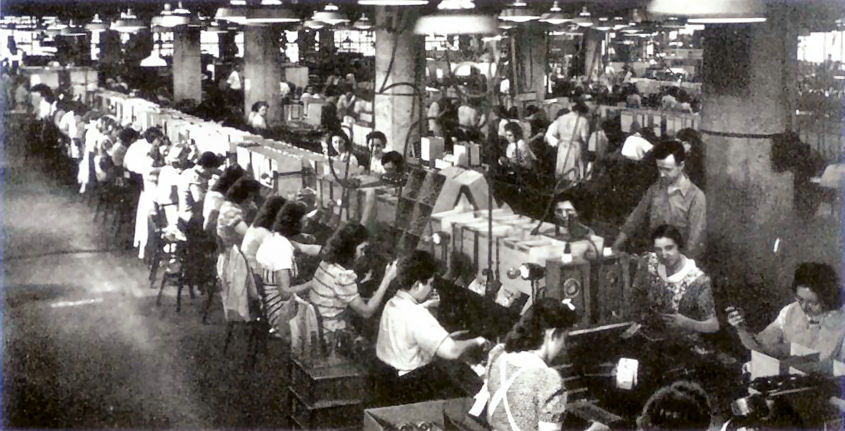
Internal report on Communist Party activity in the strike of 4000 workers at Cincinnati’s massive Crosley radio and refrigerator factory.
‘Party Agitation in the Crosley Strike’ by R. Gunkel from Party Organizer. Vol. 8 No. 6. June, 1935.
OCCURRING in a branch of the communications industry, the Crosley strike in Cincinnati, which involved 4,000 workers, was important for our Party both locally and nationally. It was important, not only because of the nature of the industry, but because of our activity in organizing the industry throughout the country, and because of the magnitude of the plant involved.
The strike was called when Crosley officials refused to officially confirm a grant of the following demands raised by the Radio and Refrigerator Workers local of the A.F. of L. within the plant:
1. Seniority rights;
2. Time and a half for overtime;
3. Half a day’s pay when called and not allowed to work;
4. Recognition of the union.
Essentially, it was a strike for recognition, since the management was ready to post an unsigned bulletin granting the first three demands. Recognition, Crosley declared, was out of the question because of his membership in the National Metal Trades Ass’n.
The union correctly recognized that not to call for strike in this situation would mean the death of the union in Crosley Radio. The temper of the membership is indicated by the threat of some workers to leading union officials: “If you don’t give us action now, we’ll tear up our books.”
The strike lasted for ten days. On the third day militancy or the strikers compelled Crosley to dismiss his scabs and close the plant. This was at the height of the refrigerator season with production nearing the peak of 1,000 units a day. The strike ended with the intervention of Safety Director Hoehler, and posting with him by the company of a grant of seniority, and time and a half, and of 2 hours pay when called and not allowed to work. The workers were obliged to accept these small gains.
The union was, therefore, still without formal recognition, but in practice it had demonstrated its ability to close the plant, and it had increased its membership from 1,600 to 3,200 out of the 4,000 workers employed at the peak.
Agitation Before the Strike
Previous to the strike two members of the Party were active in the union. They had several important posts, and around them was a small group of workers partly under their influence. One of the measures taken to bring the workers closer to the Party was to enter two-week subscriptions for them to the Daily Worker. Some literature was also sold to them, but not systematically. Attempts were also made to sell the Daily Worker outside of the plant, but the members of the concentrating unit were never made to feel sufficiently the responsibility of carrying out this work. The results were, therefore, negligible. From time to time general Party leaflets—August first, election rally, etc.—were distributed in front of the plant, but no leaflet dealing with the specific problems of Crosley workers was distributed until about two weeks before the strike. This leaflet dealt with Crosley’s hiring and firing policy, with its wage-cutting consequences, and raised the question of seniority. It was received with immense enthusiasm and definitely established the Party in the minds of Crosley workers as a vital force in their own struggles. At the same time, members of the Section Committee established personal contact with leading members of the union and even spoke at the union meetings, although not in the name of the Party. Therefore, in spite of its uneven work, at the moment of the strike, the Party had put itself in a good position for extending its agitation and organizational influence during the course of the strike.
During the Strike
When the strike broke, however, the Party as a whole was slow in responding to the situation. The fraction in the Unemployment Council failed to discuss the strike (of which it had been warned several days before), and the Council therefore, was not immediately mobilized. The concentrating unit was also backward in this respect. In consequence, on the first morning of the strike only the organizer of the concentrating unit and one other comrade were on the picket line with a Party leaflet.
To remedy this, an outline was immediately drawn up by the Agitprop department, analyzing the significance of the strike, its possible development, the forces and issues involved, the duty of the Party and the entire membership in regard to the strike, and the weaknesses to be overcome. This outline was distributed to every Party member and discussed in every unit.
The result was good. Subsequent days of the strike found more and more Party members on the picket line, agitating among the workers, distributing leaflets and Daily Workers, etc. The Unemployment Council was mobilized; it distributed its own leaflet, declaring solidarity; and one Council local marched through town under its own banner to offer aid, accompanied by the cheers of workers along its line of march.
The leaflet issued by the Party on the first morning of the strike was drawn up by two members of the concentrating unit, who had no time to submit it for criticism. In consequence, the leaflet had an alarmist appearance and dealt mostly with the danger of provocation. It dealt only incidentally with the call for mass picketing, for solidarity, and neglected entirely the popularization of demands, etc. But whatever its defects, it had a good reception. Strikers eagerly took the leaflet and aided in its distribution.
There were four subsequent leaflets in the 10 days of the strike, totaling about 8,000 copies. In addition 4-5,000 leaflets were issued to workers in other shops urging them to contribute to the strike fund, to protest against strikebreaking activities of the police, and above all, to organize and raise their own demands as the highest form of support to the Crosley strikers. But especially it pointed out the necessity of united front action of all workers against the growing offensive of the government and the capitalist class as a whole.
The main ideas in the Crosley leaflet were:
1. Maintain mass-picketing—keep out the scabs—close the plant—don’t be fooled by talk about law and order: “‘Order’ for you and ‘order’ for Crosley are two different things. ‘Order’ for you means keeping all scabs out of the Crosley plant. ‘Order’ for Mr. Crosley means opening the shop with scabs.”
2. The strike can be won against the opposition of Crosley, the Chamber of Commerce, the Metal Trades Ass’n, the police, and the city administration only by working-class solidarity—Unite all Cincinnati workers behind your demands.
3. Don’t be fooled by the arbitration swindle—there are no “impartial” arbitrators—look at automobiles, textiles and steel—it’s class against class—kick the bluffers out—demand that Crosley negotiate with you directly.
Thus the class issue was plainly drawn, but none of the leaflets issued clearly indicated the role of the Party. In all the leaflets issued there was not a word about the Party except the signatures and the expression of sentiments like this: ‘The Communist Party supports you, etc.” How the Communist Party differs from any class-struggle, trade-union organization no Crosley worker would have been able to discover from these leaflets except by the implications of its name. It is, of course, impossible to tell everything in one leaflet. But in five leaflets, the omission under circumstances like these is inexcusable.
This failure illustrates our tendency to shift from one extreme to another—a danger we need to be constantly aware of. In the past, before we began to turn seriously toward trade-union work, leaflets were written with so much of the Communist Party and its revolutionary aims in them that workers could find nothing about the issues immediately facing them. Today it’s the other way around, and the workers sometimes have to go to the capitalist press to find out that we are a revolutionary party. We still have to learn—by forethought, not afterthought—how to combine effectively our agitation on immediate issues with agitation on ultimate aims.
Similarly, when the National Organizer of the union blamed all violence in the strike on the Communists, we failed to seize this opportunity to state our position. This was a splendid chance for basic agitation. But, for insufficient reasons, we let it pass.
Another shortcoming was the introduction of demands not raised by the strikers themselves without making plain that we introduced them.
The Daily Worker’s failure to give adequate news treatment to the strike must also be noted. We distributed 1,500 copies of the Daily during the strike. But in spite of full reports sent in almost daily, it carried only insignificant items. At the same time the Ohio Examiner (scandal sheet) was giving column length stories on the front page. The national edition of the Daily Worker is still short of living up to its name.
Unfortunately, too, we held no mass meetings and so were unable to speak directly to the strikers except through individual agitation on the picket-line.
In summing up the effects of our agitation, we may definitely say that it was responsible for much of the militancy which drove out the scabs and compelled Crosley to close the plant.
Secondly, it left the majority of the workers with no illusions about the class character of the struggle being waged, or about the nature of the “mediation” services performed by federal and city officials. Third, it prevented the capitalist press from giving effect to its attempts at a “red scare.” Fourth, it definitely raised the prestige of the Party as a working-class force among Crosley workers.
Two things it failed to do: (1) to relate the Crosley strike to the conditions of struggle throughout the country; (2) to explain fully the role of the Party as the political leader of the working class.
These weaknesses must be recognized, in order that in the future they may be corrected. But they are overbalanced by a positive achievement. Did not workers say: “With the Communist Party behind us, how can we fail to win?” Did not workers whom we had never seen before come to the Party office repeatedly to suggest various forms of aid? And, the final test of all, have we not established in Crosley a nucleus recruited from among the best elements in the plant—workers with a decisive influence?
The nucleus members are already speaking of a potential membership of 50 and on May 15 will bring out their first issue of Red Broadcast.
The Party Organizer was the internal bulletin of the Communist Party published by its Central Committee beginning in 1927. First published irregularly, than bi-monthly, and then monthly, the Organizer was primarily meant for the Party’s unit, district, and shop organizers. The Organizer offers a much different view of the CP than the Daily Worker, including a much higher proportion of women writers than almost any other CP publication. Its pages are often full of the mundane problems of Party organizing, complaints about resources, debates over policy and personalities, as well as official numbers and information on Party campaigns, locals, organizations, and periodicals making the Party Organizer an important resource for the study and understanding of the Party in its most important years.
PDF of full issue: https://archive.org/download/party-organizer_1935-06_8_6/party-organizer_1935-06_8_6.pdf

