
The Second International Conference of Communist Women took place in Moscow immediately before the Third Comintern Congress in June, 1921. Opening on the evening of June 9, this first session took place on the 10th. It is chaired by Clara Zetkin who opens, followed by election of bodies, the reading of greetings, mandates, Kollontai’s report on the work of the Secretariat, followed by further comments from Zetkin. Additional sessions to follow.
‘Report of the First Session of the Second International Conference of Communist Women’ from Moscow. No. 16. June 12, 1921.
Comrade Zetkin opened the Conference
In the name of the International Women’s Secretariat of the Communist International. She greeted the Conference in the name of the communist proletariat of all countries and expressed the conviction that although our comrades up all now have not devoted sufficient attention to the women’s movement they will do so in the future. She then greeted the working women of Moscow and Petrograd, and through them, the working women and peasant women of the whole of Russia, and expressed admiration at their heroism. She expressed the conviction that after this Conference the Women Proletariat of the whole world will rally around the Third International. This Conference should give utterance to the old socialist watchword: “Ever forward, no going back.”
The Conference then proceeded to the election of the Presidium, and the following were elected: Clara Zetkin, Lilina and Kollontai. An honourary Presidium was elected composed of: Rolland Holst (Holland), Colliar (France), Gerten (Germany), Nikolayeva (Russia), Bioch (Switzerland), Matsarbeckova (Azerbeidjan), Smythe (England).
The Secretariat elected is composed of Bertha Schwartz (Germany), Lindernot (Sweden), Knitlova (Czekho-Slovakia), Czirki (Czekhia), Goloubova-Vinogradskaya (Russia), Moirova (Ukraine).
Mandate Commission: Stahl and Casparova (Russia), Bodoulevsko (Rumania), Kuiskinin (Finland), Ulsem (Norway), Faber (Germany).
Revising Committee: Koudelli (Russia), Lousiak (France), Hefke (Germany), Bloor (America), May Mikora (Bulgaria), The following agenda was then confirmed:
1) Preliminary report of the Mandate Commission; 2) Half-yearly report of the Secretariat; 3) Methods and forms of work of Communist Party among women; 4) Participation of women workers in realisation of the dictatorship of the proletariat (reporters–Lilina, Gerten, Kollontai and Zetkin).
Greetings were then read from the Conference of Women Communists in Germany held on the 7th of May, as follows:
“This Conference of women Communists of the United Communist Party of Germany held in Berlin sends hearty greetings to the International Conference of Women Communist in Moscow.
“The Women Communists of Germany are deeply convinced that the fraternity, the unity and solidarity will still further unite the women workers of all countries. They express, the conviction that the I Conference of Women Communists will indicate the right path to the proletarian women of all countries and unite us much more closely a round the Communist International and the Red Banner of the Proletariat. They will exert all their efforts in the revolutionary struggle, support the difficult heroic struggle of the Russian proletariat and facilitate the victory of the Germany Communist Party over capitalism, and thus assist in hastening the social revolution and conduct it to a victorious end.
“The Women Communists of Germany are completely convinced that the emancipation of women is possible only when the proletariat will overthrow the bourgeoisie and take power in its own hands, and when the dictatorship of the proletariat will triumph over the whole world.”
The next business was the preliminary report of the Mandate Commission which showed that the delegates present at the Conference represented Russia, Ukraine, White Russia, Latvia, Azerbeidjan, Armenia Esthonia, Czekho-Slovakia, Rumania and Bulgaria, Germany, France, Switzerland, Holland, Hungary, Norway, America, England, Spain Finland and Sweden.
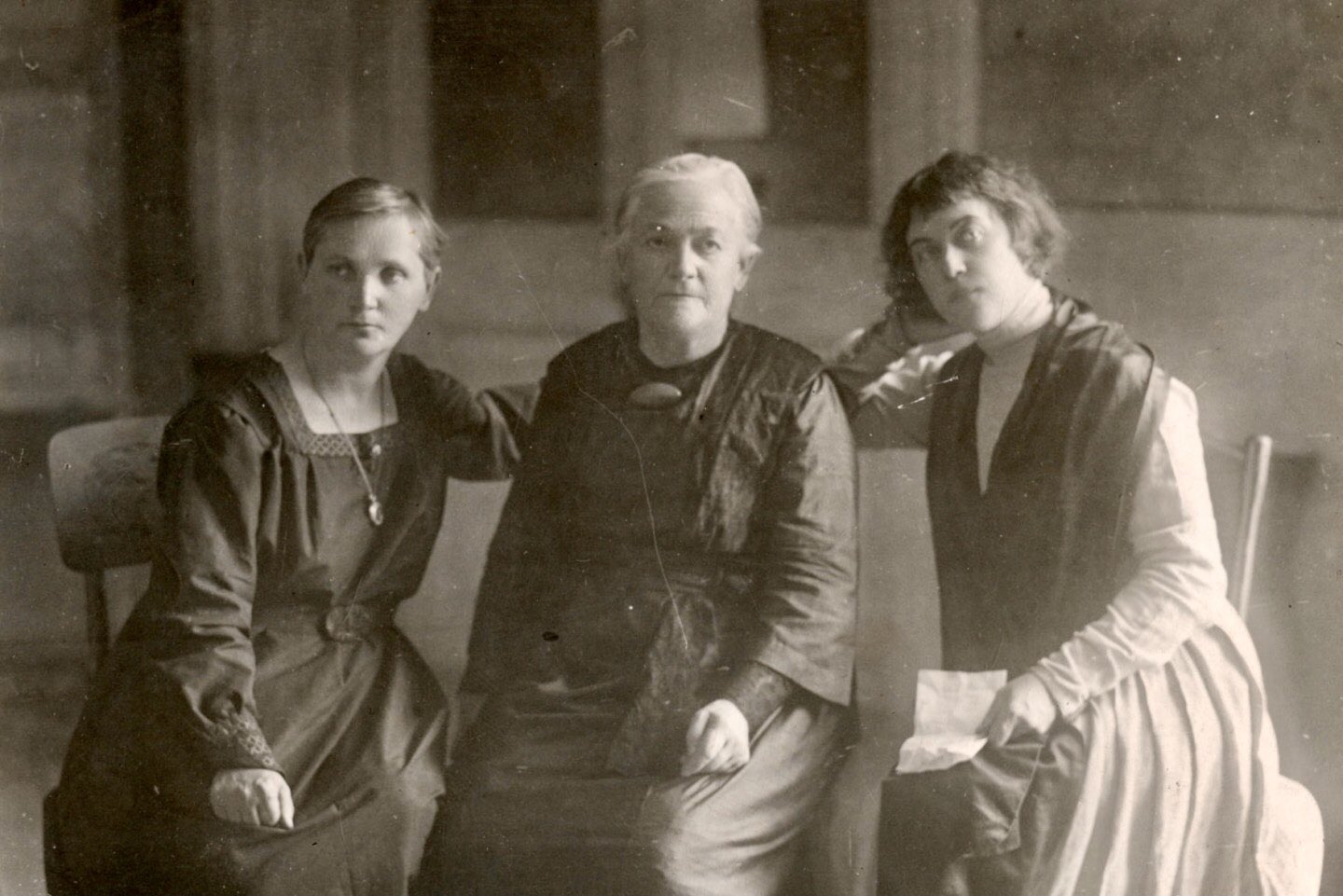
Comrade Kollontai then delivered the report on the work of the International Secretariat from the 20th November 1920. The establishment of the Secretariat was confirmed by the Executive Committee of the Comintern on the 8th August last year, in accordance with the agreement arrived at at the First Conference. The Secretariat was composed of eight comrades, six from Russia and two from other countries; one part of the Secretariat worked in Russia and the other abroad. The aims and tasks of the Secretariat 1) to spread the influence of the Comintern among the broad masses of the women workers; 2) to co-operate with the Comintern in training the labour masses in the spirit of communism; 3) to propagate methods of work for rousing women to activity and independent action; 4) questions of the emancipation of women as mothers.
The Secretariat has not been and is not an organ separate and independent of the Comintern, but is closely bound with it, and a member of the Secretariat is a member of the Executive Committee of the Comintern. It must be pointed out, however, that during the period under review the Secretariat has not displayed any particularly great activity. In the first place it was hindered by difficulties of a purely technical character. Our General Secretary lived abroad, and it was therefore very difficult to maintain International connections. Secondly obstacles were placed in our way by the whiteguards which hindered the permanent and continual contact with the Secretariat and the leadership of the organisation of women.
The movement is most highly developed in Germany and Bulgaria, in America the movement is in difficulties owing to the fact that the Party there is illegal and works underground. However, there are 70,000 women organised in the Trade Unions there and the communists must learn to penetrate into these unions. Approximately the same situation exists with regard to the English women’s movement. There immediately a committee is organised it is arrested. In France some work has been done during the last year and two papers are published. In Switzerland it is necessary to overcome the petty bourgeois psychology of the working women. In Norway International Women’s Day was very successfully carried out. The present Conference, at which representatives from all parts of the world are gathered, creates the conviction that the Women Communist movement in spite of all the circumstances referred to will continue rapidly to develop, and events in a number of countries prove that the methods and forms of work practised by the Secretariat are the most suitable.
After a short interval Comrade Zetkin opened the discussion. Referring to International connections comrade Zetkin pointed to loose international connections of the Secretariat. The reasons for this first of all life in the disorganisation of the railways which is characteristic not only of Russia but of the whole of the West, and also in the difficulty of maintaining personal connections. Messengers never returned, they were killed on the frontier. Comrade Zetkin then outlined a plan of connections for the International Secretariat which should keep each mutually informed, but all be carried out by special appointed correspondents, whose be connections should proceed through the Central Secretariat, which should be one of the active organs of the Executive Committee of the Comintern. The Secretariat must have a certain amount of freedom of action, a certain amount of initiative in approaching the women masses and their revolutionary training for the struggle for the dictatorship of the proletariat. Comrade Zetkin proposed to change the structure of the Secretariat in view of the forthcoming change in the structure of the Executive Committee. Auxiliary technical organs of the Secretariat may be organised in Western Europe which under no circumstances must play a leading role but simply carry out preparatory and executive work. This organ will be organised in one of the Western European countries. In all the remaining countries there will be these correspondents.
Moscow was the English-language newspapers of the Communist International’s Third Congress held in Moscow during 1921. Edited by T. L. Axelrod, the paper began on May 25, a month before the Congress, to July 12.
PDF of full issue: https://www.marxists.org/history/international/comintern/3rd-congress/moscow/Moscow%20issue%2016.pdf
 Revolution's Newsstand