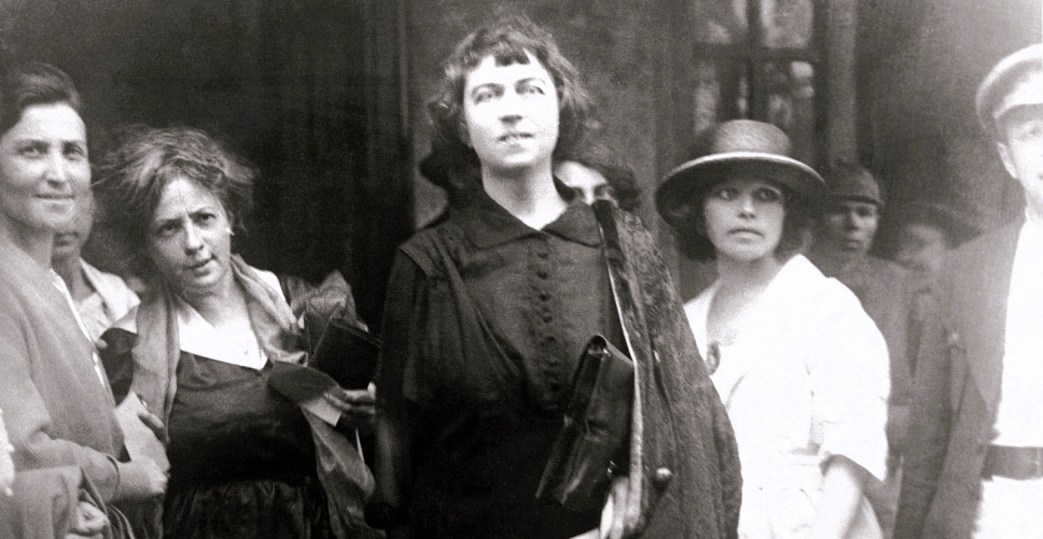
A rich report on the second session, held the evening of June 11, 1921, of the Women’s Conference as participants debate Kollontai’s report and pass a resolution, included, on the ‘Forms and Methods of Communist Work Among Women.’
‘Report of the Second Session of the Second International Conference of Communist Women’ from Moscow. No. 17. June 14, 1921.
The question of the organisation of an International Secretariat was under discussion at the Session of July 11th. The Conference opened at 8 p.m., comrade Zetkin was in the chair. (Comrade Schwarz, Germany) “We had a Conference last May when the position of the International Secretariat was discussed. We know that the work of the Secretariat was faced with great obstacles due to the difficulties of the position of the Communist movement throughout the world. We know that it was difficult to work from Moscow. A great deal has been done by Moscow in face of these circumstances, but little of what was done reached other countries, and we must confess that the secretariat did not take advantage of all the means at its disposal for developing the women’s Communist movement. If we further consider the complete absence of labour legislation for women in many countries, then we must confess, that the Secretariat shall have pointed out to the respective communist parties of Switzerland, France and others countries, the need of developing a women’s movement and the divining of suitable slogans. The slogans which were made for the International Women’s Day, were almost without exception only applicable to Russian conditions and were of little use for the political situation of other countries. Comrade Kollontai spoke here of two French journnals on the women’s communist movement but one of them edited by Boudin, is altogether outside the control of the communist party and is really a feminist paper; the same can be said of the other. It is absolutely essential that a single party organ be issued in France. Further, communist women take part in the revolutionary Women’s Union of Holland which accepts anarchist and christian-socialist elements. In England where the feminist movement is strong, a great deal was done in the woman’s suffrage struggle, but little has been done to spread the communist women’s movement. We listened with joy to comrade Kollontai’s declaration that the Secretariat would publish the necessary literature which would suit the particular conditions of each country. It appears necessary that the Secretariat in conjunction with the Executive of the Comintern should send trusted comrades to those countries where the women’s movement is weak in order to strengthen it and to organise the necessary party machinery for attracting large numbers of women workers in the communist movement. We consider necessary the creating of Western European auxiliary organ of the Women’s International Secretariat, which would help the latter in the work of spreading the communist movement among women of Western Europe. The German comrades are willing to take upon themselves the work for the creation of such an organ.
Rose Block, of Switzerland said that she came from a small country, which however is located in the centre of Europe and that she is more or less aware of the course of events in European States. Our organisation, she said, “was all the time in contact with the general secretary. The Russian comrades did all they could to keep in contact with the foreign organisations. It is necessary to observe that this was harder for us women, than for the men-communists.
Something has been done! already for the unification of our work. In connection with this we must mention the celebration of the International Women’s Day, True, the international women’s day was established already in 1910, but in a number of nations it was observed for the first time in 1921. Not long ago comrade Zetkin commenced the publication of the “Women’s Communist International”. Three numbers have so far been published in the German language only. It’s necessary to publish it within the shortest time in French and English, and the Russian comrades must reprint articles from this magazine for their Russian press.
Comrades Nikolaeva, “The first impulse on listening to the report of the Secretariat was to subject it to severe criticism. We hoped to learn from this report things, regarding the international movement, of the stages of its development, its experiences. The report however said nothing about this. Of course, great obstacles, the lack of connections explain the complex and difficult character of the work of the secretariat. The Secretariat must obtain from those, who came to this Conference, the most detailed facts and figures with regard to the movement, which we have failed to obtain up till now. Last year we accepted the Thesis at our Congress, but it is necessary for us Russians to know what methods of work were appointed, how these Theses were conducted outside of Russia, have the parties abroad established women’s departments? Last year we were also told that in the West there were separate Women’s organisations. It is important for us to know, whether such organisations exist, whether they have been destroyed. Criticising the work of the Secretariat, comrade Nikolaeva pointed out yet another serious mistake. The International Secretariat formulated those basic theses last year on prostitution. abortion, and an International Women’s Day. These theses are totally inadequate. Instead of the theses on prostitution, and abortion, we showed how to put forward a basic thesis on the Dictatorship of the Proletariat, because only when we will attain the Dictatorship of the Proletariat will we solve the problems of prostitution, and abortion.
Comrade Lilina said, the report of Comrade Kollontai made the same impression on me, as it did on comrade Nikolaeva: The Executive Committee of the Comintern, holding the formal point of view of the singleness of the movement, took no interest in the work of the Women’s International. Therein lies the chief evil of our work. If you ask me what is my attitude on the question of creating a technical organ; my reply is: I am for it, and also against it.
We should have a uniform communist movement, incorporating within itself the movement among the women as part of a whole. But under the present circumstances we shall not make progress in our work without a technical organ. The most important point lies in supporting the Executive of the Comintern. Probably it is not the fault of the latter that the women’s movement is so weak, the communist movement assumed too large dimensions for it to be able to concentrate its attention on the women’s movement. In any case, our one demand should be that the Comintern devote sufficient attention to the weak places in the communist movement among the proletarian women. That is the quintessence of the whole question.
Lucy Colliar (France) remarked that there was no need to complain of the lack of contact with the International Secretariat, because she is well aware of all the difficulties which one has to contend with in Russia, when the country is surrounded by enemies and where the correspondence even of the French women does not get through. The speaker further stressed the neglect of work among the women that is generally observable in the Party, and pointed out the difference in the activities of the women communists and feminists, the latter having no sympathy with the proletariat. Those three press organs of which Kollontai spoke do not as yet altogether belong to the Party. We want to make them organs of propaganda, specially devoted to backward masses. Expressing regret that France does not have leaders equal to Zetkin and Kollontai, Comrade Colliar nevertheless expressed complete faith in the success of the future work of women, and hoped that the methods of work which she will draw of the present conference will have yielded the most fruitful results by the time the next Conference is held.

Comrade Roland Holst (Holland) then spoke, she said:
“It was pointed out here that we work together with the anarchists, syndicalists and even Christian socialists. I wish to briefly explain the situation. Holland does not have any women’s organisation of its own. There is only one small union to which Communists, Anarchists and Christian Socialists belong. This union was formed during the war, for combatting the poverty of the working masses. After the Second Congress of the Comintern, a Communist group was organised in our union. A keen opposition was raised against this group, and many members left the Union. But the best section remained in the Communist Group thanks to its organised character, we were able to do a considerable amount of educational work. The organs of the press of the Union and the agitational apparatus fell into the hands of the Communists. In the future, after the present conference, we shall have to change the form of organisation. We shall have to organise the Communists in a separate organisation which will be an apparatus attached to the Communist Party. If the International Secretariat does not desire to have women remain passive during a general strike or civil war, but desires that they should march side by side with the men, as they did in Petrograd in the February days, it must not limit itself to sending us watchwords and leaflets. What is wanted above all, is organisational work among women, a work which is confronted by tremendous difficulties. Therefore, the Secretariat must send us agitational and organisational assistants, who could instruct us how to conduct the work.
The next speaker was Comrade Moirova (Ukraine) who said: “I am convinced that the Women Communist Movement will not develop unless the Communist International takes the work up, for that reason we must construct our apparatus so that it shall be inseverably connected with the Comintern. It does not matter where the Comintern will be, what is important is that it should be directly under the Comintern. As for the Technical Bureau, it is necessary to establish contact through the Party and the Women’s Department”.
Comrade Arachian (Armenia) referred to the necessity of devoting greater attention to the work among the women of the East.
A representative of Tchecko-Slovakia stated that the movement in Tchecko-Slovakia was still young. It began in 1918, as the overwhelming majority of working women are employed in small workshops, these masses are not yet affected by Communism, but one thing at least may be said of them, that is that they are revolutionary. We hope that as a result of energetic work in this sphere, the women will be drawn within the circle of Communist ideas. We are awaiting instructions from the Third Communist International and promise unconditionally to carry them out. To us one thing is clear”, she said, “If Russia wins, we will win”.
Comrade Kollontai’s concluding speech.
Replying to the discussion, Comrade co Kollontai in her concluding speech emphasized that her report was exclusively a business report of actual work done, that the methods of that work will be discussed in another point on the Agenda. Once again it is necessary to point out the terrible isolation of the Secretariat from our Western comrades, which resulting from the world civil war has prevented almost any material reaching us. As a result of this, it is impossible to give a complete report of the work of the Secretariat in the West, and the guidance of the work only answers the requirements to a minimum. Moreover, it is again necessary to emphasise that the absence of proper apparatus in the form of Women’s Departments in the a Communist Parties, does not render it possible to carry out these methods in the various areas. There is a tremendous consolation however, that life itself compels our comrades to avoid some of the mistakes we have made. Thus, recently in Sweden there were separate organisations, which however now are being abandoned. Replying to the remark of comrade Nikolaeva, that the theses on abortion and combatting prostitution were distributed by the International Secretariat, Comrade Kollontai recalled that in her report she had stated that the International Working Women’s Day, and the theses of comrade Semashko on abortion, and that of the Inter-Departmental Commission for combatting Prostitution were referred to in the enumeration of the literature dispatched abroad in respond to the demands of our Western comrades, who were interested in these questions. In reply to the question of comrade Smedovitch and Arachian (Armenia) as to whether it is possible in the resolution to give individual countries the right to have contact with each other, comrade Kollontai stated; whereas comrade Zetkin had already pointed out all questions of principle must be conducted through the centre, but this should in no way interfere with the possibility of communication between the various countries, if however the control of the centre is preserved.
On the proposal of comrade Roland Holst to send organisational and agitational assistance to the various areas, Comrade Kollontai stated that the Secretariat has already worked out a plan in this connection. We foresaw this, but we did not submit the construction of the Secretariat for discussion by the Conference because we are only a section of the Comintern, and we, as an auxiliary organ of the Comintern could not discuss our organisation before the Congress of the Comintern had discussed its own reorganisation. Comrade Kollontai spoke with particular warmth on the importance of the work among women of the East for its struggle against capitalism, “Not a single large capitalist country she said could maintain itself if its colonies would revolt against her. The work must be conducted among the women of the East in order to shake the power of our world enemies; to attract to ourselves the women of the East is to obtain a future ally.” In conclusions comrade Kollontai speaking for herself expressed the opinion that the title of the new organ of international work published in Germany “The Women’s Comintern” should be changed to “The Bulletin of International Work among Women” if the language permits such an alteration.
The following resolution on the forms and methods of Communist work among women was then put to the vote and carried.
Resolution on the Forms and Methods of Communist Work Among Women.
The Second International Women Communists’ Conference in Moscow declares that the crisis in capitalist industry and the bourgeois system which rests thereon, makes it absolutely of vital importance for the proletariat of those countries where such a system exists, to fight for the conquest of political power and the establishment of the Dictatorship of the Proletariat. This can only be accomplished by the proletariat of the wide masses of women workers allying themselves to this task consciously, determinedly and self-sacrificingly. In those countries where the proletariat has already seized political power and established the dictatorship as in Soviet Russia, it behooves to concentrate all its attention on the struggle against national and international counter-revolution and to building the Communist Commonwealth. which shall free the whole of humanity. The wide masses of women workers must conceive, with a clear and inflexible consciousness that the defence of this commonwealth must be one of their cares. The Second International Women’s Communists Conference in Moscow therefore demands that the Communist Parties of all countries, in accordance with the statutes and theses of the Third International, exert the greatest efforts in awakening the wide masses of women workers to Communism, to unite and attract them into the Communist Party for the revolutionary struggle and revolutionary reconstruction. The will and ability to act and fight of the wide masses of women, must be continually intensified and spread. To achieve this all those parties which are affiliated to the Third International must organise women’s committees in every one of their organs and institutions from the highest to the lowest, which must agitate, organise and educate the wide masses of women workers, and have their representatives in all the leading and guiding organs and parties. These committees must not be separate organisations inside the Communist Party, they only are organs of practical necessity for the actual solution of their own particular problem: to mobilise and educate the wide masses of women workers for the struggle for political power, and the Communist Commonwealth. Hence they must work in close contact with the party in all its spheres of work, but have special mobility in the methods and kind of work and in the establishment of order which is absolutely necessary for the success of the work, taking into consideration the peculiarity of women’s psychology and the special position of women in society, which has not yet disappeared. The concrete work of these Women’s Committees is pointed out in the theses accepted by the Conference. The Women’s Organisations, which exist at present in the Communist Parties, must constantly have in view their double responsibilities. They must unite the ever-increasing mass of women, those possessed of consciousness, and firm wily and to draw them within the Revolutionary Class struggle. They must attract t Communism, and draw away from capitalism, all the oppressed and exploited and after the victory of the Proletarian Revolution, to attract to Communist construction, all those women who are more loyal and more capable of self-sacrifice.
From the ranks of this awakened mass of women workers, and their proletarian sisters, the Communist International will form a nucleus in every country, which will lead its comrades: The Women’s organisations in the Communist Parties, must remember in their work that the spoken and written words are not the only means of agitation and enlightenment, but that there are still more active means, viz. the participation of women workers in all active movements, and in the struggle of the Revolutionary Proletariat, in strikes, general revolts, demonstrations and armed risings.
Moscow was the English-language newspapers of the Communist International’s Third Congress held in Moscow during 1921. Edited by T. L. Axelrod, the paper began on May 25, a month before the Congress, to July 12.
PDF of full issue: https://www.marxists.org/history/international/comintern/3rd-congress/moscow/Moscow%20issue%2017.pdf

