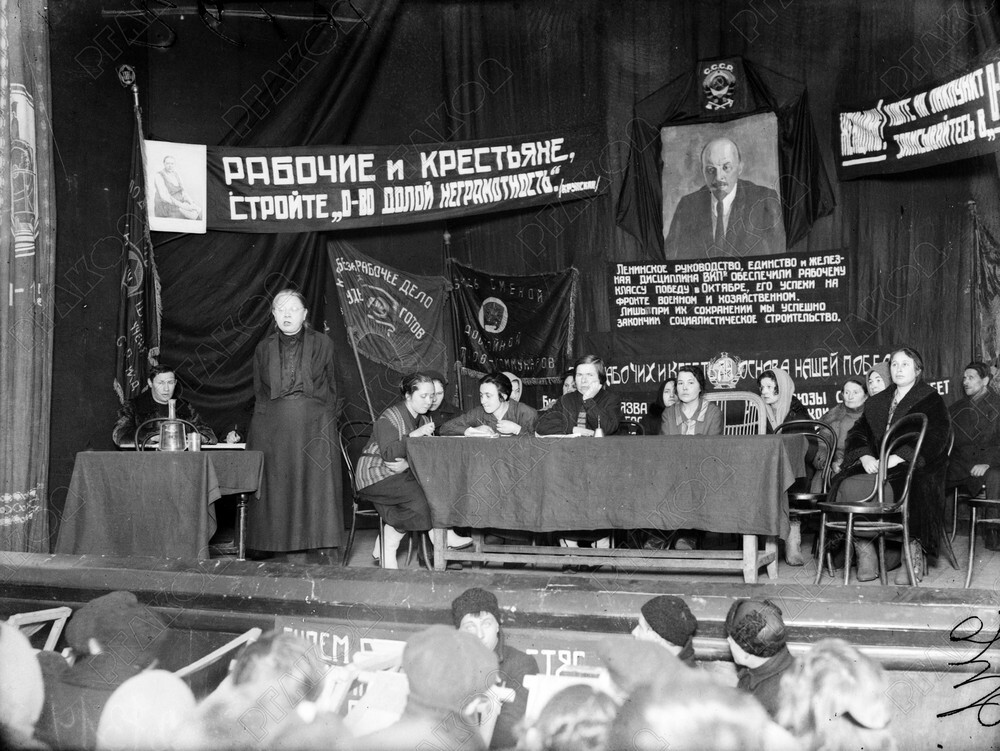
A look how the new course of study with its three cores–nature and man, work, and society–were developed each year in early Soviet schools.
‘VII. Experiments with Subject-Matter–The Course of Study’ by Scott Nearing from Education in Soviet Russia. International Publishers, New York. 1926.
VII. EXPERIMENTS WITH SUBJECT-MATTER–THE COURSE OF STUDY.
Something has already been said, in the chapter on elementary education, about the kind of program that is being tried out in the Soviet Schools. Soviet educators are striving to create an educational system that will meet the needs of the new society that they are building. There were no real precedents for this task. There had been many isolated educational experiments, but as the Soviet Union was the first workers’ republic, its educators faced a new educational situation.
Programmes Officiels de l’Enseignement dans la Republique des Soviets is a publication of the Educational Workers’ International that gives a very full account of some of the earlier efforts to shape a program for the elementary schools, together with a large part of the pro- gram that was being experimentally tried by the Soviet schools in 1924-5. (The pamphlet contains 92 large pages, and can he had for twenty-five cents from the Secretary, L. Vernochet, 33 Rue Grange-aux-Belles, Paris, France.)
The Scientific State Council of the Russian Republic had been working systematically on the question of subject matter, and of method in the handling of subject matter. In 1923-24 a tentative plan was published, with instructions to teachers to try it out, to discuss it in their educational meetings, and to pool the results of their experiences. By 1924-5 this plan was to be generally applied, as modified, to the two lower grades of the elementary schools. What was this plan?
Soviet educational authorities explained its purpose in these terms: “Children of workers and peasants do not go to school in order to leave their class, to rise above it, to become intellectuals, as was the case in former times, but in order to join the organized advance-guard of their class, and to become worthy collaborators and comrades of the workers and of the revolutionary peasants” (Programmes Officiels, p. 59). Therefore “at the foundation of the whole program lies the study of human labor and its organization. The point of departure is the study of local labor.” (Ibid. p. 15.) From its beginning to its end, the Soviet educational system is built upon the study of and the participation in human labor. Students are either learning about labor, or they are preparing for labor, or they are sharing in labor. (The term “labor” means, of course, not hand work, but, in the terms of the Soviet Constitution: “effort that is productive or useful to society, including housekeeping.”)
Thus far the subject matter has been worked out most completely in the two extremes of the program: in the lower grades of the elementary schools and in the higher technical schools. The same principle is being applied, however, to all grades of the educational system.
Perhaps an idea of the direction in which this theory is leading can best be gained by quoting a part of the official program of the elementary schools in the Russian Republic. This program is intended to give the younger children a certain minimum of orientation to the life surrounding them, and a certain minimum of experience in the actual processes of labor and of social organization.
The official program of the labor school as tentatively adopted by the educational authorities of the Russian Federation on March 5, 1923, is, in brief outline, as follows: (This summary is taken word for word from the official program, which gives first a brief summary and then an extended elaboration.)
“I. Outline of the program for the school of the first degree 8-12 years).
“1. First year.
a. Nature and man. The seasons of the year.
b. Work. The daily work of the family in the country and the city.
c. Society. The family and the school.
“2. Second year.
a. Nature and man. Air, water, the sun. Plants and domestic animals and their needs.
b. Work. The work of the village and of the part of the city in which the child lives.
c. Society. The administrative institutions of the city and the village.
“3. Third year.
a. Nature and man. Elementary notions (observations) of Local nature. The life of the physics and chemistry, human organism.
b. Work. Economy of the region.
c. Society. The administrative institutions of the region. The history of the region.
“4. Fourth year.
a. Nature and man. Geography of Russia and of other countries. The life of the human body.
b. Work. The national economy of the Soviet Union and of other countries.
c. Society. Organization of the state of the Soviet Union and of other countries. Pictures of the past life of the human race.”
The outline for the next three years is very much more detailed. I will therefore reproduce a sample the portion devoted to the sixth year: (pupils of 14 years).
“a. Nature and man.
1. Sufficient physics and chemistry to understand:
A. The lives of men and animals;
B. The application of these sciences in industry (construction of machines and motors, electricity, etc.).
2. Minerals, mines, combustibles. Russian mineral regions and coal fields.
3. Industrial animals and vegetables.
4. Man as a member of the animal world. His anatomy and physiology.
5. Hygiene of physical and intellectual work. The organism well and sick.
“b. Work.
1. The extraction of minerals and combustibles.
2. Chemical and mechanical industry. Hand work, manufacturing, factory industry. Organization of work in a small shop, in a factory and in a manufacturing plant. The development of different branches of industry in Russia and in other countries. Divisions of the Soviet Union.
3. Technology of agricultural production.
4. Anthropological geography. Man and human society dependent on the natural environment.
5. Man as a worker. The organization of his work. Hygiene of work and workers’ health.
“c. Society.
1. The workers and the capitalists. Wage labor and capital. Private property and labor. The situation of the working class. The union of aristocrats and capitalists. Constitutional monarchy. The republic Bourgeois dictatorship. Capitalism. Competition. The chaos of production. The struggle between labor and capital. The Chartists. The year 1848. The Communist Manifesto, expressing the aspirations of the working class. International association of workers. The First International. Effort of the workers to take power: the Paris Commune. The Second International. The struggle through strikes. Trade unions. Political parties. Capitalism in Russia. Survivals of Feudalism. Monarchy. The struggle against it in 1905 and in 1917.” (Programmes Officiels, pp. 7-8.)
These are samples of the type of subject matter that is being presented in the Soviet elementary schools. The official program goes into greater detail, but these quotations are extensive enough to give a good idea of the type of material that the younger children are asked to handle, under the three general headings of “nature and man,” “labor,” and “society.”
Additional light is thrown on this problem of subject matter in a section of the official program which sets forth the specific aims that the subject matter is intended to accomplish. These aims are summed up in this way:
“It is evident that these exercises in the elementary schools do not constitute a preparation for a particular profession. It implies general preparation and general study of the work necessary for each adolescent, independent of the profession or the trade that he will choose in the future. As the greatest common divisor, this sum will appear in all of the professions, in all of the skilled work, thus representing the minimum of knowledge necessary before beginning to learn a profession or trade.
“The program, or, better, the total of this general knowledge of the processes of labor, may be divided into the following groups:
“Minimum of knowledge and of habit of work that should be known to pupils who finish the first section of the elementary school. (First 4 years; ages 8 to 12.)
“A. Habits of orientation. 1. Orientation in space: the determination of any point in the town or in the region, on a map. 2. Orientation in time: the determination of the time necessary to travel a given distance, or to do some simple piece of work. 3. Orientation in distances and in quantities: simple arithmetic, utilization of the multiplication table, of the scales, simple and decimal weights and measures. 4. Orientation in quality: determination of the approximate quality of the articles of primary necessity. 5. Orientation in all of the administrative institutions: the securing of information in any of these institutions. 6. Orientation in all forms and in all the means of locomotion and of communication: utilization of the tramway, the train, the post, the telephone, the telegraph, etc.
“B. Habits in the doing of definite tasks. 1. Composition of the plan of a yard, of a house, of a street, of a region. 2. Drawing and designing simple objects. 8. The writing of reports on work done. 4. Preparing of a plan of work to be done. 5. Preparation of a report on any occurrence. 6. Making of a budget, of an account, simple bookkeeping.
“C. Habits of work in the home. 1. Individual hygiene. 2. Hygiene of the home. 8. Scouring and cleaning clothes and linen. 4. Simple cooking.
“D. Habits of utilizing simple conveniences and of installing certain comforts. 1. Simple repairs of the house, the furniture. 2. Utilization of electricity. 8. Simple repairs of the above. 4. Taking down, cleaning and setting up simple machines.
“E. Habits of farm work. 1. Elementary needs of domestic animals and vegetables. 2. Work, according to age, in the fields, the flower garden and the vegetable garden.
“F. Habits of scientific work and research. 1. The conduct of systematic observations on any phenomena. 2. The systematic collection of facts and documents concerning any question. 3. Utilization of a dictionary, of an agenda, of a catalog, of a paper, of a review, of a guide, etc. 4. Utilization of a museum, of an exposition, of a library, of archives, etc.
“G. Habits of work in political and administrative organizations. 1. Participation in general meetings, presiding at general meetings, preparation of minutes. 2. Individual and collective execution of certain social tasks, and collaboration in the work of the different organizations. 3. Organization of social enterprises (circles, societies, co- operatives, clubs, recreations, fetes, etc.). 4. Composition of a wall newspaper, of statements, reviews, etc.
“Most of these habits will be naturally acquired along the plan indicated, by the methods of teaching applied to active work; if the school understands how to profit by every occasion to permit the students to put in practice- in socially useful activity—the theoretical knowledge they have acquired.” (Programmes Officiels, pp. 47-49.)
Subject matter, under this program, is no longer reading and writing, spelling, arithmetic and history. Subject matter is the world we live in and the things we do in it. But what of reading and writing and arithmetic?
They come in, incidentally, but none the less surely, as they are needed. “In the course of studying phenomena, our pupils will be compelled to get enough exercise in reading, writing and arithmetic. There is no danger that they will fail to learn these things, without which they cannot study any of the themes.” (Ibid. p. 13.)
But the themes come first. The pupil must have an interest, a desire to find out; a reason for wanting to know how to read. He must wish to investigate some fact that he has observed, to take part in some activity that is going on around him. Then the instructor says to him: “You wish to join this organization of pupils that is running the student life of the school? But what use will you be there if you cannot read and write, multiply and divide? If you wish to take part in the activity of your group, you must be able to communicate with your group,–to read what they write, to write to them, to express yourself in figures.” Then, because the pupil has an interest in the thing he wants to do, he will acquire the means that are necessary to do it. “It is only necessary that the means should not be too far off, and that the children should feel and see that, relatively, it will be useful.” (Ibid. p. 47.)
To what extent is this new course of study being used in the Soviet Union? I did not go into a single elementary school where some form of it was not in operation. The completeness with which the new program has been adopted depends upon many factors, but principally upon the ability and training of the local educational authorities. In the smaller villages, the individual teacher must initiate. There seems to be no lack of good intentions. Many of the village teachers are poorly equipped, however, and they do not know how to put a new system into practice. In the city schools, some modification of this program is being generally experimented with. None of the Soviet educators pretend that this is a final word on their educational program. They believe, however, that it is an advance over the programs now in use in many of the western countries, and they are unanimous in their agreement that it is the best educational program that the Russian schools have ever had.
Foreword, I A Dark Educational Past, II The Soviet Educational Structure, III Pre-School Educational Work, IV Social Education—The Labor School, V Professional Schools (High Schools), VI Higher Educational Institutions, a. Higher Technical Schools (Colleges), b. Universities, c. Institutes, VII Experiments With Subject-Matter—The Course of Study, VIII Experiments With Methods of Instruction, IX Organization Among the Pupils, X The Organization of Educational Workers, XI Higher Education For Workers, XII Unifying Education, XIII Socializing Culture.
International Publishers was formed in 1923 for the purpose of translating and disseminating international Marxist texts and headed by Alexander Trachtenberg. It quickly outgrew that mission to be the main book publisher, while Workers Library continued to be the pamphlet publisher of the Communist Party.
PDF of later edition of book: https://archive.org/download/in.ernet.dli.2015.123754/2015.123754.Education-In-Soviet-Russia.pdf
 Revolution's Newsstand