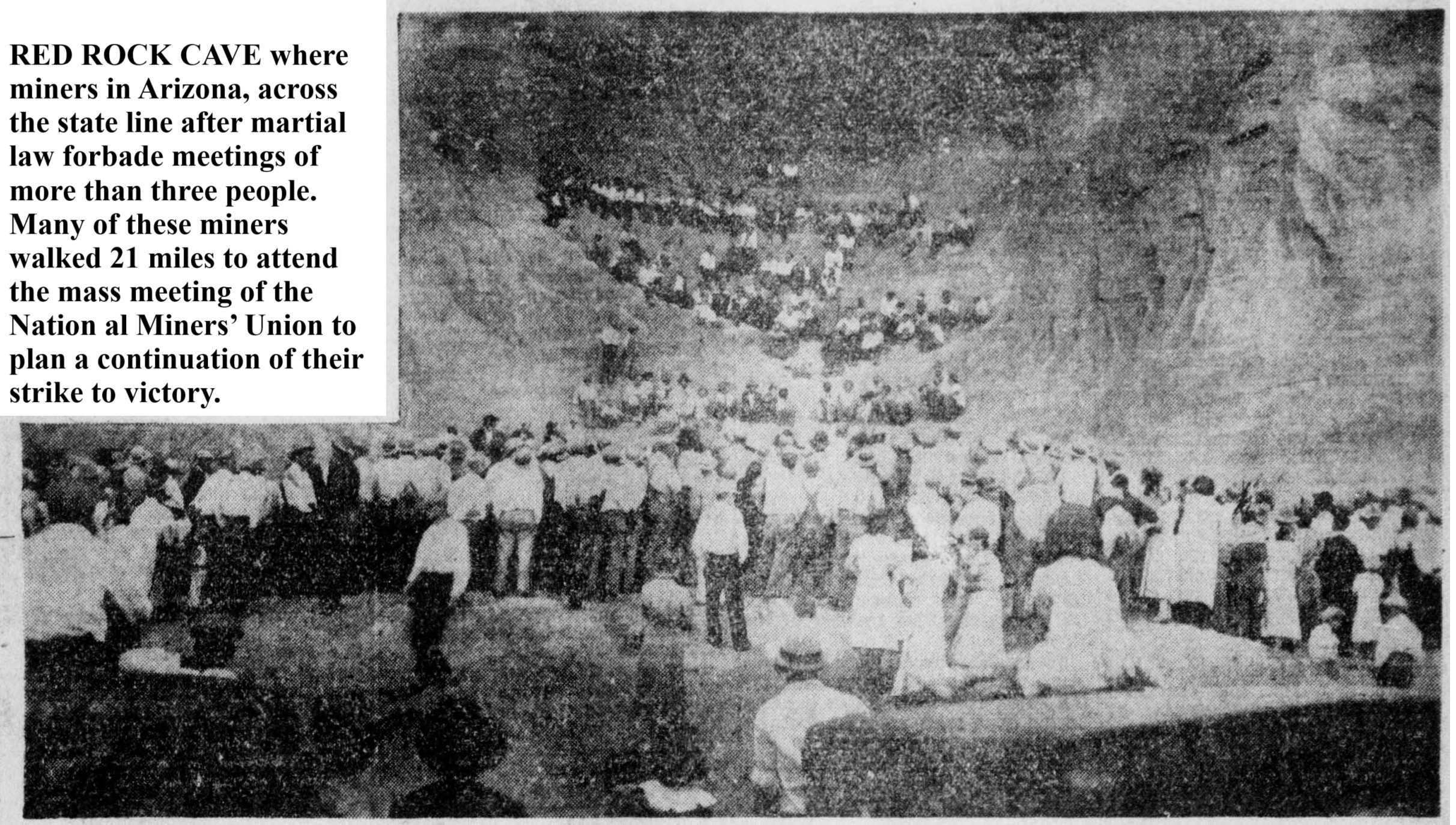
Because of martial law in New Mexico, striking Gallup N.M.U. miners walk over twenty miles to the Arizona border to meet at a cave in Lupton.
‘600 Miners Cross Over to Arizona for Strike Meeting’ from The Daily Worker. Vol. 10 No. 229. September 23, 1933.
Many Walk 21 Miles, When Militia in N. Mexico, Under Martial Law, Prohibit Strikers from Gathering; Miners Face Hunger
GALLUP, New Mex., Sept. 4. Denied the right to hold union and strike meetings, 800 miners and their families came 21 miles to the Arizona state line to carry on the plans for strike activities. Those who had no cars started out hours earlier on foot to the meeting. The gathering took place in a huge cave in the red rocks of Lupton, Arizona. Two truckloads of cops guarded the state line with the intention of preventing the strikers from returning to Gallup at the close of the meeting, but the huge masses of miners prevented them from attempting this, and they returned to Gallup. Martial law forbids the gathering of more than three people in a group.
Additional forces, sent in here to aid the work of the strike, were held by the troopers in the union office and not permitted to leave. A permit for a meeting was secured from Brigadier General Woods, who instructed the miners’ committee that they could meet but could not make “inflammatory” speeches. At the meeting. Martha Roberts announced that the union was going to demand a definition of the word inflammatory, before they spoke. An editorial in the Albuquerque Journal, flaying the mayor for his strikebreaking activity in sending in the troops, was read instead.
The meeting was then adjourned and a picnic of the miners took place at the Red Rock Cave late that afternoon. One of the miners brought a can of paint and in huge letters painted across the cave the words “National Miner’s Union, Aug. 28, 1933.” This is the date the strike was called.
The meeting was addressed by Pat Toohey, member of the National Executive Committee of the National Miners’ Union; H. Allander, represen tative of the youth section of the union: A. McCormick, member of the Building Trades Council of Denver, and other speakers. The spirit of the meeting ran high. The miners determined to resume their picket lines, which had been dispersed at the point of bayonets by the National Guard. The miners are still 100 per cent out. None of the mines have been able to work.
The next day another permit was secured for a meeting in Gallup. At this time a definition was obtained of what the general meant by the word “inflammatory.” The definition included a clause which stated that “any attack on the constituted authority” would be considered a breach. This meant that the speakers were to be prohibited from exposing the strike-breaking activity of Governor Seligman. The speakers refused to do this, and defied the guard.
During the course of the speeches, the troops began mobbing up and getting clubs. A guard of 20 workers prevented them from getting at the speakers.
The miners have displayed a marvelous spirit through it all. However, the relief situation is becoming quite serious. Unless help is forthcoming at once, the miners will be forced back to work by hunger. The miners are waging a battle against the operators who are notorious “open-shoppers.” Strikes before have all been lost. It is evident that this strike is pressing the operators hard.
Every effort is being made to break the strike. It is almost a certainty that the miners will win If given sufficient backing. Send all funds to Box 218, Gallup, New Mexico, The United Mine Workers is carrying on a scabbing campaign, calling on the miners to go back to work, with the threat of expulsion from the union. General Woods of the National Guard has given a permit for the Gallup Chamber of Commerce to hold a meeting to take up the question of cutting off of relief to the striking miners of Gallup.
The Daily Worker began in 1924 and was published in New York City by the Communist Party US and its predecessor organizations. Among the most long-lasting and important left publications in US history, it had a circulation of 35,000 at its peak. The Daily Worker came from The Ohio Socialist, published by the Left Wing-dominated Socialist Party of Ohio in Cleveland from 1917 to November 1919, when it became became The Toiler, paper of the Communist Labor Party. In December 1921 the above-ground Workers Party of America merged the Toiler with the paper Workers Council to found The Worker, which became The Daily Worker beginning January 13, 1924.
PDF of full issue: https://www.marxists.org/history/usa/pubs/dailyworker/1933/v10-n229-sep-23-1933-DW-LOC.pdf

