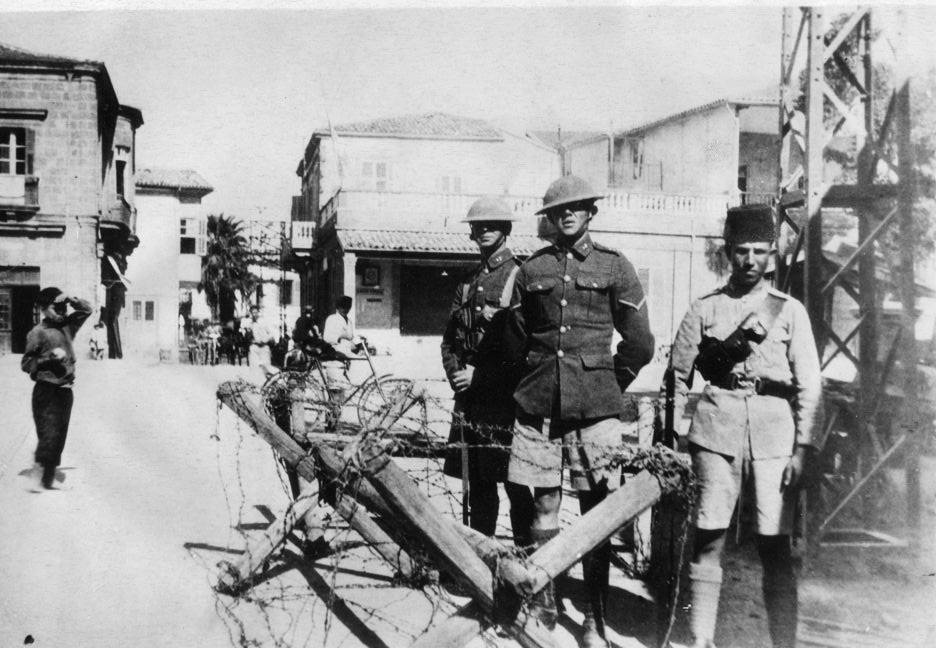
For decades, since 1878, Cyprus was a key base for projecting British imperialism in the Mediterranean. In 1929, Ramsay MacDonald the pious and bereft leader of the sub-reformist Labour Party formed his second minority government, entirely beholden the Liberals. A regime woefully irresponsive to the Great Depression at home, while adamantly acting in defense of the Empire abroad with no less than former Sidney Webb, now Baron Passfield, as Colonial Secretary. 1928 saw protests against 50 years of British occupation, with many advocating unification with Greece. A 1929 law followed on sedition, including provisions for torture. Within a year of this article, further repression and radicalization sparked a revolt against a new British tax regime in October, 1931. Put down with force by British guns in a just few days. Cyprus would remain a British possession until 1960, and continues in the Commonwealth today.
‘British Imperialist Oppression in Cyprus’ from International Press Correspondence. Vol. 10. No. 30. June 26, 1930.
British Imperialism has introduced new repressive laws in Cyprus with a view to stifling any protests from the masses of the workers and peasants. The local and central authorities must be saved from all criticism.
A little while ago the representative of British capitalism and the loyal executor of the MacDonald Labour government in Cyprus, Sir Ronald Storrs, the Governor of Cyprus, decreed a new Press Law. This law contains numerous provisions for gagging the press and also provides for a bond of two hundred pounds sterling to be deposited by all persons receiving a license to publish a newspaper in Cyprus, this sum to be confiscated wholly or in part should the newspaper publish libelous or seditions matter. According to Section 4 Paragraph B of this law the Governor is the judge of what is libelous and seditious.
The new law even imposes these intolerable conditions on those newspapers which already exist, and they have been given a period of three months in which to comply with the new regulations and find securities in the sum of two hundred pounds sterling each.
It is clear that this is intended as a gagging law, and it is equally clear that it will rest most heavily on the workers press. In the first place, it will be difficult for the Communist Party of Cyprus to find the necessary security. It is even probable that a considerable section of the newspapers now being published will have to suspend publication on account of their inability to find the necessary security. This is however exactly what the authorities want, for if the voice of the press is weakened then it will render the task of imposing prohibitive taxation easier in the future.
The heavy taxes imposed by the British authorities to maintain their costly and extravagant administration on the island represent a crushing weight for the workers and peasants. The annual budget of the British authorities in Cyprus has risen almost to a million pounds sterling, and the per capita tax is estimated at three pounds sterling although the island is extremely poor.
All articles of mass consumption are taxed heavily and it is difficult for the workers and peasants to purchase even the most necessary commodities in order to exist at all. In addition wages are being so that the masses are being ground between the upper and nether millstones.
These frightful conditions are not unalterable. The government could easily alleviate the poverty of the masses by reducing the budget and lowering taxation. For this however, it would be necessary to cut down the fantastic salaries of the various departmental heads and of the hosts of “experts” who are brought from London to Cyprus to do work for which it is difficult to observe the necessity. Further real economies could be made by overhauling the complicated and bureaucratic system established by the British in Cyprus and in other colonies.
The British government, however, has no intention of making any efforts to improve the miserable situation of the masses. On the contrary, in its efforts to find a field for British capitalist activities in Cyprus it makes the situation of the masses even more difficult. Thus it has now been decided to float a loan of six hundred thousand pounds sterling in London to be used to improve the roads of the island and to enlarge the harbour in Famagusta (Salamis) and turn it into a naval base for Great Britain. Its proximity to the Dardanelles and the Black Sea makes it particularly valuable as a base for naval operations against the Soviet Union. The harbour in its present condition is quite satisfactory for the limited trade of the island, and its extension is not demanded by the interests of the native population of Cyprus. The sums. expended will go to the benefit of British industry which will supply the materials, and to British engineers who will supervise the work.
The conditions of the working class in Cyprus are intolerable. Labour protective legislation is unknown. The existing laws are applied solely against the masses and in favour of the employers. The new Penal Code introduced in January 1929 deprived the miners in Cyprus of the right to strike, and the right of the other workers to strike is practically also fictitious. A strike did occur last year and was met with all the repressive powers of the authorities. Many workers were months to twelve months for not other crime than that of having downed tools in an industrial struggle. The government supported the Asbestos Company up to the hilt in its efforts to maintain the oppressive working conditions and low rates of wages.
The legal existence of workers associations or clubs is dependent upon a governmental permit, and such clubs are strictly supervised by the police who have the right to withdraw the permit and close down the clubs or associations at their own discretion without the formality of having to submit proof.
The British authorities in Cyprus have not forgotten the old imperial principle “Divide and rule” and they exercise it here with all their old cunning. The British Governor, Sir Ronald Storrs, has cleverly sown hatred between the Greek and Turkish populations of Cyprus and has gathered a little clique of notables around the government who are prepared to serve it in return for their privileged position. The fictitious sanction of the British authorities in Cyprus is given by these treacherous Greek and Turkish bourgeois who are prepared to let themselves be misused for any purpose in return for government positions and high salaries. These traitors are the right hand of the British government in oppressing and exploiting the toiling masses of Cyprus.
Under the influence of the political agitation and propaganda of the Communist Party of Cyprus, the common people are steadily beginning to realise that their interests can only. be served by ejecting the British encroachers, overthrowing the local bourgeoisie and giving them the fit reward for their treachery, and setting up a workers and peasants government on the island.
International Press Correspondence, widely known as”Inprecorr” was published by the Executive Committee of the Communist International (ECCI) regularly in German and English, occasionally in many other languages, beginning in 1921 and lasting in English until 1938. Inprecorr’s role was to supply translated articles to the English-speaking press of the International from the Comintern’s different sections, as well as news and statements from the ECCI. Many ‘Daily Worker’ and ‘Communist’ articles originated in Inprecorr, and it also published articles by American comrades for use in other countries. It was published at least weekly, and often thrice weekly.
PDF of full issue: https://www.marxists.org/history/international/comintern/inprecor/1930/v10n30-jun-26-1930-Inprecor-op.pdf

