
A central figure in the proletarian women’s movement both before and after the creation of the Third International, Hertha Sturm’s contributions were enormous, and deserving of much greater recognition and understanding. Born in 1883 as Edith Fischer, she became a schoolteacher at 19. After several years of teaching, she left for Leipzig University in 1911, the same year she joined the Social Democratic Party, to pursue higher education. A rarity, Sturm received her doctorate in Social Economy in 1914. Taking a leading role in the Party’s women’s work, she worked closely with Clara Zetkin and others. On the internationalist left, Sturm was an original member German C.P. 1919 and was imprisoned for activities with the Bavarian workers’ republic. A German delegate to the 2nd Comintern Congress in 1920, she became a leading force in the emerging Communist Women’s movement. Strurm organized its first international gatherings as member of the Comintern’s International Women’s Secretariat. She led the Western European Bureau based in Berlin from 1921-24. Though he would lose her positions in the German Communist Party as a ‘rightist’ in 1924, she would relocate to Moscow and continue here work under Clara Zetkin in the International Women’s Secretariat, organizing and leading its conference and work. In this article, she announces the circumstances and aims of Fourth Communist Women’s Congress in June, 1926, the final genuine one to be held. By October, 1928 changes in the Comintern made Sturm’s ‘rightist’ associations incompatible with the new Third Period and she returned to Germany, where she lost Party positions but remained a member. Sturm (also known by her married name Edith Schumann) was arrested immediately on the Nazi’s taking power in March, 1933. After her release she began work with the anti-fascist left Socialists in the Neu Beginnen underground group. Arrested against September, 1935, she was tortured and reportedly attempted suicide. March,1936 she was sentenced to five-year prison, after which the historical record of this pioneering and leading Communist who helped define a proletarian women’s politics and led antifascist resistance, ends. Undoubtedly to perish in jail or in the war’s mass bombings. All of the documents from the coming conference can be found here.
‘On the International May Conference on Work Among Women’ by Hertha Sturm from International Press Correspondence. Vol. 6 No. 44. May 27, 1926.
‘On the International May Conference on Work Among Women’ by Hertha Sturm from International Press Correspondence. Vol. 6 No. 44. May 27, 1926.
The international Conference which is to be held in Moscow at the end of May to discuss work among women, falls at a time when the gigantic strike in Great Britain shows how seriously capitalism is shaken to its foundation in spite of all its relative stabilisation. The most powerful and, up to the present, most secure State in Europe is now experiencing its first serious crisis which will be of far-reaching significance for the acceleration of the fight for liberation of the international proletariat. The question of the national and international united front of the proletariat has come more than ever to the fore. With regard to the concrete forms of the united front and its organs, experience shows us more and more clearly a great wealth of possibilities, all of which should be drawn upon exhaustively. It is up to us to make systematic use of all existing non-party mass organisations which include working women, and to develop them so as to attract and activate the women, Good fractions, women’s organisations and commissions, women’s departments, groups and circles of women workers and of other working women in trade unions, co-operatives in the Red Aid, in organisations of tenants, small peasants and war victims must develop a specially organised activity within the scope of the organisation as a whole. In this connection, Some questions will arise to which hitherto insufficient study has been devoted, for instance the organised affiliation of working housewives to the trade unions of their husbands, a question which politically is of far-reaching importance for such weighty branches of industry as mining, heavy industry and transport.
In addition to these permanent organisations, the question should further be investigated of the creation of action and unity committees of working women, in which women of various political views in addition to Communists, Social Democrats, Clericals and non-party women would temporarily work together at tasks of the moment which are limited to a certain time. Committees of this kind have done good work in Germany for instance, in the campaign for the expropriation of the princes, and in Great Britain for the propaganda campaign of the trade unions among women.
The meetings of women delegates will play a unique and prominent part in all great movements for unity of the working class and especially of the masses of women. This specific form of work, which, in the Soviet Union, forms so to speak the main pillar of the party work among the broad masses of women, is still comparatively unknown in the West. Since the first broad discussions on the subject at the Third International Conference of Communist women in 1924, most sections have concerned themselves very little with the question either ideologically or practically. Only Germany, Great Britain and Finland can point to successful results, which confirm the great significance of the Meetings of Women Delegates.
These meetings which consisted of elected representatives of women workers in factories, of wives of workers in residential districts and of various organisations of working and proletarian women, became organs for the class war for the actual demands of working women over and beyond the limits of the party. But these attempts prove at the same time, just by their defects, that that which is typical in the nature of mee tings of women delegates, that which distinguishes them from other forms of work and gives them their peculiar value, has not yet penetrated far enough into the consciousness of our parties and their women’s departments.
For this reason the May Conference should devote special attention to this question.
The Conference will have to initiate the organisation of meetings of delegates in the West, after the progress of the reorganisation of the parties on the basis of factory nuclei has created one of the most important preliminaries for solid work in this field. A broad ideological campaign must now be started in all countries in order, by discussions within the party and exact instructions, to prepare the soil for the organisation of delegates’ meetings.
Among those organisations which, as a meeting ground for various strata of working women, offer a point of support for communist work and may thus become auxiliary organs for the meetings of women delegates, the non-party women’s organisations should be given special consideration.
The categorical rejection of any form of special women’s organisations by the International Women’s Conference in 1926, is in contradiction to the fact that in Europe and America there is an enormous number of proletarian women’s organisations, some of them very large. Beyond this, some of the practical demands of life have made it seem opportune in a number of cases for the Communist parties themselves to take the initiative in founding sympathising women’s organisations. The Conference, on the basis of its experience, will have to form an opinion as to how the best use can be made of such women’s organisations, under what conditions and forms they can be developed so as to avoid deviations and especially to make them serviceable without putting more important tasks of the movement as a whole on one side.
The work among the women of the East demands special forms and methods which must take into calculation the peculiar significance of Eastern peoples and their fight against imperialism in world politics and also the special conditions in the situation of the women. On the lines of former international resolutions on the question of the Orient, special stress must still be laid on the methods of the women’s clubs and their support of and participation in the national revolutionary movements. In keeping with their position in the world, China and Japan will be in the foreground.
The Conference will also deal with the question of peasant women, but only in a brief instructive report. The lack of practical experience in work among peasant women in the West and the lack of means for tackling this work at once, force us to a certain self-restraint, whilst on the other hand. the critical situation in various highly capitalist industrial countries in connection with the great campaign for national and international trade union unity demands the greatest concentration of forces on getting hold of the women in factories and trade unions.
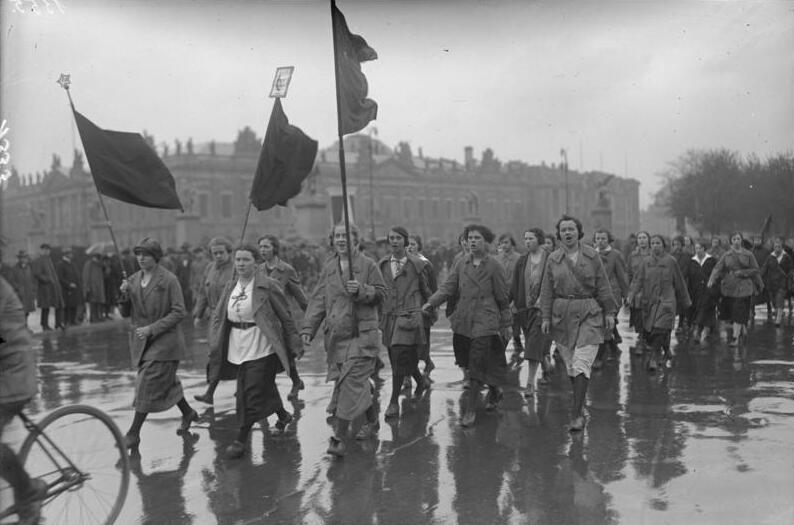
In order to carry through all the tasks with which they are faced, the Communist Parties require a well-functioning party apparatus. The special organs for the work among women, from the women’s department of the C.C. down to the woman organiser of the factory nucleus, still show certain deficiencies in their construction and their work, and in many cases are absent altogether. The latter applies particularly to the factory nuclei in which, up to the present, the larger sections are almost the only ones which can give evidence of practical attempts and success in work among working women. In this connection, the reports of a Moscow district women’s department and a nucleus in a large women’s factory in the Soviet Union will show in a concrete way what can be done in various fields by a woman’s department and a nucleus which are well constructed and firmly incorporated in the whole party apparatus. In this respect the question of the circles of women workers round the factory nuclei will be of special interest, for, in the they form West and the East as once in the Soviet Union and will form a preliminary stage for the meetings of delegates. The last point of the Conference deals with the political training and the Press for propaganda among women. The problem of political training is two-fold. In the first place, still more intensive ideological campaign has proved necessary within the working class, including the Communist party, in order to break down the prejudices against the participation of women in political life. In the second place it is indispensable that a staff of theoretically and practically schooled Communist women should be systematically educated. The Conference will be able to give practical instructions for a solution of this task, on which depends essentially a fundamentally clear, purposeful activity among the masses.
As regards the Press, a still more decisive course than hitherto must be taken with the object of winning over large non-party masses, especially of women workers. The enlistment of working women correspondents, the vivid description, especially through telling illustrations, of the life of the women workers and peasants in the Soviet Union and turning to account the workers’ delegations to the Soviet Union will play an important part in this question.
In order to ensure international leadership, support and animation of the work of agitation and propaganda, it will be the duty of the Conference to give an expert opinion on the founding of an international bulletin which will transmit, fructify and intensify the international experiences of the sections, a task which will have to be more strongly emphasised in the period before us. The value of this Conference will be still more increased in that, apart from the discussions of the Conference, the Women’s Department of the C.P. of the Soviet Union will give the delegates an opportunity of improving their knowledge as to the excellent work and achievements of the Soviet Union and of its leading party, the Bolsheviki, in raising the creative powers of the masses of women in every sphere and in giving them complete social freedom, by instructive lectures and excursions at the source.
International Press Correspondence, widely known as”Inprecorr” was published by the Executive Committee of the Communist International (ECCI) regularly in German and English, occasionally in many other languages, beginning in 1921 and lasting in English until 1938. Inprecorr’s role was to supply translated articles to the English-speaking press of the International from the Comintern’s different sections, as well as news and statements from the ECCI. Many ‘Daily Worker’ and ‘Communist’ articles originated in Inprecorr, and it also published articles by American comrades for use in other countries. It was published at least weekly, and often thrice weekly. The ECCI also published the magazine ‘Communist International’ edited by Zinoviev and Karl Radek from 1919 until 1926 monthly in German, French, Russian, and English. Unlike, Inprecorr, CI contained long-form articles by the leading figures of the International as well as proceedings, statements, and notices of the Comintern. No complete run of Communist International is available in English. Both were largely published outside of Soviet territory, with Communist International printed in London, to facilitate distribution and both were major contributors to the Communist press in the U.S. Communist International and Inprecorr are an invaluable English-language source on the history of the Communist International and its sections.
PDF of full issue: https://www.marxists.org/history/international/comintern/inprecor/1926/v06n43-may-27-1926-inprecor.pdf
 Revolution's Newsstand