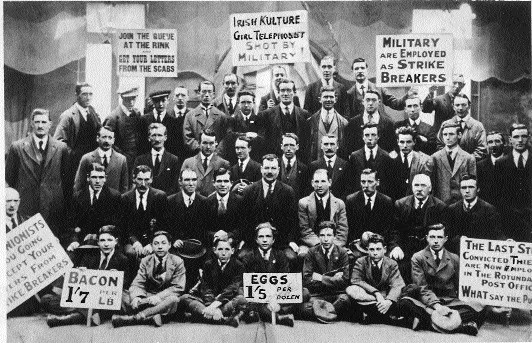
In 1914, James Connolly predicted that partition of Ireland would unleash “a carnival of reaction both North and South, would set back the wheels of progress, would destroy the oncoming unity of the Irish Labour movement and paralyse all advanced movements whilst it endured…” James Connolly was entirely correct. The defeat of Republicans in the Civil War left the revolution not only unfinished, but stunted. The Irish labor movement which played such a vanguard, vital role in the revolutionary years 1913-1923, had become a conservative shadow of its former self. G. Mc. Lay (any help with identification?) describes those dark days as impotent labor faced a country ruled by the reactionary victors of the Civil War.
‘Labour in Ireland’ by G. Mc. Lay from International Press Correspondence. Vol. 6 No. 12. February 11, 1926.
At present there is not a Communist Party in Ireland or anything to take its place.
Formed in November, 1921, shortly before the signing of the Treaty, the Communist Party of Irland was only about 8 months in existence when the Civil War broke out: Born in the lull of the Truce, the Party was very soon cradled in the lap of armed revolt by at once deciding to take up rms with those remaining true to the Republican cause, thus fulfilling the revolutionary need of helping on the struggle for National Freedom in order to weaken the forces of Imperialism–Great Britain.
The stress of the struggle proved a great strain on the resources of such a young organisation. Imprisonments. raids etc. made it very difficult to carry on. Despite the difficulties of “illegality”, the “Worker’s Republic”, the Party Organ, except for the first 2 weeks of the fighting, was published every week. and a very considerable propaganda carried on amongst the Republican Forces urging the adoption of an Economic Programme, suited to the needs of the Town workers and Peasants of Ireland. The efforts in this direction failed with the leaders but had good results among the rank and file of the Republicans.
The defeat of the Republicans and the cessation of the fighting, found the Party sharing in the aftermath of the struggle quarrels about policy and conduct of Party affairs. Before the end of 1923, it was found impossible to continue publishing the “Worker’s Republic” and shortly after the Party was disbanded.
The dissension and chaos that led to the break up of the C.P.I. has been general, both politically and industrially, in the labour movement in Ireland for the last 3 years. This is the natural outcome of the National Split and Struggle. Consider that the workers who formed the bulk of the Free State forces on one side in the armed struggle and of the Republicans on the other, are the same workers who make up the trade unions, ad at once the fundamental reason for the divisions in the ranks of the labour movement is apparent…this is the real cause of the breakaway from the Irish Transport and General Workers Union to set up the Workers’ Union of Ireland. This has greatly aggravated the discord but is not the first cause of same as so often asserted. How the Employers have benefitted by the disunity in general and the splitting of the largest Trade Union in Ireland in particular, will be seen later.
In Irish revolutionary history, the setting up of the Free State will be recorded as the betrayal of the National Struggle by the larger capitalists, estate and ranch owners, and large farmers on their obtaining a certain amount of Economic Freedom. Immediately this had been done by force of arms, the a great need was cheaper production and economy in the affairs of the State, including the Municipal and other local bodies. Economic pressure had forced many workers into the Free State army. Soon the most of them were demobilised thus adding to the already large numbers of the unemployed.
Systematic onslaughts on wages have been the order, taking the workers section by section. Municipal councils, such as Dublin and Cork, that refused to use their powers to reduce the wages of their employees and bludgeon down the standard of living generally, have been dissolved and commissioners appointed to do the dirty work. Tariffs have been placed on clothes, boots, furniture, confections, tobacco, soaps and other goods coming into the country. These are the methods of the Capitalists to enable the small and badly equipped Irish Industries to Germany and other countries, but lower wages and tariffs raising prices mean reduced purchasing power of the workers and so the methods defeat their own ends.
Very few of the unemployed in the Free State get any unemployment benefit or the “dole” as it is called. The exact numbers of the unemployed are not known, they have little or no organisation, and what they have is on the charity collecting basis. Attempts at organising them have been on wrong lines and so the Government does as it likes because there is no organisation to take up the cudgels on their behalf. There must be at least 60,000 to 70,000 unemployed in the Free State of whom only about 1 in every 12 gets the “dole”. They have to depend on charitable organisations and their friends and relations.
Under guise of doing something for the unemployed the Government has set up on a small scale relief works. This has mostly meant getting necessary work done, such as road making, at wages much lower than the trade union rates. The latest instance of this is the Shannon scheme, which is to provide electric power for the whole of the Free State. Because of the low wages offered the scheme has been boycotted. Here also the resistance of the workers has broken down, principally because the unemployed ex-soldiers (National Army) have been used by the government contractors as scabs for the unloading of ships with material for the scheme in Limerick Harbour and on the job itself. One more in the long sequence of defeats for the Irish Workers during the last 3 years.
Increased competition from Denmark and Sweden and the raising of the ban on Canadian cattle has greatly reduced agricultural exports to the impoverished British market and so the agricultural workers share in the unemployment and onslaughts on wages and the general miserable conditions of life now the lot of the workers.
If ever the fallacy of splitting the existing unions, rather than carrying on the fight against the reactionaries within, has been in doubt the lesson of Ireland should once and for all prove that the place to fight reaction is inside the existing unions. No one doubts the earnestness and good intentions of those responsible for the breakaway from the Irish Transport and General Workers Union. When the split took place the great need was to re-unite the politically divided workers by forcing the issue of a united front on the industrial field to meet the attacks of the bosses.
The Irish Transport and General Worker’s Union had a membership of about 100,000, roughly 1/3 of the organised workers of Ireland. A fraction of the energy spent on the setting up of the Workers’ Union of Ireland and its activities since, if concentrated within the I.T. and G.W.U., would have once again made that union the driving force in the Irish Labour movement and have prevented at least some of the defeats that the workers have suffered.
Instead, false issues have been raised and the workers, instead of fighting the employers, have been splitting each others heads and sowing seeds of rank and file hatred that will take years to get over. From being a powerful weapon in the working class struggle, the I.T. and G.W.U. has become a scab providing organisation, used by the bosses to beat the new union–Workers’ Union of Ireland. In the latest instance, the coal workers lockout, the I.T. and G.W.U. provided scabs working under police protection. As soon as the resistance of the men’s union, the W.U.I., had been broken the employers began sacking some of the scabs and taking back their old workers at reduced wages. Beaten and without lockout pay these had little or no option but to accept.
On the political side, the only apology for a labour movement is the Irish Labour Party. But for an occasional feeble protest by the 14 or so members in An Dail its existence would scarcely be known. Enmeshed by supporting the Free State to be set up it has ever since played the part of the mongrel cur, kicked for its pains and unable to do more than give a feeble yelp. or rather lacking courage to do more.
The Republican Party, although having 47 members of An Dail (who have never taken their seats) is fast losing ground. The great needs of the Irish Workers are economic and because of the strong capitalist section of its membership, the Party has never been able to formulate an economic programme to hold its supporters amongst the town and country workers and attract the now disillusioned workers that supported the Free State because of specious promises re “plenty of employment”, “better houses” etc.
Further, the abstentionist policy of the Republican a failure, has proved T.Ds. (Member of Dail Eireann) and soon a further split in the ranks of the Republicans will take this question of place, ostensibly round going into An Dail. As there are quite a number of the T.Ds. who are left wing Republicans, standing for the setting up of a Workers’ Republic, the split, if it comes, although nominally round the question of going into An Dail, is more likely to be in reality for and against adopting a programme for rallying the movement on a Workers, Republic basis. Anyhow, to settle questions of policy, a special Ard Fheis has been arranged for March. The failure of the ultra leftist policy on the Industrial field, the extreme weakness of the official Labour Party and lack of a fighting policy of all of the unions forming it, and the Republican failure to adopt an economic programme, all tend to make the time opportune for the formation of the mass Workers’ Party of Ireland. And soon it is expected to have a strong virile section of the Communist International in Ireland.
International Press Correspondence, widely known as”Inprecorr” was published by the Executive Committee of the Communist International (ECCI) regularly in German and English, occasionally in many other languages, beginning in 1921 and lasting in English until 1938. Inprecorr’s role was to supply translated articles to the English-speaking press of the International from the Comintern’s different sections, as well as news and statements from the ECCI. Many ‘Daily Worker’ and ‘Communist’ articles originated in Inprecorr, and it also published articles by American comrades for use in other countries. It was published at least weekly, and often thrice weekly.
PDF of full issue: https://www.marxists.org/history/international/comintern/inprecor/1926/v06n12-feb-11-1926-Inprecor.pdf
 Revolution's Newsstand
George McLay was the pseudonym of George Pollock, one of the founder members of the Communist Party of Ireland in 1921 – https://www.dib.ie/biography/pollock-george-a7404
LikeLike
Thanks!
LikeLike