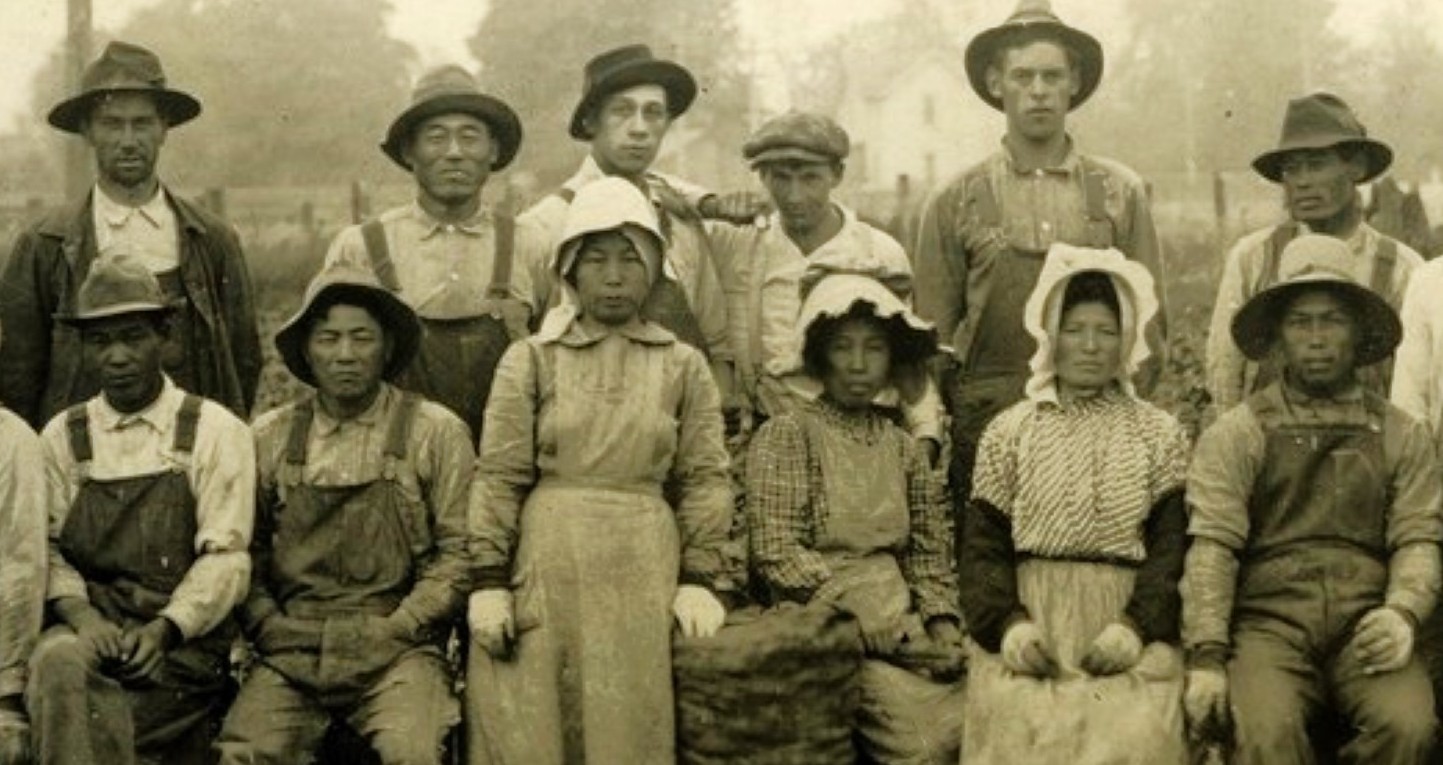
Stating the danger of war between Japan and the U.S. and the harmful division and racist exclusion of Asian workers, Takahashi denounces jingoism in the workers’ movement. Takeshi Takahashi came to America as a teenage “disciple of Denjiro Kotoku,” in 1906 and built a branch of Kotoku’s Socialist Revolutionary Party, established that year, in San Francisco. The S.R.P. and the Bay Area I.W.W. soon held meetings and exchanged papers. By June, 1907 the San Francisco I.W.W. was producing leaflets in Japanese at the same time, the Socialist Party had passed anti-Asian resolutions in California and nationally. While in Chicago Takahashi joined the I.W.W. in 1907, writing articles about Japanese labor in Hawaii and Japan. With the encouragement of Emma Goldman, Josephine Conger Kaneko and others, he launched the Japanese-language I.W.W. paper The Proletariat in 1909. However it was only to last a year for lack of financial support.
‘Let Us Unite’ by Takeshi Takahashi from The Proletarian/プロレタリア(Chicago). No. 4. January 25, 1910.
It is no longer necessary to insist upon the right of Japanese workers to enter this country, the same as other nationalities. Yet there are still some who come out in every manner opposing the interest of Japanese workers. These are like the capitalistic yellow journalists who have large opportunity for knowing nothing whatever of the subject under discussion. Their sole purpose is to simply arm others. They repeat all their arguments upon scanty knowledge, about the final impossibility of the harmony of the races, largely showing their racial prejudice, and with one or two of their ‘own’ labor questions. For instance, in the National Convention of The Woman’s Trade Union League, a delegate from San Francisco point represented this well.
The delegate introduced a resolution urging the extension of the Chinese exclusion law to include Japanese.
She furthermore stated: “It is a question of bread and butter to us on the Pacific coast. I was instructed by the Central Labor council, which is paying my expenses here, to introduce the resolution. We know the Japs out of our way. The Chinese are gentlemen in comparison.”
We do not know ourselves whether Japanese are gentlemen or not. We have been enough referred to already by the capitalist writers as “bad, dishonest Japs”.
The strange thing is to hear the same “old story of the Japanese” by a delegate to a laborer’s convention, when as a matter of fact, all those “bad Japs” have practically ceased to come to this country according to the restrictions of the immigration law.
Clever socialists have already withdrawn their Anti-Japanese views because they know now what “Mighty Conquerors” Japanese workers can be even while they are in such miserable condition. Why should the need be to cry Japanese exclusion any longer, although the expenses of said delegate were paid to introduce the resolution from Far-way-west San Francisco. Yet Japanese exclusion is not out of season, a part of the bargain was also well displayed in the convention of the A.F. of L. which took place recently in Toronto in adopting Anti-Japanese resolutions.
Recent conditions prevailing among Japanese workers on the western coast are deplorable. A vast throng docked in front of an employment agency seeking a job even in mid-summer. The active Anti-Japanese movement for the last 3 years has been effective enough to drive them out of certain districts and concerns. The movement employs a cowardly and sneaking method even using means of violence. Japanese are attacked in day time openly on the streets of the western metropolis and no one interferes.
At the same time, what are the capitalists of both countries realizing today? They are greeting each other with best wishes over the pacific billows, and do not hesitate to compromise whenever their interests demand it, though they are engaged in hot commercial fighting in the markets of China.
How cordially was Prince Kuny, who represented aristocratic Japan, received in the White House! How did Baron Shibuzawa and his party, which represented plutocratic Japan, meet an arrogant hospitality of American capitalists, as they traveled through every city while you, you workingmen, greet Japanese workers by the throwing of bricks and sneering. However, let these be the affair of the past. The time now reaches us that such a trifle difference should vanish altogether and we should and must unite upon a common interest against our real enemy, the Capitalist class.
We call the attention of fellow workers, that the fierce competition in the markets of Eastern countries are driving the nations into crisis.
A vast increasing of military and naval armament of Germany and England which was once commented by the journals in sensational manner are only the situations that responded commercial conflict of both countries in Chinese markets.
A rumor of a coming fight between the U.S.A. and Japan is not the outcome of the question of “school children” nor that of “emigration” but it depends on the further development of the policy of trusts in Manchuria.
What the outcome may be of this commercial competition, no one can tell, but it is very safe to predict that we, working men, shall become one, and all, directly affected by it. In either case the war would be declared or even if they compromised, it would be on a more wise way in which to exploit us by wholesale.
Certain, so long as Capitalism exists, it is that, in the future, as the past has in many cases illustrated, mere diplomatic peace talk will not do, and our blood will be taken to accumulate more wealth for a few persons, which recalls horrid memories of Jap-Russo war. We, workers of America and Japan especially, should not neglect to learn a lesson from the past. We shall not any longer be driven to the battle field like cattle. Workingmen of all nations should come forward to stop the inclination of Militarism, through every effort and if necessary, by means of extreme measures.
Let us unite! Not only in words, for unless our unity develops into actual action, the emancipation of wage slaves can not be accomplished. Salvation lies in the unity of workmen regardless of race or color!
Down with capitalism, patriotism, militarism and racial hatred! Throw away flags of the nations into the mire. Let our red banner alone be triumph eternally over the earth. On there our aspiration lies!
The Proletarian, a bilingual paper published in Chicago by Takeshi Takahashi for ‘Japanese members of the Industrial Workers of the World’, lasted on briefly with a few issues produced in 1909 and 1910. Takeshi came to America as a teenage anarchist, a “disciple of Denjiro Kotoku,” in 1906, and attempted to build a branch of Kotoku’s Socialist Revolutionary Party, established that year in San Francisco. The SRP and the Bay Area I.W.W. held meetings and exchanged papers and by June, 1907 the San Francisco I.W.W. was producing leaflets in Japanese. At the same time, the Socialist Party had passed anti-Asian resolutions in California and nationally. While in Chicago Takahashi’s anarchism developed into anarcho-syndicalism and he joined the I.W.W. in 1907, writing articles about Japanese labor in Hawaii and Japan. With the encouragement of Emma Goldman, Josephine Conger Kaneko and others, he launched The Proletariat in 1909. However it was only to last a year for lack of financial support.
PDF of full issue: https://files.libcom.org/files/The%20Proletarian%20Chicago%20No%204%20January%2025%201910%20English%20Japanese%20Bilingual.pdf

