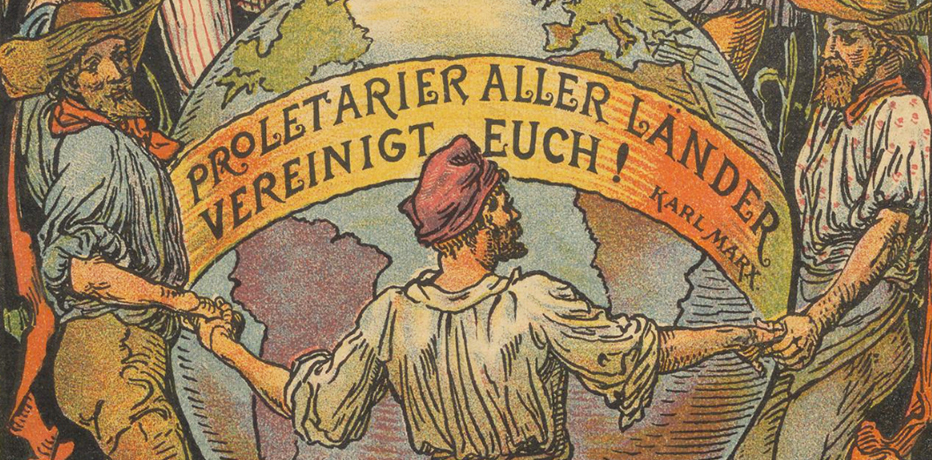
To celebrate the birth of Karl Marx on this day, May 5, in 1818 here is Hermann Schlüter’s account of Marx’s role in the First International. Written shortly before Schlüter’s death and first published Class Struggle around Marx’s 100th birthday. Hermann Schlüter (1851-1919) was born in Schleswig-Holstein and joined the left wing of German Social Democracy as a teen and helped publish newspapers and magazines of the SPD. A decades-long correspondent of Engels both in Germany and later when Schlüter emigrated to the US in 1889 where he joined the editorial board of the New Yorker Volkszeitung, he was close personal friends with Friedrich Adolph Sorge. At first he was a member of the the Socialist Labor Party, later he joined the Socialist Party, which he represented at the Amsterdam Congress of the Second International in 1904. An anti-opportunist and anti-revisionist, he contributed to the debate in Marxism in both Germany and the US. Though firmly in the center of the Party, at the end of his life he served on the editorial board of Louis Fraina’s Class Struggle and worked with Ludwig Lore (and even met Trotsky during his brief US sojourn). However, it is Schlüter’s historical works, mainly of the proletarian movement in the US and England, that are his lasting legacy.
‘Marx and the International’ by Hermann Schlüter from Class Struggle. Vol. 2 No. 3. May-June, 1918.
I. The International Workingmen’s Association that was called into being in September 1864 in London, was not the creation of a single man. And yet a single man, Karl Marx, gave this organization its form and its content, defined its aim: the union of the workers of the world for the emancipation of the proletariat.
The thought that became the keystone of the International Workingmen’s Association was not new, even in 1864. The idea of international unity of mankind, in fact, did not originate in the labor movement, even if it did find its most decided expression there. During the great French Revolution, the ideal of universal brotherhood was born; of a world republic that would tear down all national boundaries, that would give peace to the world.
At that time the radical bourgeoisie of England, too, declared itself in sympathy with these international ideas. In November 1792 they sent a message to the French revolutionary parliament which said, in part: “A Triple Alliance not of crowns, but of the people of America, France and Britain will bring Liberty to Europe and peace to the world.”
In another message these British reformers protested against the thought of a heritage of hate between England and France, while looking forward to the movement when an indissoluble bond may unite both nations, the forerunner of peace and unity all over the earth.
French as well as English philosophical political literature of that time contains numerous references to the international unity of mankind, which naturally found its most intense expression in the democratically inclined portions of the population. The July Revolution in Paris was greeted with undivided rejoicing by the working class of England, so far as it had entered public life at that time. At great mass demonstrations; they gave voice, in speeches and resolutions, to their solidarity with the revolutionists of Paris, they supported its fighters and its victims, held memorial demonstrations, and were permeated with a feeling of solidarity with the revolutionists.
As they saw more and more clearly the differences that existed between the various classes of society, the workers realized that they, as workingmen, had interests that were in opposition to those of their exploiters and oppressors, that human solidarity must include, first of all, the members of the same class of society. The idea spread that the workers of all nations belong together, that they must unite their forces for the more effective pursuit of their interests against the ruling classes of all nations. And it is astonishing, how clearly this thought of international working-class solidarity in all countries was expressed, at that time, at the beginning of the thirties of the last century, at a time when the labor movement was just coming into existence.
Thus, for instance, the Socialist cooperative movement of England, in 1832, sent delegates to France, to the St. Simons and to the United States of America in order to emphasize there, the unity of interests of the workers of all nations. French workmen at Nantes sent an address to English labor declaring: The workers of all countries are brothers. Let us form a union that neither seas and rivers nor state boundaries can divide. Let us all come together, all the cities and the industrial centers of the world.” In a message to the workers of America an English Cooperative Congress emphasized that the working class must transform, entirely, existing social and political conditions. English Trade Unionists called to French workmen: We agree with you most heartily that the workers of all nations are brothers.
In The London Workingmen’s Association, where the Charter that later became the program of the Chartist movement, was first drawn up, this internationalist tendency was particularly apparent.
In an appeal to the workers of the countries issued by this organization we read: “If you feel with us, then you will tell of it in your shops, you will preach it in your organizations, you will publish it in hamlet, in town, from country to country, from nation to nation: that there is no hope for the sons of labor until those whose interests are identical with theirs, have an equal right to decide what laws shall be passed, what plans shall be made to rule this country justly.”
And another appeal to the working class of America, issued by the same organization in the fall of 1837, begins with the words: “We turn to you in a spirit of fraternity, as is fitting among workers in all countries of the world.”
The same thought is expressed in an appeal to the European working class, when it says: “Producers of all wealth: we see that our oppressors are united. Why should not we, too, have our bands of brotherhood, our Holy Alliance?”
When, in November 1836, The London Workingmen’s Association sent an address to the laboring class of Belgium in which national differences were condemned as foolish, the Belgians answered in a similar tone. In an address to the working class of America we read: “The tyrants of the world are strong because we, the toiling millions, are divided.” And in an appeal to the workers of France: “We turn to you, because we believe that the interests of our class, the world over, are identical.”
Thus, the international solidarity of the proletariat played an important role at the earliest awakening of the labor movement, and everywhere, in the labor organizations, found suitable expression on all occasions. But there were also organizations that made the propagation of this thought their foremost duty, that tried to bring together workers of various nationalities for the sake of uniting them for the furtherance of the mutual interests of the working class in all countries.
In the middle of the 40’s London had become the haven for countless refugees from the different countries of the European continent. Among these men, at the end of 1844, the idea of forming an international organization, which was to be the meeting place of the Democrats of all nations first took root. This organization came into existence in the beginning of 1845, and called itself the “Democratic Friends of all Nations.” It was not particularly successful.
In the summer and the fall of the same year a number of international celebrations were held in London, that were visited by Democrats from all nations. The best known of these celebrations is that of September 22, at which Julian G. Harney was the chief speaker. This celebration was the first meeting of more than a thousand representatives of international democracy. In their decisions they demanded not only Internationalism, but Communism as the aim of the proletarian movement.
This idea of an international association for democracy was taken up by Harney who proceeded, at the beginning of 1846, to organize the “Fraternal Democrats,” an organization that shortly afterward united the radical wing of the English Chartists with the revolutionary refugees from the continent. This organization kept up relations with the democrats and reformers, not only of Europe, but of America as well.
In Paris in 1843, German refugees had organized a democratic secret organization, “Bund der Geachteten.” Out of this the famous “Bund der Gerechten” evolved, after a split in 1836. Members of this “Bund der Gerechten” organized the public “Deutscher Arbeiter-Bildungs-Verein,” which later, as “Kommunistischer Arbeiter-Bildungs-Verein” was destined to play a momentous role in the labor movement. Here, on English soil, the “Bund der Gerechten” that had hitherto remained entirely German, rapidly developed into an I international secret society. Here speakers from all nations were heard. In February 1846, Harney delivered a speech in which he said: “The cause of the people is alike in all nations—the cause of labor, of exploited, enslaved labor. In every country those who produce wheat, live on potatoes; those who raise cattle, never taste meat; those who raise grapes taste only the dregs of their noble juice; those who make clothes go in rags; they who build houses, live in wretched hovels; they who produce the necessities, the comforts, the luxuries of life, are drowned in misery. Are not the sorrows and the destitution of the workers alike in all countries? Is not their cause identical?”
The leading spirits in the “Bund der Gerechten,” and in the “Kommunistischer Arbeiter-Bildungs-Verein” tried earnestly to induce Karl Marx and Friedrich Engels to join their ranks. How the influence of these two theoreticians gave a new foundation to the Socialists of the “Bund der Gerechten,” how they turned it into the “Communistic League” is too well known to require repetition. It is generally known that this metamorphosis was partly accomplished, partly furthered, by the Communist Manifesto whose publication gave to the modern labor movement its first theoretical foundation.
The “Communistic League” thus was the first concrete expression of an international labor movement. Many of those who were active in this secret organization, later assumed a leading role in the International Workingmen’s Association. The theoretical principles that were written upon the standards of the “Communistic League” are the same principles that are today the connecting link between the units of the entire world proletarian movement. Here, in the Manifesto of this “Communistic League,” the great word of Marx and Engels, “Proletarians of the World, Unite!” began its victorious journey over the face of the earth.
II. The overthrow of the revolutionary movement of 1848 killed the labor movement on the European continent. The 10th of April, 1848, gave the death blow to the Chartist movement in England. The Communist trial in Cologne and the general reaction all over Germany choked the first germ of independence in the working class; in France the coup d’état of Napoleon crushed down the last vestiges of a labor movement that might have escaped the overthrow of the June insurrection.
But the overthrow of the 1848 revolution brought in its wake unheard-of industrial prosperity. Capitalism, which had reached a modern state of development only in England, took root upon the continent. In Germany, in France, new forces were awakened. In reactionary Central Europe the remaining walls of mediaeval craft domination were rent asunder. Freedom of movement, freedom of labor were victorious over ancient craft rules.
The “free play of economic forces” began. Capital started on its triumphal march over the European continent. But at the same time, it bore, in the words of Marx, its own gravedigger.
The rapid development of capitalism in the countries of the European continent, awakened the labor movement as well. In France labor and Socialist organizations of the most widely diversified character came into being. In Germany Lassalle’s agitation culminated in the organization of the “Allgemeine Deutsche Arbeiter-Verein,” and in England the trade union movement grew as it had not grown in 30 years.
In London, in 1862, the World’s Fair was held, a triumph of a growing capitalist world. At this rendezvous of the bourgeois world, labor, too, played its part. From Germany and France labor delegations were sent to London. Here they met the English workers, and became familiar with a form of economic labor organizations that was practically unknown on the continent. The relations thus established were continued in written communications and discussions. At that time the labor movement in London stood under the influence of persons who used the economic power of the trade unions for political purposes. The ties that were formed between workingmen of London and Paris during this Exhibition, led to the decision to arrange mutual demonstrations on all international questions that moved the world. The overthrow of the Polish revolt of 1863 led to a protest demonstration that again brought French workers to London. This protest meeting was held on April 1864 in St. James. Here a committee of English workingmen was elected, which sent a sharp protest to the workers of France, whereupon the latter answered with a second delegation for whose reception a public meeting was arranged on September 28, 1864, in St. Martin’s Hall in London. This meeting became the birthplace of the International Workingmen’s Association.
The meeting was attended by Germans, Poles and Italians as well as by French and English. The chairman was Professor Beesley, who had already made a name for himself by his support of the working class. In his opening speech he expressed the hope that this meeting would lead to the formation of more intimate relations between the workers of the various nations. He further dwelt upon the autocratic acts of the government, calling upon his hearers to rid themselves of that egoistic sensitiveness that hides under the name of patriotism.
The shoemaker Odger spoke in the name of the English workers.
The English trade unionist, Wheeler, brought in the following resolution:
“The meeting has received the answer of our French brothers to our appeal. Once more we bid them welcome, and since their program will further the harmony of labor, we accept it as the basis for international unity. At the same time we appoint a committee with the privilege of increasing its membership at will, to draw up the by-laws and regulations for such an organization.”
This resolution was debated and accepted. The election of the committee was taken up, and among those elected was Karl Marx. Thus the International Workingmen’s Association was founded.
With the years a legend has gained credence that Marx was the founder of this famous association, that he was its creator and patron. Nothing could be further from the truth. As a matter of fact he came into this organization rather unwillingly and was exceedingly critical of its aims and ideas. In a letter to Engels written at that time Marx draws a vivid picture of the unclear semi-bourgeois opinions of the prominent members of the association, and shows how, only after he was convinced of the impossibility of accepting their proposed programs, he brought in his “Inaugural Address to the Working Classes” as a substitute for the proposals of the others.
To this Engels answered: “I am eager to see your “Address to the Working Classes.” It must, in truth, be a work of art, after all that you told me in your letter about these people. But I am glad that we are coming into contact with people who at least represent their class, and after all, that is the most important consideration…But on the whole, I suspect that the new association will soon split up into its theoretical bourgeois and its theoretical proletarian elements, as soon as the work of ‘precision’ shall have begun.”
Here, too, there is nothing that suggests that Marx’s activity in the Workingmen’s Association was part of a preconceived plan for the unification of the proletariat of all countries. Marx became active there only when everything had already been arranged. In no way did he force himself into an official capacity into the organization. On the contrary, he was with difficulty persuaded to do so, against his own preferences. But once in the General Council, he used his whole power to direct the new Workingmen’s Association into the channel that, in his opinion, alone could fulfill the requirements that would have to be met. His experience, his keen mind soon assured him that influence upon the central body, that made it possible for him to direct and form the declarations and decisions of the International, to become its “head.”
The International Workingmen’s Association was not the creation of one man. It came into existence as the necessary product of economic development, which forced the working class in all countries to unite more closely, in order to strengthen its position in the struggle.
III. We would have to write a history of the International Workingmen’s Association in order to describe in detail the work of Karl Marx in this first organization of the labor movement of all countries.
The Inaugural Address, this first official declaration of the new organization, still lacks, as Marx himself remarked, “the old daring language.”
But its principles, on the whole, were thoroughly in accord with the contents of the “Kommunist Manifesto,” and the closing sentence of this manifest “Proletarians of all countries, unite,” was also the closing sentence of the Inaugural Address. The International Workingmen’s Association had found its theoretic basis before it was founded. Of course it was not possible to force the full recognition of these principles in the International at once. In France Proudhon’s ideas dominated the Socialist leaders. In England the masses had almost forgotten the revolutionary ideals of the Chartists. The narrow trade union conception that had become dominant in the labor movement of that country determined the attitude of the working class. It was necessary, therefore, first of all, to emphasize the points of likeness between these various groups and theories, to push the differences of opinion slightly into the background, lest the International at the outset become the arena for inner quarrels and differences.
Karl Marx, who by his wisdom and his farsightedness had quickly become the acknowledged head of the General Council, was particularly capable in this respect. He kept the unifying forces of the labor movement consistently in the foreground, and thus succeeded in bringing Socialists, Proudhonists, Communists and Trade Unionists together for the achievement of a common goal.
Against all these factors labor possesses only one element of success—its numbers. But numbers are a determining factor only if they are united by an organization and led by knowledge. For this reason the workers of all countries must be united. For this reason they must overcome their prejudices. For this reason they, the proletarians of all nations, must unite in one band of brotherhood.
It was for this reason Marx pushed the idea of the class struggle into the foreground in his inaugural address, to create a foundation upon which all workers might stand, to determine the lines of cleavage between the capitalist world and the world of labor. He described the purpose of capitalist development in the years after 1845. He described the terrible misery that existed on the one hand, the mad thirst for wealth of the ruling class on the other. “It is a great fact, that the misery of the working class has not decreased from 1848 to 1864, and yet this period has been unequalled in the development of industry and the growth of trade.” The increase of riches and power in these years was truly enormous, but it was limited to the ruling classes. And while these ruling classes climbed up on the social ladder, the mass of the working people sank down into ever increasing want at least in the same ratio that marked the rise of the upper classes. Hunger lifted its head in the capital of Great Britain and became a social institution, and the inmates of the prisons of England received better food than the “free” workers of the country. He showed that, with a slightly different local color and a somewhat smaller degree, English conditions were being reproduced in every country on the continent that was in the process of industrial development. The fate of the workers of England will be the fate of the workers of the world!
Only a Marx, with his clear conception of the contents of the Labor movement, with his remarkable understanding of the subject, could accomplish this herculean task. Without him the international unification of the working class would have had to wait many years for its realization.
Like the Inaugural Address, all of the other numerous important declarations of the General Council of the International were written by Marx. He determined the direction along which the movement was to go, within the leading authority of the International, and backed up this decision in the published manifesto. And the effect, particularly upon English politics, was far greater than is generally recognized.
Thus, for instance, the International played a prominent role in the agitation for extended suffrage in England, which in 1867 created another million of new voters. For the purpose of carrying on this agitation the English workers had founded a “Reform League.”
Concerning this Karl Marx wrote to Friedrich Engels on May 1, 1865: “The great success of the International Association is this: The Reform League is our work. In the inner committee of 12 (six middle class men and six workingmen) the workingmen are all members of our Council. All middle-class bourgeois efforts to mislead the working class we have baffled…If this regalvanization of the political movement of the English working class succeeds, our Association, without making any fuss, will have done more for the European working class than would have been possible in any other way. And there is every promise of success.”
A few days later, on the 13th of May, Marx added a postscript to this letter to Engels. “Without us, this Reform League would never have been founded, or it would have fallen into the hands of the middle class.”
After the reform movement during the following year had assumed an absolutely revolutionary character, after the labor speakers, who at the same time were members of the Council of the International, had recalled, in mass demonstrations, that once before the people of England had beheaded its King, Marx again wrote to Engels on July 7, 1866: “The London Labor demonstrations are miraculous, compared to what we have been accustomed to seeing in England since 1849. And yet they are purely the work of the International. Mr. Lucraft, for instance, the chief on Trafalgar Square, is one of our council. That is the difference between working behind the scenes, hidden from the public eye, and showing off in public, according to the favored manner of the Democrats, while one does nothing.”
It was Karl Marx also, who led the General Council to take a stand in the Irish question, to demand the solution of this problem from the point of view of the working class.
He showed that the working class in England would never be capable of decisive action until its Irish policy was distinctly separate from that of its ruling classes; that it must not only make common cause with the Irish, but must even take the initiative in dissolving the union between Ireland and England, to put in its place a freer, more liberal relationship. He insisted that this solution alone is commensurate with the interests of the English proletariat. So long as the English land oligarchy can hold itself entrenched in Ireland, it will be impossible to overthrow it in England, and yet its overthrow is the foremost condition in the liberation of the English working class. In Ireland, however, the destruction of the landed aristocracy will be much more easily accomplished, once the solution of this problem has been placed into the hands of the Irish people themselves. For in Ireland the fight against landlordism is an economic and a national question as well.
In pursuance of this policy in the Irish question as outlined by Marx, the General Council of the International took its stand on the side of the revolutionary Irish movement. It protested, for instance, against the inhuman treatment accorded to Irish political prisoners in British prisons, and against the death sentence passed upon a number of Fenian conspirators.
It was upon a suggestion from Karl Marx that the General Council took its stand on the question of Negro slavery and the American Civil War. Again he was chiefly instrumental when the London workingmen, under the direct influence of the General Council, arranged protest meetings against the anti-Union attitude of their manufacturers and their government.
On the 22nd of November, 1864, the Council decided to send an address to the American people, congratulating them upon the recent re-election of President Lincoln. The address, written by Marx, was presented to Lincoln through the American ambassador in London, and said, in part:
“Everywhere they (the European workmen) patiently bore the hardships imposed upon them by the cotton crisis, opposed enthusiastically the pro-slavery intervention – importunities of their betters – and from most parts of Europe contributed their quota of blood to the good of the cause.”
“While the workingmen, the true political power of the North, allowed slavery to defile their own Republic, while before the Negro, mastered and sold without his concurrence, they boasted it the highest prerogative of the white-skinned laborer to sell himself and to choose his own master, they were unable to attain true freedom of labor, or to support their European brethren in their struggle for emancipation; but this barrier to progress has been swept off by the red sea of civil war.”
“The workingmen of Europe felt sure that as the American War of Independence initiated a new era of ascendancy for the middle class, so the American Anti-Slavery War will do for the working class…”
This address to Lincoln was answered by Charles Francis Adams, then United States Minister in London. It seems that Lincoln also sent a personal answer to the General Council, for Marx wrote to Engels: “The fact that Lincoln answered us so politely, and was so blunt and formal in his communications to the Bourgeois Emancipation Society, has made the ‘Daily News’ so indignant that it did not print our answer.”
It is generally known that, beside this address to Lincoln, the International sent two other addresses to America, one to President Johnson on the assassination of Lincoln, and a second to the people of the United States. The latter rejoices in the end of the war, and congratulates the people of America for having preserved the Union. Both addresses were written by Marx.
But Marx was the spokesman of the International not only in foreign and general political questions. He was active, as well, in the inner work and clarification of the movement, and undertook the work that this entailed. Thus most of the preparatory work for the annual Congress of the Association was the work of his pen. His also were the wonderful memoranda that were presented by the General Council at these congresses. He was the author of the most important resolutions that were adopted by these congresses upon recommendation by the General Council.
The illuminating resolutions, on labor unions that were adopted at Gent at the Congress of 1866, were his. Today it is difficult to understand their importance in view of the then existing state of affairs. On the European continent there were no unions after the pattern of the English trade unions. The Marxian resolution demanding the furtherance of the trade union movement on the continent, met with active opposition from the French and the Swiss delegates. They insisted that such unions would never develop on the European continent. But two years later, at the International Congress in Brussels, there were forty delegates representing continental labor union organizations.
In the General Council itself Marx more than once found active opposition on this question. As in the International, there were represented in the General Council the most widely diversified views. It became necessary to bring about an understanding and wherever possible, agreement between these various groups. All who knew him tell with what almost superhuman patience Marx strove to accomplish this. Marx did not allow the most tiresome debates in the General Council to keep him from pursuing his work of education in these meetings. And though his time was scant—he was finishing the first volume of his “Capital,” at that time—he was always ready to give it for the sake of bringing clearness and understanding to the members of the Council.
The following is an example: One of the members of the General Council, John Weston, a disciple of Robert Owen, believed it to be useless to work for a general increase in wages, because the capitalist would cover the difference by increasing the price of his product, thus keeping the worker in his old condition. Therefore, he argued, labor unions are dangerous.
Marx opposed this stand in the General Council and in order to make himself clear, delivered a long theoretical lecture in one of its sessions which was later published under the title “Value, Price and Profit.” In this lecture he showed, using the history of the labor union movement as an illustration, that the argument used by Weston, was not, in reality, based upon the actual facts, and he investigated, thoroughly, the laws that control wages in capitalist society. Through his splendid dissertation he won the General Council over to his side. Later the Council supported, almost unanimously, the proposals and resolutions on labor unions that were presented by Marx at the International Congresses.
Not only in the regular questions of politics and organization did the opinion of Marx prevail. His views also determined the position adopted by the General Council in questions of war, and particularly regarding the Franco-Prussian war of 1870-71 and its after-effects.
During this war the General Council published two addresses, both written by Karl Marx. The second of these was particularly important.
In the first, which was written a few days after war was declared, Marx was of the opinion that Germany was fighting a war of defense. The falsification of the Ems dispatch was then not yet known. In this address he says verbatim:
“Whatever may be the outcome of the war of Louis Bonaparte with Germany, in Paris—the death-knell of the second Empire has already rung. It will end, as it began, with a parody. But let us not forget, that the governments and the ruling classes of Europe have made it possible for Louis Bonaparte for 18 years, to play the cruel joke of a restoration of the second Empire.”
“On the part of Germany the war is a war of defense. But who has put Germany into a position that makes this defense necessary? Who made it possible for Louis Bonaparte to make war upon Germany? Prussia! It was Bismarck who conspired with that same Louis Bonaparte, in order to crush down popular opposition at home and to annex Germany to the Hohenzollern dynasty.”
In the second message, that was published right after the capture of Napoleon at Sedan, Marx and the General Council protested against the continuation of the war by Germany. The war of defense had become a war of conquest, as was proven by the demand for the annexation of Alsace-Lorraine.
“Certainly, the territory of these provinces at one time belonged to the long dead German Empire. And, therefore, it is maintained that this piece of earth, and the human beings that have grown up upon it, must be confiscated as an eternal possession of the German nation. But if the map of Europe is to be changed that it may correspond with old historic rights, then let us under no circumstances forget, that the Kurfiirst of Brandenburg was at one time, for his Prussian possessions, the vassal of the Polish Republic.”
In this address Marx made his famous prophecy, that the annexation of Alsace-Lorraine would drive France into the arms of Russia and would bring a pew and a greater war. He declared: “Do the German jingoes really believe that German peace and freedom are assured, if they force France into the arms of Russia? If the fortune of arms, if rejoicing over success and dynastic intrigues lead Germany to rob French territory, only two paths are open before it. Either it will become, whatever may happen, the obvious serf of Russian aggrandizement, or it must arm, after a short period of rest, for a new ‘defensive war,’ not for one of those half baked ‘localized wars,’ but for a gigantic war against the united Slav and the Roman races.”
Our times have shown how clearly Marx foresaw the political course of events.
It is well known how wonderfully Karl Marx pictured the Paris Commune in his address of the General Council on “Civil War in France.” According to him, the Commune was, in the main, a government of the working class, the newly discovered political form under which alone the economic liberation of the working class can be achieved. On the 28th of May the last Commune revolutionists gave up their lives. Only two days later, on the 30th of May, Marx read his papers in the General Council, describing the historic significance of the Commune in short, pregnant lines, but more clearly and truthfully than this has ever been done anywhere in the mass of literature that has been written on this subject.
It would lead us too far afield, should we further discuss the contents of Marx’s address on the Commune, especially since it is probably well known everywhere in working class circles. Nor can we more than mention in passing the part played by Marx in the differences that arose within the International after the Fall of the Commune, as a result of the secret machinations of Bakunin and his followers.
The work that fell to the lot of Marx as a result of these unpleasant quarrels was enormous. It is possible that it would have exceeded even the limits of his endurance, had he not gained in Friedrich Engels, who had moved from Manchester to London, an industrious helpmate in the work of the International.
In September 1872, the last Congress of the International Workingmen’s Association on European territory was held. It was the first International Congress which Marx was able to attend. It was decided to transfer the General Council of the Association from London to New York. This put an end to the direct participation of Karl Marx in its business affairs.
After the Congress of the Hague was over, Marx spoke in a mass meeting in Amsterdam, where among other things he said:
“The Congress at the Hague has proclaimed the necessity for the working” class to fight against the old social state, which is on the point of collapse, on the political as well as on the social field…A group had arisen in our midst which proclaimed working class abstinence from political work.
“We deemed it our duty to declare, how dangerous and how threatening such opinions may become for our cause. The worker must, sometime, get the political power into his own hands, in order to lay the foundation for a new organization of labor. He must overthrow the old political system that upholds the old institutions, unless he is ready like the old Christians —to sacrifice the ‘Kingdom of this World.'”
“And,” he continues, “Citizens, let us remember that fundamental principle of the International: Solidarity. Only so long as we keep alive this rejuvenating principle among the workers of all nations will we achieve the great aim that is our goal: The overthrow of capitalist society must be based upon solidarity. That is the lesson of the Paris Commune that fell only because this solidarity was lacking in the workers of the other countries.”
And in closing, Marx said in this speech, which, in a way, marked the end of his official activity as member of the General Council of the International Workingmen’s Association:
“As for me, I will remain true to the task I have undertaken, and will work unceasingly to lay the foundation for the solidarity among the working class. No, I am not withdrawing from the International, and the remainder of my life, like all my energies in the past, will be dedicated to the triumph of our social ideal, which, -be sure that that time will come—will bring about the world rule of the proletariat.”
What Marx promised there, he has kept. After the Hague Congress, as before, it was Marx who enriched the proletarian movement of the world with his powerful mentality.
Karl Marx cannot be called the “founder” of the International Workingmen’s Association. This first great union of the workers of all countries had no founder in the generally accepted sense of that term; it was the product of necessity at a given stage of economic development. But he first gave the organization its content. He determined its course; it was his untiring work that gave to the International its significance.
Therefore, the name of Karl Marx is forever bound to the International Workingmen’s Association.
The Class Struggle and The Socialist Publication Society produced some of the earliest US versions of the revolutionary texts of First World War and the upheavals that followed. A project of Louis Fraina’s, the Society also published The Class Struggle. The Class Struggle is considered the first pro-Bolshevik journal in the United States and began in the aftermath of Russia’s February Revolution. A bi-monthly published between May 1917 and November 1919 in New York City by the Socialist Publication Society, its original editors were Ludwig Lore, Louis B. Boudin, and Louis C. Fraina. The Class Struggle became the primary English-language paper of the Socialist Party’s left wing and emerging Communist movement. Its last issue was published by the Communist Labor Party of America. ‘In the two years of its existence thus far, this magazine has presented the best interpretations of world events from the pens of American and Foreign Socialists. Among those who have contributed articles to its pages are: Nikolai Lenin, Leon Trotzky, Franz Mehring, Karl Liebknecht, Rosa Luxemburg, Lunacharsky, Bukharin, Hoglund, Karl Island, Friedrich Adler, and many others. The pages of this magazine will continue to print only the best and most class-conscious socialist material, and should be read by all who wish to be in contact with the living thought of the most uncompromising section of the Socialist Party.’
PDF of full issue: https://www.marxists.org/history/usa/pubs/class-struggle/v2n3may-jun1918.pdf
 Revolution's Newsstand