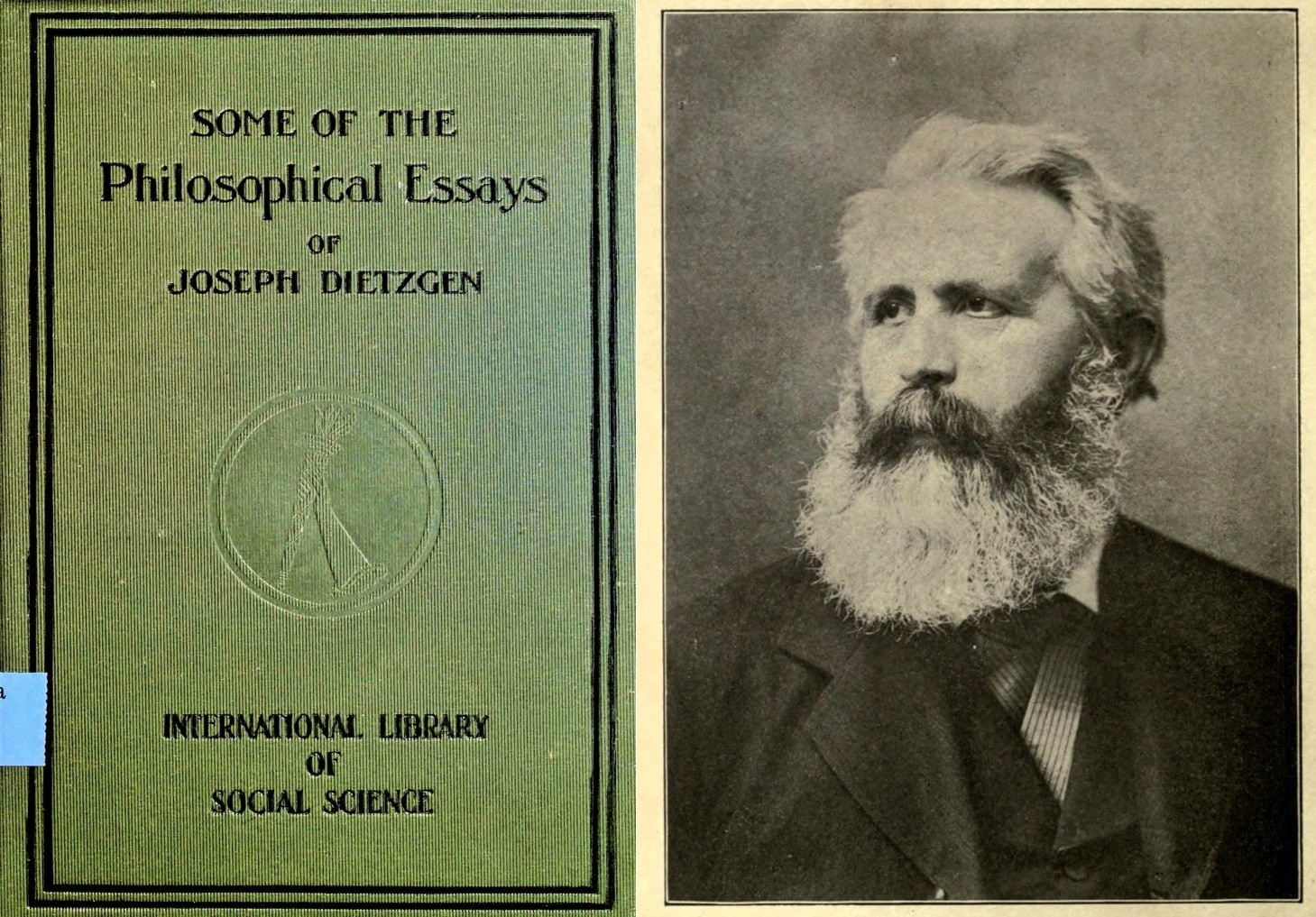
A section from Dietzgen’s 1887 ‘Excursions of a Socialist into the Domain of Epistemology.’
‘Materialism versus Materialism’ (1887) by Joseph Dietzgen from Philosophical Essays. Translated by Max Beer and Theodore Rothstein. Charles H. Kerr Publishers, Chicago. 1906.
“The insight,” says Frederic Engels, “gained into the utter perversity of the hitherto prevailing German idealism led necessarily to materialism, but, of course, not to the mere metaphysical materialism of the eighteenth century.”
This modern materialism which is here derived from the total perversion of German idealism and of which Engels himself is one of the founders, is little under stood, though it forms the fundamental basis of the theory of German Social-Democracy. We propose, therefore, to make it the subject of a somewhat detailed examination.
This specifically German, or, if you like, Social-Democratic materialism, can best be characterized by comparing it with the “metaphysical, exclusively mechanical materialism of the 18th century;” and when we further confront it with the German idealism from the perversity of which it sprang, the character of the Social-Democratic basis, which, owing to its materialist name, is easily exposed to misrepresentation, must clearly reveal itself.
And first of all, why does Engels call the materialism of the 18th century “metaphysical?” Metaphysicians were people who were not satisfied with the physical or natural world, but always carried about the idea of a supernatural, metaphysical world. Kant in his preface to the Critique of Pure Reason sums up the problem of metaphysics in three words: God, Freedom and Immortality. One knows now that God was a spirit, a supernatural spirit, who created the natural, physical, material world. The celebrated materialists of the 18th century were no friends or worshippers of this biblical story. The problem of God, Freedom and Immortality, so far as it refers to a supernatural world, left those atheists thoroughly indifferent. They stuck to the physical world and were so far no metaphysicians.
It is evident that Engels uses the word in a different sense.
Of the primary great mind beyond the clouds the French and English materialists of the 18th century had disposed completely enough; but they could not help occupying themselves with the secondary human mind. It is the difference in the conception of this mind, its nature, its origin and its constitution which distinguishes the materialists from the idealists. The latter regard the human mind and its ideas as children of a supernatural, metaphysical world. Still they have not been content with the mere belief in such a distant origin, but rather strove, since the very days of Socrates and Plato, to sup ply this belief with a scientific basis, to prove it, to elucidate it, just as one proves and elucidates physical things of the tangible world. In this way the idealist brought the knowledge about the nature of the human mind down from the transcendental, metaphysical world to the real, physical, material world which reveals itself as a dialectical or evolutionary process, where mind and matter, though two, are yet one, that is, twin children springing from one blood, from one mother.
The idealists originally favored the religious notion that the world was created by a spirit. In this they were completely wrong, since it finally, as a result of their efforts, became evident that it is precisely the natural material world which is the original; that this was created by no spirit, but on the contrary, the natural or material world itself is the creator which brought forth and developed man with his intellect out of itself. Thus it was discovered that the supreme uncreated spirit is but a fantastical image of the natural mind which has developed in, and together with, the human nervous system and its brainy skull.
Idealism, which derives its name from the circumstance that it sets the idea and the ideas, those products of the human head, above and before the material world – both in point of time and importance, this idealism has started very extravagantly and metaphysically. In the course of its history, however, this extravagance has toned down and become more and more sober till Kant himself answered the question which he had set out to solve, viz.: “Is Metaphysics at all possible as a science?” in the negative; Metaphysics as a science is not possible; another world, that is, a transcendental world can only be believed and supposed. Thus the perversion of idealism has become already a thing of the past, and modern materialism is the result of the philosophical and also of the general scientific development.
Because the idealist perversity in its last representatives, namely Kant, Fichte, Schelling and Hegel, was thoroughly German, its issue, dialectical materialism, is also a pre-eminently German product.
Idealism derives the corporeal world from the mind, quite after the fashion of religion where the great spirit floats over the waters and has only to say: “Let there be,” and it is. Such idealist derivation is metaphysical. Yet, as mentioned already, the last great representatives of German idealism were metaphysicians of a very moderate type. They had already emancipated themselves considerably from the transcendental, supernatural, heavenly mind, – not, however, from the spell-bound worship of the natural mind of the world. The Christians deified the mind, and the philosophers were still permeated to such an extent with this deification, that they were unable to relinquish it – even when the physical human mind had already become the sober object of their study – making this intellect of ours the creator or parent of the material world. They never tire in their efforts to arrive at a clear understanding of the relation between our mental conceptions and the material things which are represented, conceived and thought.
To us, dialectical or Social-Democratic materialists, the mental faculty of thinking is a developed product of material Nature, whilst according to the German idealism the relation is quite the reverse. That is why Engels speaks of the perversity of this mode of thinking. The extravagant worship of the mind was the survival of the old metaphysics.
The English and French materialists of the 18th century were, so to speak, too hasty opponents of this sort of worship. This over-hastiness prevented them from emancipating themselves from it thoroughly. They were extravagantly radical and fell into the opposite perversity. Just as the philosophic idealists were worshipping the mind and the mental, so were the materialists worshipping the body and the corporeal. The idealist over estimated the idea, the materialist matter, both were dreamers and in so far metaphysicians, both distinguished mind and matter in a fantastic, unreal way. Neither of them raised themselves to the consciousness of unity and monism, generality and universality of Nature which is not either material or mental, but is one as well as the other.
The metaphysical materialists of the 18th century and their present followers – for there are still some of them among us – undervalue the human mind and the inquiry into the constitution and its proper use just as much as the idealists overvalue them. They, the materialists, proclaim, for instance, that the forces of Nature are properties of matter, and that especially the mental force, the force of thought, is the property of brain. Matter or the material, i. e., the ponderable and the tangible, is in their eyes the main thing in the world, the primary substance, while the mental energy, like all non-tangible energies, is but a secondary property. In other words, ponderable matter is to the old materialists the exalted subject, and all other things subordinate predicates.
There is in this mode of thinking an exaggeration of the importance of the subject and a disparagement of the predicate. The fact is lost sight of that the relation between the subject and the predicate is a variable one. The human mind may legitimately turn every predicate into a subject, and vice versa, every subject into a predicate. The snow-white color is, if not tangible, at least as substantial as the color-white snow. To think that matter is the substance or the main thing, and its predicates or properties are mere subordinate appendices, is an antiquated, narrow way of thinking which has taken no notice of the work of the German dialecticians. It must now be understood that subjects are composed exclusively of predicates.
The statement that thought is a secretion, a product of the brain, as bile is a secretion of the liver, tells us some thing that is unquestionable. Yet, it must be confessed that the analogy is a very bad, a faulty one. The liver, the subject of this observation, is something tangible and ponderable; likewise the bile which is said to be the predicate or the effect of the liver. In this illustration both the subject and the predicate, both the liver and the bile, are ponderable and tangible, and it is this circumstance which conceals what the materialists wish to convey when they represent the bile as the effect and the liver as the superior cause. We must therefore specially emphasize what in this case is not at all disputed, but what in the relation between the brain and mental energy is entirely lost sight of, – namely, that the bile is not so much the effect of the liver as the effect of the life-process as a whole. In the life-process of human nature as in the cosmic life-process of the natural Universe the liver and the bile are of equal standing and equally subordinate, equally cause and equally effect, equally subject and equally predicate.
By saying that bile is a product of the liver the materialists do not in the least wish to deny that both are of equal value as subjects of scientific research. When, however, it is stated that consciousness, the faculty of cognition, is a property of the brain, the tangible subject appears to them as the sole object worthy of study, while the mental predicate is a mere settled thing as it were.
We call this mode of thinking of mechanical materialism narrow because it makes the tangible and the ponderable the subject, the depositary of all properties, and that to such an extent as to overlook entirely that in the Universe the transcendentally extolled palpability plays precisely the same subordinate predicative part as every other subordinate subject of General Nature.
The relation between subject and predicate explains neither matter nor thought. Still in order to elucidate the connection between the brain and the mental energy it is necessary to elucidate the connection between subject and predicate.
We shall, perhaps, come nearer to the point, if we select another example, an example where the subject is material, but the predicate is such as makes it at least doubtful, whether it is material or mental. If, for in stance, the legs walk, the eyes see, the ears hear, it is questionable whether the subject and its predicate belong together to the domain of the material; whether the light which is seen, the sound which is heard, and the movement which is effected by the legs are something material or immaterial. The eyes, ears, and legs are tangible and ponderable subjects, while the predicates – vision and its light, hearing and its sound, movement and its steps (apart from the legs which do the pacing) can neither be touched nor weighed.
Now, how great or small is the conception of matter? Do colors, light, sound, space, time, heat and electricity belong to it, or must we relegate them to a different category? With the formal distinction between subjects and predicates, things and properties, causes and effects, the question is by no means disposed of. When the eye sees, the palpable eye is, of course, the subject. But one is also justified to reverse the expression and to say, that the imponderable vision, the forces of light and vision are the main things, the subjects, while the material eye is a mere instrument, a secondary thing, attribute or predicate.
So much is evident: matter has no greater importance than the forces, and the forces have no greater importance than matter. Materialism is narrow when it gives matter the preference and waxes in enthusiasm over the material at the expense of the forces. Those who assume the forces to be mere properties or predicates of matter are badly informed of the relativity, or the variability of the difference between substance and property.
The conception of matter and the material has hitherto been very confused. Just as the lawyers cannot agree as to the first day of life of the child in the womb, or as the philologists continually dispute what is to be taken as the beginning of speech, whether the alluring cries and love songs of birds are speech or not, or whether speech by mimics or gestures are of the same category as vocal speech, so also do the materialists of the old school continually dispute as to what is matter, – whether it is merely the tangible and ponderable which ought to be regarded as such, or also the visible, smellable, audible and finally the whole Nature, including even the human mind which is also an object of study, namely, of epistemology.
We see, the distinguishing mark between the mechanical materialists of the 18th century and the Social-Democratic materialists trained in German idealism consists in that the latter have extended the former’s narrow conception of matter as consisting exclusively of the Tangible to all phenomena that occur in the world.
There is nothing to say against the transcendental materialists distinguishing between the tangible and ponderable, on the one hand, and the smellable, audible and visible and even the world of thought, on the other. We only object to their carrying this distinction beyond reasonable bounds, failing thereby to see the common and kindred nature of things or properties, – in other words, we object to their distinction becoming metaphysical, thereby missing the significance of the common category which embraces all opposites and contrasts.
The old materialists dealt in irreconcilable opposites just like the perverted idealists. Both place cognition and its material too far from each other, they magnify the opposition in an unnatural manner, and that is why Engels calls their mode of thinking “metaphysical.” An example to illustrate this is the common way of thinking which forgets that death which concludes life is but an act of life and stands in the same connected relation with life as might be seen in the opposition between word and deed where a little thought will show that word is, after all, deed too – words are ideas embodied by an act of will – thus confirming our view that “metaphysical” distinctions are inadmissible.
Modern science is even to-day still animated by the bias of the materialists of the 18th century. These materialists were the general theoreticians, the philosophers of natural science, so to speak, in so far as the latter confines its study to the mechanical, that is the palpable, the ponderable and tangible. Natural science, of course, has begun long since to overstep these limits. Already Chemistry has led beyond the narrow boundaries of the mechanical, and the same is now being done in Physics by the theory of the conservation and transformation of energy. With all that, however, science is narrow and wanting in penetration, it still lacks a systematic theory of the Universe as an infinite monistic evolutionary process. The study of the human mind and of all those relations which cognition has effected in human history, that is, the things political, judicial, economical, etc., all this natural science excludes from its province, still laboring under the delusion that mind is something metaphysical, is a child of another world and not subject to the laws governing the Universe.
Science deserves that reproach not because it separates the mechanical, chemical, electro-technical and other knowledge from one another and constitutes them special branches; this is quite legitimate; our reproach is only directed against the metaphysical mode of thinking in which science is caught, as it were, in a straightjacket, as is evidenced by its hard and fast distinctions and by its absolute separation of matter from mind. It is only in so far as it does not perceive that Politics, Logic, History, Law, and Economics – in short, all mental relations are natural and scientific relations, that it together with the mechanical materialists and the German idealists still remains in the metaphysical, that is in the transcendental stage.
It is not what one thinks of the stars or animals, plants or stones that distinguishes materialists from idealists; the characteristic point is solely and only the respective view of the relation between body and mind.
The insight into the total perversity of German idealism which would not desist from regarding mind as a metaphysical primus creating all tangible, visible, audible and other phenomena, led necessarily to the Socialist Materialism which is called “Socialist” because it was the Socialists Marx and Engels who first enunciated clearly and distinctly that the material, that is, the economic conditions of human society form the basis from which the entire superstructure of the juridical and political institutions as well as the religious, philosophical and other modes of thought are at each historical epoch in the last instance explained. Instead of explaining, as hitherto, the existence of man out of his consciousness, it is now, on the contrary, the consciousness which is to be explained out of his existence, that is, from the economic position, from the way and manner of bread-winning.
The Socialist materialism understands by matter not only the ponderable and tangible, but the whole real existence. Everything that is contained in the Universe – and in it is contained everything, the All and the Universe being but two names for one thing – everything this Socialist materialism embraces in one conception, one name, one category, whether that category be called the actuality, reality, Nature or matter.
We, modern Socialists, are not of the narrow opinion that the ponderable and tangible matter is matter par excellence. We hold that the scent of flowers, sounds and smells are also material. We do not conceive the forces as mere appendices, mere predicates of matter, and matter, the tangible one as “the thing” which dominates over all properties. Our conception of matter and force is, so to speak, democratic. One is of the same value as the other; everything individual is but the property, appendix, predicate or attribute of the entire Nature as a whole. The brain is not the matador and the mental functions are not the subordinate servants. No, we modern materialists assert that the function is as much and as little an independent thing as the tangible brain-mass or any other materiality. The thoughts, too, their origin and nature, are just as real matters and materials worthy of study as any.
We are materialists because we do not make of mind a metaphysical monstrosity. The force of thinking is to us just as little a “thing in itself” as gravity or a clod. All things are merely links of the great universal connection which alone is durable, true, subsisting and thus more than a phenomenon, indeed, the only “thing in itself” and the absolute truth.
Because we Socialist materialists have only one inter-related conception of matter and mind, the so-called mental relations such as those of politics, religion, morals, etc., are to us also material conditions; and material labor and the bread-and-butter question are only in so far regarded by us as the basis, the perquisite and foundation of all mental development as the animal element is prior in point of time to the human one – which does not prevent us from valuing man and his intellect very highly.
Socialist materialism is distinguished by the fact that it does not undervalue the human mind as the old materialists did, nor over-value it as the German idealists did. It proceeds in its appreciation in a moderate manner and regards both Mechanics and Philosophy from the standpoint of critical dialectics, namely as interrelated phenomena of the inseparable world-process and world-progress.
In his General Morphology Ernst Haeckel says:
“The general and rapid advancement made by Geology and Botany in consequence of the extraordinary services rendered by Linnaeus to the systematic knowledge of animals and plants, led to the erroneous assumption that the systems themselves were the aim of science and that it was only necessary to enrich the system with as many new forms as possible in order to render durable service to the cause of zoological and botanical sciences. It was thus that there arose the great and melancholy host of zoologists of the Museum and botanists of the Herbarium who could distinguish by their names each of the thousands of species, but at the same time had not the slightest knowledge of the rougher and more delicate structural conditions of these species, of their development and life-history, of their physiological and anatomical conditions … We must, however, point out the singular delusion under which modern Biology labors when it advertises in glowing terms as scientific Zoology and scientific Botany the bare mechanical description of the inner and delicate, especially microscopical, form-relations and compares this, not without pride, with the pure description of the external and rougher form-relations, which was exclusively prevalent in former times and which is the chief occupation of the so-called systematizers. As long as these two schools, which are fond of contrasting themselves so sharply, are aiming at description only (whether of the external or internal, the delicate or the rougher forms, does not matter) the one is worth just as much as the other. Both of them can only rise to the level of science when they try to explain the form and trace the law underlying it. In our firm conviction, the reaction which was sooner or later bound to come against this totally one-sided and narrow empiricism, has in fact already begun. Darwin’s discovery, given to the world in 1859, of the natural selection in the struggle for existence – one of the greatest discoveries of the human mind – has with one stroke turned such a fierce and clear light upon the obscure mass of the gradually accumulated biological facts that even the most obstinate empiricists – if they wish to keep pace with science at all – will in future no longer be able to avoid the new Natural Philosophy which arose as a consequence of it.”
We quote these words of Haeckel, one of the most renowned naturalists of the time, to show what his attitude is to the old question: what is science? What must we do in order to understand, to study, to explain stones, plants, animals, men and human instincts? Man possesses in his head an active faculty which is engaged in this work of elucidation. It is the different ideas, opinions and views on this active faculty – otherwise called mind, intellect, reason, faculty of cognition – which divide the old and new Materialists as well as the Idealists into different camps. These parties all differ between them as to the mind and the way in which this mind arrives at science and how science must be constituted.
In natural science there is comparatively little difference of opinion on this subject, yet, as we have just heard from Haeckel, sufficient to arouse a lively discussion as to what is science and what is not. Classical, however, the controversy becomes only in the so-called “philosophical” branches of knowledge which deal with the doctrines and lives of the teachers of religion, of statesmen, politicians, jurists, sociologists, economists, etc., that is, with the most vital interests of human society. It is there that one is first to perceive to the full extent the import which attaches to what one thinks of the human mind and of the influence which a solid method of thinking, or, in fact, a theory of it has for human society.
No doubt, natural science knows how to use the human mind, – its successes are proof of that. But these same naturalists are also sometimes engaged in discussing politics, religion, socialism, etc., and though they know how to use their brains scientifically in their own province, this habitual use is not sufficient for purposes of solving successfully problems which arise in other do mains. We, therefore, believe to have proved by this fact that we are justified in proceeding with our inquiry into the nature of the faculty of thinking and into the proper and successful mode of its application.
As we don t agree with the old materialists who thought that they had sufficiently explained the intellect by calling it the property of the brain, we cannot hope for a solution of the problem by subjecting the human mind to an anatomical dissection. Nor can the speculative way which expects to find out the nature of the mind by rummaging in the interior of the head, be ours because such idealist speculation has achieved altogether too little. Thus comes opportunely Haeckel with his opinion about the proper method of science. He contemplates the human mind, and how it worked historically, and this appears to us to be the right method.
Every natural product behaves with a peculiarity of its own; the stone remains stationary, and the wind travels from land to land. Nor is the mind a thing that can be got hold of at a certain place; true, we feel its activity in our head, but it does not remain there; it issues forth into the wide world and there it combines, if not chemically, still as a matter of fact with all objects of the universal Nature. As little as the wind can be sepa rated from the air, can our mind be separated from the other natural objects; it only manifests itself as a phenomenon in mental combination with such natural things. Without the natural combination with other material the mind is not to be had. It is probably not a chemical element which can be produced in a pure state. And why should everything be chemical?
And so the mind knows something of plants and animals. Botany and Zoölogy are mental combinations. In natural sciences – generally speaking, in everything which we know positively – the human mind is naturally combined with the respective material things and is only to be conceived and represented in such combinations.
Now, Haeckel tells us of the melancholy host of zoologists of the Museum and botanists of the Herbarium and explains that the method in which they combined their mind with animals and plants was not the right one. And the succeeding scientists, too, who studied the more delicate and inner structures microscopically, but still confined themselves to mere description of the objects, did not know how to bring about the right combination between the subject and the object, mind and matter. It was only the discovery of the natural selection through the struggle for existence, given to the world by Darwin in 1859, which was a proper mental combination – so Haeckel thinks, and we take the liberty to differ.
Let not the reader misunderstand us. We do not dispute that Darwin and Haeckel have correctly and in a scientific way combined their individual minds with the vegetable and animal kingdom and produced clear crystals of knowledge. We merely want to call the attention to modern dialectical materialism which is of opinion that Darwin and Haeckel, however high their merits are, were not the first and not the only ones who produced such crystals. Even the melancholy zoologists of the Museum and the botanists of the Herbarium left us a good slice of science. The arrangement of the vegetable and animal kingdoms in classes, species and varieties according to different characters was a fully justified scientific combination of mind and matter, “bare description” though it was. Without thoughts it could not have been done. Certainly Darwin has done more; but still nothing but more. He added to the old a new light, but his light was by no means a different light from that of Linnaeus. Darwin uses the “ many accumulated biological facts” and adds some new ones; he describes Embryology and how by means of natural selection the changes are inherited and how these inherited changes by means of the struggle for existence become stronger, and so intermediate forms and new varieties arise. By means of observation and accumulation of facts and their description a new light is gained or, rather, the light gained previously is increased. The service rendered by Darwin is great, but not so overwhelming as to justify Haeckel in making this “science” something higher than the everyday combination of the human mind with the objective facts.
We have already pointed out in our first article that the narrow materialism not only considers mind a property of the brain – a proposition which nobody disputes – but infers from that directly or indirectly that the faculty of reasoning or of knowledge predicated of the brain was not a substantive object of study, so that the study of the material brain yielded sufficient information of the mental property and force. As against this, our dialectic materialism proves that the question ought to be considered after the precept of Spinoza from the standpoint of the Universe, sub specie æternitatis. In the endless Universe matter in the sense of the old and antiquated materialists, that is, of tangible matter, does not possess the slightest preferential right to be more substantial, i.e., more immediate, more distinct and more certain than any other phenomenon of Nature.
It is an essential broadening of our sphere of knowledge to conceive the material subject, the brain, together with its mental predicate, that is, both the brain and the mind, as mere properties or phenomena or changes of the absolute subject, the natural Nature which has no other nature besides, or above or outside. This conception restrains the extravagance with which materialists extoll their matter, and idealists their function of the brain to the skies.
Those materialists who make tangible matter the substance and the intangible function of the brain a mere incidence think too little of this function. In order to gain a more adequate and just idea of it, it is above all necessary to go back to the fact that they are children of one mother, that they are two natural phenomena on which we turn a light when we describe them and arrange them in classes, species and sub-species.
When we declare as regards matter – and nobody will dispute it – that it is a phenomenon of Nature and state the same with regard to the mental faculty of man, then, of course, we still know very little of them. Yet so much we do know that they are twin-children, that nobody must separate them to any extravagant extent, that nobody must draw between them a distinction toto genere, toto coelo.
If we wish now, for instance, to know something more of matter, then we must do as the zoologists of the Museum and the botanists of the Herbarium did once upon a time, – we must try to ascertain, to study and to describe its different classes, families and varieties, how they rise, pass away and change into one another. This is the science of matter. Whoever wishes for more wishes something transcendental, and does not understand what knowledge means, does not understand either the organ of knowledge or its use. When the old materialists deal with special matters, they behave quite scientifically; but when they have to deal with abstract matter, with its general conception, then their helpless ness in the science of knowledge stands revealed. It is precisely the merit of the idealists that they at least have advanced the use of abstractions and general ideas to an extent which enabled modern socialist materialism to recognize at last, that matter and conception are ordinary products of Nature and that there is not and cannot be anything which does not wholly belong to the one and only absolute category of the natural world.
Our materialism is distinguished by its special knowledge of the common nature of mind and matter. Wherever this modern materialism takes up the human mind as an object of study, it treats it like any other object of study, consequently like the zoologists of the Museum, the botanists of the Herbarium and the Darwinists treat the knowledge and description of their objects. Unquestionably, the former have by their classification thrown a light upon the thousands of their objects. Perhaps that light was not a very strong light and Darwin strengthened it in a way which made the additional light outshine the original one. Yet, the old “describers” had to “know” before they could classify, and Darwin’s knowledge itself was nothing but a description guided by the conception of evolution and yielding, by a description of the natural proceedings, a more adequate picture of the accumulated facts.
With all that, the old zoologists and botanists were narrow-minded interpreters: they interpreted the varieties of the animal and vegetable kingdoms merely as regards their contiguity, and failed to see their evolutionary process. To have drawn within the limits of his observation the historical transformation constitutes in the main the merit of Darwin. It is impossible to deny the fact that it was Darwin’s science which first illuminated the results gained by the zoologists of the Museum. Still, the same will also happen to modern natural science: future discoveries will enlarge those already made, will consequently make them always more and more valuable. Nothing and nobody can pose as the only true solution, but everything is to be considered from the standpoint of the Universe.
The materialist theory of knowledge amounts, then, to this statement, that the human organ of cognition radiates no metaphysical light, but is a piece of Nature which pictures other pieces of Nature whose essence is explained when we describe it and bring it in connection with the whole Universe as the one Reality and the real Unity. Such a description demands from the epistemologist or philosopher that he should treat his subject in the same precise way as the animal world is treated by the zoologist. Should I be reproached with not following this precept immediately, I would point to Rome which, too, was not built in one day.
It is remarkable how those enlightened naturalists, who know so well that the eternal movement of Nature has through adaptation, selection, struggle for existence, etc., produced elephants and apes out of protoplasma and molluscs, should be reluctant to acknowledge that mind has developed in the same way. Why should not reason be able to accomplish what bone did? But true, bones did not do it, and reason cannot do it. It is the substantial force of the Universe, in which they participate, which has brought about the things that are, and all that the human mind can do is to form a picture of its gradual, consistent and rational working. Why does it wish for more? It only wishes for more because and in so far as it is too exacting and extravagant a taskmaster.
When we say not only of reason, but also of Nature in general that it is rational, we do not wish to convey the idea that this rational Nature and its working are the predetermined and purposeful work of a fantastic mind. Nature, which could develop the human reason, is such an astounding thing that it requires no central organ for its rational development. Wonderful Nature is not robbed of its wonderfulness by our “knowledge,” “cognition,” “interpretation”; it may, however, by a closer description or an adequate picture, well be freed from all transcendentalism, from all mystification, – nay, interpreted and grasped, in so far as one does not form an exaggerated idea of those mental functions, but gains a true conception thereof.
Just as the zoologist of the Museum got to know his animals by description of the class, species and family in which they have been arranged, so is also the human mind to be studied through finding the different varieties of the mind. Every person has an intellect of his own which together with those of all others must be considered as blossoms of the general mind. This general human mind has, like the individual one, its development partly behind, partly before it; it has had and will have to undergo different and manifold metamorphoses, and if we follow those back to the beginning of mankind we arrive at a stage where the divine spark manifests itself but dimly in bestiality. The bestialized human mind forms there the bridge to the animal mind proper, then to the mind of plants, to the spirits of the wood and mountains. In other words: in this manner we arrive at the understanding that between mind and matter as well as between all parts of the universal unity of Nature there are but gradual and hardly perceptible transition-stages, but no metaphysical differences.
It is because the old materialism did not understand this fact; because it was unable to conceive the ideas of matter and mind as but abstract pictures of concrete phenomena; because in spite of its religious free-thought, in spite of its disparagement of the divine mind, it did not know what to do with the natural mind and was on account of such ignorance unable to overcome metaphysics, – it is because of all that that Engels called this materialism metaphysical, and the materialism of Social-Democracy, which has received a better schooling through the preceding German idealism, the dialectical.
In the eyes of this latter kind of materialism the mind is a collective name for the mental phenomena, as matter is a collective name for the material phenomena, and the two together figure under the idea and name of the phenomena of Nature. This is a new epistemological mode of thinking which applies to all special sciences, to all special thoughts, and puts forward the principle that all things in the world are to be considered sub specie æternitatis, from the standpoint of the Universe. This eternal Universe is so combined with its temporal phenomena that all eternity is temporal, all temporality is eternal.
The substantiated mode of thinking of Social-Democracy throws thereby a new light upon the old problem with which idealism was afflicted, namely, how can we think truly, how is the subjective thought to be distinguished from the objective? The answer is: thou shalt not distinguish transcendentally; even the most exact representation, even the truest thought can only give you a picture of the universal varieties which exist within and outside you. It is not at all so difficult to distinguish realistic pictures from the fantastical, and every artist can do it with the utmost precision. The fantastical ideas are borrowed from reality, and the most exact ideas of reality are necessarily animated by a breath of fantasy. Exact representation and ideas render us excellent services precisely because they do not possess an ideal exactness, but only a moderate one.
Our thoughts cannot and must not agree with their objects in an exaggerated, metaphysical sense of the word. What we desire and may and should desire, is to gain an approximate idea of reality. Hence, also reality can only approach our ideals. There can be, outside the idea, no mathematical point, no mathematical straight line. In reality all straight lines contain an admixture of crookedness, just as even the highest justice must still contain a grain of injustice. Truth is of a substantial nature and not of an ideal one; it is materialistic; it is not to be conceived through thoughts alone, but also through the eyes, ears and hands; it is not a product of thought, but on the contrary, the thought is a product of universal life. The living Universe is incarnate truth.
Philosophical Essays by Joseph Dietzgen. Translated by Max Beer and Theodore Rothstein. Charles H. Kerr Publishers, Chicago. 1906.
The Charles H Kerr publishing house was responsible for some of the earliest translations and editions of Marx, Engels, and other leaders of the socialist movement in the United States. Publisher of the Socialist Party aligned International Socialist Review, the Charles H Kerr Co. was an exponent of the Party’s left wing and the most important left publisher of the pre-Communist US workers movement. It remains a left wing publisher today.
PDF of original book: https://archive.org/download/someofphilosophi00dietiala/someofphilosophi00dietiala.pdf

