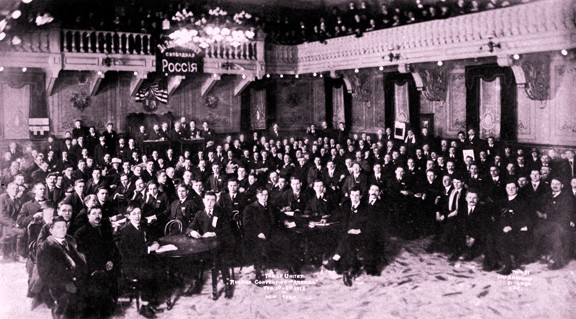
Engdahl provides a valuable history of early Russian Socialist organizing in the U.S. The Federation affiliated to the Socialist Party would not be formed until 1915.
‘Russian-American Socialists Rapidly Joining Party of Their Class’ by J. Louis. Engdahl from The New York Call. Vol. 5 No. 17. January 17, 1912.
At Coming National Convention the Exiled Victims of Bloody Nicholas Will Probably Get a Translator-Secretary and Formally Take Their Place in the Ranks of Foreign Language Organizations.
CHICAGO, Jan. 13. The constitution of the National Socialist party says that national foreign-language organizations must have 500 members in good standing before they can enjoy the rights of a foreign-language section in the Socialist party.
The question then arises as to what is to become of the national foreign-language organizations that cannot muster the necessary 500 members.
There are enthusiastic Socialists among the foreign-speaking party members who are planning to carry their contention that the national Socialist party should give greater support to the weak organizations into the weak foreign organizations into the national convention that opens at Oklahoma City on May 12.
The position of these foreign-speaking Socialists is clearly stated by Michael Altshuler, instrumental in organizing the Russian Socialists of the United States and in the history of the Socialist movement among the Russians in the United States.
After years of tedious work and heart-rending disappointments and struggles it is believed that the Russian Socialist movement in the United States now numbers the necessary 500 members, distributed among twenty-five branches in the States of Illinois, Wisconsin, Minnesota, New York, New Jersey, Massachusetts, Pennsylvania, Michigan, and California.
If the Russians can show this to be a fact they will be able to secure a translator-secretary at the national headquarters, whose salary will be paid by the Socialist party, and then the real work of organizing the Russian Socialists of the United States will begin.
But there are other peoples speaking foreign languages in the United States, many of whom are Socialists, but who cannot get in touch with each other for purposes of organization because of the many difficulties that confront strangers in a strange land.
“The National Executive Committee, as the representative of the National Socialist party of the United States, should exert just as great efforts to organize the foreign-speaking Socialists as they do in carrying on the work of the Socialist party in unorganized States,” says Altshuler. “One branch of the work is just as important as the other.”
In January of 1910 Altshuler called on J. Mahlon Barnes, then National Secretary of the Socialist party, in this city, and asked:
“Are there any Russian Socialist branches in the Socialist party?”
Barnes stated that so far as he knew there was not a single Russian Socialist branch in all the nation.
“Then I’m going to start one,” answered Altshuler, and he proved as good as his word. Working at all hours and without remuneration, but with the privileges of the national office granted to him. Altshuler began building the foundation of the national Russian Socialist organization.
Started on “Bloody Sunday.”
The sub-foundation, of course, was laid in the hail of bullets on “Bloody Sunday” in St. Petersburg in January, 1905, and at the mass uprising of the Russian people in Moscow, the Baltic States and among the Armenians of the Caucasus, in December of the same year.
Previous to the year 1905 the Russian exiles had sought temporary refuge in the countries of Western Europe. They published their newspapers, pamphlets and leaflets in Berlin, Paris, Vienna, Budapest and other cities and smuggled them to those still remaining within the darkness of the Czar’s domains.
These exiles felt that the day was soon near when one, big revolution would shake the Czar from his imperial throne and the country be given to the people to be ruled by all for all. They had heard of the wonderful America as a land of gold and much riches, and had scorned it as the abode of the covetous and not the future home of a liberty-loving people. Freedom in Russia to them meant something greater than riches in America.
But the year 1905 saw Tyranny’s blackest hand do its bloodiest work, and the Russian exiles, and those who were newly made exiles saw that the task of establishing freedom of the people in the place of the tyranny of the “Little Father’ was greater than they had even dreamed, and it became the decision of the many that it would take a long time to work substantial changes.
Existence in Western Europe became almost as intolerable as it was in Russia itself, and only then the shores of the United States offer themselves as a last refuge.
They came across the Atlantic from the Russian refuges of Europe and became new refugees in the industrial centers of the Eastern States. They found their way across Siberia to the Pacific ports of Japan and China, escaping across the biggest ocean to find new homes in the Western States of this country.
There were those who crossed over the Bering Sea in boats of skin, from the coast of Asia to the frozen shores of Alaska, where in one case the United States Socialist party had to put up a strenuous fight to keep them from being delivered back to the Russian Government.
Four or five Social Democratic Russian groups sprang up in different parts of the United States, no dues being paid and no records being kept of the meetings. Russian Socialists came to these meetings and left again, and no record was kept of their coming or their going. Anyone attending a meeting was a member of the group for the time being.
The two objects of the members of these groups was to raise funds and create sentiment in support of the Russian revolution.
The mass immigration of Russians continued throughout the year 1906. but the exiles were scattered to the four winds in New York, Pennsylvania and Massachusetts in the East, and in the mining camps of Colorado and California of the West.
Paper Is Started.
During the panic that started in the closing months of 1907, the Russians began issuing a paper called the Russky Golos (Russian Voice), with John Okunzof as its editor.
Editor Okunzof had been arrested in Chita, Western Russia, and sent to Siberia, and condemned to hard labor. He escaped to Japan and then to the United States, finally arriving in New York City, where the home of the first Russian Socialist publication in this country was established.
Shortly after the first issue of the paper appeared certain among the Russians began the formation of a non-partisan Russian organization, known as the Russian Workingmen’s Association.
The object of the association was to educate the Russians and to help them to help themselves. Special attention was given to the study of the English language and much was done to find work for the unemployed Russians. This non-partisan organization met with considerable success, forty organizations or clubs being formed in the numerous industrial centers of the nation.
In the meantime the Russian Socialists were still alive. In 1908 the Social Democratic groups started a movement to organize all the Russian Socialist branches. This resulted in the holding of a convention in New York City, when a central committee was elected and a monthly magazine called the Russian-American Worker started.
This work was carried on for about a year when interest seemed to lag: the monthly magazine was dropped and the Social Democratic organization and the Central Committee disbanded. This left the Russian Non-Workingmen’s Association alone in the field as the year 1909 came to a close.
Partisan
This was the condition that confronted Michael Altshuler after he had paid a visit to National Secretary J. Mahlon Barnes in January of 1910 and heard from Barnes that there were no Russian Socialist branches in the United States. In Chicago, however, Altshuler found the 9th Ward Russian branch, which gave him an opportunity to start work.
Altshuler was born in 1884 a Russian. He grew up and became a printing pressman by trade, He joined the Social Democratic party in Russia in 1902 when he was 18 years of age. He has four times fallen into the clutches of the Czar’s emissaries and been cast into prison three times being released and once escaping to win his own liberty.
Organize Russian Labor Union.
In 1905 he was devoting considerable of his time organizing unions among the printers as a result of the law of 1904 by which trade unions were legalized. He was hindered greatly in this work, however, owing to the fact that he did not have a passport in his own name, which was entirely contrary to the law and order rule of the Czar. So he left Russia, going to Budapest, Hungary, where he started a Social Democratic group to spread the knowledge of conditions in Russia and to raise funds for the Social Democratic party at home.
In most of the countries of Western Europe the law declares that foreigners cannot take part in the political movements of the different countries. Altshuler’s dream was to start a Russian Socialist movement in foreign countries, working in harmony with the Socialist movements of those countries.
But this was impossible in Europe.
And so he turned his eyes toward America, coming to St. Paul, Minn., where he found work in a printing establishment in July, 1909.
One day he was raising a window when it fell and a piece of glass so injured his left eye that he was compelled to come to Chicago to have it treated. And as he nursed his eye, otherwise being practically active, Altshuler started out to hunt and organize Russian Socialists in Chicago, with the hope that the organization would spread over the entire land.
The 9th Ward Russian Socialist branch secretary called a special meeting to hear Altshuler’s plans. The meeting was attended by eight members, all of whom approved of the speaker’s plans and decided to let him go ahead, but did not think that their own numbers were sufficient to accomplish anything.
But Altshuler did not quit. He began giving lectures before the Russian Non-Partisan Social Economic Club, which held its meetings in Hull House. In February of 1910 another meeting of the 9th Ward Socialist party branch was called, and this time fifty members were present, and the enthusiasm had considerably increased.
Altshuler again made the report that he had given to the first meeting, and as the result of the decision to do something the Russian Agitation Bureau of the Socialist party was formed. It was to consist of four members and plans were made to start a paper to spread the propaganda of the Russian organization. The agitation bureau, of which Altshuler was the secretary, had to raise most of the money to get out the first issue of the publication through collections. One incident that showed the democracy of the Russian Socialist organization was the fact that everything that went into the new publication was first submitted to and indorsed by the Russian branch.
The New York Call was the first English-language Socialist daily paper in New York City and the second in the US after the Chicago Daily Socialist. The paper was the center of the Socialist Party and under the influence of Morris Hillquit, Charles Ervin, Julius Gerber, and William Butscher. The paper was opposed to World War One, and, unsurprising given the era’s fluidity, ambivalent on the Russian Revolution even after the expulsion of the SP’s Left Wing. The paper is an invaluable resource for information on the city’s workers movement and history and one of the most important papers in the history of US socialism. The paper ran from 1908 until 1923.
PDF of full issue: https://www.marxists.org/history/usa/pubs/the-new-york-call/1912/120117-newyorkcall-v05n017.pdf

