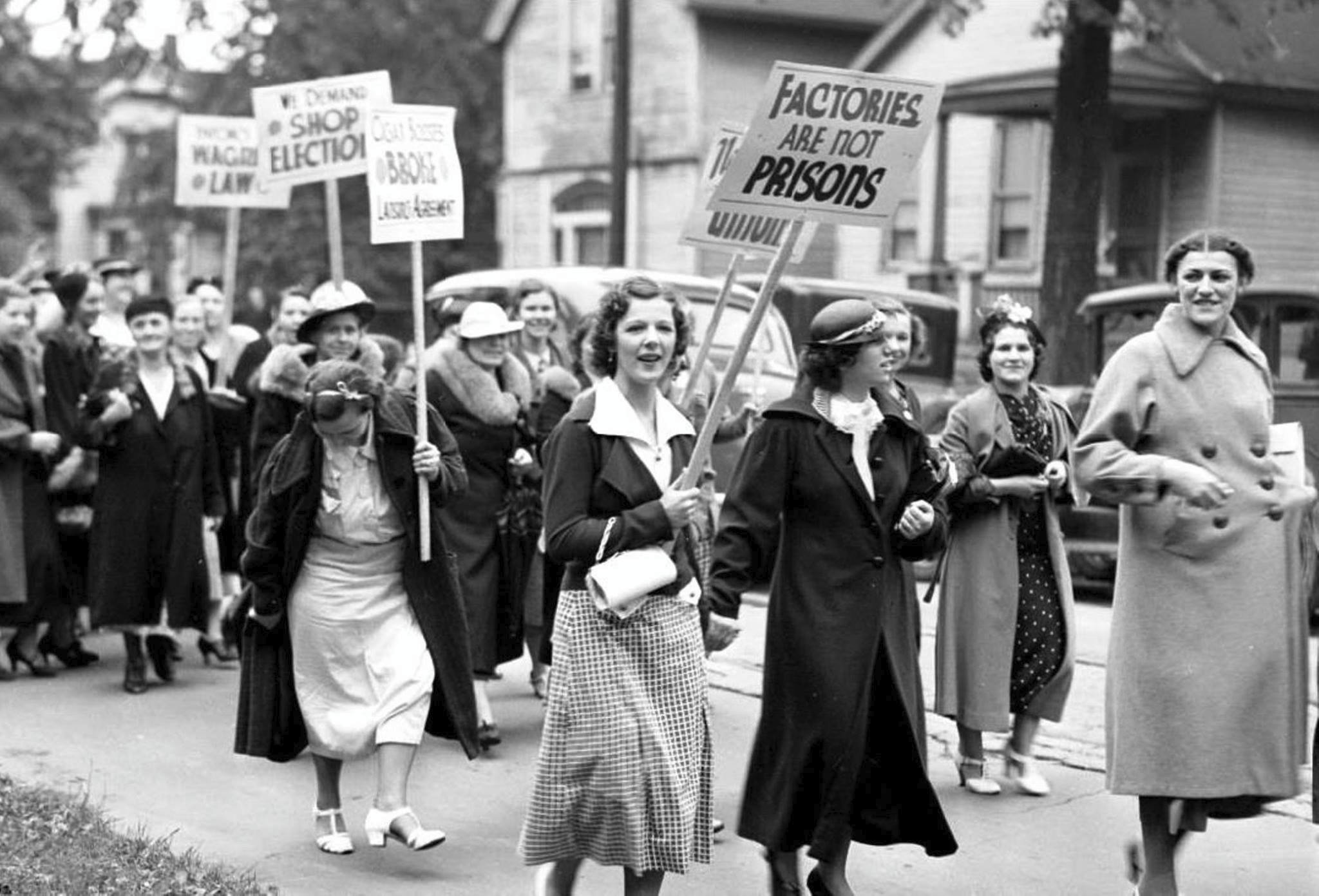
Thousands of largely Polish-speaking women working in Detroit cigar factories without a union, inspired by the Flint sit-downs, occupied their workplaces on February 16, 1937. The epic conflict drew thousands of fellow workers into the struggle, saw evictions and riots, and culminated in a 200,000 person march in Cadillac Square. With the aid of an insurgent C.I.O., the workers founded Cigar Workers Union Local 24 and won union recognition on May 17, 1937.
‘Detroit Women Cigar-makers are Fighting Brave Battles’ by Margaret Cowl from The Daily Worker. Vol. 14 No. 67. March 19, 1937.
(The writer at one time was a tobacco worker. This article is based on an interview with women tobacco workers, now on, sit-down strikes in a number of plants in Detroit.)
“We sat down to stand up for our rights.”
This is the slogan of over 2,000 striking women cigar makers in Detroit.
Young Viola Wojick, chairman of the Joint Strike Committee of the cigar-makers, summed up the rights of the working women when she said: “We working women want to be treated like human beings in the factory. We want to mean something in life. We want a decent wage: We are fighting against the 52-hour week.”
Her eyes beaming with enthusiasm, she continued: “We will win the fight for our rights, because we will not go back without our union.” Viola is a stripper in the factory of Bernard Schwartz making the R.G. Dun brand of cigars.
Strippers are among the lowest paid. They work 45 hours and receive from $10 to $15 a week. “I worked six years in the one factory and got $12 a week,” remarked one stripper. “The bad system of lights causes headaches,” said another. “The windows are closed, the ventilation bad. They save the tobacco from drying up, but we dry up with it,” stated a young stripper. “We get constipation troubles because we sit so many hours, the lavatory is so far away from our department; we must clean our machines, sweep the floor, get to the cafeteria and eat, all in 30 minutes.” “We can’t enjoy ourselves on Sundays, even miss church, because we are too tired after the week’s work.”
Some of the girls wished to know if “Recrosco Sedative” was a harmful drug since that is what some of them are given during menstruation & to keep severe pains from interrupting their work.
MOTHERS IN FIGHT
Frances Losinski, a 40-year-old mother of four children, is the chairlady of her shop. She is a hand roller. She was born in Detroit and has been a tobacco worker since the age of 14.
“I stayed home only long enough to have my babies,” she said. “I am in this fight so that my children could have a place in life. We wo men are fighting together, so that we be no slave to anyone. Present-day wages are insufficient for a worker’s family because prices have gone up so. My husband and oldest son work in auto plants, but they, too, are on strike.”
“We have no one to protect us,” said a young cigar-maker. If the super does not like a girl, he will pick on her until she loses her job. Another job is hard to get. I know a young mother who was several months pregnant and because she would not yield to the advances of one of the overseers, she had to leave the shop even before she was able to make some money to pay the expenses of the doctor when her baby came,” said this young worker.
“Even in the presence of others, we are insulted. That is why we want the union to protect us.” Interrupted a very young girl: “I graduated from high school with high honors. I worked several weeks in the office of a large concern. I had to leave because the boss got too funny. Now I work in the tobacco factory. The foreman creeps up on us from behind to see how we are working. He laughs when we get frightened.”
“I want you to meet a girl in my shop who has the best job on the floor. She worked 18 years in the one plant. Now she gets $17 or $18 a week. She is tormented by the super who says that it is about time older girls quit. But where will she go? She has parents to support. That is why she is fighting with us for the union.”
TOUGHER FIGHT FOR WOMEN
While men workers must fight for bread, for their right to organize into a union of their own, against the terror of the corporations, against injunctions, working women must fight not only for these things, not only for the right to the job, but also against the disrespect towards women in the factories on the part of the lackeys of the corporations; against the very idea that women are the playthings of men, an idea born of the capitalist system itself.
The strike of the women cigar-makers is conducted by themselves. The strike committee is under their own leadership. That is why there is such solid unity and that is why the women are so determined to fight for the right to live like human beings. Their demands to the employers include: a 25 per cent increase in wages; union recognition; 40-hour week; time and a half for overtime and proper ventilation. They know that with the recognition of the union, they will be able later on to get at least some protection for themselves as mothers, as women.
They are well organized into various committees in the plants. The plants are kept very clean. Nothing is touched or destroyed. Food is brought into the plants from central union office and is cooked in the plant. Food committees elected by different plants solicit the neighboring stores for food. Inside the plants the women read and knit and crochet. They hold their committee meetings every day. Women are on the negotiating committee for the two plants that settled and that recognized the union. In these two plants the shop committees consist of women. On each committee there is a man to represent the men workers in the plant. The Executive Board of their local union–No. 155 of the Cigar Makers International Union affiliated with the A.F. of L. are all women.
EMERGENCY BRIGADE AIDS
The Emergency Brigades of the women’s auxiliaries of the Auto Workers Union have responded to the call of the women cigar-makers and are doing splendid work in feeding the women strikers, and in keeping contact with their families.
Men workers, members of the Auto Workers Union have inspired the women sit-in strikers by organizing solidarity torchlight demonstrations around the tobacco factories. They send men to protect the women during demonstrations against sweatshop conditions which the women hold around the homes of executives of the tobacco plants. Marion Gilpin, a young auto worker, spends all her time in helping–especially with the strike bulletin. The girls in the General Cigar plant like her very much and appreciate her work. Mary Zuk, councilwoman from Hamtramck, and a leader of the 1935 meat strike in Detroit, is giving unstintingly of her time. The girls invited her to serve on the negotiations committee. Mrs. Mudra, a leader of Polish workers.
The Firemen and Oilers Union sent in me to keep the furnaces going. The Plumbers Union sent assistance to see that the plumbing is in good shape. The solidarity given to the women strikers by both the C.I.O. unions and the craft unions in the A.F. of L. helps to cement the unity of the women inside the plants.
C.P. BOLSTERS STRIKE
“The Communist Party collected $64 at its meeting for our strike,” said one of the women. “Sure, the Communists are for the working people. Now I understand why they are called ‘Reds’. We like the Daily Worker because it tells the truth about us,” she said, “Our strike committee decided to permit the name of the Young Communist League to remain on the boxes of games which the Y.C.L. sent us. That is because the Y.C.L is helping so splendidly,” a young girl told me.
“We are learning much in this strike,” said one of the older women workers. And that is true. Ever since the C.I.O. promised to fight for more wages for the lowest paid workers, countless numbers of working women became articulate in the struggle for their rights. Women are among the lowest paid. Since the Flint auto workers have shown how to fight to win, tens of thousands of women in Detroit here engaged in sit-down strikes with the main demand, recognition of tic union under C.I.O. leadership.
In these struggles they are learning that they must fight for something even bigger than their bread and butter. They are beginning to learn that they must get together to fight for equality rights, against the corporations that represent blackest reaction; for a chance for their children.
The Daily Worker began in 1924 and was published in New York City by the Communist Party US and its predecessor organizations. Among the most long-lasting and important left publications in US history, it had a circulation of 35,000 at its peak. The Daily Worker came from The Ohio Socialist, published by the Left Wing-dominated Socialist Party of Ohio in Cleveland from 1917 to November 1919, when it became became The Toiler, paper of the Communist Labor Party. In December 1921 the above-ground Workers Party of America merged the Toiler with the paper Workers Council to found The Worker, which became The Daily Worker beginning January 13, 1924.
PDF of full issue: https://archive.org/download/per_daily-worker_daily-worker_1937-03-19_14_67/per_daily-worker_daily-worker_1937-03-19_14_67.pdf

