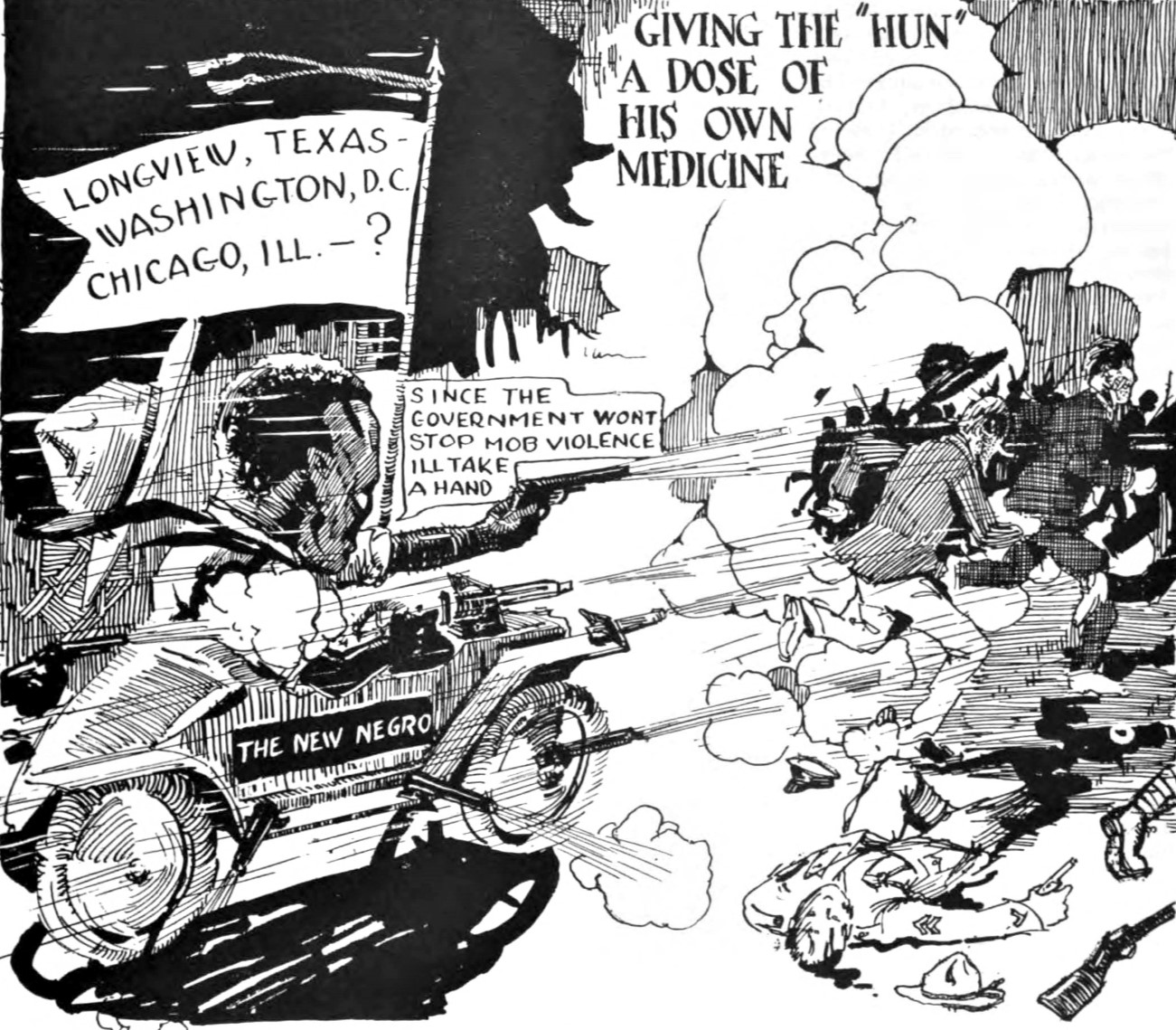
Clarity from The Messenger editors during 1919’s ‘Red Summer’ as they lay out a strategy to end lynchings through a combination of organized physical self-defense and mass workplace actions to invoke both immediate consequences to the mobs and generate pressure on national institutions, with the aim of creating an international movement against a white supremacist United States.
‘How to Stop Lynching’ by A. Philip Randolph and Chandler Owen from The Messenger. Vol. 2 No. 8. August, 1919.
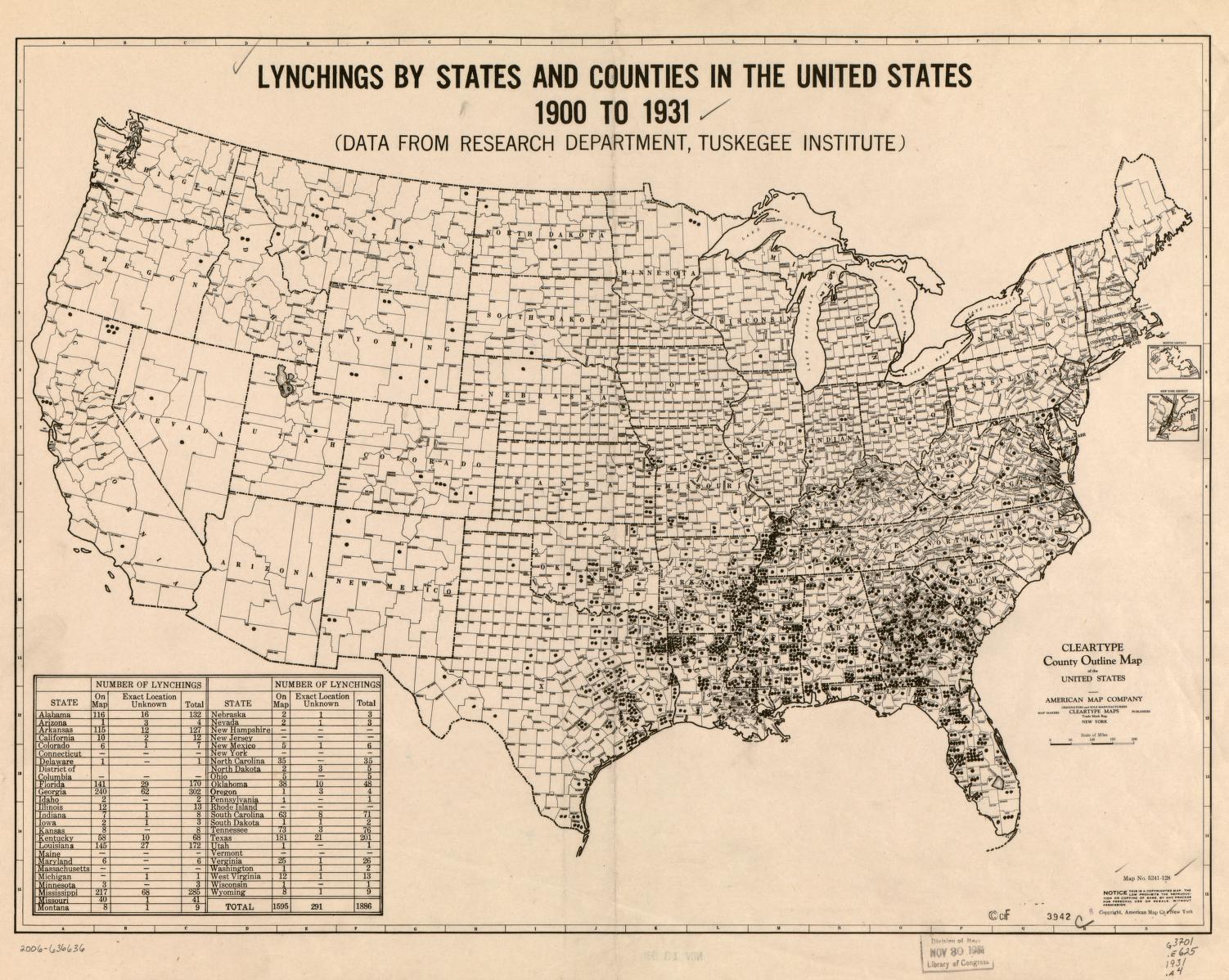
Lynching is our chiefest problem in America today. All Negroes are agreed, and some white people also, that it is the arch crime of America and that it ought to be stopped. The only difference is that of method. The question of How?
We are also pretty well agreed that the methods adopted by Negroes at the behest of Negro leaders, in the past, are futile and valueless.
For instance, we have sent telegrams to Southern Governors only to be told in reply, that they have no power and oftentimes no inclination to stop what they are pleased to characterize as “an orderly lynching.” Experience has taught us that appeal to “Big White Politicians” is simply ineffective. For even the President, Woodrow Wilson, made a pronouncement against lynching (Of course he was only interested in Robert Prager, a German who had been lynched, and especially in view of the fact that Germany had threatened to take revenge upon American citizens residing in Germany) with no visible effect upon the Southern mob.
The MESSENGER proposes an immediate program for Negroes. This program includes two methods. First, physical force and secondly, economic force.
Physical Force
Anglo Saxon jurisprudence recognizes the law of self-defense. Our information also records that the right of self-defense is recognized in the laws of all countries. Not only is the right of self-defense recognized with respect to the person about to be injured, but it is recognized that the person about to be injured may summon others to assist him in repelling an attack. We are consequently urging Negroes and other oppressed groups confronted with lynching or mob violence to act upon the recognized and accepted law of self-defense. Always regard your own life as more important than the life of the person about to take yours, and if a choice has to be made between the sacrifice of your life and the loss of the lyncher’s life, choose to preserve your own and to destroy that of the lynching mob. Recently we have had a few instances of the effect of organized self-assertion on the part of Negroes in the South. The Nation points out that on the 25th and 26th of May a mob in Memphis, Tenn., where Eli Persons was lynched a year ago, had settled upon a race riot. It was found out, however, that Negroes were well armed and organized to meet the attack with resistance. This having been learned, the Mayor of Memphis immediately called the Chief of Police, and both together promptly called off the riot. Just a few days ago, the Negroes of Long View, Texas, held up a mob which started out to lynch a Negro school teacher who had reported a lynching through the Chicago Defender. Instead of leaving the Negro school teacher to himself, to make his own defense, a group of Negroes, well armed and well organized, fired upon the advancing mob, shooting down four members of the mob, whereupon its steps were taken backward rather than forward. The Governor of Texas, as a rule, has always claimed that he had no troops and no power to stop the action of the mob but when the Negroes at Long View protected their lives with shot and shell and fire, the Governor of Texas sent militia and rangers and army planes to restore law and order in Long View. The MESSENGER wants to explain the reason why Negroes can stop lynching in the South with shot and shell and fire. All mobs act on the principle of pessimism. One hundred to fifteen thousand men usually take part in lynching one Negro, with the Negro handcuffed and arrested, unable to defend himself. The very numbers who engage in it are evidence of the cowardice of the mob. But when the mob knows that somebody is going to have to give his life, each man thinks that he may have to give his life. No one desires to make this sacrifice, and although it is perfectly certain that twenty millions of people can beat down eight millions, if the sacrifice to accomplish this is so great, it will deter the twenty million from its aim; and so with the mob. A mob of a thousand men knows it can beat down fifty Negroes, but when those fifty Negroes rain fire and shot and shell over the thousand, the whole group of cowards will be put to flight.
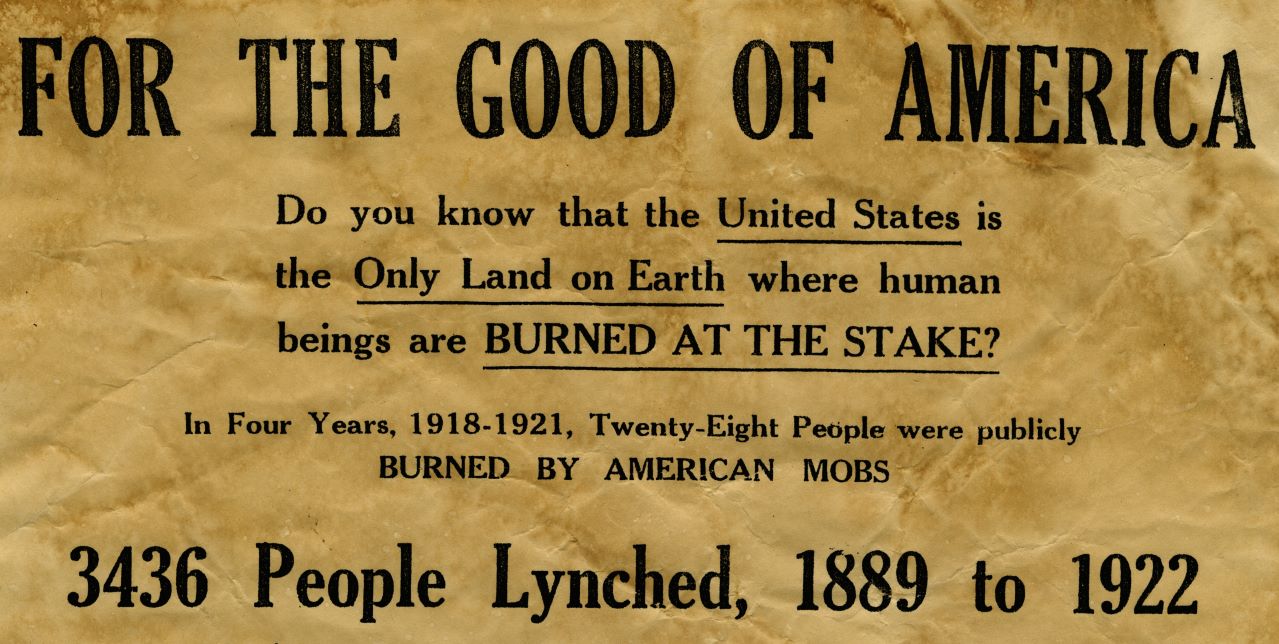
This may sound rather strange talk for the pacific editors of the MESSENGER, but we are pacific only on matters that can be settled peacefully. The appeal to the conscience of the South has been long and futile. Its soul has been petrified and permeated with wickedness, injustice and lawlessness. The black man has no rights which will be respected unless the black man enforces that respect. It is his business to decide that just as he went three thousand miles away to fight for alleged democracy in Europe and for others, that he can lay down his life, honorably and peacefully, for himself in the United States. In so doing, we do not assume any role of anarchy, nor any shadow of lawlessness. We are acting strictly within the pale of the law and in a manner recognized as law abiding by every civilized nation. We are trying to enforce the laws which American Huns are trampling in the dust, connived in and winked at by nearly all of the American officials, from the President of the United States down.
Economic Force
Physical force is not the only weapon of the Negro. He has tremendous economic power. He constitutes on-seventh of the industrial population of the United States. In the South, his economic power is even greater. According to Professor Albert Bushnell Hart of Harvard, the Negroes in the South produce three-fifths of the wealth, that is, one-third of the population produces over one-half of the wealth. Now one of the best ways to strike a man is to strike him in the pocket-book. Cotton is the staple crop of the South. The Negroes are the chief producers of cotton. They also constitute a big factor in the South in the production of turpentine, tar, lumber, coal and iron, transportation facilities and all agricultural produce. They should be thoroughly organized into unions, whereupon they could make demands and withhold their labor from the transportation industry and also from personal and domestic service and the South will be paralyzed industrially and in commercial consternation. That state of affairs will attract the attention and interest of the whole world. Lynching will immediately be made a national and an international problem.
The problem will become national because the textile industries of the North and West are dependent upon the products of Negro labor. When Massachusetts, New Jersey and New York can no longer get cotton for the mills, the mills must close. Machinery stands idle. Men are unemployed. Discontent grows. Social unrest spreads. Revolution stares the government in the face. The building and lumber trades will also be at a standstill. Mechanics will be thrown out of work. Carpenters, masons, moulders, painters, plumbers, electricians, machinists, contractors and architects will have their work cut down. Something will then have to be done. Both capitalists and workers will become interested in abolition of lynching–the capitalists because their profits will be cut off, from the cessation of business, and the workers because their wages will be cut off, from the cessation of work. At this time, the whole of the United States will for the first time, be interested in abolition of lynching, not because they will love the Negro any more, but because it is necessary for their own interests to stamp out this typical American injustice.
Lynching will then become an international problem, also. During the Civil War, when the Southern Blockade was on, and cotton could not be shipped to Europe, industrial paralysis was thrown into Great Britain. In Manchester, Leeds, Liverpool and London, the textile industries had to be closed. Work stopped in those great industrial centers and every Englishman began to inquire about American slavery. The Englishmen wanted slavery abolished, because the fight over the institution was striking them in the pocketbook. Slavery became an international problem because cotton could not be supplied. At that time, however, only a few million bales of cotton were produced. Today over a hundred million bales are being produced each year, largely by Negroes. Now, if the hold up of a few million bales made slavery an international problem, the hold up of hundreds of millions of bales of cotton will make lynching an international problem of prime importance. If Negroes withdraw their hands from the cotton fields, the cotton will rot on the farms. The South will get on its knees, just as it was almost on its knees over the migration during the war. It did not want Negroes to leave there, not because they were hankering for Negro company but because they wanted the Negro’s work–his labor power
At the present time, these two forms of attack will suffice for Negroes to enter upon. Whenever you hear talk of a lynching, a few hundred of you must assemble rapidly and let the authorities know that you propose to have them abide by the law and not violate it. Offer your services to the Mayor or the Governor, pledging him that you can protect the life of any prisoner if the State militia has no such power. Ask the Governor or the authorities to supply you with additional arms and under no circumstances should you Southern Negroes surrender your arms for lynching mobs to come in and have sway. To organize your work a little more effectively, get in touch with all of the Negroes who were in the draft. Form little voluntary companies which may quickly be assembled. Find Negro officers who will look after their direction. Be perfectly calm, poised, cool and self-contained. Do not get excited but face your work with cold resolution, determined to uphold the law and to protect the lives of your fellows at any cost. When this is done, nobody will have to sacrifice his life or that of anybody else, because nobody is going to be found who will try to overcome that force.
Industrially, let the farmers organize farmers’ protective unions. Let the lumber workers, moulders, masons, plasterers and other Negro workers on railroads and in mines organize into unions, quietly and unostentatiously. Be prepared to walk out in concert, every man and woman who does any form of work. Let it be known that we are down to plain business, free from any foolishness or play.
Let every Negro in the South, begin to work on this program by agitating for it in the lodges, churches, schools, parlor and home conversation and while at work in factory or field. Write also to us about any detail in entering upon this work. If this program is pressed, a year from now, we can call out of the fields, the factories and the mines between a million and two million Negroes, who will initiate the true work of making America a real, “land of the free and home of the brave.”
The Messenger was founded and published in New York City by A. Phillip Randolph and Chandler Owen in 1917 after they both joined the Socialist Party of America. The Messenger opposed World War I, conscription and supported the Bolshevik Revolution, though it remained loyal to the Socialist Party when the left split in 1919. It sought to promote a labor-orientated Black leadership, “New Crowd Negroes,” as explicitly opposed to the positions of both WEB DuBois and Booker T Washington at the time. Both Owen and Randolph were arrested under the Espionage Act in an attempt to disrupt The Messenger. Eventually, The Messenger became less political and more trade union focused. After the departure of and Owen, the focus again shifted to arts and culture. The Messenger ceased publishing in 1928. Its early issues contain invaluable articles on the early Black left.
PDF of full issue: https://www.marxists.org/history/usa/pubs/messenger/1919-08-v2n08-aug-Messenger.pdf

