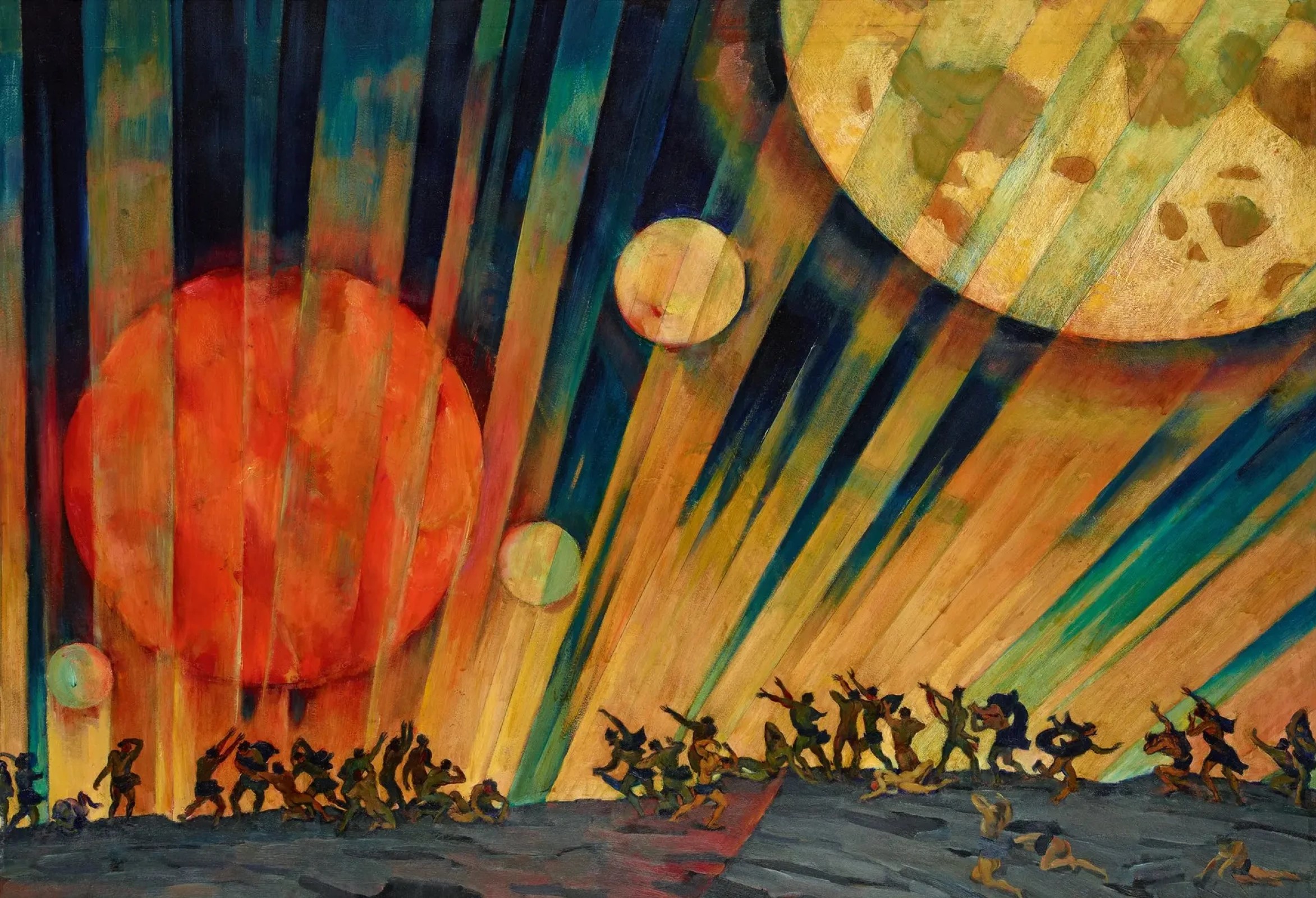
Reflecting the revolutionary vistas opened by October, Louis C. Fraina greets the end of World War One with a program of social transformation.
‘The Problems of Reconstruction’ by Louis C. Fraina from Revolutionary Age. Vol. 1 No. 4. November 27, 1918.
To The Workers:
THE war is dead–unless the sinister interests represented by the reactionary press provoke a new war against Socialism in Russia and Germany. The war is dead–and the real struggle, the great social struggle of the proletariat against Capitalism is now in action.
Unless you of the working class, who do the work and don’t own the instruments of work, think and act upon the problems of reconstruction, the world, instead of becoming safe for democracy, will become safe and safer for plutocracy, for the capitalist and the profiteer.
Perhaps one of your loved ones is in the army, perhaps one of them has died–what’s to be done after the war? Shall the old world of industrial oppression persist? All the dead shall have died in vain, all the living shall have agonized in vain, unless you think and act upon the problems of reconstruction, learn out of this war to think and act as a class against the capitalist class, who own the instruments of work and do no socially necessary labor, yet garner the richness of life, unless you highly resolve: The horrors of the old order of Industrial autocracy shall disappear; the agony of the war shall not happen again; the new world shall be a world of peace, of industrial democracy, the world for the workers.
It is generally agreed that the world after the war will be a new world, a world vastly different from the world that produced this war.
A new world, yes: but of what sort? A world of capital, or of labor? A world of industrial autocracy, or of industrial democracy?
Reactionary Capitalism is learning the language of the new order, and it is developing a perfect technique for the deception of the workers. Industrial democracy is a case in point. You are hearing much of this democracy–financiers and captains of industry, and their “liberal” hirelings, are speaking frequently about the need of “industrial democracy.” What do they mean? What do they mean? Do they mean that the workers shall own industry, shall decide the disposal of the things they produce? Do they mean that the profit system should end? No! Real industrial democracy would mean the unconditional surrender of Capitalism. They mean that the workers should be “consulted,” that the workers should be allowed to form “committees” with a say but no power, they mean that the workers should remain wage-slaves while playing with the toy of a fraudulent industrial democracy. Society, that is to say, the workers, should own and control industry, and by means of the industrial vote govern industry that and that alone, is industrial democracy: industrial self-government of the working class. The bourgeois prattle of “industrial democracy” is pure camouflage. Equally camouflage is the general discussion of “reconstruction.”
Reconstruction, in the mouth of the capitalist, means reconstruction that promotes Capitalism, that retains the subjection of the proletariat. Capitalist reconstruction means adapting Capitalism to the new world conditions so that new and huger profits shall be made.
Real reconstruction is fundamental. Not this or that thing shall be reconstructed, but the whole of society.
On this issue the great social struggle will depend; on the consequences of this struggle will depend the destiny of the world. Workers: are you thinking, preparing, organizing?
Capital is organizing itself, is preparing to use conditions after the war to make more profits, to acquire more wealth, to oppress still more the working class. Capital is preparing for Imperialism.
Labor must organize–not along the old lines of bargaining, of small concessions, but for the transformation of the industrial autocracy of Capitalism into the industrial democracy of Socialism. The working class must organize industrially and politically to dispute with capital the mastery of government, the mastery of industry, the mastery of the world. Labor must fight capital relentlessly, uncompromisingly, by means of the class struggle, until labor conquers capital and becomes supreme. The working class must prepare for Socialism.
Now is the time to prepare! Socialism is your instrument–the instrument against the profiteer, who is a capitalist, and against the capitalist, who is a profiteer–the instrument for the emancipation of the working class from industrial autocracy.
The problems of peace are problems of reconstruction, and the problems of reconstruction are problems of peace.
They say that this war was “a war to end war.” They say that this “shall be the last war.” And this shows how the mass of the people hate war and yearn for universal peace, for the free opportunity to devote one’s self to productive tasks and the simple joys of life.
But this “war to end war” was not the first of its kind in history. Perpetual peace has been the dream of the ages and always a dream. Slightly more than one hundred years ago the world fought France and Napoleon as disturbers of the peace, as yesterday it fought Germany and the Kaiser; and after Napoleon was beaten they rearranged things to secure permanent peace: peace did not come, but dark reaction instead.
Permanent peace will not come of territorial readjustments or political reconstruction. Permanent peace will come only if society itself is reconstructed, only by the overthrow of Capitalism and the control of society and the world by the Socialist proletariat, the working class.
This was a “war to end war”–but then why do so many newspapers, why do so many powerful groups, why do Theodore Roosevelt and others urge and campaign for universal military service? Why does Secretary of the Navy Daniels propose larger naval armaments? Militarism is not a guarantee of peace.
Think, men and women of the working class, you who suffer and toil, about these plans for a larger militarism, for universal military service! Do they mean peace? Do they mean liberty and happiness for the workers?
And while considering the end of the horrors of war, consider the horrors of peace: the slaughter of workers through preventable industrial accidents, the slaughter of workers through preventable industrial diseases, the slaughter of workers through over-work, the slaughter of workers through poor and insufficient food. Capitalism itself is the great horror!
New wars may come. They must not come. But understanding of social facts and proletarian action alone will prevent new wars.
Two great powers developed during the war–the state power and the financial power. The state acquired new and wider powers becoming centralized, more authoritative, and establishing a drastic control over industry. The state now tells workers often that they cannot strike; and this policy may persist after the war. Indeed, many capitalists want to see the state absolutely many capitalists want to see the state absolutely control labor and prevent strikes. Finance-capital is becoming rapidly more powerful; the profiteers–and the profiteer is nothing but a capitalist–are making enormous profits, developing more reserve capital, acquiring larger powers for imperialistic financial conquests and oppressing the workers.
These two powers–the state and finance-capital–are becoming unified in imperialistic State Capitalism, the final stage of Capitalism, the greatest instrument for the oppression of the proletariat, of the working class.
The struggles of the Socialist proletariat must be directed against this State Capitalism, which means against imperialistic Capitalism itself.
State Capitalism is the unity of finance-capital and the state against the working class. State Capitalism means that the state controls industry, controls labor, in the interest of the capitalist class, employers, the oppressors of labor. State Capitalism means Capitalism at the climax of its power, more malevolent, more tyrannical, more murderous. And it is precisely this State Capitalism that is comprised in “the new world after the war” as used by the apologists of Capitalism–in other words, the “new world” would mean a world of dominant Capitalism, of oppressive state power, of a still more oppressed working class.
This is not the world for an intelligent worker, conscious of his class and determined to struggle for the only new world which will bring peace liberty, happiness–the new world of universal Socialism, a world for the workers, in which industrial liberty and democracy will prevail. It is the struggle for the new world that will engage the energy of class conscious workers.
There is a theory suggesting that government control or government ownership of industry will solve the problems of poverty, of low wages, of grinding, health-destroying toil. It is a mistaken theory. After all, government control or ownership of industry still means the capitalist in power, still means profits and dividends wrung out of the blood and agony of the workers, still means the wages and profits system, which is the source of all the evils which oppress the working class. No! Capitalism itself must be overthrown, for fundamentally it makes no real difference to the workers whether they are the wage-slaves of private Capitalism or State Capitalism.
Instead of state (capitalist) control of industry, there must be established worker’s control of industry–control by those who work for the benefit of those who work, not control by lawyers and politicians for the benefit of the capitalist and the parasites of Capitalism.
Industry must be turned over to the workers–that is, that must and will be the basis of reconstruction after the war. This alone will mean a reconstruction making for peace, liberty, democracy and happiness.
The mill, mines, factories, all the means necessary for the life of the people, must be the possession of the people: they must be owned, managed, directed by the workers themselves, for the workers–which alone will mean for the people.
The workers in the mills, mines and factories will control in each particular workshop–not an employer. The vote–the industrial vote of the workers in each particular industry will decide affairs. Each factory will not be independent of each other–that would be anarchy; but all factories, will be united by means of appropriate administrative organs elected by the votes of the workers, culminating in the central industrial government elected directly by the workers. This would be industrial democracy–not the industrial autocracy which prevails under Capitalism, ruled by Kaiser Morgan, Kaiser Rockefeller, and the other Kaisers of the financial empires of modern Capitalism.
Efforts will be made by the hirelings of Capitalism to direct the energy of the workers into struggles for small objects, and particularly for State Capitalism. Do not allow this to happen! All problems are centralized into one problem— the overthrow of Capitalism, the abolition of the wages system.
This is the great issue, and as you struggle for this fundamental object, you will take lesser gains, but over and above all, this ideal of Socialism must guide your energy and your struggles.
The energy of the proletariat after the war must be directed in our great final class struggle against Capitalism.
Not this or that thing–but Capitalism itself must go: that is the only class conscious course.
The immediate demands in this great struggle for the conquest of power by means of Socialist industrial and political action will be:
1. Worker’s control of industry, to be exercised by industrial organizations of the workers and the industrial vote.
2. Repudiation of national debts–the workers shall not assume new burdens latent with unparalleled suffering.
3. Expropriation of the banks–finance-capital must be destroyed, the banks nationalized and used for the people, instead of the people being used for the banks.
4. Expropriation of the railways, the steel industry and other large (trust) organizations of capital–not one cent compensation to be paid, as “buying out” the capitalists would insure a continuance of the exploitation of the workers: provision, however. to be made for small owners of stock not exceeding $10,000 or unable to work for a living.
5. The nationalization of foreign trade–this to insure the ending of the commercial antagonisms that might produce new wars.
These fundamental measures, of course, would imply a struggle against Capitalism itself, the conquest of power by the workers. These measures would be introduced on the basis of a new Socialist State, and would be preliminary measures in the establishment of Socialism—industrial self-government, the world for the workers.
The Revolutionary Age (not to be confused with the 1930s Lovestone group paper of the same name) was a weekly first for the Socialist Party’s Boston Local begun in November, 1918. Under the editorship of early US Communist Louis C. Fraina, and writers like Scott Nearing and John Reed, the paper became the national organ of the SP’s Left Wing Section, embracing the Bolshevik Revolution and a new International. In June 1919, the paper moved to New York City and became the most important publication of the developing communist movement. In August, 1919, it changed its name to ‘The Communist’ (one of a dozen or more so-named papers at the time) as a paper of the newly formed Communist Party of America and ran until 1921.
PDF of full issue: https://www.marxists.org/history/usa/pubs/revolutionaryage/v1n04-nov-27-1918.pdf

