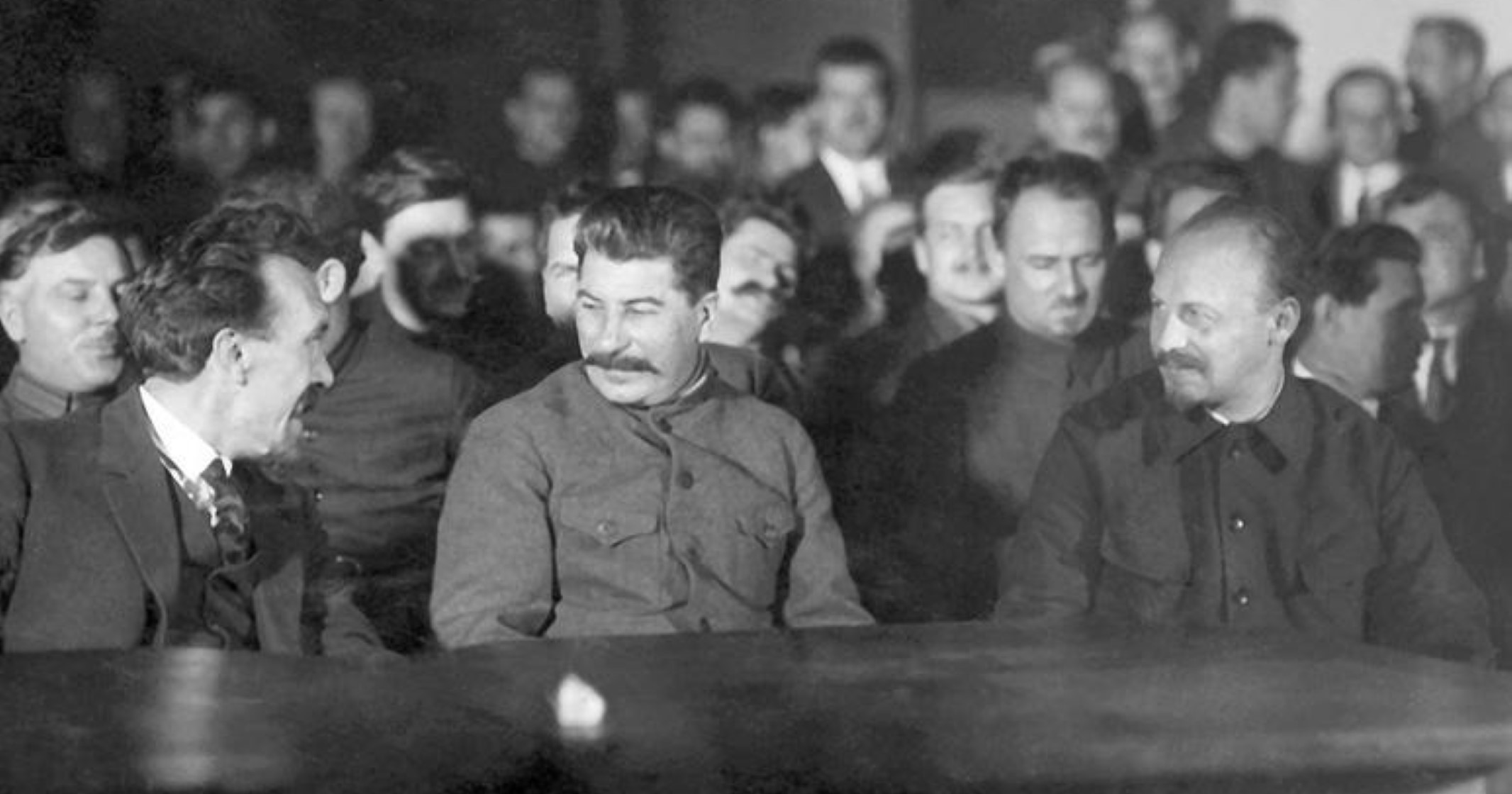
Before 1928 virtually all of the factional and political struggles within the U.S. Communist Party were over national issues and not directly related to fights within the Russian Communist Party. That would change dramatically with the Comintern’s Sixth Congress, which came after the expulsion of the United Opposition in late 1927, and inaugurated the ‘class against class’ position of the Third Period, resulting in the expulsion internationally of the so-called ‘Right Opposition’. Within a year of the Congress, the U.S. Communist Party expelled a majority of its leadership cadre and lost one-third of its membership as the ‘Cannonites’ (‘Trotskyites’) and ‘Lovestoneites’ (‘Bukharinites’) were expelled as part of an international Comintern campaign against oppositions to the new Stalin leadership of the International. Leon Platt speaking for the new leadership in the U.S. Party justifies the expulsions below.
‘The Struggle for the Comintern in America’ by Leon Platt from The Communist. Vol. 8 No. 9. September, 1929.
The internal struggle now taking place in the Communist Party of America as well as within the Communist Parties of other countries, is the most outstanding and important since the days when the international communist movement declared Trotskyism a counter revolutionary ideology and opened war against it. The actions of Lovestone and his group, and the struggle of our Party against them bring to the surface a series of questions, which are of decisive importance to the membership of our Party and to the revolutionary workers who carry on their daily struggle under the leadership of the Communist Party. The present day position of Lovestone on the role of the Comintern, the role of leadership in a Communist Party, and his role in the struggle against war and for the defense of the Soviet Union must be exposed before the working class, and show his degeneration to Social Democracy.
1. Why do the Communists fight among themselves?
Many of our Party members and revolutionary workers who are being influenced by our Party ask this question. The bourgeoisie, the social democrats and all other enemies of the revolutionary movement are again rejoicing over the internal struggle in our Party and the actions the Party had to take in eliminating some of its former leaders who ceased to lead and became misleaders. The Communist Party wants to make it clear that internal controversies in a Communist Party are not based on personal struggle between individual leaders. Internal fights in a Communist Party are based on political differences and not on unprincipled scramble for power as the bourgeoisie interprets and as even some of our backward members believe it to be.
The development of the revolutionary movement is not following a straight line. The tactics and policies of our Party are being shaped according to the economic and political situation existing in the United States at given periods and are subordinated to our chief aims of the full realization of our Communist program. If at a certain period the economic and political conditions change, then the party basing itself on Leninist analysis of these changed conditions must also change its course and adopt new tactics to be able to cope with the newly created situation. This the Party must do if it does not want to isolate itself from the toiling masses and remain the leader of the working class in its struggle against capitalism.
From the experience of the revolutionary movement we know that, in a period when the Party has to take a sharp turn, we have certain sections of our members as well as sections of our leadership, who do not see the changed economic and political conditions and consequently refuse to follow the new political line of the Party and not only persist in maintaining their old course but begin actively to oppose the new orientation and decisions of the Party. This creates the basis for differences in a Communist Party. It is true that our American Party went through many years of unprincipled struggle without any political basis; this fact was already long ago established by the Comintern and does not concern the present struggle of the Party against Lovestone and his group.
The Communists as convinced Leninists carry on an uncompromising struggle against those who deviate from the Leninist line of the Party. This struggle cannot remain a secret or be avoided. The Party as the leader of the working class, brings out into the open all the political differences that exist in the Party and on the basis of consistent Leninist political discussion it clarifies its membership and the revolutionary workers and thereby adopts a correct Communist policy that will lead the working class to victory. However, those leaders of the Party, who refuse to subordinate themselves to the accepted opinions and decisions of the Party majority and insist on following a different line, the Party vigorously combats and does not hesitate to use any disciplinary measures against them.
2. The Question of Leaders in a Communist Organization
The present period of capitalist development, known as the third period, is being characterized by the sharpening of the internal and external contradictions of capitalism which have their inevitable effect upon the working class, leading to developing sharp class struggles. Lovestone refuses to see the contradictions arising in the present third period of capitalist development and began to organize an active opposition to the new course of the Party and the Communist International. The American Party as well as the Communist International has already had experience with situations, where former Party leaders instead of being the champions of the new course and tactics of the Party become an hindrance and prevent the Party from carrying out its new tasks. Of particular importance to us are the experiences derived from our struggle against counter-revolutionary Trotskyism.
When Lovestone today pretends not to understand the reasons for the decisive and energetic action of the Party against him and his group it will be of interest to recall some of the views expressed by one of the present leaders of the right wing group and see how today they lost every vestige of Communist consciousness and responsibility. In a speech made by Wolfe on Trotskyism in 1928, it is said:
“We live in a changing world and those who are not capable of adjusting themselves may lead today in the right direction, tomorrow in the wrong direction. Then they become misleaders and must be fought. The history of our movement is full of such persons.” (From a corrected stenogram of a speech by B.D. Wolfe.)
“Thus the same leader continuing to lead in the same direction when a new direction is necessary, becomes a misleader and it becomes necessary for the working class to cease to follow him, oftentimes to fight him.” (From an article by B.D. Wolfe, Leaders and Faction fights.)
This was the approach of our Party membership in the struggle against counter-revolutionary Trotskyism. However, it is not only limited to Trotskyism, but applied to leadership in a communist organization generally. In the present moment in the case of Lovestone, Wolfe and Gitlow.
The Trotskyites, to justify their struggle against the Communist International brought up the past services of Trotsky, his personal abilities and individual greatness. Likewise Lovestone and his groups bring continually up their past work as a justification for their present slander and struggle against the Comintern. The membership must answer Lovestone as it did to Trotsky, that their past work as leaders who today became renegades is not the question before the Party. The party and the revolutionary working class do not judge their leaders only on their past. What is important for the party is where do they lead at present? We shall let Wolfe speak again to show how Lovestone and Wolfe degenerated to social democracy. In the same speech Wolfe continues:
“So I say we cannot ask how eloquently does this man speak? How much has he served us in the past, how much has he seemed to be a leader. At every stage, again and again, we must subject our leadership to the most searching analysis and ask where are they leading in the present movement? What are the objective results of their proposals for the working class? In our movement there is no room for hero worship. When our leaders become misleaders, we break them just as we have made them, otherwise we cannot go ahead to victory.”
The membership of our Party has no sentimental approach to its leadership and the personal factor is not important. “The membership therefore must understand and not to permit itself to be confused with the demagogic arguments of Lovestone expressed in every one of his anti-Party documents, about his past services, long membership in Party, devotion, etc. All this does not justify his struggle against the Communist International, but on the contrary condemns him. This petty bourgeois ideology basing leadership in a Communist Party on sentiment must be condemned, because it weakens the consistency of a bolshevik leadership which can only lead to the political degeneration of the party. Only those who are permeated with a bourgeois ideology and completely degenerated into the camp of social democracy can judge leadership on the basis of personal characteristics. The membership of a Communist Party has only a political attitude to its leadership. They judge concrete deeds and policies and nothing else, and in spite of everything Lovestone, Wolfe and Gitlow have done in the past the moment however, they began to struggle against the Communist International they were condemned by the membership and expelled from the Party. To make Wolfe understand why this was done we will let Wolfe speak further:
“Let him not dare to say: ‘Look what I did for the movement yesterday.” For the working class must always answer: ‘What are you doing for the movement today?’ It is useless for him to urge: ‘On such and such an occasion I was right’ when it is clear to all conscious workers that on the present occasion he is wrong.”
“The revolution has no respect for persons. In fact the more prominent a leader has been in the past, and the greater his reputation, the more dangerous his influence for the bad becomes when he attempts to lead in the wrong direction.” (Leaders and Faction Fights by B.D. Wolfe.)
The history of all those who deviated from the line of the Communist International and resisted its decisions shows that they inevitably have to land in the camp of social democracy. From passive resistance and disagreements on little questions they finally build up a political platform which becomes incompatible with membership in the Communist International.
3. THE ROLE OF THE COMINTERN
The 6th World Congress correctly pointed out and confirmed by the 10th Plenum of the C.I. that the main danger facing the Communist Parties is the right danger. The right danger consists in the failure to see the contradictions of capitalism in the present period, the shakiness of capitalist stabilization, the great disproportion between the developing forces of production and the contraction of markets, the effects of capitalist rationalization on the working class, sharpening of the contradictions between the state building socialism and the capitalist world and the effect of all these contradictions on the working class and the further development of capitalism. The working class in the present period of capitalist contradictions is becoming more radicalized and is entering into a counter-offensive against its exploiters, the economic struggles of the workers are today being raised to a higher level and the daily struggles for better economic conditions are today assuming a political character and directed against the capitalist system as a whole. The increasing pressure of the imperialist world on the colonial countries inevitably leads to a growing resistance on the part of the colonial people against imperialism and the growing class differentiation in the colonies, where the working class is also assuming the role of the leader of the National Liberation movement. On the other hand the basic internal and external contradictions of capitalism, are sharpening the war danger between the U.S.S.R. and the imperialist world and between the imperialist powers themselves. Deviations from the above analysis given by the Comintern, inevitably leads to an overestimation of the strength of capitalism and thereby creating the impression that the working class will never be able to overthrow capitalism, underestimation of the readiness of the working class to struggle for better economic conditions, softening of our struggle against the “progressive” and “left” wing of the Socialist party. Not seeing the present contradictions of capitalism and their effect upon the working class will lead the party to isolation from the masses and instead of being at the head of these struggles of the workers the party will find itself at the tail end of these struggles. For this reason the C.I. and every Party in the Comintern are carrying on a bitter struggle against the right winger and conciliators who fight the political line of the Communist International. This struggle was yet begun at the 9th Plenum of the C.I. and at the 6th congress, however, the moment the decisions of the congress began to be put into effect, the right wing became more crystallized and increased its resistance to the line of the C.I. This necessitated for the C.I. to take more energetic measures in combatting the right wing. To Lovestone, however, the right wing in the Comintern is the Comintern itself. In one of his documents of August 19, Lovestone writes:
“Replacing any attempt (by the 10th Plenum L.P.) to estimate the situation of the parties of the Comintern as a whole, there are whole columns of measureless abuse against the “rights and conciliators” (that is generally primarily at those who resist the revision of the line of the 6th congress.”)
The characteristic feature of all those who in the past have fought the line of the Comintern and refused to carry out its decisions is, that they carry on their struggle under the pretext of fighting the revisionist and saving Leninism. In America too, Lovestone is justifying his struggle and slander against the Communist International under the pretext that the E.C.C.I. and the 10th plenum are revising the decisions of the 6th congress and Leninism. In the same document of August 19, Lovestone states:
“The tenth Plenum and its thesis has put a stamp of official approval on the dangerous line of revision of the 6th congress decisions and of Leninism recently carried through by the E.C.C.I. and the “new leaderships” in the U.S, and other countries.”
The party and the Communist International are not blind to this hypocrisy. From the experience of the revolutionary movement we know, that many crimes were committed in the names of Leninism and Marxism. In 1912 Bernstein revised Marxism under the excuse that he was trying to save Marxism. Trotsky and Cannon in America are today fighting the Communist International also under the excuse that they are fighting the revision of Leninism. Brandler and Thalheimer in Germany, who deny the existence of the war danger advocating collaboration with the social democrats for workers control of production, denying the fascist role of the social democrats, are also fighting the Comintern under the excuse that the Comintern it revising the 6th congress and Leninism.
The events that took place since the 6th congress proves distinctly that not only was the analysis of the 6th congress correct, but that this line was effectively carried out by the Comintern in the course of the daily struggles of the International proletariat. The sharpened struggle against social democracy and the exposure of its fascist role before the working class, the raising of the economic struggle of the workers to a higher level by transforming them into political struggles against capitalism generally, the August 1, anti-war demonstrations, all this represents an effective application of the policy adopted at the 6th World Congress of “class against class.” The expulsion of the right wingers from the Communist International and cleansing the ranks of all communist parties from opportunists and social democrats is a continuation of the policy laid down at the 6th congress of struggle against the right danger and ideological consolidation of the Communist Parties. The antiwar demonstration of August 1 taking place over the entire world is a direct outgrowth of the line of the 6th congress in the struggle against war and for the defense of the Soviet Union.
On the other hand issuing strike-breaking bulletins on August 1, urging the workers not to strike when the party in certain sections of the country did issue the slogan: “Down tools on August 1,” failure to see the contradictions of capitalism in the third period, failure to see the growing radicalization of the American workers, violation of the most fundamental principles of communist organization etc., represents not only a revision of the 6th world congress decisions but of communist principles generally and succumbing to social democracy.
Lovestone with his “theory” of the “degeneration” of the Communist International is going a step further. He is not limiting himself with the charge that the C.I. is revising the 6th congress and Leninism, but that the C.I. is destroying the Communist Parties of the International. In the document of August 19, Lovestone writes:
“The ‘new leaderships’ are conducting a campaign of ideological and organizational terror (similar to our own ‘enlightenment campaign’) which have succeeded in paralyzing the energies of the Parties and giving them great political and organizational setbacks in practically all countries (U.S.S.R., Germany, France, U.S., Czecho-Slovakia, England, Poland, Italy, Switzerland, Canada, etc.)”
What is the political meaning of Lovestone’s charges of the “degeneracy” of the Comintern, what political conclusions can he draw from this if he is to take Lovestone seriously? If the Comintern is revising Leninism, so what is it accepting in its place? Every class conscious worker knows, that today there are only two ways for the working class to follow, either along the Leninist revolutionary lines or along capitalist lines. The revolutionary front and the capitalist front are today more leveled than ever before, there is no middle ground between them. According to Lovestone, when the Communist International revised Leninism it naturally must accept social democracy, then the logical conclusion one can come to is, that the Comintern is no longer a communist organization, that it outlived its purpose and has no justification for its existence as a revolutionary force. These are the conclusions Lovestone draws in one of his documents of September 4. In this document Lovestone charges the Communist Party of the Soviet Union and the Communist International that they revised Leninism and accepted Trotskyism in its place. Lovestone says:
“With the support of the E.C.C.I. the ‘new leaderships’ are carrying through a revision of the line of the 6th congress and Leninism. Such revision has brought them closer to the line and views of Trotskyism in its various forms.”
The revolutionary working class however, knows that Trotskyism is a counter-revolutionary ideology incompatible with Communism and those who “are brought closer to the line and views of Trotskyism in its various forms” are counter-revolutionaries.
The renegade Lovestone further says that the E.C.C.I. endorsed such leaderships in the various parties of the C.I. that “have succeeded in paralyzing the energies of the Parties and giving them great political and organizational set-backs…in practically all countries (U.S.S.R., Germany, France, U.S., Czecho-Slovakia, England, Poland, Italy, Switzerland, Canada, etc.” What political conclusions can one draw from this statement if he is to take Lovestone seriously in the case. If the Comintern today is destroying the energies of the parties—the leader of the working class and giving them great organizational and political set-backs, then the Comintern is not only destroying the Communist movement which it itself helped to build, but with this very act it is defeating the working class and thereby assuming a counter-revolutionary role and must be combatted as such. If the Comintern is no longer the general staff of the world revolution, the leader of the struggles of the exploited and oppressed workers and colonial people then why should the workers follow the Comintern and carry on struggles under its banner? If the Comintern replaced Leninism with Trotskyism then why should a true communist belong the Comintern? This is where Lovestone leads to. This is how Lovestone thinks and this is political basis for struggles against the Party and the Comintern leading directly to counter-revolution.
However, the developments since the world congress prove that it is Lovestone who degenerated to Trotskyism and revised Leninism, and that the C.I. applied the decisions and program adopted at the 6th congress in a true Leninist fashion. The struggles carried on by our German Party under the leadership of the C.I. in the Ruhr district, the strike in Lodz, the strikes in Bombay, Calcutta, the strike of the textile and agricultural workers of Czecho-Slovakia, the miners’ and textile strikes in France, the strikes in Colombia, the Gastonia strike, the heroic struggles of the Berlin proletariat on the barricades on May 1, the political demonstrations of the International proletariat on August 1 against imperialist war and for the defense of the Soviet Union. All these heroic battles of the International working class, led under the direct guidance of the Communist International shattered the capitalist world and drove social democracy to fascism, all this shows distinctly that the Comintern is the only revolutionary organization fighting capitalism.
Only a renegade and social democrat blinded by his zeal to discredit the leader of the working class can say that the Comintern today is revising Leninism and accepting Trotskyism in its place and breaking up the various parties of the Communist International. Such views have no place in Communist Parties and individuals holding such views cannot remain members of the Communist International, and when the Party expelled Lovestone and his right wing group, it did what Wolfe himself expected the Party to do:
“The vanguard of the working class is not made up of blind followers and the wisdom of no individual is greater than the collective wisdom of the Party that judges him and that places him in a position of trust and removes him from this position according to how he serves at any given moment.” (Leaders and Faction Fights, B.D. Wolfe.)
THE STRUGGLE AGAINST WAR AND FOR THE DEFENSE OF THE SOVIET UNION
The main task facing the Communist movement is the struggle against imperialist war and for the defense of the Soviet Union. The Party must popularize the achievements of the Russian workers in their building up of socialism and mobilize the support of the American workers for the defense of the U.S.S.R. What is the role of Lovestone in our struggle against war? It is necessary to establish the fact, that any one having a wrong view on inner Party questions cannot fight the war danger. The struggle and the slanders of Lovestone against the Comintern is undermining the prestige of the Comintern and thereby weakening our struggle against imperialist war. The direct acts of Lovestone coming out against the strikes the Party called in various sections of the country for August 1 and minimizing its political significance is of the same counter revolutionary character as the action of the Trotskyites who have also appealed to the workers not to demonstrate on August 1. Then if the Comintern revised Leninism and is no longer a revolutionary organization, why then shall the workers respond to the call of the Comintern in the struggle against war? Why should the workers defend this Comintern?
If the Communist Party of the Soviet Union is accepting Trotskyism and is not building socialism then it is going to capitalism, and then why should the workers defend it? If the Russian Communist Party is nothing else but a bureaucratic machine revising Leninism then why should the workers of other countries follow the example of the Russian party and establish a dictatorship of the proletariat in their country? It must be recognized that Lovestone with his slanders against the Comintern and the Communist Party of the Soviet Union is undermining the prestige of the U.S.S.R., the successful building up of socialism and is weakening the efforts of the party and the C.I. in mobilizing the support of the American workers for the defense of the Soviet Union. In this present period the attacks of Lovestone on our party is of the same counter-revolutionary nature as those of the Trotsky opposition. It would be here of interest to bring the opinion of one of the present leaders of this right wing group, of those who slander the Comintern and the Communist Party of the U.S.S.R. and its effect on our struggle against war. In 1928 Wolfe wrote:
“If they were successful if the working class were to believe their slanders, then they would be strengthening the imperialist armies, lessening the possibility of turning the imperialist war into a civil war, strengthening the forces preparing to attack the Soviet Union, and weakening the forces preparing to defend it. Their propaganda s the more dangerous because it is disguised in the name of Communism.” (B.D. Wolfe, the Trotsky Opposition, page 55.)
As part of the struggle of our party against war, the party must carry on a struggle against counter-revolutionary Lovestonism and with his defeatist attitude, spreading pessimism, is undermining the efforts of the Party and the Comintern in mobilizing the workers for the defense of the Soviet Union.
The struggle against Lovestone and his right wing group can best be carried on by building the Party. Unless we widely popularize the decisions of the 6th world congress and the 10th plenum and make every member understand the contradictions of the present period of capitalist development and its effects on the working class, the party will not be in a position to lead the growing struggles of the American workers. In this period particularly it will be necessary for the party to continue its uncompromising struggle against Lovestone and all other manifestations of the right danger. The best answer the Party membership can give to disruptive activities of Lovestone is to strengthen the party organization, raise the political level of the membership and activize our party units. The American Party has great opportunities of becoming a mass party if it will follow and apply the political line of the Communist International. The position of the American working class is continually becoming worse, the deadly effects of rationalization and the tremendous war preparations of American imperialism will bring the American workers to the realization that only through sharp class struggle against their exploiters, under the leadership of the Communist Party and the T.U.U.L. established in Cleveland on August 31, will they be able to defeat their capitalist enemies. While the membership will build the party and T.U.U.L. and other mass organizations, Lovestone and his group will further degenerate into social democracy and completely go over into the camp of capitalism.
There are a number of journals with this name in the history of the movement. This Communist was the main theoretical journal of the Communist Party from 1927 until 1944. Its origins lie with the folding of The Liberator, Soviet Russia Pictorial, and Labor Herald together into Workers Monthly as the new unified Communist Party’s official cultural and discussion magazine in November, 1924. Workers Monthly became The Communist in March ,1927 and was also published monthly. The Communist contains the most thorough archive of the Communist Party’s positions and thinking during its run. The New Masses became the main cultural vehicle for the CP and the Communist, though it began with with more vibrancy and discussion, became increasingly an organ of Comintern and CP program. Over its run the tagline went from “A Theoretical Magazine for the Discussion of Revolutionary Problems” to “A Magazine of the Theory and Practice of Marxism-Leninism” to “A Marxist Magazine Devoted to Advancement of Democratic Thought and Action.” The aesthetic of the journal also changed dramatically over its years. Editors included Earl Browder, Alex Bittelman, Max Bedacht, and Bertram D. Wolfe.
PDF of full issue: https://www.marxists.org/history/usa/pubs/communist/v08n09-sep-1929-communist.pdf

