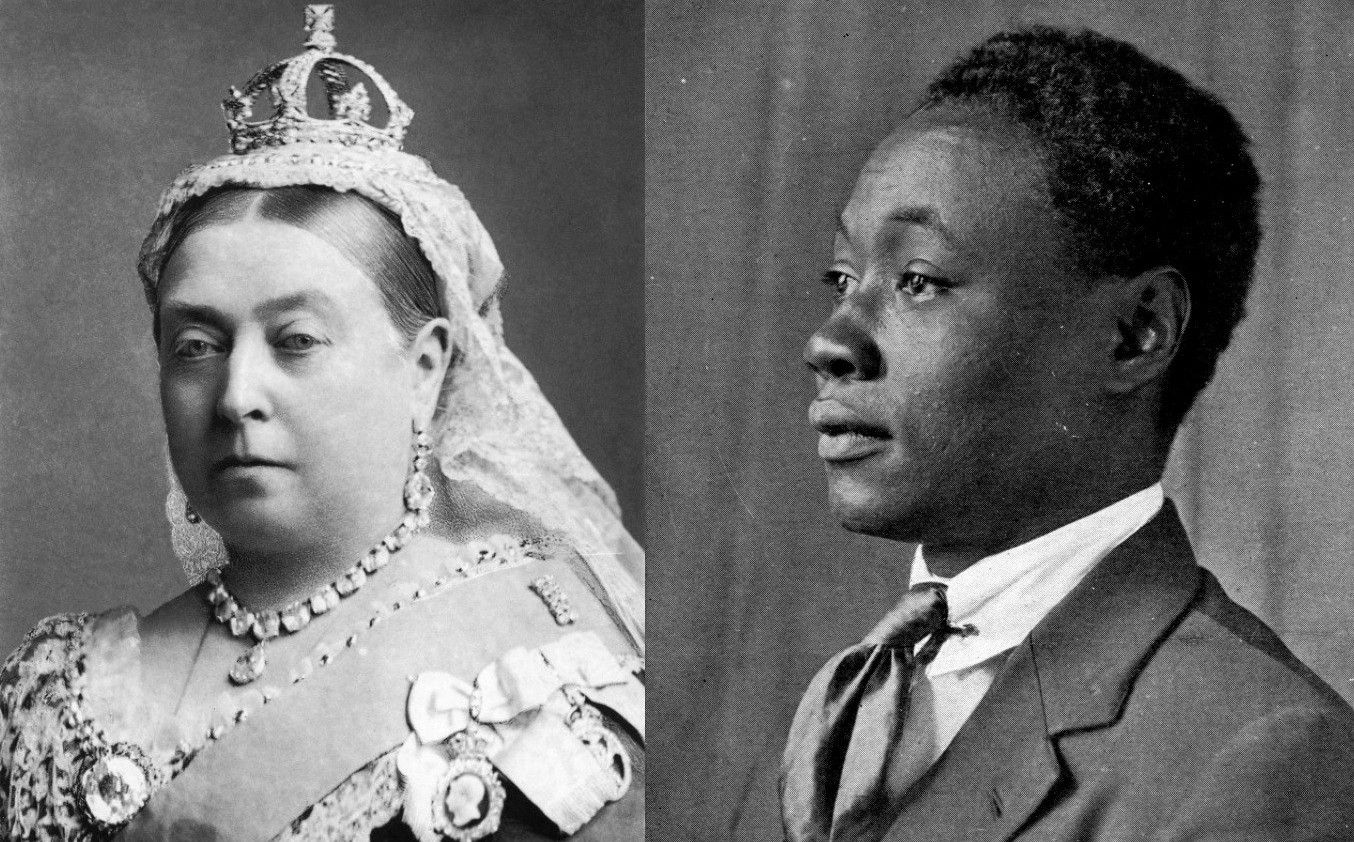
Born in 1890 and growing up in Britain’s colony of Jamaica, Queen Victoria was Claude McKay’s sovereign during his formative years and loomed large in his active imagination. As he grew, his understandings changed, as did his image of the dead Queen. On the occasion of Lytton Strachey’s biography, McKay remembers his transformed relationship with the Empire’s head.
‘Queen Victoria’ by Claude McKay from The Liberator. Vol. 4 No. 9. September, 1922.
QUEEN VICTORIA’S Diamond Jubilee of 1897 was the big event of my boyhood years. It thrilled me to exaltation, and I grew twice bigger than my seven years. On that day of June I flaunted a brand-new brown drill suit made with a sailor cape, and for the first of my life I was to wear stockings and black boots like my brothers and sister.
The house was astir before the fowls flew down from the mango trees. With one of my cousins who was helping my mother with the large household, I went to the spring for water. That day she was to make extra meals for our little friends and cousins from nearby districts. I bore a brown two-jointed vessel of bamboo filled with water, she a kerosene can, and we made three trips before daybreak came, dissipating the soft red glow that enveloped Mocho mountain.
The Queen’s Jubilee! Before eight o’clock the chapel school, set right on the small of Zion Hill, was overflowing with happy, dark-skinned and golden-hued children. We went through our devotional exercises, the mulatto school-master exhorted us, and I received and swallowed my first impressionable lesson on the British Empire. And at the head of that Empire I visioned a woman greater than my own mother greater than all other women, a woman who was “mother, wife and queen.” Tennyson’s rhymes of the Queen was one of our choicest memory gems. “Her court was pure, her life serene.” The solid, respectable Poet had saluted his solid, respectable Queen.
Nine o’clock brought the older folk with our lunches, the fiddles, the flutes, the fifes, the tambourines, the kettle drums, and old Cudjoe beating the big bass drum. Over the pulpit was Victoria’s picture, sad and heart-touching, in her widow’s weeds. The cloth was slid back and we rose and sang with deep enthusiasm “God Save Our Queen.” The prizes were given out. And when I received the second best medal of the Queen in bronze, for good attendance, I hung my head and cried shamefully because the first medal, a little miniature of the old woman in a gold-gilt frame, was given to my classmate, friend, and rival for excellent character.
“Jubilee for the Queen, jubilee, jubilee for our queen; Victoria, Victoria, Victoria the good.” All that day we repeated those words. We sang them and danced to them. We formed up in files with banners, flags and pennants streaming. The monitors and older pupils had worked for a week, cutting out pretty white and colored letters for our banners so that our school should make the most effective showing. The music led the column; our feet followed in happy unison, our parents, uncles, aunts and cousins bore up the rear. Down the yellow parochial road we marched to the main to meet other schools, one, three, five, seven miles distant, that came marching down the green hills, up from the valleys, to the tune of “Rule Brittania.” They came from John’s Hall, Mainridge, Nine Turns, Tabernacle, Crooked River, Bunyan, Ballard’s River, Collington, Frankfield, Red Hills, Trinity and Staceyville. Hundreds of us, thousands of us. As each swung into column the nearest school shouted greeting: “Jubilee for the Queen,” and the words went sounding down the whole long line. In the big common at Mear’s Pen the day was devoted to making us joyful. Nightfall was already upon us when our school marched back singing over two-mile-long Park Hall hill, the bugbear of draymen, for there the choicest draft mules and hardiest horses of the hills hauling loaded drays and carts met with disaster, bringing shame upon their proud owners. But we children fairly danced over it, not a whit tired from the day’s fun. We could have kept on for two days at the same pace. We were unwilling even to go to bed and think and dream of our great, good Queen!
But to my emotional and romantic mind the Diamond Jubilee was merely a beginning. I had touched a mysterious reality of which I was eager to know more. There were about four heavy, illustrated books, Lives of the Queen, in the house. I drank in them all. Her pictures adorned the white-washed walls. I asked questions. And my teacher and parents told me that Victoria had freed the slaves. She had mounted the throne of England with the words, “I will be good,” on her lips. The Bible was her light. From her great love for her colored subjects she had freed them from slavery. She loved India and was Empress of that strange mystery-land, some of whose sons were her daily attendants. And among her vast possessions our tiny island, even Jamaica, was distinguished, honored in her being its Supreme Lady. And so we pupils wrote down in our exercise books and in our minds, “Victoria, the Good, Queen of Great Britain and Ireland, Empress of India and the Supreme Lady of Jamaica!”
Extraordinary indeed is the growth of the child mind, which seemingly absorbs, retains and discards ideas by accidental occurrences. A very sacred ideal like the sincere affection of a relative may be shattered beyond repair by an unwitting remark or a harsh glance, a new treasure takes its place miraculously; but often some silly discredited symbol retains its hold in the heart, spreading out into the imagination, coloring and overshadowing all thought. Like such a symbol was the legend of Victoria. To my mind she represented Omnipotence and Omniscience. As I grew bigger she grew mightier. The police, the soldiers, the officials, even the governor, all belonged to her. She controlled the machinery of life. Imagine then my amazement, when an Englishman of that most highly honored and superior tribe, which always decline mechanically to the precedence of the Sovereign in and out of England, quite carelessly destroyed my schoolboy myth, rendering me speechless for a long while.
“She was just an obstinate, vindictive and malicious old widow,” he remarked casually. To be sure I was now in my higher, elementary school stage. I knew that the African slave trade was discontinued by act of Parliament before Victoria was born. I knew she did not really bring about the ending of Negro slavery in the British dominions and colonies. But if I were a little more informed of historical events, Victoria simply loomed larger and nobler in my imagination. She was to me what Lincoln is to the little American Negro child. If her ministers sometimes erred, if Englishmen abroad were often cruel and inconsiderate of the small rights of the native population, the Queen herself, like the Christian God of the world, was a Majesty great and holy who also ruled over sinful subjects. The Englishman smiled at my fancies and told funny stories about the Queen.
One I remember dealt with Victoria’s attitude towards an aged titled couple. The man was an old eccentric who traced his line back to the Norman invaders and was occupied with the upkeep of his castle and estate, finding no pleasure in politics and society. But the hobby of his old wife was to attend court functions rigged out in the regalia of her rank. In some little manner the Queen desired to change this, to her, irregular course of life of this couple; but the old man proved refractory and Victoria, enraged over a subject disobeying her, revenged herself by removing the wife’s name from the court list.
And now this Life of the Queen strips the Legend bare of its halo and all the saintly trappings in which the solid self-righteous English bourgeoisie invested it. Victoria stands out alone naked and unbeautiful, quite ugly, a very poor figure. Those who are expecting a ripping biography from a special angle may not perceive the joke. The incisions, the lacerations, the sweet sensation of stripping naked may be found in a line of a paragraph, a paragraph of a chapter or beautifully inlaid in the last chapter of the book. The ultra- extremist might spit, the hoary conservative might condemn; but the biographer has neatly put his stuff across and sold it besides to the respectable Anglo-Saxon buying world of two continents. And the Mystery stands revealed for those who want to see.
Victoria was merely a little commonplace personality who grew up with the deity-idea of kingship fixed in her mind. Her strange German parents got married for the high purpose of giving birth to a ruler of England. As a child she was always impulsive and domineering. When a mere tot she could say to her little playmate about her toys, “You must not touch those, they are mine; and I may call you Jane, but you must not call me Victoria.”
The dominating passion of her life was not to “be good” as she desired the world to know, but it was to appear to her subjects as a perfect paragon of respectability. At the beginning of her reign she set her face grimly against the coarse masculine laxity of the preceding courts. In her zeal for outward appearances she went so far as to encourage and foster a quite unfounded scandal of sexual indiscretion in one of her ladies-in-waiting. She possessed a morbid dislike of change, opposing her ministers from petty personal motives; to her the difference between the Whigs and the Tories was largely determined by the manners of her ministers.
But in all things her chief purpose was to guard, extend and conserve her royal prerogatives. She loved, yet wanted to be queen over her dear Albert. She fell, however, before his sustained onslaught of calculated reserve, and yielded everything to him, body, mind and throne–a victim of her manifold ecstatic emotionalism. Before his death she came to worship his slightest wish, word or deed. She was amazed at his scientific activities and even marveled at his labors in trying “to convert sewage into agricultural manure.” But death took possession of her heaven, from which she withdrew to don perpetual widow’s weeds and live in an atmosphere shrouded in mystery and thick with superstition. She clung to the useless remains of her dead husband as only a civilized decadent could. Indeed Victoria was the supreme embodiment of the decadent spirit of this age. Savages and the ancients buried the things of the dead with the dead.
But Victoria even ordered fresh water to be set in a basin every day for Albert, whose ghost to her mawkish imagination visited the palace every night. She might have become the high priestess of spiritism. It must have been this superstitious vein predominant in her life that possessed her to become Empress of India, learn Hindustani and have a bodyguard of Indian servants. It must have been the rosy-hued fake religion and mystery that reached Victoria’s heart. There is nothing recorded to prove otherwise. Obviously it was not the poetry, philosophy and art of the plundered country which stormed her imagination.
Outwardly a woman of great sorrows, solid and fixed, Victoria put her seal of approval only upon solid, heavy, respectable things. She was avid of power, but distrustful of change. She was dead against woman’s suffrage. A woman agitator of title should, in the Queen’s opinion, be whipped. She let it be known she was opposed to a second marriage. No divorced woman was received at court. No liberties could be taken by her nearest relatives or the highest personages. The Heir-Apparent was virtually an outcast from her home. But to one person she allowed all liberties, one who almost came to take the place of the Prince Consort in her heart, who was her daily attendant, whose chamber adjoined hers. By him she was “bullied, ordered about and reprimanded.” And she meekly submitted to the dictatorship of her Scotch servant John Brown.
CLAUDE MCKAY.
The Liberator was published monthly from 1918, first established by Max Eastman and his sister Crystal Eastman continuing The Masses, was shut down by the US Government during World War One. Like The Masses, The Liberator contained some of the best radical journalism of its, or any, day. It combined political coverage with the arts, culture, and a commitment to revolutionary politics. Increasingly, The Liberator oriented to the Communist movement and by late 1922 was a de facto publication of the Party. In 1924, The Liberator merged with Labor Herald and Soviet Russia Pictorial into Workers Monthly. An essential magazine of the US left.
PDF of full issue: https://www.marxists.org/history/usa/culture/pubs/liberator/1921/09/v04n09-w42-sep-1921-liberator-hr.pdf
 Revolution's Newsstand