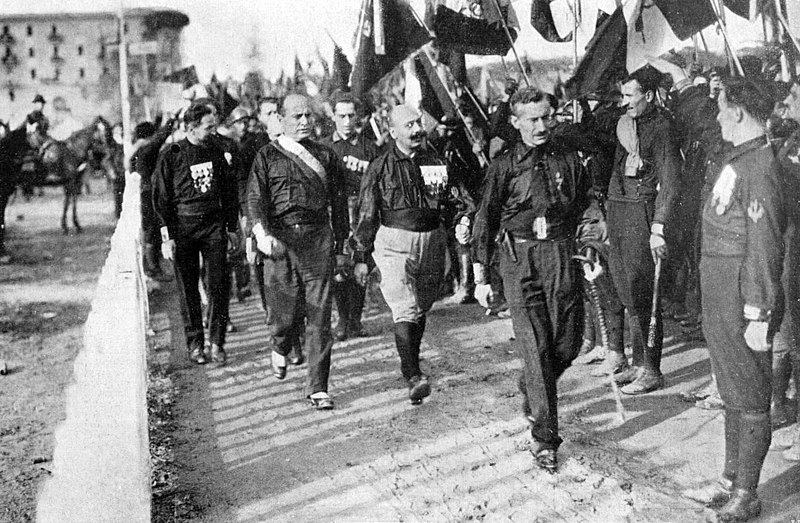
While all manner of militaristic, reactionary, and obscurantist movements have accompanied the rise and dominance of capitalism, “fascism”, as originally defined, was a product of the First World War and its immediate European aftermath. Below, an early analysis of Italian Fascism and its roots in the ‘Arditi’ from a veteran of Italian Socialism and founder of the Communist Party.
‘Fascism’ by Egidio Gennari from International Press Correspondence. Vol. 1 No. 4. November 1, 1921.
A word or two on the development, the causes and the structure of “Fascism” in Italy.
During the war, when the military situation was unfavorable to Italy, and when the growing economic difficulties gave the revolutionary spirit of the proletariat new strength, Fascism sprang up from all the reactionary and democratic forces, in coalition with the renegades from Socialism and Syndicalism who had passed over to interventionism and even to, the camp of the revolutionary movement.
At first “Fascismo” limited itself to parliamentary action and its principal field of activity was at Rome. It was responsible however for some acts of violence against men who had remained faithful to the internationalist ideal. But the principal activity of “Fascismo” consisted in pushing the government to suppression of the revolutionary movement.
After the War, when the bourgeoisie, on the verge of bankruptcy, saw itself menaced by the spirit of revolt of the proletarian masses, which like those of Russia, of Hungary and of Bavaria, saw that their only safety lay in the revolution, the officers, the petty-bourgeois youth (that is to say, the “déclassé” of the War, who feared demobilization and the resulting unemployment), the “Arditi” who had the same characteristics and the same tasks as the Fascisti of today formed the nucleus of bourgeois resistance.
THE ORGANISATION OF “ARDITI”.
The Arditi—during the War the shock-troops–was composed partly of demobilized arms and partly of demobilized soldiers taken in hand and organized by “Big Business” (Mussolini and other renegades). The task of this organization was that of all White Guards the defense of capitalism by means of terror. The “Arditi” sacked the workers’ institutions, set fire to the “Avanti “, organized attacks, threw bombs at labor-demonstrations, etc.…But after the 1919 elections, in which the Socialist Party triumphed, and after the proving of the revolutionary spirit of the proletariat, “Arditism” was dissolved. Its central nucleus nevertheless was later to constitute the kernel of Fascism.
The cradle of Fascism was at Triest and Bologna. This is enough to explain its origin and its purposes, Triest and the “Venezia giulia” having been, even a long time after the end of the war. under military occupation, and therefore under the absolute control of militarism and of irregular bands which followed d’Annunzio in his Fiume adventure.
Bologna is one of the most important agrarian centers, where after decades of struggle the agricultural workers have, especially in 1919, won a complete victory over the landed proprietor’s who were forced to accept claims implying a limitation of the right of property. Face to face with the gravity of the moment, in the fear of threatening and more serious defeats, perhaps even of expropriation, the proprietors made ready for war, and organized all their forces for defense and attack.
Thus Fascism, in Italy, apart from its international white Guard aspect and from its origin—Arditism–is the creation, the direct product of the banks and of big industry; it carries the military and agrarian stamp. And mention must also be made of the great strength which the commercial petty-bourgeoisie brings it.
Italian Fascism found a favorable environment. In the first place it was the expression of the international bourgeois reaction which was raising its head everywhere, but mainly in Hungary, Bulgaria and Jugoslavia. It is not unworthy of belief that Fascism in Italy was instigated and supported by the allied Powers themselves who were organizing capitalist reaction in all Europe.
Fascism was also aided by the weariness of the proletariat after revolutionary efforts–above all after the occupation of the factories which collapsed because there was no political party capable of leading the revolution–in a word by all the errors and weaknesses which at the very beginning set up an insufficient resistance to Fascism, and in this way allowed it to develop and to spread over all Italy.
The worker’s organizations which at that moment should have directed the action of the proletarian class, failed to do so. young Communist Party and the revolutionary proletarians did not lay down their arms, however.
For the last ten months in Italy the Fascisti (supported by the police and the army) have been fighting every day against the workers. The former, well equipped, armed with guns and bombs, possessing many motor trucks, can quickly concentrate their forces in all parts of Italy and attack cities and villages according to all the rules of military warfare; the latter are poorly armed. The former march in military formation or protected by the police; and if they are repelled, the government forces intervene provided with armored motor cars and even with cannon. The workers are disarmed and imprisoned by thousands. The actions of the Fascisti are now known to all. destroy Communist and Socialist locals, printing houses, labour headquarters, and even the homes of revolutionary workers. They sometimes take possession of small towns. They break into houses at night to inflict the worst kinds of violence on communists, revolutionaries and their families, sometimes going as far as to assassinate–all this by mandate from the bourgeoisie and in full accord with the government.
The most characteristic action of Fascism carries the lie to the democratic bourgeois States, still defended by Socialists for whom universal suffrage remains the means for pacific conquests. By menace and violence, the Fascisti force, as a matter of fact; the dissolution of hundreds of municipal governments conquered by the Socialist Party before the split, in many cases almost by unanimous vote.
With Fascism the bourgeoisie throws off the democratic mask. Bourgeois reaction and Fascism in Italy show once more the proletariat to be on the horns of this dilemma–either to suffer under the terror and the violence of the bourgeoisie, or to exercise revolutionary violence and to establish class dictatorship. These facts show that the struggle cannot be avoided. when the situation is ripe for the conflict; to try to avoid it is only to permit a reaction as pitiless as after a defeat. They also demonstrate that in retarding the proletariat in its struggles, in making it dream of compromises, of pacific conquests and pacts with the bourgeoisie, in pretending that ephemeral concessions obtained in a critical hour are real and enduring conquests, the Social-democrats are nothing more nor less than the faithful allies of the bourgeoisie, of the counter-revolutionaries, and that they well deserve the epithet–social-traitors.
The revolutionary workers of Italy who keep up their resistance and who have already written memorable pages in the history of proletarian struggles, have understood it, and they are enlisting in the new fighting formation, created by the Communists Party–the “Arditi del popolo “
Against the old “Arditism”, changed now into “Fascism” we are opposing the new organization of revolutionary workers.
We believe that in spite of the cowardice and treason of the Socialist Party, in spite of the peace-treaty signed with Fascism (which has up to now only revived the criminal activity of Fascisti bands), that in spite even of the approaching attempt to create a Socialist Government, a thing which is perhaps very near, the Fascisti White Terror will always remain, in Italy, a terrible revolutionary lesson from which the masses will profit. And we are certain that the Communist Party will be able fully to accomplish its revolutionary duty.
International Press Correspondence, widely known as”Inprecorr” was published by the Executive Committee of the Communist International (ECCI) regularly in German and English, occasionally in many other languages, beginning in 1921 and lasting in English until 1938. Inprecorr’s role was to supply translated articles to the English-speaking press of the International from the Comintern’s different sections, as well as news and statements from the ECCI. Many ‘Daily Worker’ and ‘Communist’ articles originated in Inprecorr, and it also published articles by American comrades for use in other countries. It was published at least weekly, and often thrice weekly.
PDF of full issue: https://www.marxists.org/history/international/comintern/inprecor/1921/v01n04-nov-01-1921-inprecor.pdf
 Revolution's Newsstand