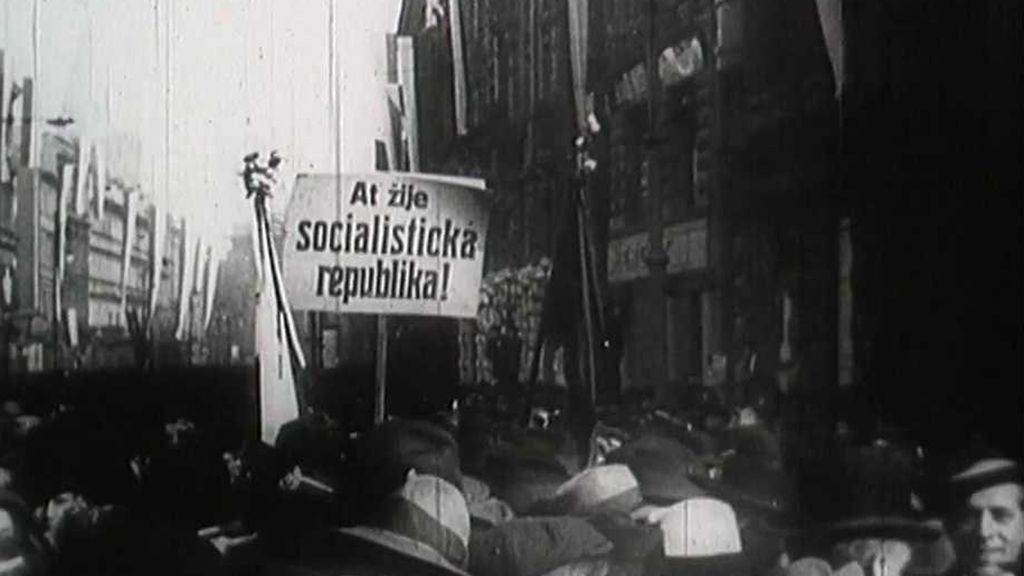
While finding the commonalities among them is obviously important to understanding fascism as it has developed over the last century, it is in their specific characteristics of time and place that the fascist dynamic is best understood. All of the new states to emerge from the Austro-Hungarian Empire saw a post-War reaction as national myths were made real and which class would rule was in violent dispute. Karl Kreibich, a German-speaking Czecho-Slovak Communist, on what fascism looked like there.
‘The Development of Fascism in Czecho-Slovakia’ by Karl Kreibich from International Press Correspondence. Vol. 3 No. 1. January 3, 1923.
There is no doubt that we are confronted by the rise of an extensive Fascist movement in Czecho-Slovakia. The threads being spun between the Orgesch organizations in Germany and the German nationalist classes of Czecho-Slovakia are becoming more and more visible, and are preparing the way for an irredentist movement. At the same time the Czecho-Slovakian newspapers publish constant reports on the spread of the “Narondni hnuti” (national movement, the name of the Czech Fascist organization). Even the German social democrats, who a year ago attempted to ridicule the first disclosures of our press on the German-Bohemian Orgesch organizations, are now taking the matter more seriously, and that part of the Czech press opposed to the Fascist movement shows great signs of disquietude, but more on account of the Czech than on account of German Fascism, which is not taken very seriously by the Czechs.
In any case, we Czecho-Slovakian communisis have got to take the Fascist movement seriously, not only because the groups from which Fascism recruits its forces (gymnastics clubs, legions, etc.) have already long existed, but above all because the economic and political conditions making for Fascism are to be found in Czecho-Slovakia. The economic crisis heavily burdens the country, its economic relations to neighbouring states are difficult and complicated, every exertion has to be made to overcome the crisis, the last ounce of strength must be wrung out of the working masses for the salvation of capitalist economy. In no place are the wages of the workers and the salaries of the civil servants so palpably reduced as in Czecho-Slovakia, there is no country where unemployment is so terrible. The carrying out of an economic program such as planned, at the expense of the working population, requires ruthless brutality and a strong and determined governmental power. Thus the government of the “strong hand” had to be formed, in which the wire-pullers of the government parties, who have hitherto only worked behind the scenes, themselves took an active part, in order to throw the weight of their authority in the balance.
But the political powers of this government coalition are by no means equal to the gigantic task which it has set itself. Czechish social democracy is no doubt well represented in Parliament, but it has no corresponding hold on the masses. It is only because they have nothing more to lose, that these bankrupt betrayers of the proletariat agree to everything that the finance capitalists and agrarians demand of them. The fermentation among the masses, after reaching Czechish social democracy two years ago, has now spread to Czechish socialism, whose position has, up to now been unshaken.
Although inner difficulties have prevented our party from applying the united front tactics as comprehensively and thoroughly as might have been desired, still the masses following the Czech socialists have awakened into movement; there is open and concealed revolt within the party, and under this pressure of the movement among the masses, the leaders are becoming uncertain and hesitant, they are ceasing to be quite reliable pillars of the government. Among the agrarians and capitalists this is bound to create a desire for a regime free from the necessity of considering the social democratic parties. For these parties fear the masses, and are a hindrance to a sharper persecution and suppression of the communist movement. Hence the backing of the Fascist movement by the national democratic press.
But Czechish Fascism is preparing for battle on two fronts at once. It has not only to defend the capitalist state against the revolutionary labor movement, but at the same time the Czech national state against the national minorities. It has to fight simultaneously in the class war and in national war. The rebellion of the majority of the Slovaks against the Prague Czech system of government, destroys the fiction of a united Czecho-Slovakian nation, and renders the formation of a new Czecho-Slovakian coalition government more and more difficult, as the Czechs alone do not possess a majority in the state. At the same time the first pre-requisites for a Czecho-German bourgeois-socialist government coalition have been recently complied with. The “German Parliamentary Alliance”, comprising the whole of the German-bourgeois deputies in the Czech Parliament has been dissolved. The personal contact and community between the social democratic party leaders and the leading spirits of the Amsterdam trade union international is, in Czecho-Slovakia, as in Austria, much closer and more intimate than anywhere else, and the German social democrats have agreed so completely with their Czech colleagues in reducing the wages of the workers, and in preventing the formation of the united front, that any political antagonism still existing between these two cliques of leaders is based solely on bourgeois nationalism in both camps. As soon as bourgeois fractions are found on the German and Czechish sides, willing to work together in a government majority, this hindrance to a German-Czech bourgeois-socialist government will be overcome. This coalition is approaching nearer and nearer, and the antagonisms in the present coalition are becoming increasingly acute. The social democrats and socialists desire the new coalition in order to free themselves from the oppressive social rule of the national democrats, who bring the whole coalition system into discredit; at the same time they expect to be rid of the fetters of coalition with the clericals, an alliance which embitters the anti-clerical masses of the Czechish working people.
But Czech finance capital sees its scarcely won position of monopolist of the home markets, already endangered by a Czecho-German coalition with a strong social democratic trend. Therefore the national democrats are irreconcilable opponents of this coalition. The disciples of unqualified adherence to French foreign policy side with them. The ranks of the opponents of the coming coalition are also swelled by the extreme nationalist intellectual circles, and by the legionaries, who fear that any injury to Czech supremacy in the state involves injury to their civil service careers. All these elements combine to form the Czecho-Fascist movement. While the present bourgeois socialist coalition is showing the first sign of going to pieces, the next coalition is not only knocking at the door; but the mines are already being laid which in turn are to shatter this coalition. This explosion will however affect the whole system, and confront the state with the urgent question: Dictatorship of the bourgeoisie or dictatorship of the proletariat. The bourgeoisie is already building on Fascism, the proletariat on its united front. The decision will depend on which fighting front rallies first: that of the bourgeoisie or that of the proletariat.
Here it should not be forgotten, that one leading cause of Fascism inadequacy of state power at the critical moment must be more rapid in its effects in Czecho-Slovakia, than in other countries. The bourgeoisie is composed of antagonistic elements: old Austrian bureaucrats and new extreme national elements side by side with German and Hungarian officialdom, who cannot be relied upon under all conditions. The army is still more inadequate. This contains still more unreliable elements: old Austrian officers of German nationality. The rank and file is also unreliable, owing to different nationalities and communist propaganda (at the last communal election at Jicin the majority of the garrison voted communist). To this must be added that the geographical situation of the state is most unfavorable from a political standpoint, its frontiers strategically most disadvantageous, and the irredentist danger so acute at many critical points of the political situation–in Slovakia the dangerous autonomist tendencies are also to be reckoned with–that even a larger army than the present one would scarcely suffice, under the present critical circumstances, to defend the frontiers of the state, quite apart from the maintenance of “order” at home.
The conditions and thus also the danger, fully exists in Czecho-Slovakia. The proletariat will have to take the matter very seriously indeed, although the beginnings of the movement may appear trivial. In the Czecho-Slovakian state it is easier to declare the “fatherland” to be in danger than in other countries,
for the danger is much more real. The German danger, that is, the danger of a German success in the case of a conflict with a capitalist nationalist Germany, is indeed so great that in earnest Czech circles Fascism is decisively rejected as a fighting organization against the Germans, these circles being convinced that such a movement only increases the antagonism towards the Germans, without accumulating sufficient force to banish the German danger in the case of a serious conflict. But whether seen from a national or a social side, the “fatherland”, the capitalist state, will always be endangered, and Fascism will always be wanting to save. Fascism in Czecho-Slovakia is a real danger for the proletariat, and it must take steps against it in good time.
International Press Correspondence, widely known as”Inprecorr” was published by the Executive Committee of the Communist International (ECCI) regularly in German and English, occasionally in many other languages, beginning in 1921 and lasting in English until 1938. Inprecorr’s role was to supply translated articles to the English-speaking press of the International from the Comintern’s different sections, as well as news and statements from the ECCI. Many ‘Daily Worker’ and ‘Communist’ articles originated in Inprecorr, and it also published articles by American comrades for use in other countries. It was published at least weekly, and often thrice weekly.
PDF of full issue: https://www.marxists.org/history/international/comintern/inprecor/1923/v03n01-jan-03-1923-Inprecor-loc.pdf

