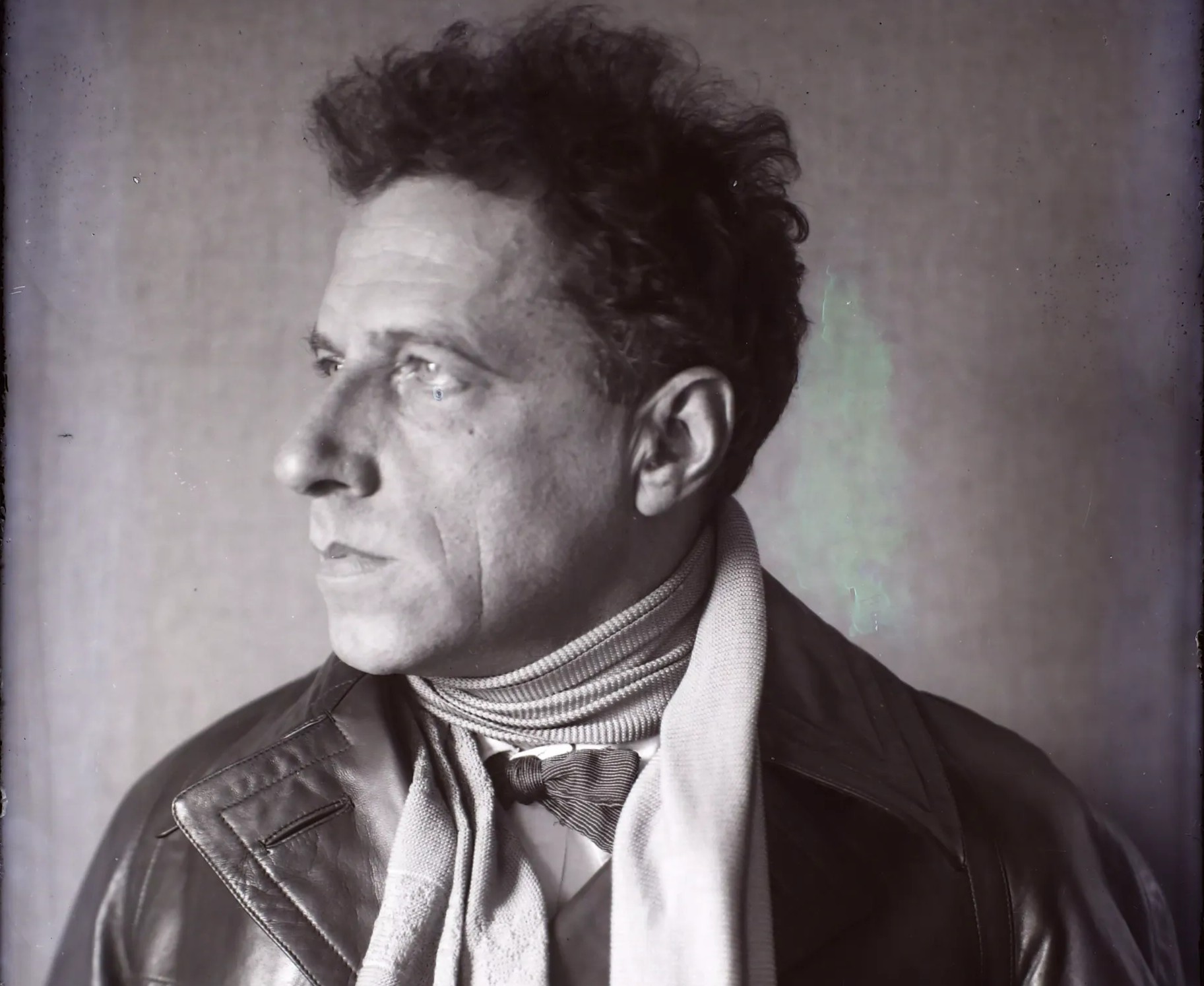
An amazing article by H.W.L. Dana as he visits Vsevolod Meyerhold in 1934 and learns of the physical plans, included in the article, for his new theater and discusses staging, lighting, and revolution. Unfortunately, Moscow’s pioneering Meyerhold Theatre was closed by order of the Politburo in January, 1938. One of the great artists of his generation, Vsevolod Meyerhold was arrested in 1939 on the ludicrous charge of being a ‘British and Japanese spy’ and Trotskyist agent, and shot on February 2, 1940.
‘Meyerhold’s New Theatre’ by H.W.L. Dana from New Theatre. Vol. 2 No. 1. January, 1935.
THE gong rings with a hard metallic clang. It is like the beginning of a prize fight. The searchlights shift and focus on the brightly lighted ring. They’re off! The fight is on! We lean forward from our seats high up in the amphitheatre and look down on what is going on below. Instead of a single combat between two boxers, we find the whole stage seething with activity. There are dramatic struggles between groups of actors, clashes between masses, between classes. Actors excitedly rush up and down inclined planes, flights of stairs, scaffoldings, constructivist towers. The stage is vertical as well as horizontal. The action is in three dimensions. The stage itself acts, shifts, changes. Revolving disks turn in one direction with outer rings circling about in the opposite direction, wheels within wheels. Platforms slowly rise and fall. Searchlights play madly round about. Moving picture projectors flash wild scenes on the walls, on the ceiling. Music, brass bands, screeching radio, drums and guns rend the air asunder. The whole great circle of spectators is caught up in the excitement. It is a circus gone mad. Yet we are given bread as well as circus. There is edification, meat, meaning, method in the madness. Weare in imagination already in Meyerhold’s new theatre.
Heretofore Meyerhold has never had a theatre of his own construction to work in. He has never really had an opportunity before to work out his imaginative theories fully. For years he has had to make use as best he could of the old-fashioned Zon Theatre on the Triumphal Square in Moscow and now that that is torn down to make place for his new theatre, he is temporarily making shift under the still greater handicaps of what was the Passage Cinema Theatre. At last, when the new Meyerhold Theatre is finished, he will have a chance to carry his plans into fulfillment such as he has never had before.
When Meyerhold described to me the astounding plans for this theatre of his own choosing and his own design, his eyes fairly glistened with excitement and his shock of gray hair was tossed about, as he waved his hands to indicate the different parts of the projected auditorium. “The first principle of my new theatre,” he said, “is not to separate the audience from the stage by a proscenium arch, but to have the audience surround the actors.” And he stretched out both his arms as if to embrace an imaginary circular stage between them. He went on to rail against the ordinary theatre where the curtain goes up like the rolling up of a Fourth Wall to reveal the other three walls of a realistic drawing room. Meyerhold does not believe in realistic representation. He believes in what he calls “Conditionalism.” As with Pavlov’s conditioned reflexes, it is not necessary to have the stimulus of the actual objects. It is sufficient to have the stimulus of conditions associated with them which produce the emotions through the power of suggestion. When Meyerhold gets explaining, we need someone to explain his explanation. One thing, however, is clear: he is not afraid of the “theatre theatrical.” He is not afraid of “destroying the illusion” because “there is no illusion to destroy.” There is no attempt to deceive us into thinking that we are peeping through a key hole at an intimate scene we are not supposed to see. He frankly brings the actors out into the limelight and has them do their stuff in the very midst of the audience. It is frankly stylized, artificial in the sense of being art rather than nature. The more the audience who surround this action can be caught up into its mood, the better.
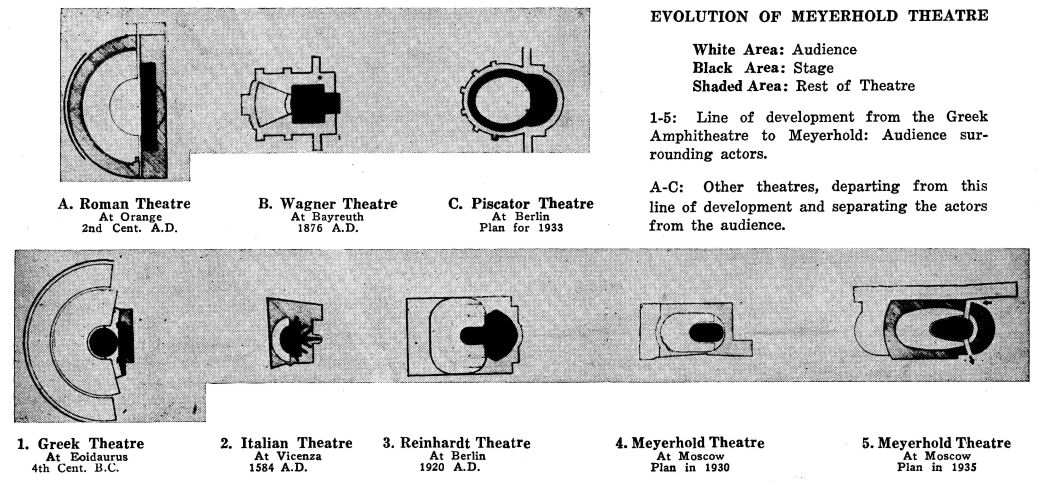
TO explain the evolution of his idea of a theatre in which the spectators encircle the actors, Meyerhold proceeded to show me a series of plans of other theatres. With these, he traced, on the one hand, the line of development of his projected theatre from an ancient Greek amphitheatre, such as that at Epidaurus, where the audience surrounded in a semi-circle the central circle of action of the chorus. From this he passed to the theatres of the Renaissance, for example that designed by the Italian architect Palladio for the Olympian Academy at Vicenza, or the Elizabethan theatres, such as Shakespeare’s circular Globe Theatre, where the spectators still in large measure surrounded the actors. Meyerhold pointed out a similar condition in the popular Japanese theatre of the Kabuki. He pointed out in the plans of the Grosses Schauspielhaus which Hans Poelzig, the German architect, built for Reinhardt in Berlin, that to some extent the same was true there. Meyerhold would carry this line of development one point further and have the whole stage engulfed in the auditorium. “This will give,” Meyerhold said, “complete unification of actors and spectators.”
On the other hand, Meyerhold got out plans of other theatres which had departed from this line of development and brought about what he felt was a false separation of the actors from the audience. The Roman theatres differed from the Greek theatres by filling in the entire semi-circle with the spectators and forcing the actors back on a stage apart. Later theatres had increased this separation by placing the action of the stage on the other side of a proscenium arch removed from the audience by an orchestra pit, by footlights, etc. This tended to make the scene a sort of picture seen through a gilded frame. Whereas Meyerhold would keep the actors in the same hall with the spectators, the traditional nineteenth century theatre tended to place them as though in another room. In the great Festival Theatre which Gottfried Semper designed for Wagner at Bayreuth, the enormous stage, bigger even than the auditorium, is entirely detached from it. Again Piscator’s daring plan for a new theatre in Berlin (which was rendered impossible by the coming of the Nazi counter-revolution) though it mingled the audience with the actors, was based on exactly the opposite principle from that of Meyerhold, having the actors surround the spectators instead of the spectators surrounding the actors.
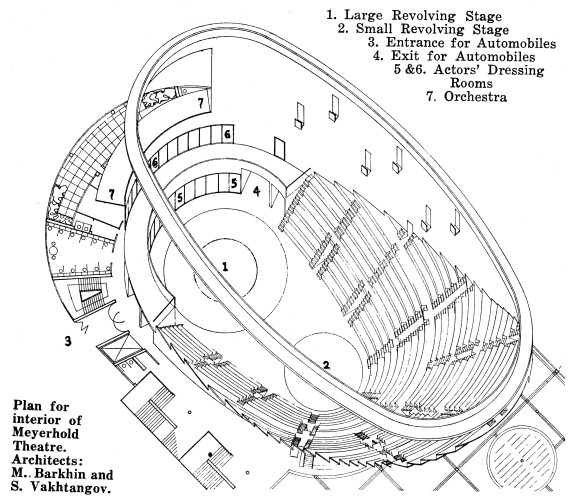
Meyerhold next took a blunt pencil and made hasty sketches on a rough piece of paper showing how he planned a great oval which would include both audience and stage within the same circumference, but with the stage on the inside. Quickly his nervous hands drew in the circles within circles to represent the revolving stages he is planning and curving arrows to indicate the circulation by which automobiles may enter the theatre from the street, pass around the stage, and’ go out again to the street.
As architects for his new plan, Meyerhold has had many brilliant minds to help and advise him. The sketches started by M. Barkhin have been further developed by Sergei Vakhtangov, the young son of Eugene Vakhtangov, the famous director of the Third Studio of the Moscow Art Theatre, now called the Vakhtangov Theatre. Young Vakhtangov, since the death of his father, has moved farther to the left and is now designing the sets for Meyerhold’s plays and the detailed architectural plans for Meyerhold’s Theatre. He showed me countless ground plans and cross-section and one isometric projection (reproduced herewith) showing a view of the auditorium of the theatre from above down. Here can be seen the steeply inclined rows of seats for the spectators surrounding the stage like a great horseshoe and rising from the level of the stage with a continuous sweep back. to the very top of the theatre some five stories high.
Pointing to Vakhtangov’s drawing, Meyerhold explained that the egg-shaped stage would contain two revolving stages. An earlier plan had been to have these of the same size. Now it is planned to have a difference between these two: a larger one (1) farther back, with an outer ring which can revolve in one direction while the inner circle can revolve in the other direction, and a smaller revolving disk (2) nearer the audience which can be covered with additional seats for the spectators when a more intimate play is to be produced needing only the single stage. Both of these revolving stages will be hydraulic disks like elevators so that they can be raised to different levels. If necessary the central core of the larger disk can be raised to a still higher level than the outer ring forming a sort of pyramid. This with the addition of steps and scaffoldings will enable the actors to act on a vertical as well as on a horizontal stage.
THESE revolving stages can be lowered into the basement where new sets can be wheeled unto them, and then lifted back into place. If necessary the wells into which these disks sink when lowered can be filled with water to produce sea effects such as Meyerhold has already given us with the use of real water in Roar China. Far better than a painted ship upon a painted ocean on a back drop is the feel of the real metal structure of a ship and the feel of real water. Meyerhold defeats realism by reality.
Then Meyerhold showed me with great glee on the plan the place (3) where automobiles will be able to enter the theatre directly from the street, circle around the outer edge of the stage, leave their passengers opposite their seats, and then pass around and out again through another exit (6) onto the street. I found myself looking at the mad master with astonished incredulity, expecting to see that he was winking at me mischievously to see how much of his fairy story I would believe. But, no! There he stood entirely in earnest.
Carried away by his enthusiasm he went still further. “On holidays,” he said, “when there are parades in the streets, the processions can be diverted, enter the theatre, march around the stage, waving their banners and singing, and then pass on toward the Red Square.” Thus Meyerhold’s Theatre is not to be aloof from the stream of popular life but is to be caught up in the public demonstrations and to be made an integral part of the civic life of the Workers’ Republic.
If the spectators are to surround the stage on three sides, the fourth side is to be for the actors’ dressing rooms. Instead of having these tucked away, inaccessible and out of sight, there will be two rows of little rooms, like the compartments in a European sleeping-wagon. The lower of these curving rows (5) will give access directly unto the stage in plain sight of the audience. The upper row (6) will bring the actors out unto a gallery in back of the stage, from which they can readily descend to the level of the stage itself. In these railroad sleeping compartments the actors, after their strenuous activities on Meyerhold’s stage, can lie down and rest within hearing of what is going on the stage, keeping in touch with the rhythm of the play as it progresses, ready to emerge again at the proper psychological moment. And so “they have their exits and their entrances.”
Above these two galleries of dressing rooms will be a third gallery for the orchestra (7), again in plain view of the audience. Not rising from some sunken orchestra pit, but blazing forth from the curved sounding-board of the wall of the auditorium, the orchestra will play a prominent, a predominant part in many of Meyerhold’s projected performances. He is planning a number of plays in verse on the collective farm, homeless waifs, etc., and in these, musical elements will be essential. Pushkin’s original text of Boris Godunov in play form with Mussorgski’s music as a background will at last be possible. Shakespeare’s Hamlet has from the first been Meyerhold’s ambition, but as he said: “Only the new building will make it possible to produce the greatest masterpiece of the world dramatist.”
Above the music will be the light. “Light,” according. to Meyerhold, “should be used like music.” Accordingly, still higher up, above the orchestra, and from points all around the great oval at the top of the theatre will come searchlights, playing down at various angles on the stage below. In other words, the stage lighting will not be concealed in footlights, or tormentors, or borders inside a proscenium arch; but will be clearly visible streaming down from the top of the theatre “as dramatic,” Meyerhold added, “as searchlights on an aeroplane landing field.”
Meyerhold seems to feel a particular beauty in these, declaring: “The lines of the shafts of light will be like pillars and flying buttresses in architecture.” Since the purpose of Meyerhold’s theatre is not realistic representation but suggestion through the power of association, he does not feel that the lights must change only to represent evening coming on or an actual flash of lightning. He feels free to have the spotlights change and play about at will. Actors can deliberately move into a special shaft of light to produce a special effect. The use of colored light, again, can cause a changing appearance on the sets and actors below. As Meyerhold said: “Like the changes in music the lights will change to indicate changes in the mood of the play.”
In addition to the rays from these floodlights and spotlights, there will also be the rays coming from the various moving picture projectors which Meyerhold will have stationed at various points about the theatre. Meyerhold has always been interested in combining the film with the stage. In his new theatre, the cinema will play upon screens at the back of the stage, curtains on the walls of the theatre, and even on the ceiling.
RADIO as well as cinema will be included in this all-inclusive theatre and broadcasts from high up in the auditorium will resound through the hall, linking up Meyerhold’s Theatre again with the outside world of the Soviet Union.
Along an oval track running around the top of the auditorium, will be cranes and derricks in plain sight of the audience, with machinery arranged to lift and shift mechanical structures on the stage below.
On the top of all this, on the flat roof of the theatre will be a sun parlor and a roof garden with space for recreation and sport and for the training of Meyerhold’s actors in that “Bio-mechanics” and “Sociomechanics” which play. such an important part in their art of acting.
Refreshments can be wheeled in on moveable buffets so as to be accessible. In the entrances the audience can wander through the spacious foyers on each level where they will find photographs and models of Meyerhold’s other productions and special exhibitions arranged in connection with the play that is being enacted. There, too, they will find a museum, library, book-stalls, and a restaurant. Or, if they prefer, they can wander onto the stage in the center of the audience. There buffet-wagons will be wheeled out to provide sandwiches and drinks. Indeed those who prefer to stay and retain their seats between the acts will find what would otherwise be the bareness of the empty stage, relieved by the colorful picture of the audience circulating there. On occasions special comic intermezzos will be prepared to entertain the audience during the intervals of the main drama, as was often done in the great period of Spanish drama. Thus there will really be no break in the movement and life of the theatre. “A series of transitions will bind the whole together,” Meyerhold said, “as in the different parts of a Beethoven symphony.”
THE new theatre which is now being built for Meyerhold, will stand where his old theatre did on the Triumphal Square at the crossing point of two of the main thoroughfares of Moscow, the Sadovaya or Garden Boulevard encircling the inner city, and the Tverskaya, or as it has been renamed Gorki Street, leading towards the Red Square and the Kremlin in the center of the city. At the intersection of these two great streams of traffic will stand this new center of Soviet culture.
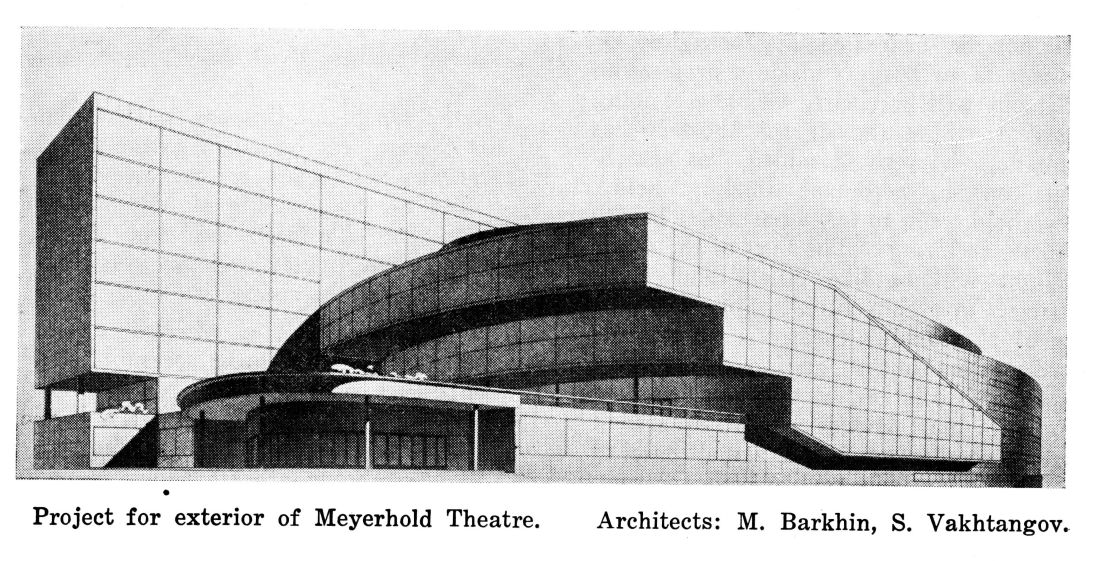
For the main facade of the new Meyerhold Theatre, various startling architectural designs have been proposed, but it has been finally decided to adopt one that will be in keeping with the plans for the architectural development of the rest of the Triumphal Square. Along the walls of this facade and on the sides of the tower will be bas-reliefs of striking scenes from Meyerhold’s productions. On top of the tower will be a colossal of the Futurist poet, Mayakovski, who used to lift his giant figure above the crowd, roaring to the marching workers his loudthroated songs of revolution.
It was Mayakovski whose strange, poetic, cosmic Mystery-Bouffe was the first play produced by Meyerhold after the Russian Revolution. It was Mayakovski whose extraordinary dramas, The Baths and The Bed Bug, later on gave Meyerhold’s Theatre a new lease of life. When Meyerhold and Mayakovski got together sparks flew and startling drama came into existence.
Such are the astounding plans for the new theatre now being built by Meyerhold for the Revolutionary Drama of Revolutionary Russia.
The New Theater continued Workers Theater. Workers Theater began in New York City in 1931 as the publication of The Workers Laboratory Theater collective, an agitprop group associated with Workers International Relief, becoming the League of Workers Theaters, section of the International Union of Revolutionary Theater of the Comintern. The rough production values of the first years were replaced by a color magazine as it became primarily associated with the New Theater. It contains a wealth of left cultural history and ideas. Published roughly monthly were Workers Theater from April 1931-July/Aug 1933, New Theater from Sept/Oct 1933-November 1937, New Theater and Film from April and March of 1937, (only two issues).
PDF of full issue: https://www.marxists.org/history/usa/pubs/workers-theatre/v2n01-jan-1935-New-Theatre.pdf

