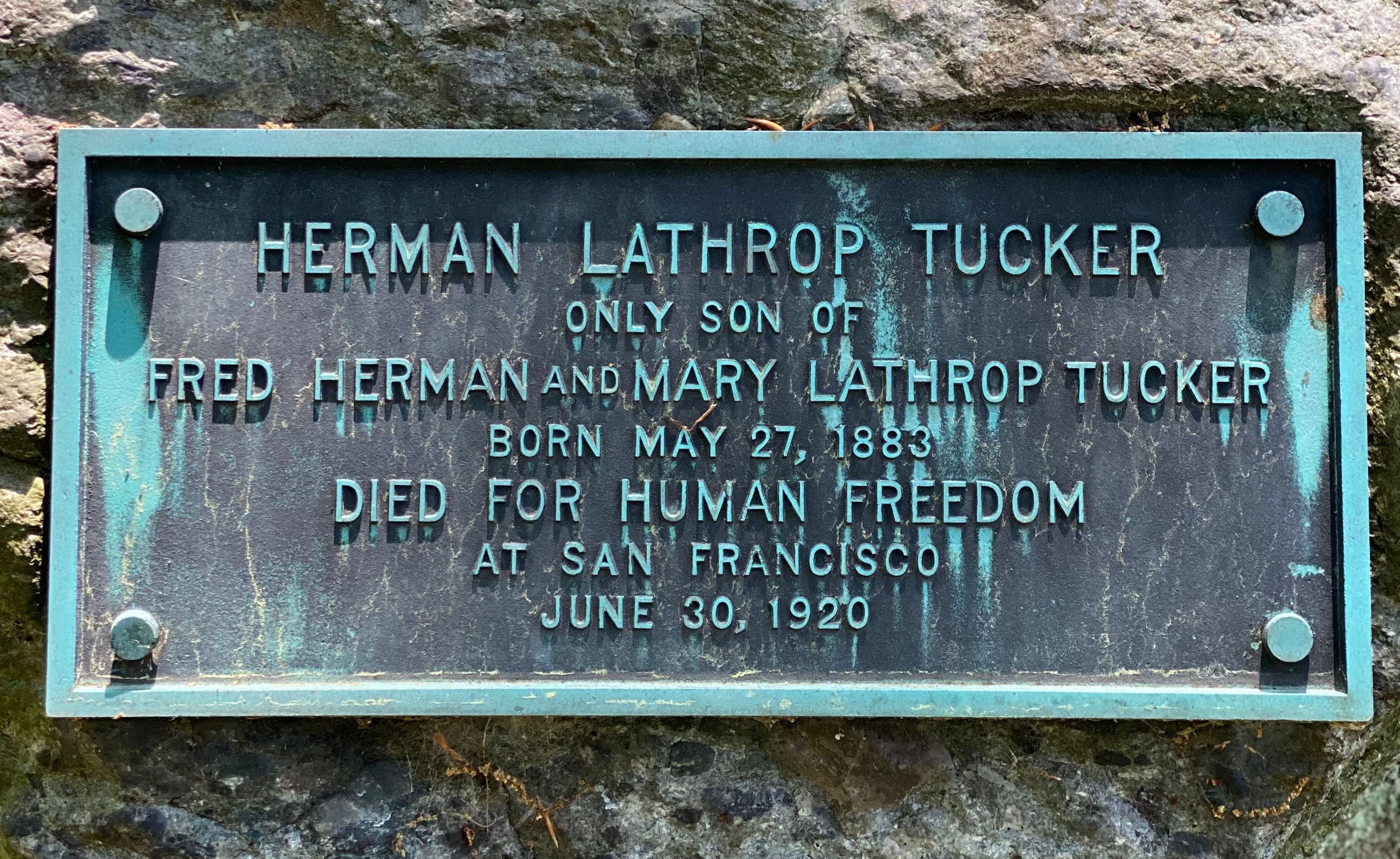
A remarkable death and a remarkable life.
‘Herman Lathrop Tucker’ from The Liberator. Vol. 3 No. 10. October, 1920.
A Friend of Russia
HERMAN LATHROP TUCKER, who was killed in an airplane accident in San Francisco at the time of the Democratic convention while distributing propaganda for the lifting of the Russian blockade, was the kind of American whose career makes one believe in America. He was an adventurer in the finest sense, an adventurer in thought as well as in action. He had led the expedition which climbed for the first time the sheer heights of Corupuna, the topmost peak of the Peruvian Andes. But he had done things which were, for a member of his class, more unusual than that. When in Butte, Montana, in the Government forestry service, he saw one day outside his office a group of men who were attempting to speak on the street corner, and who were being pulled down by the police and taken off to jail as fast as they got up, he inquired, and found that they were members of the I.W.W. He rushed out, mounted the soap-box in his turn, and had barely uttered the words, “I am an American, and I believe in–” when he was arrested and carted off to jail with the others. He found himself in the company of Bill Haywood, Elizabeth Gurley Flynn and eighty other members of the I.W.W. Within a few days he was also a member. He became an active worker for socialism. Herman Tucker was only thirty-seven years old, and his friends regret, together with the loss of an eager and boyish and ever lovable personality, the magnificent energy and fearless spirit which would have found more splendid opportunities for action in the great future that awaits us. But though it was only in an incidental skirmish, a fighter cannot choose his death–and he died fighting for the revolution.
The Liberator was published monthly from 1918, first established by Max Eastman and his sister Crystal Eastman continuing The Masses, was shut down by the US Government during World War One. Like The Masses, The Liberator contained some of the best radical journalism of its, or any, day. It combined political coverage with the arts, culture, and a commitment to revolutionary politics. Increasingly, The Liberator oriented to the Communist movement and by late 1922 was a de facto publication of the Party. In 1924, The Liberator merged with Labor Herald and Soviet Russia Pictorial into Workers Monthly. An essential magazine of the US left.
PDF of full issue: https://www.marxists.org/history/usa/culture/pubs/liberator/1920/10/v3n10-w31-oct-1920-liberator-hr.pdf
 Revolution's Newsstand