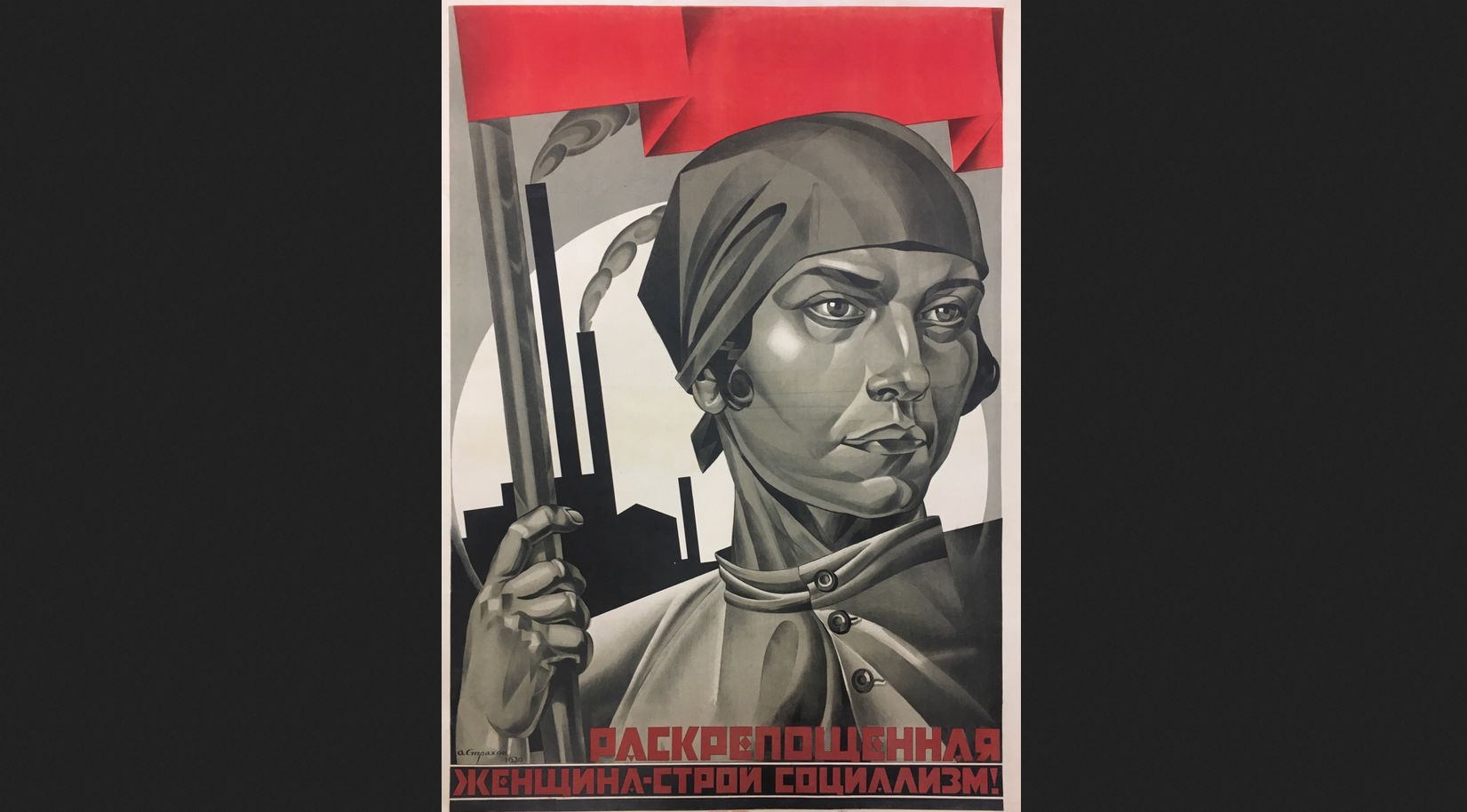
Aleksandra Artyukhina’s speech (the written report here) to the Fourth International Conference of Work Among Women held in Moscow during May and June, 1926. Artyukhina, a textile worker, was editor of ‘Rabotnitsa,’ and head of the Department for Work among Women (Zhenotdel) of the Central Committee of the Russian Communist Party.
‘The Work of the C.P.S.U. among the Working Women of the Soviet Union’ by Aleksandra Artyukhina from International Press Correspondence. Vol. 7 No. 38. July 6, 1927.
Special Session. Sunday morning, May 30th 1926.
Reporter Comrade AKTIUKHINA:
I have been instructed to report on our Work among the Working Women of the Soviet Union.
We, together with the whole Party, take into consideration the conditions in which we live and the difficulties confronting us when we judge the achievements and defects of our work.
The first and foremost question is that of women labour in industry. During the last two years there has been a definite tendency to keep women workers in the factories, whereas a few years ago there was a movement against woman labour in industry. We brought up this question for discussion in our Party and in trade unions, with the result that woman labour is now firmly established in a number of branches of industry, thanks to our joint efforts. We also brought to the notice of the Party the necessity of extending Party influence, to scattered groups of working women. Hitherto our work was mainly limited to working and peasant women. Lately our attention was drawn to the necessity of capturing for the Party also other sections of the female population workingmens’ wives, domestic servants, teachers, office workers, etc.
I would now to say something about our successes in regard to women’s position in industry. In 1922-23 the number of women employed in industry decreased in comparison with the pre-war period. In 1912 30.4% of labour employed in industry was woman labour, in 1916, i.e. during the war, woman labour constituted 38.7%. The percentage of woman labour in industry on January 1st 1926 was 28.4%. Thus in comparison with 1912, the difference is not very great and shows a downward tendency. If we turn our attention to the various branches of industry, we notice even an increase of woman labour in comparison with the pre-war period. In 1912 woman labour in the metal industry constituted 4.8%, whereas in 1926 it constitutes 9.8%, i.e. double that of the pre-war period. The textile industry is a particularly characteristic example: In 1912 woman labour constituted 54% of the total labour power, today it constitutes 57.8% which means that the pre-war level has been exceeded.
But the more important fact is, that not only the percentage of woman labour has increased in a number of branches of industry, but also the total number of women employed there. Formerly the number of women employed was 606,000 whereas today it is nearly 676,000. However, the total number of men employed in industry has risen in the course of the last few years, from 5,000,000 to 7,000,000, so that the increase of woman labour power is not keeping pace with the general increase of the number of workers. Absolute figures have certainly increased, but we are still 2% short.
Above all it should be pointed out that among many of our economists, the tendency still prevails to look upon woman labour as of smaller value and as less remunerative. If one takes into consideration that protection of woman labour, of motherhood and childhood, is on a very high level with us in the Soviet Union, one cannot help asking oneself if, and in how far, this protection of woman labour is a burden on the industry, is into it loss. This question was not raised until quite recently and there is as yet no definite material available to show to what extent the cost of production is increased through our legislation for the protection of motherhood and childhood. But on the strength of the preliminary results of this investigation, one can assume that in spite of the special legislative protection of woman labour, the latter is not more expensive than man labour. Thus in this sphere, we have to contend with prejudices which must be overcome.
Another very important point in connection with drawing women into industry is the low qualification of woman labour power. In the present development of our industry, first consideration is given to the unemployed registered in the labour exchanges. But a study of the lists of unemployed women shows us that we have hardly any qualified labour forces among women. Even in Moscow, the main industrial centre, qualified women working can be literally counted on the fingers of one’s hands. It goes without saying that the number of qualified men workers is much higher. This is the chief explanation for the inclination to draw men into industry in preference to women.

Even a casual investigation of the ranks of women workers already drawn into production shows that the low qualification of woman labour is a great determining factor. However, a certain improvement in the qualification of woman labour has been noticeable during the last two years. It is certainly very small: According to the statistics of the People’s Labour Commissariat the improvement amounts to 2.5% in regard to skilled labour and 1.5% in regard to semi-skilled. Thus there is a definite upward tendency, but the progress is very slow. This is a great impediment in our work against which we will have to struggle a good many years. We must endeavour to raise the qualification of the women already employed in industry, in order to deprive our economists of the argument that women are not skilled enough to be given much consideration in connection with the extension of our industry.
Skilled women workers constitute only 16% of labour power employed in industry, and semi-skilled 36%, which means that there is over 40% of unskilled labour power. Because of this proportion we have set ourselves definite tasks in connection with raising the qualification of woman labour. Our work is manifold. We have first of all factory apprenticeship schools where the number of women pupils increases from year to year: in January 1925 their number was 52,000 or 17.7%; 1926 the percentage of women pupils increased considerably; in that year twice as many girls were admitted as in the preceding year. In the trade schools too the number of women pupils has increased. They came from young working women’s ranks and most of them were quite young girls. Apart from this, definite work is carried on to raise the qualification of adult workers. During the last two years we have begun to give less qualified but better gifted labour forces higher quality work, placing assistant women workers in charge of looms. Isolated attempts have also been made to introduce group training for women workers, etc. These are only our first steps in this direction, and we draw the attention of our men comrades to this work.
Just a few more words on women’s unemployment. It is considerable, and this is one of the greatest obstacles to our work among women. Moreover unemployment among women does not show any signs of diminishing, it remains stationary and in some places it tends to increase. Of course unemployment here is of a different character than in West Europe where working women are dismissed wholesale. There are no mass dismissals of women workers here. The explanation for increased unemployment among women is, that we have a great influx of unskilled labour power from the rural districts.
I will deal now with the general conditions of working and peasant women. In the course of the last few years it has been possible to create favourable premises for the introduction of women workers into the process of production. In connection with this I draw attention to a considerable increase in the number of factory creches and similar institutions. We have at present 778 factory creches, 521 children’s consultation centres, 276 consultation centres for pregnant women and 103 mother and child homes.
The construction of dwellings is one of the most important questions among the general tasks connected with economic development. Co-operative building societies are increasing: in Moscow, Tula, in the Donetz Basin, in Ivanovo Voznesensk and in a number of other towns workers’ dwellings, and whole workers’ colonies are being constructed. The Women’s Department sees to it, that in connection with these building operations, the requirements of working women are considered, i.e. that public laundries, dining halls, central kitchens, creches, etc., are also put up. In regard to this our Women’s Department insists on efforts being made to make women’s lives easier, to free them from the drudgery of house-work.
I must draw your attention to toiling women’s active participation in the co-operative movement. 1,085,000 peasant women are organised in co-operatives, whereas the number of women workers co-operators is 1,558,000. Women workers constitute 25% of the co-operative membership, peasant women 16%. Peasant women’s and women workers participation in leading co-operative organs is very satisfactory: They participate in managing committees, auditing commissions, etc.; women’s membership of co-operatives is not only important in itself, through their active participation it will be possible to raise the standards of life of working and peasant women and to bring more sections of the population into the co-operation.
I will deal now with Trade Unions. In regard to the two main features of our activity raising women workers qualification and their standard of life (child care, feeding, housing) the best part of the work devolves on the trade unions. In this respect the trade unions give us as much support as they themselves receive from the Party. As far as recruiting of active trade unionists from working women’s ranks is concerned, trade union statistics show that there are almost as many women as men in the unions; the number of unorganised women workers constitutes only 4.5%.
An considerable number of women workers take an active part in trade union work in Trade Councils, trade union committees and factory councils. A considerable percentage of women workers take an active part in the work of labour protection, education and production commissions. A very large number of women workers are active as workshop delegates. Women workers constitute 28% of the total number of workers in industry, women delegates 21% of the total number of delegates, so that in regard to participation in minor trade union work women workers keep pace with men workers. Matters are less satisfactory in regard to the higher trade union organs. In the Central Trade Union Council women constitute 13% and in Trade Union Committees 15% of the membership; on the other hand there are fewer women workers in the managing committees of the gubernia sections.

I am coming now to the question: Party and women workers: In regard to this we have come to the conclusion that women workers are not a uniform body to whom one and the same methods of work can be applied. As there are distinctly three different sections of women, the Party should have different methods of work for each of them. There is first of all a section of active women workers already at work in trade unions, Soviet co-operatives, even in their executives, auditing commissions, etc. This cadre of active women workers is growing and is helping the Party to permeate the mass of women workers with Communist ideology. This cadre of active women workers collaborates not only with our Party, but also with organisations with which it is connected. The next section is that on which we concentrate our work at present, namely, women delegates attending elementary political education circles, etc.
The third section comprises backward women workers who have still to be captured and organised by us. It is of the utmost importance to approach this section correctly because just at present many women are drawn into industry who come from the rural districts and do not know anything about factories and factory life. They too must be brought under the influence of the Party.
A few words about Delegate Meetings. There are at present 78,500 women delegates, whereas in 1925 there were only 60,000, which means an addition of over 18,000 this year. Election statistics of 1925 showed that through delegate elections a considerable number of working women were captured by us. But in spite of this we think that we captured only about one-half of the total number of the working women, although the election campaign was carried on energetically with the support of the Party and the trade unions. We are endeavouring to raise the political education level of a certain section of women delegates, but our main efforts are in the direction of training them for trade union and other public work. Through the delegates we get in contact with the mass of working women. Delegate meetings work is the centre of our activity.
If we sum up our activity among working and peasant women we can say that our cadre of active workers, the upper stratum of working women belonging to the Party, has greatly developed with the help of the delegate meetings. We can safely say that we should not have made such progress in our work if we had not applied the method of working women’s delegate meetings. Therefore our delegate meetings are at present the centre of our activity among the working and peasant women of the Soviet Union and of a whole series of our Eastern regions. This point requires maximum attention on the part of the Party. Delegate meetings are the best school of Communism, the best method for the education of working women for public activity.
I will deal now with delegates’ work. With the help of our delegate we keep in contact with ten working women, as one delegate is elected to every ten working women. She conveys to her electors the knowledge which she has acquired at the delegate meeting, particularly in regard to practical work. We have organised a series of sections for practical work with delegates: the trade union section, the co-operative section, the section of institutions for raising the standard of life of working women. In Moscow we have an industrial section where working women acquire the rudiments of factory management. Just at present we are engaged in summing up and propagating the experiences of this work, in order to be able to form cadres of working women also for economic work.
Another achievement is the organisation of a juridical section of the Moscow delegate meetings. A considerable number of working and peasant women are acting as jurors. To be able to do justice to this responsible work, women should have a knowledge of court procedure, the construction of the court, etc. In our juridical section women delegates acquire practical knowledge of court procedure. In connection with this I would like to point out that a great many questions which come up for discussion in the people’s courts are closely connected with working and peasant women’s interests. That is why we want women versed in law as judges and jurors, and the juridical section is to help us in this. The first trial is made in Moscow, and we will let the other republics have the benefit of the experience gained here.
Education circles claim also special attention. In this respect Leningrad keeps ahead of other towns. These circles have done good work with respect to getting hold of sections of active working women who do not participate in delegate meetings. There are about 1,000 such circles throughout the union. Full statistics will not be compiled till the autumn. 36,000 working women participate in these 1,000 circles. What are the results of this work? The most active elements who have gone through political courses, are drawn into public work, are put up as candidates at Soviet elections. The best elements have joined the Party and work in Soviet organs. This form of work enables us to capture large sections of working women.
The third section is the remaining mass of working women. The educational level of these women is very low: The number of illiterates is considerable, even among delegates, so that our first and foremost task is to teach these women to read and write, The Y.C.L. is helping us with this work, and the more advanced working women too organise reading and writing courses. But in spite of all this we are unable to cope with all the illiterates. With the help of trade union and Party organisations slow but sure progress is made with this work. The main and the most difficult task to which the Party and the trade unions should pay maximum attention is: to draw the mass of backward working women into the reading and writing courses, into our organisations and above all into the delegate meetings, transferring them from there to other organisations after careful training.
A few words about club work. Club membership statistics show that the percentage of women members corresponds with the general number of working women employed in industry. However, only the younger women workers join clubs. Our clubs are still not paying enough attention to women workers burdened with young children and family cares; they do not do much to meet their requirements, be it even through the organisation of a club nursery, a women’s corner, social evening for proletarian women, etc.
I will deal more fully with our press, as this constitutes one of our main achievements during last year’s work. We have four central periodical for women: 1. “The Woman Communist”, leading organ for functionaries working among peasant and working women. This periodical is published by the C.C. of the Party; its edition is 25,000. 2. “The Woman Worker” intended for the mass of women workers, for the active cadres of the two first sections, for the more or less educated women workers (edition 78,000). 3. “The Peasant Woman” with an edition of 45,000. 4. “The Woman Agricultural Labourer”, published by the Agricultural and Forest Labourers’ Union, edition 26,000. We have also here in Moscow a periodical for the mass of working and peasant women in the Moscow gubernia, the “Woman Delegate” with an edition of 45,000, as well as several periodicals in a number of national republics published in Russian and also in the vernacular of the national minorities. The circulation of these periodicals is mostly by subscription: working and peasant women subscribe to these periodicals and pass them along after they have read them.
A large number of women workers and peasant women correspondents are attached to these periodicals. Their total number is about 1600 and in addition, there are 1493 women contributors to the Moscow periodicals. In comparison with the general workers correspondents movement this number is certainly small, but one should take into consideration that the correspondents movement among women is as yet in its initial stage, and that the number of non-Party women is very big. Our periodicals perform definite work among the working and peasant women correspondents; their letters are utilised and published. Our periodicals are mostly composed of such letters and can be therefore considered as mass periodicals.
I must say something about activity among workers’ wives. In connection with the general development of the activity of all the sections of the working population one can say that our work among these circles of women has also made considerable progress. We draw workers’ wives (differentiating between them and housewives in general) into delegate meetings, taking care that maximum influence is secured for working class element, that workers’ wives do not give the meetings the imprint of their ideology, but that they should be brought under the influence of the delegate meetings and should profit by them. Taken all together, 30,000 workers’ wives participate in delegate meetings, but in relation to the general number of delegates they constitute only 10-18%.
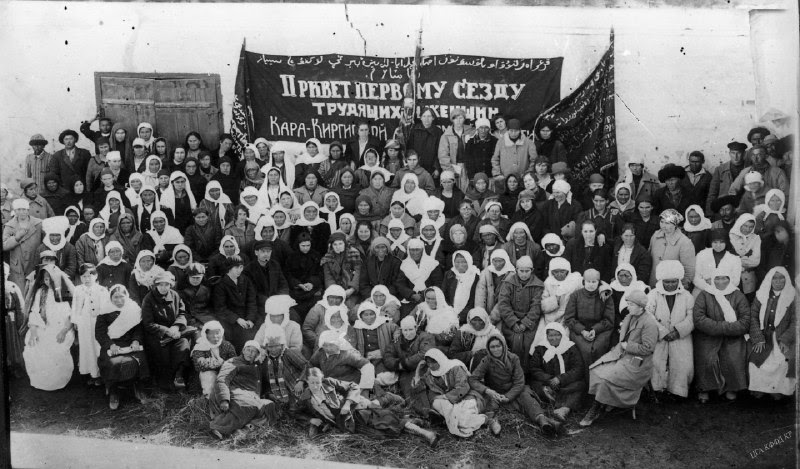
Workers’ wives are also drawn into Soviets. Unfortunately I have no general statistics at my disposal, but we know, for instance, that in Turkestan and in the Ukraine workers’ wives constitute 10% of the membership of Soviets. As workers’ wives have comparatively much leisure (more than women employed in factories) we are endeavouring to draw them into practical work in various social institutions, first and foremost in co-operatives and in institutions fighting against child vagrancy.
In regard to our work among peasant women the organisation of peasant women delegate meetings occupies first place. Just as in the towns, delegate meetings are the centre of our work also in the rural districts. However, it is only during the last two years that this work has been given definite form. The delegates are elected by the peasant women, they keep in close contact with their electors, carry on practical work in Soviets, co-operatives, mutual aid committees, etc. Here too, the number of delegates has increased. In 1924-25, there were 121,000 peasant women delegates, in 1925-26, 246,800, and at the end of 1926, their number will probably exceed 300,000. This mighty army of peasant women organised in the delegate meetings, this school of Communism, based on a combination of practical training and political education work, is one of the big achievements of our Party.
We have also achieved considerably success in regard to the standard of life of peasant women; for instance the number of creches in rural districts has considerably increased and is continuing to increase. In our work among the women of the rural population we do not limit ourselves to delegates, Soviet members, the active of peasant women who work in co-operatives, mutual aid committees, etc., we also work among the masses. In connection with this, village reading rooms play an important role. Special peasant women days are organised, women’s literature, the periodical “The Peasant Woman”, etc., are always available in these reading rooms.
A special branch of our work is work among the women of the East. Here in the Soviet East, i.e. in our border regions, Kazakstan, the Caucasus, etc., considerable success has been achieved. This work is under the control of the C.C. of our Party. The method of work which is most successful in the East and has given positive results, is the Club. In 1925 there were 61 Red Corners with 4000 members and 51 Clubs with 15,000 members. At present the number of Women’s Clubs, Red Corners, and Women’s Departments of Village Clubs is steadily increasing. Apart from club work, delegate meetings adapted to the conditions of life of Eastern women are particularly successful. They sprang up at first in towns, but are gradually spreading to the villages (Kishlaks and Auls).
In the East too, good results have been achieved through delegate meetings. In spite of the prejudices of which there are so many in the life of Eastern women, in spite of impossibility for them to move about freely in the streets, and in spite of the general seclusion of women and of the difficulty to get in contact with them, delegate meetings have proved to be a real and expedient method of work. In 1924-24 there were in the East 25,000 women delegates, in 1924-25 very nearly 18,000 who were drawn into Soviet work. At present our main task in this sphere is the training of functionaries.
In conclusion, I should like to say a few words on women’s admission to the Party. The number of women members is increasing in the Party, and their social composition is improving. In 1925, there were 76,494 women members 10.3% of the total membership, in 1926 there were 128,817 women members 12.8%. The social composition of the women members is as follows: 59% of the total number are women workers, which is an improvement on the working class percentage among men members. All this goes to show that our delegate meetings and our activity among women workers have led to definite results. 15,2% are peasant women and women office workers, other categories 25.8%. The conditions of Party membership are the same for us as for the Party as a whole, i.e. our task is to capture for the Party first of all women workers’ and peasant women who have already experience in Soviet and other practical work, who have already participated in delegates meetings, etc. Moreover, this increase of women workers and peasant women will reduce the percentage of women office workers in the Party which is considerable.
Special work is done for the preparatory and continued training of women functionaries for work among women. Special courses were organised for this purpose. This work is carried on by us jointly with the Agitprop.
In conclusion, just a few words about the apparatus and executive of the Party. Our apparatus for work among women is gradually improving qualitatively as well as quantitatively. Women workers and peasant women take more and more part in our work. Our task is: to draw more women workers and peasant women into active work, as they know best the conditions of life of working women.
A great change has taken place in our apparatus from the C.C. down to the nucleus. Our entire work is under the control of the Party, we are an integral part of the Party apparatus.
All our decisions are made in agreement with the Party. Everything is done through the competent Party executive. The Party is better informed than before about the needs and requirements of the masses and exercises more control over our work than ever before. What we have to do now is: to establish this control consistently down to our lowest nuclei—workshop nuclei of big enterprises and villages nuclei. Control by the Party must be fully established also in regard to our minor work. Our foremost task is the training of new cadres of women Communists for our activity among women workers and peasant women in general, and working women in the East in particular.
International Press Correspondence, widely known as”Inprecorr” was published by the Executive Committee of the Communist International (ECCI) regularly in German and English, occasionally in many other languages, beginning in 1921 and lasting in English until 1938. Inprecorr’s role was to supply translated articles to the English-speaking press of the International from the Comintern’s different sections, as well as news and statements from the ECCI. Many ‘Daily Worker’ and ‘Communist’ articles originated in Inprecorr, and it also published articles by American comrades for use in other countries. It was published at least weekly, and often thrice weekly. A major contributor to the Communist press in the U.S., Inprecorr is an invaluable English-language source on the history of the Communist International and its sections.
PDF of full issue: https://www.marxists.org/history/international/comintern/inprecor/1927/v07n38-jul-06-1927-inprecor-op.pdf

