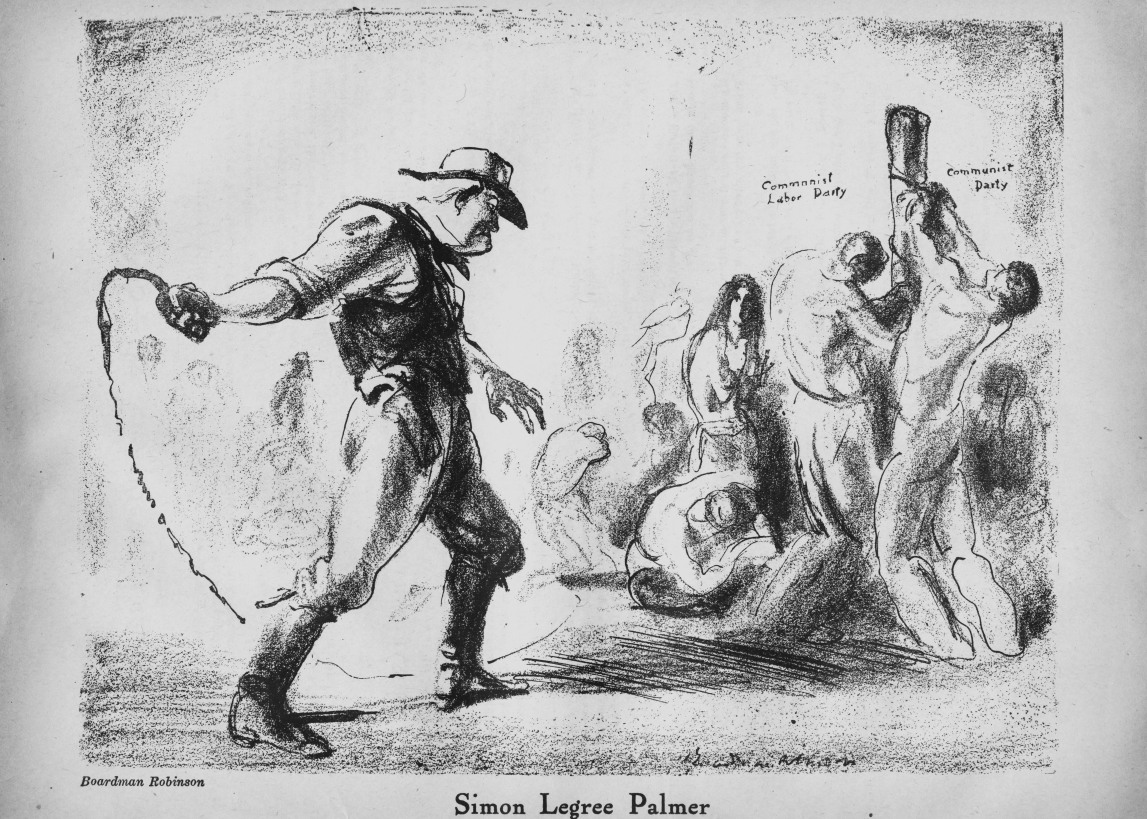
A very fine writer, Giovannitti, with courtroom artist William Gropper, cover the Palmer Raid-era trial of the Communist Labor Party during the First Red Scare.
‘Communism On Trial’ by Arturo Giovannitti from The Liberator. Vol. 3 No. 3. March, 1920.
FOR the third time in three short years America has committed the unforgivable sin against the holy ghost of her principles and her customs, her traditions, and her lore. Whatever the editor of the Liberator may think of Americanism, I for one, still a stranger in my chosen land, have believed till a few days ago in the liberty, the fair play and the idealism of America. Even today, when most of my dreams have been blasted away by the blind and idiotic reaction of a handful of pirates and buccaneers who have fastened their clutches at the throat of the Republic, I am hurt and shocked and wounded, but I am not yet disillusioned. There is nothing the matter with the American people—it is the bourgeoisie of America that has grown too fat and swinish to care for anything except the protection of its trough, its sty and its litter. A pilgrim can see that better than an indigene—that is why, in spite of my long sojourn, being still a foreigner who no longer expects to be treated as a guest, I dissent from Max Eastman’s indictment of Americanism. He simply repeats today what the great Abolitionists thundered seventy years ago. America was then the last nation of the world that still tolerated slavery, and the only nation that sent to jail and hanged and lynched the upholders of the principle of the political equality of all men. But a few years later America abolished slavery, and she did it more wondrously than any other nation, not by a mere edict, not by the passing of a law, not by the ransoming of the captives with gold and silver, but by the power of the sword, and at the price of blood, even as Camillus had taught the young Roman that liberty should be bought.
Of course it is very hard and trying to keep my faith alive in these days, but still I insist that the time is not far off when the stranglehold of the small gang of cut-throats will be pried loose, and sanity and serenity and tolerance will be re-established again. In the meantime we are treated to a wholesale slaughter of ideas that has no parallel in the history of mankind, not even in that 16th century that is so red and dripping with the blood of the philosophers. To kill ideas–that is to kill them by violent assaults and actual physical force–seems to be the main, or rather the only object of our present administration, for I cannot find that it has accomplished anything else since the war was ended. After the auto-da-fe of the I.W.W. and the pogroms of the Socialist Party, it is now the turn of Communism to be lynched upon the open places before the gathered rabble that has never known the wherefore of any public execution, but has always enjoyed the bestial spectacle.
Just the mere appearance of this idea in a small corner of our political ocean where it has hardly raised a bubble, is deemed sufficient reason for rounding up every man and woman who favors it, and throwing him in jail for ten years. This is indeed weird and bewildering, but it is not hard to explain. It is, as Bovio said some thirty years ago while defending the same Communists in Italy (they are most of them in parliament now, and redder than ever) it is that this idea is so disturbing, so frightening, so palpably true that the mere enunciation of it takes the actual semblance of a revolutionary act. If it scares certain people, if it disturbs their siesta, if it keeps them awake at night, then it is an unlawful thing, it is a crime, and it must be suppressed, even tho’ it has gone no farther than a speech and a printed sheet.
There is unquestionably a goodly and ever growing number of thinking and earnest men in America who firmly believe that Capitalism must go at once, today.
There is still a larger group who are more or less sure that this fat, ataxic, goutish old gentleman is going jollily by himself, and that there is no necessity to hurry him along, just for the sake of neighborliness and Christian charity. And there is also a third group, very small, mostly made up of lawyers, politicians and college men, who while being as sure as the second group, make believe that they are not, tho’ they very seldom have the cheek to say that the old gentleman is going to live forever and ever. It is this last body of gentlemen, not the whole of the American people, that are crying out for the blood of the first group. I have no objection to that–they are paid by their boss just for that purpose–but are they really doing the job well and honestly?
It seems to me that the method they have selected couldn’t be worse. You cannot convince a man in dead earnest that he is wrong by ordering him to shut up–you have got to argue with him. You have got to show him that his theory is not sound, that his method is unscientific, that his proposed changes cannot be brought about that way. There is only one other way that I know. Get again out of your cellars the rack and the screw, the branding irons, the bilboes, Lord Exeter’s daughter, and the rest of the sacred arsenal, secure full confessions and then dig a hole in the middle of the Brooklyn bridge and set up there a steam guillotine that will shorten off people at the rate of fifty thousand an hour. Can this be really done? Well, I am fairly inclined to believe that with the help of God and the good will of President Wilson, Mr. Palmer would give it a fair and decent tryout–but even so I wouldn’t guarantee its absolute success.
Now this difficulty of exterminating ideas is particularly vexing and grievous in the case of Communism. There is no telling how many people have been infected with the contagion. Every newspaper in the country has done its best to advertise it, even in preference to the Spanish flu. During the last two years I have read more about it in the New York Times than in all the Communist weeklies put together. In every church it has been excommunicated with the same amount of theological fervor as Protestantism was fulminated against–which makes me surmise that it has spread considerably among the faithful, and it will do more so after the interdict. Some people claim that it has even entered stealthily into the colleges, and however unbelievable this may be (and I give it out with much reservation), there are even a few people who maintain that the A.F. of L. itself is not entirely immune from the virus. In Germany this idea wrecked an empire and stopped the world war. In Italy it has sent 156 men to parliament, including one under sentence of death who because of that was elected in two places. It is raising Cain in Czechoslovakia, and it has stopped piano playing as a political asset in Poland.
In Finland and in Hungary this idea ruled supreme and unopposed for months; then it went down murdered by foreign cannon–but the Finns and the Hungarians still believe in it and in the story of Lazarus and Jesus. And in Russia, in the largest abode of the white man in the world, this idea has passed triumphantly through several plebiscites, it has broken through fourteen armed fronts of reaction and it owns now one hundred per cent of all the stocks, bonds, securities and currency of the country as well as five million bayonets with five million men behind them.
How can all this be stopped, and who’s going to stop it? I don’t know. Nobody knows. That is nobody except Mr. Palmer and Mr. Rorke. Eureka! Mr. Rorke the District Attorney who prosecuted Gitlow found the true solution when he told the jury: “You twelve men stand between civilization and anarchy as the sentinels of society.”
I looked at the twelve men again, and really I could hardly believe it.
The trial? Oh yes, but that really does not matter. There was nothing to the trial save two human elements involved in it–the personality of the accused and that of his attorney. No new departure from the ancient grooves of platitudinous legal piffle was made by the prosecution, which only introduced the manifesto of the Communist Party and said that it was against the law. Whether Communism is a good or a bad thing, whether it is practical or utopian was not threshed out at all. Nor did the defence depart from the usual rules. It offered no evidence whatever tending to justify Communism; it did not put the defendant on the stand to ask him questions, to define, to describe, to elucidate, to explain. It was so unlike what one expected from Darrow, but it was correct. Why waste time? Were the twelve men qualified to enter into the theoretical aspects of Communism? They were not. On the contrary they had been chosen chiefly because they knew nothing about the subject they were going to absolve or to condemn. Their impartiality was gauged by their lack of information–it seems that it is a major point of law that the more ignorant a man is, the better juror he will make. And these men were supposed to be the “peers” of Ben Gitlow! Well, I hope that when Communism comes, the first thing it will do will be to abolish juries, or at least see to it that they are not the peers of anybody.
I said there was nothing to the trial, but there was. There were two great moments, when Gitlow made his statement to the jury and when Darrow summed up. I have seldom been thrilled as I was when Ben Gitlow got up. I know the atmosphere of the courtroom–I am indeed quite at home there, tho’ not as an amicus curiae. I know how difficult it is to restrain one’s emotions, especially when one is talking and is charged by his conscience to say all he believes and by his affections not to be foolhardy, nor to risk overmuch. But Ben Gitlow is the right kind of man, for which the Immortals be thanked. He made it easy for me to listen and to remain there. Impassive, clear-eyed, sure of himself, without the arrogance of weakness, without the suavity of unpleasant cunning, deliberate, forthright, he spoke with a clear, even, resonant voice. A finer specimen of manhood could not have been selected by the Communists as their first ambassador to begin negotiations for the capitulation of capitalism in its inmost citadel. Big, dark, wholesomely fleshy, he seemed to have been carved out of a huge granite rock by the sledgehammer of a master, with simple and mighty blows, without any whittlings of the chisel nor any pandering to the anaemic tastes of the fashions. There is something elemental in this young man that reminded me of two great statues–the Captive Breaking His Bands bursting out into a Moses without beard and the tables of the law. Darrow also gave me the same impression; of him also I thought sculpturally two great rough statues, two powerful caryatids supporting a noble architrave, two opposite symbols of the ends of the same force; one young, massive, explosive with life, the other a bit bent, a bit scarred, a bit mutilated, not ruined but made nobler by the years.
As they slouched and lumbered before the bench hiding the judge with their great bulk, I could not think of a more perfect combination of lawyer and client. Darrow has always been lucky with his historical clients, or perhaps he has selected them with the meticulous care of the fine artist that he is. Perhaps that is why he refuses so many cases. Think of them: Bill Haywood, Jim MacNamara, Ben Gitlow–a triad of giants, the Cyclop, Porphyrion and Anteus, blasters of mountains and hurlers of rocks, superb, intangible, Michelangel-esque. I could not conceive of any penitentiary that could hold them till they die. The capitalist Uranus might bind and lock them in his hell, but the proletarian Jupiter is sooner or later going to release them and hurl them against the drunken and somnolent heavens.
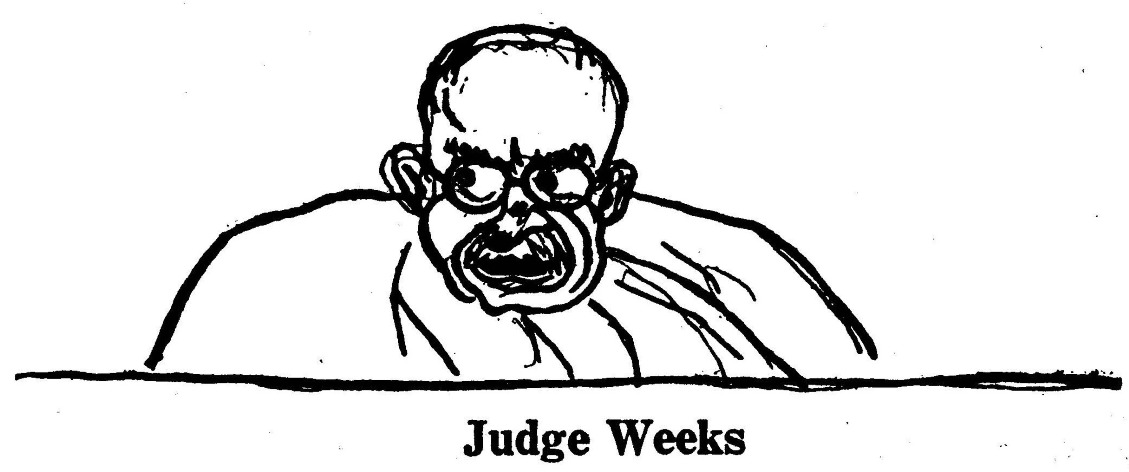
Gitlow spoke for some fifteen minutes, continually interrupted by the judge who would not let him say what he was, what he believed, what he wanted, because it was against the rules of the procedure. But Gitlow managed to say that he considered himself a revolutionist in the eyes of present society, that he would keep on fighting for Communism in or out of jail, that he asked for no clemency but only for a fair comprehension of his ideas. And that was all. It was enough. The trial should have been brought to a close right then and there, for that is all there is to any such trials. But that much had to be said—not because of the irrepressible desire to speak one’s mind, but because of the cowardly silence of thousands of others–the dumb mass of the American workers. It wasn’t a defence–it was the reaffirmation of a principle in the only place in America today where principles become dynamic by the sheer power of their enunciation. He had to speak and he did it wonderfully. Well done, my friend, my comrade. I embraced in you mentally my lost brother who died in the war, and I felt less lonely, stronger because of your being there. You reminded me of the words of Saint Augustine, another great aristocrat of the spirit. Dixi, et salvavi animam meam. You can go to jail now. Nobody will feel bad about you, for you have saved your soul from the meanest of all torments–you have kept it whole and un-polluted by the regrets of the well-thinking, the pity of the rabble and the mercy of the Beast.
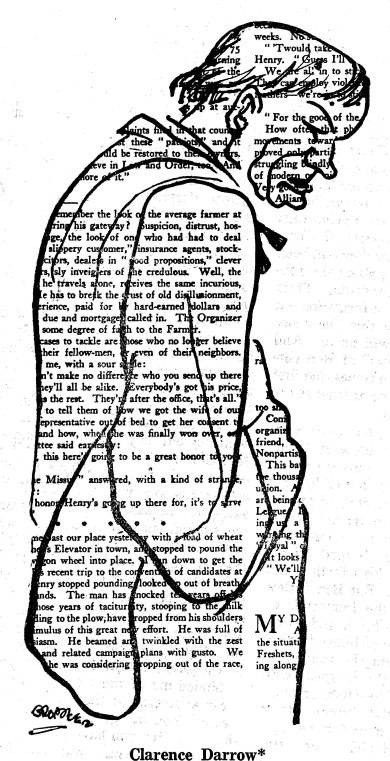
For two hours Clarence Darrow battled and stormed and raged against the ramparts of the prosecution, striking down brick after brick and raising strident red sparks with the tempered steel of his oratory. It is not possible to describe the eloquence of this man, save by translation of his very name. It should be spelled with an apostrophed D, like French or Italian. Think of it! The Sheen of the Dart! A javelin of light. A futurist poet couldn’t have selected a better pseudonym. His great frame shook and trembled, as if under the blasts of an internal upheaval, his fists rose and fell as if brandishing unseen swords, his sun-baked, sun-cracked, magnificently ungainly face reverberated as if before. the bursting furnace of his own thought. His voice now rose in huge tidal waves of passion, now fell suddenly down to a whisper! now it stopped for long unbearable pauses, hemmed in by the tyranny of silent words. A voice that could at once order a battle charge and croon a lullaby, hurl a heaven-wrecking challenge and murmur a quivering benediction. What would have happened to America if this man had been made Attorney General during the war and had decided to prosecute his own cases! What would have happened to Russia if in the scorching days of the Red Terror this man, a Commissar of Public Defence, had addressed millions of ragged and starved ghosts and dashed them headlong against the “frontier of civilization”?
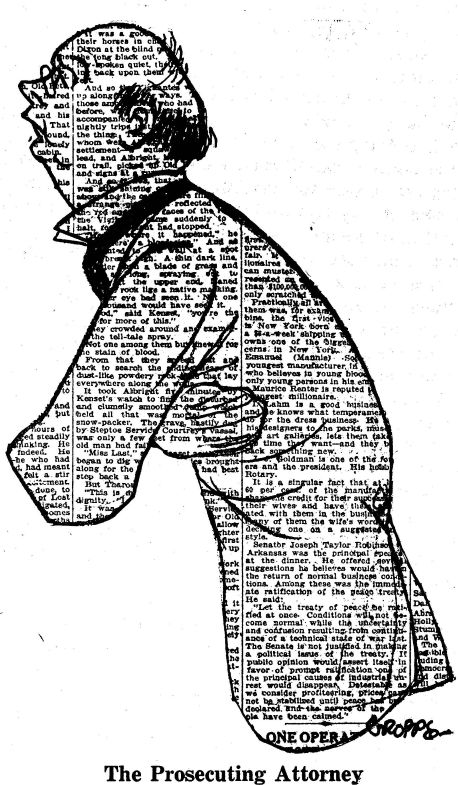
Poor, pathetic twelve men good and true, posted as sentinels between civilization and anarchy! They had no chance. How could they acquit Communism when Communism was represented by such a man as Gitlow and defended by this unleashed old Lucifer, dark, uncouth, still sooty with the dust of the abyss, but still fulgurant with the untarnishable glow of the archangel. What could the twelve meek apostles of a resurrected messiah of fear and stupidity, a law exhumed in another dark hour of dread and brutish passion–what could they do before an idea that asked for no clemency and defended itself in such a way? Such an idea was surely too redoubtable to let it run at large. Its defence was more blood-chilling than its indictment. Such logic, tolerance, learning, such glowing love for humanity were indeed too much for any sentinels of civilization. They looked scared. They looked at the judge, the court attendants, the lawyers–they looked around instinctively for protection. They must have felt relieved at once. Thank God, there were still policemen, still manacles, jails, turnkeys, straight-jackets, cats o’ nine tails in the world. They must have felt glad that it was still daylight when Gitlow and Darrow finished and, and that they wouldn’t have to go home in the dark. They must have felt thankful and reassured when Mr. Rorke got up to tell them about the law, and the law only, which, whether good or bad, must be obeyed. It must be a fine and easy thing to obey the law when this law watches over your sleep and your pocketbook and smoothes the wrinkles of your ruffled soul, and helps you to get out of the stress and wrack of hard thinking, and soothes your conscience with the assurance that if you convict you cannot possibly go wrong, while if you acquit you might possibly replunge the world into the dark and roaring chaos. They had to convict. There was no other way out. It was the easiest way. And they did it.
And so, thanks to that, America also takes at last her long-vacant place among the sisterhood of modern forward–moving nations, for thanks to that, America now also has a Communist movement and has entered definitely the jousts on the side of the militant proletariat.
*These drawings were made by Gropper on a newspaper because the court objected to his using a sketch-book.
The Liberator was published monthly from 1918, first established by Max Eastman and his sister Crystal Eastman continuing The Masses, was shut down by the US Government during World War One. Like The Masses, The Liberator contained some of the best radical journalism of its, or any, day. It combined political coverage with the arts, culture, and a commitment to revolutionary politics. Increasingly, The Liberator oriented to the Communist movement and by late 1922 was a de facto publication of the Party. In 1924, The Liberator merged with Labor Herald and Soviet Russia Pictorial into Workers Monthly. An essential magazine of the US left.
PDF of full issue: https://www.marxists.org/history/usa/culture/pubs/liberator/1920/03/v3n03-w24-mar-1920-liberator-hr.pdf

